- English
- French
- German
- Portuguese
- Spanish
- Russian
- Japanese
- Korean
- Arabic
- Greek
- German
- Turkish
- Italian
- Danish
- Romanian
- Indonesian
- Czech
- Afrikaans
- Swedish
- Polish
- Basque
- Catalan
- Esperanto
- Hindi
- Lao
- Albanian
- Amharic
- Armenian
- Azerbaijani
- Belarusian
- Bengali
- Bosnian
- Bulgarian
- Cebuano
- Chichewa
- Corsican
- Croatian
- Dutch
- Estonian
- Filipino
- Finnish
- Frisian
- Galician
- Georgian
- Gujarati
- Haitian
- Hausa
- Hawaiian
- Hebrew
- Hmong
- Hungarian
- Icelandic
- Igbo
- Javanese
- Kannada
- Kazakh
- Khmer
- Kurdish
- Kyrgyz
- Latin
- Latvian
- Lithuanian
- Luxembou..
- Macedonian
- Malagasy
- Malay
- Malayalam
- Maltese
- Maori
- Marathi
- Mongolian
- Burmese
- Nepali
- Norwegian
- Pashto
- Persian
- Punjabi
- Serbian
- Sesotho
- Sinhala
- Slovak
- Slovenian
- Somali
- Samoan
- Scots Gaelic
- Shona
- Sindhi
- Sundanese
- Swahili
- Tajik
- Tamil
- Telugu
- Thai
- Ukrainian
- Urdu
- Uzbek
- Vietnamese
- Welsh
- Xhosa
- Yiddish
- Yoruba
- Zulu
7220AC Super Precision Bearing: A Practical Buyer’s Guide
If you're sourcing high-precision bearings for CNC spindles, industrial pumps, or automation equipment, the 7220AC super precision bearing deserves serious attention. This single-row angular contact ball bearing features a 25-degree contact angle, a 100mm bore diameter, 180mm outer diameter, and 34mm width. Manufactured to ISO P4/ABEC-7 or P2/ABEC-9 standards, it handles both radial and axial loads with exceptional accuracy. This guide walks procurement managers, OEM engineers, and bearing distributors through everything needed to make a confident purchase decision.
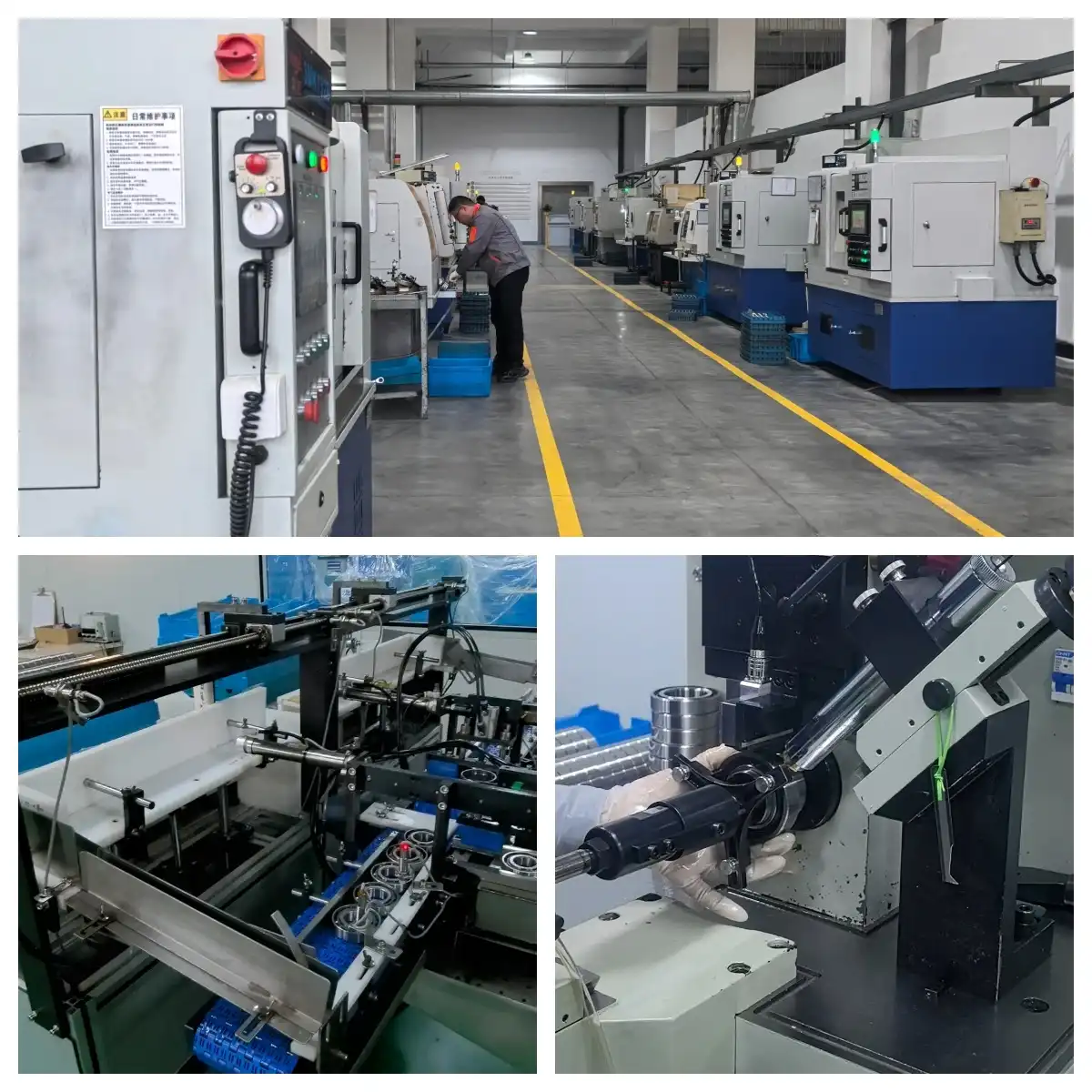
Understanding the 7220AC Super Precision Bearing
What Sets It Apart from Standard Bearings
Standard bearings can handle modest speeds and loose specs. The 7220AC Super Precision Bearing has tighter geometric limits, which means that runout is limited to the level of microns. This degree of physical stability immediately lowers vibration, lowers heat production, and increases the service life of the machine. This type of bearing is right for situations where chatter marks on a piece of work or micron-level shaft movement could lead to expensive fails.
Key Technical Specifications
The 7220AC bearing is made of vacuum-degassed GCr15 (equivalent to AISI 52100) bearing steel, which makes it last longer when loaded and unloaded many times. It weighs about 3.15 kg. For hybrid configurations, rolling elements can be made of steel or silicon nitride (SiN) ceramic. The cage is usually made of phenolic resin (bakelite) or PEEK, which reduces friction and allows oil-air lubrication at speeds above 10,000 RPM. The dimensions are as follows: inner diameter 100 mm, outer diameter 180 mm, width 34 mm, contact angle 25°, mass 3.15 kg, material GCr15/SiN₄ (hybrid), accuracy class P5, P4, and P2, and cage type bakelite, nylon, and PEEK. The mounting arrangements are DB, DF, and DT. The delivery time is 7 working days.
| Parameter | Specification |
|---|---|
| Inner Diameter | 100 mm |
| Outer Diameter | 180 mm |
| Width | 34 mm |
| Contact Angle | 25° |
| Mass | ~3.15 kg |
| Material | GCr15 / Si₃N₄ (hybrid) |
| Accuracy Class | P5 / P4 / P2 |
| Cage Type | Bakelite / Nylon / PEEK |
| Mounting Arrangements | DB, DF, DT |
| Delivery Time | 7 working days |
How the 25-Degree Contact Angle Works
This bearing is between the 15-degree "C" type and the 40-degree "B" type because it has a "AC" suffix that means a 25-degree contact angle. A bigger angle makes the bearing more rigid along its axis, which lets it fight thrust forces from cutting tools or pump impellers. With a shallower angle, the rotational speed can be higher while the heat is lower. The 7220AC Super Precision Bearing is strong enough for heavy mixed loads and fast enough for high-speed spindles when it is set to 25 degrees.
Comparing the 7220AC with Alternatives
7220AC vs. 7220C and 7220B
The 7220C bearing (15-degree contact angle) works well in places with very high speeds and low axial loads. Heavy axial thrust works well with the 7220B (40-degree angle), but speed is lost. The 7220AC is right in the middle of them. When both speed and vertical stiffness are important at the same time, engineers usually choose the 7220AC. This includes most CNC and industrial pump uses.
Steel vs. Ceramic (Hybrid) 7220AC
Steel rolling elements are good for most industrial work and don't cost too much. Ceramic (Si₃N₄) balls arranged in hybrid patterns are about 40% lighter than steel balls, produce less rotational force at high speeds, and can handle higher temperatures. When spindles are going faster than 12,000 RPM, a hybrid 7220AC Super Precision Bearing can make the grease last longer and cut down on heat movement. The cost per unit is higher, but many producers make up for it by having less downtime.
Brand Comparison Overview
| Brand | Accuracy Class | Key Strength | Typical Application |
|---|---|---|---|
| SKF | P4 / P2 | Dimensional consistency | Machine tool spindles |
| NSK | P4 / P2 | Hybrid ceramic options | High-speed CNC centers |
| FAG (Schaeffler) | P4 / P2 | Preload precision | Grinding headstocks |
| NTN | P4 / P2 | Thermal stability | Automotive spindles |
| ATLYC | P5 / P4 / P2 | Cost-performance, OEM flexibility | Industrial & automotive OEMs |
Tolerance offsets vary from manufacturer to manufacturer when mixing brands in the same frame. Uneven pressure distribution can cause two bearings with the same part number to fail before they should. Make sure that both bearings in a set come from the same company.
Practical Applications of the 7220AC Super Precision Bearing
CNC Machining Centers and Spindle Assemblies
The 7220AC Super Precision Bearing is often used for the wheels of both vertical and horizontal milling machines. Cutting tools can't push through it, and the radial precision stays tight enough to keep precision workpieces from getting chatter marks. It was shown that when a German company that makes machining centers switched from a normal P5 bearing to a P4-grade 7220AC bearing, measurable runout went down by 38% and spindle fix intervals went up by more than 12 months.
Precision Grinding and Industrial Pumps
Runout must be less than 1.5 microns in both surface and cylindrical grinding headstocks. Its stiffness makes the 7220AC able to hold grinding wheels against strong cutting forces without bowing. For high-flow centrifugal pumps and screw compressors with 100mm diameter shafts, these bearings handle constant thrust loads from fluid pressure in high-temperature settings, where it's important to keep the clearances correct to avoid early wear.
Robotics, Aerospace, and Automotive
Controlling both accuracy and weight is important for robotic joint actuators and aircraft support equipment. In these areas, hybrid ceramic 7220AC bearings are often used because they are light and don't get too hot. In electric motor and transmission uses, the bearing's ability to keep its shape at high temperatures allows for long repair intervals. This is a quality that directly meets IATF 16949 standards for OEM supply chains.
Procurement Insights: How to Source Effectively
Identifying Reliable Suppliers
Make sure that the company you buy from has both ISO 9001 and IATF 16949 certifications before you buy any angular contact bearings at this level of precision. These two standards show that processes for quality management, tracking, and fixing problems are built in and not just happen by accident. The Luoyang Auto Bearing Co., Ltd. (ATLYC) was founded in 2010 and has both certifications. For 15 years, it has sold precision bearings to customers in the US, Germany, South Korea, Russia, Iran, and Turkey.
Avoiding Counterfeit Products
Fake angle contact bearings look exactly like real ones, but they don't pass a comparison test for dimensions. For each batch, you should ask for material test certificates and measurement inspection records. Suppliers of good 7220AC Super Precision Bearings make it easy to track a lot from the steel heat number to the final inspection. The most effective way to be sure of its authenticity is to buy it directly from approved makers or their authorized dealers.
Lead Times, MOQ, and OEM Options
ATLYC ships standard 7220AC Super Precision Bearing orders within 7 working days. Lead times can be changed for OEM and custom designs that include certain cage materials, clearance classes, or private marking. When buyers place large orders, they usually negotiate lower unit prices starting with moderately small minimum order quantities. Talking about expected volume early on in the buying process gives companies time to plan production runs and keep extra stock on hand.
Tips for Selecting the Right Bearing for Your Application
Match the Accuracy Class to Your Equipment
The accuracy level P5 is good for most industry machines. P4 (ABEC-7) is good for most CNC and pump uses that need accuracy. P2 (ABEC-9) is only for aircraft tools and high-precision grinding. If you choose a higher accuracy class than what the application needs, you will pay more for nothing. It is possible to measure performance loss when choosing a class that is too low. Before defining, make sure you know what runout range your equipment needs.
Evaluate Load, Speed, and Environment Together
Before choosing a 7220AC bearing, you should think about these three important factors at the same time:
- Dynamic load rating (C): Confirms fatigue life under your specific combined radial and axial load cycle. GCr15 steel provides a well-established L10h baseline for calculating service intervals.
- Speed limit (dmn value): The 7220AC super precision bearing supports high-speed operation, but the cage material and lubrication type directly govern the actual speed ceiling. Oil-air lubrication extends the safe speed range significantly beyond grease-lubricated limits.
- Operating temperature range: Standard steel configurations handle typical industrial temperatures. Hybrid ceramic rolling elements are specified when sustained high temperatures would degrade standard steel fatigue properties.
Together, these three factors tell you if a normal P4 steel 7220AC will work for you or if a hybrid ceramic P2 variant is better for your industrial setting.
Work Closely with Your Supplier's Engineering Team
A good 7220AC supplier can tell you about the preload class, cage material, clearance adjustment, and matching sets. This level of technical support is very helpful for OEM customers who are building spindles or pumps and need more than just published catalog data. The tech team at ATLYC allows for customization and gives free application-specific advice to people who are interested in buying.
Conclusion
The 7220AC Super Precision Bearing is a well-known and technically precise part that can be used in a lot of different demanding industrial settings. It can be used for CNC machining, grinding, pumps, and cars thanks to its 25-degree contact angle, P4/P2 accuracy grades, and GCr15 or hybrid ceramic construction. How well the bearing works over a full service interval will depend on which version you choose, how you mount it, and the amount of certification the provider has. When buyers match their buying criteria with engineering needs, they always get better results than when they choose based only on price.
FAQ
What is the difference between 7220AC and 7220ACD bearings?
No, each maker cuts its bearings to precision offsets that are unique to that brand.
Can I mix 7220AC bearings from different brands in the same spindle?
Always get both bearings in a spindle set from the same company and the same batch of production.
What lubrication works best for high-speed 7220AC applications?
Oil-air lubrication is the best way to go for high-speed tasks because it keeps things cool while reducing friction. A good synthetic grease from companies like Klüber or Kyodo Yushi works well at average speeds. However, it should only fill up to 20% of the empty bearing space to keep heat from building up and churning away the grease.
How does preload selection affect bearing life?
Heavy preload makes the structure more rigid, but it also raises the operating temperature, which can shorten the fatigue life if it doesn't cool down enough. Light setup makes the material run cooler, but it might not be stiff enough for heavy cutting passes. The right preload class depends on the needs of the machine tool, and you should check with the application tech at your bearing provider to be sure.
What is the standard mounting arrangement for machine tool spindles?
For machine tool wheels that use the 7220AC Super Precision Bearing, the back-to-back (DB) setup is the norm. This setup gives the most moment rigidity and is used most often in CNC milling and grinding applications around the world.
Get the Right 7220AC Super Precision Bearing from ATLYC
ATLYC has been making precision bearings since 2010 and has six production workshops that are certified by both ISO 9001 and IATF 16949. As a reliable 7220AC Super Precision Bearing supplier, we offer accuracy grades of P5, P4, and P2. We also offer standard delivery in 7 days and full OEM customization. You can email our engineering team at auto@lyautobearing.com or go to https://aotezhoucheng.aixdb.cn/ to get a price, matched-set specs, or help with your application.
References
1. Harris, T. A., & Kotzalas, M. N. Rolling Bearing Analysis: Essential Concepts of Bearing Technology. Taylor & Francis, 2006.
2. Eschmann, P., Hasbargen, L., & Weigand, K. Ball and Roller Bearings: Theory, Design, and Application. John Wiley & Sons, 1985.
3. International Organization for Standardization. ISO 492: Rolling Bearings — Radial Bearings — Dimensional and Geometrical Tolerances. ISO, 2014.
4. Schaeffler Technologies AG & Co. KG. FAG High-Precision Bearings: Technical Product Catalog. Schaeffler Group, 2019.
5. NSK Ltd. Precision Machine Tool Bearings: Application Engineering Guide. NSK Technical Report, 2020.
6. Hamrock, B. J., Schmid, S. R., & Jacobson, B. O. Fundamentals of Fluid Film Lubrication. Marcel Dekker, 2004.
Learn about our latest products and discounts through SMS or email
