- English
- French
- German
- Portuguese
- Spanish
- Russian
- Japanese
- Korean
- Arabic
- Greek
- German
- Turkish
- Italian
- Danish
- Romanian
- Indonesian
- Czech
- Afrikaans
- Swedish
- Polish
- Basque
- Catalan
- Esperanto
- Hindi
- Lao
- Albanian
- Amharic
- Armenian
- Azerbaijani
- Belarusian
- Bengali
- Bosnian
- Bulgarian
- Cebuano
- Chichewa
- Corsican
- Croatian
- Dutch
- Estonian
- Filipino
- Finnish
- Frisian
- Galician
- Georgian
- Gujarati
- Haitian
- Hausa
- Hawaiian
- Hebrew
- Hmong
- Hungarian
- Icelandic
- Igbo
- Javanese
- Kannada
- Kazakh
- Khmer
- Kurdish
- Kyrgyz
- Latin
- Latvian
- Lithuanian
- Luxembou..
- Macedonian
- Malagasy
- Malay
- Malayalam
- Maltese
- Maori
- Marathi
- Mongolian
- Burmese
- Nepali
- Norwegian
- Pashto
- Persian
- Punjabi
- Serbian
- Sesotho
- Sinhala
- Slovak
- Slovenian
- Somali
- Samoan
- Scots Gaelic
- Shona
- Sindhi
- Sundanese
- Swahili
- Tajik
- Tamil
- Telugu
- Thai
- Ukrainian
- Urdu
- Uzbek
- Vietnamese
- Welsh
- Xhosa
- Yiddish
- Yoruba
- Zulu
OEM RA Crossed Roller Bearings: Customization and Quality Checks
When procurement engineers need a single bearing to handle radial, axial, and moment loads simultaneously without sacrificing space, RA Crossed Roller Bearings become the clear answer. These thin-section, high-precision bearings feature cylindrical rollers arranged alternately at 90-degree angles inside V-groove raceways. The outer ring separable design combined with integral inner ring rotation makes them ideal for tight-clearance assemblies in robotics, automation, and precision instrumentation. At ATLYC (Luoyang Auto Bearing Co., Ltd.), we manufacture RA Crossed Roller Bearings across inner diameters from 20 mm to 350 mm, built to ISO 9001 and IATF 16949 standards, and trusted by customers across the United States, Germany, South Korea, and beyond.
Understanding RA Crossed Roller Bearings: Design, Benefits, and Applications
Structural Configuration
The RA series has an outer ring that can be separated and an inner ring that can't be separated. There are 90-degree V-groove raceways that hold cylindrical rollers that are perpendicular to each other. This means that each roller touches the raceway along a line instead of a point. This shape spreads the weight evenly across all the rolling parts, so there's no need for separate thrust and radial bearings in the same assembly.
Size Range and Material Specification
ATLYC RA Crossed Roller Bearings come in a wide range of sizes to meet the needs of different engineers. For standard bearing stock, GCr15 chrome steel is used. For uses that need deeper hardenability, GCr15SiMn is used. After being heated, both materials reach a surface hardness of HRC 58–62, which is high enough to withstand continuous duty cycles. The inner diameter ranges from 20 to 350 mm, the outer diameter from 70 to 540 mm, and the width from 12 to 45 mm. The materials used are GCr15 and GCr15SiMn, and the accuracy classes are P6, P0, P5, P4, and P3.
| Parameter | Specification |
|---|---|
| Inner Diameter | 20 – 350 mm |
| Outer Diameter | 70 – 540 mm |
| Width | 12 – 45 mm |
| Material | GCr15, GCr15SiMn |
| Accuracy Class | P6, P0, P5, P4, P3 |
Application Fields
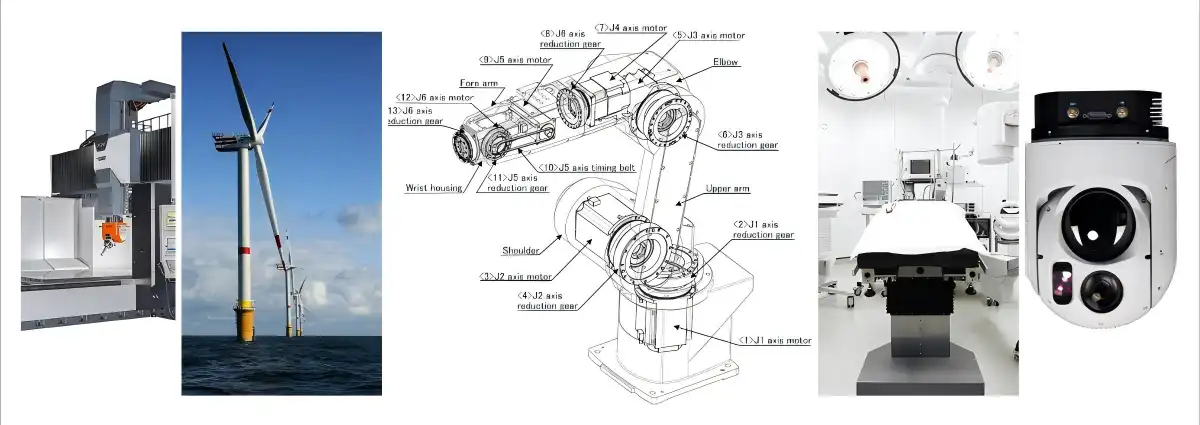
Some of the things that use these RA Crossed Roller Bearings are machining center rotary tables, precision indexing tables, medical imaging equipment, coordinate measuring machines, and stages for making integrated circuits. The RA series is a natural fit for places where positioning accuracy needs to stay within micron-level tolerances when loads are added together.
Customization Capabilities of OEM RA Crossed Roller Bearings
What OEM Customization Actually Covers
Catalog sizes are standard work for a lot of uses, but programs that are very special need something else. ATLYC provides OEM engineering services for a wide range of products, including ones with tighter size standards than P3, different cage materials, and sealed versions for dirty settings. Customers can also ask for non-standard bore-to-OD ratios if the fitting space needs a thinner wall than what is listed in the catalog.
Here are the main factors that can be changed to make this bearing set your own:
- Accuracy class selection: P6, P0, P5, P4, and P3 grades are in production; tighter custom tolerances can be discussed based on application load data and speed requirements.
- Sealing and lubrication: Contact seals, non-contact shields, or open configurations paired with lithium soap grease or customer-specified lubricants for cleanroom or vacuum environments.
- Material upgrades: Standard GCr15 handles most industrial duty cycles, while GCr15SiMn suits applications with deeper case depth requirements or higher operating temperatures.
With these choices, the bearing can be made to fit the needs of the machine, so engineers don't have to change the machine to fit a standard part. Proper OEM specification leads to shorter design iteration cycles, fewer extra parts, and more predictable service intervals.
Real-World Impact of Custom Specification
A machining center rotating table that runs at P4 accuracy and has a sealed RA crossed roller bearing system keeps cutting fluid and metal chips away from the raceways, which lowers the wear that comes from contamination. In one recorded process improvement at a company that makes automation equipment, the time between relubrications went from 500 hours to over 2,000 hours when they switched from an open bearing to a contact-sealed OEM version. That one change cut expected repair downtime and machine downtime in a way that could be measured.
Quality Assurance and Testing Methods in RA Crossed Roller Bearings Manufacturing
Dimensional and Geometric Inspection
Before leaving the ATLYC plant, every RA crossed roller bearing goes through measurement testing against ISO 492 tolerances. Coordinate measuring tools and accurate air gages are used to measure the bore diameter, outer diameter, width, and radial runout. Batch records are kept so that they can be tracked, which helps customers who have to follow the rules for IATF 16949 supply chain audits.
Performance and Material Testing
In addition to checking the shape, material integrity testing checks the hardness according to GB/T 230.1 and looks at the microstructure to make sure that the carbides are distributed correctly in GCr15 and GCr15SiMn steels. Runout is measured by rotation precision tests that apply a certain axial load. Using the Anderon meter for vibration and sound testing can find flaws below the surface that can't be seen with just a measuring tool.
| Test Category | Method / Standard | Acceptance Criterion |
|---|---|---|
| Dimensional inspection | ISO 492 | Per accuracy class (P6–P3) |
| Hardness test | GB/T 230.1 | HRC 58 – 62 |
| Radial runout | CMM / air gauge | Per P-grade tolerance |
| Noise / vibration | Anderon meter | Z-value within class limit |
| Surface finish | Profilometer | Ra ≤ 0.2 µm on raceways |
Documentation and Traceability
There is a quality proof for each production batch that has the material heat number, the results of the dimension check, and approval of the accuracy class. When people buy RA series crossed roller bearings for controlled industries like medical devices, semiconductor equipment, or aircraft subassemblies, they can ask for the full inspection report package to be sent with the shipment.
How to Select the Right OEM RA Crossed Roller Bearing Supplier
Certification and Manufacturing Capacity
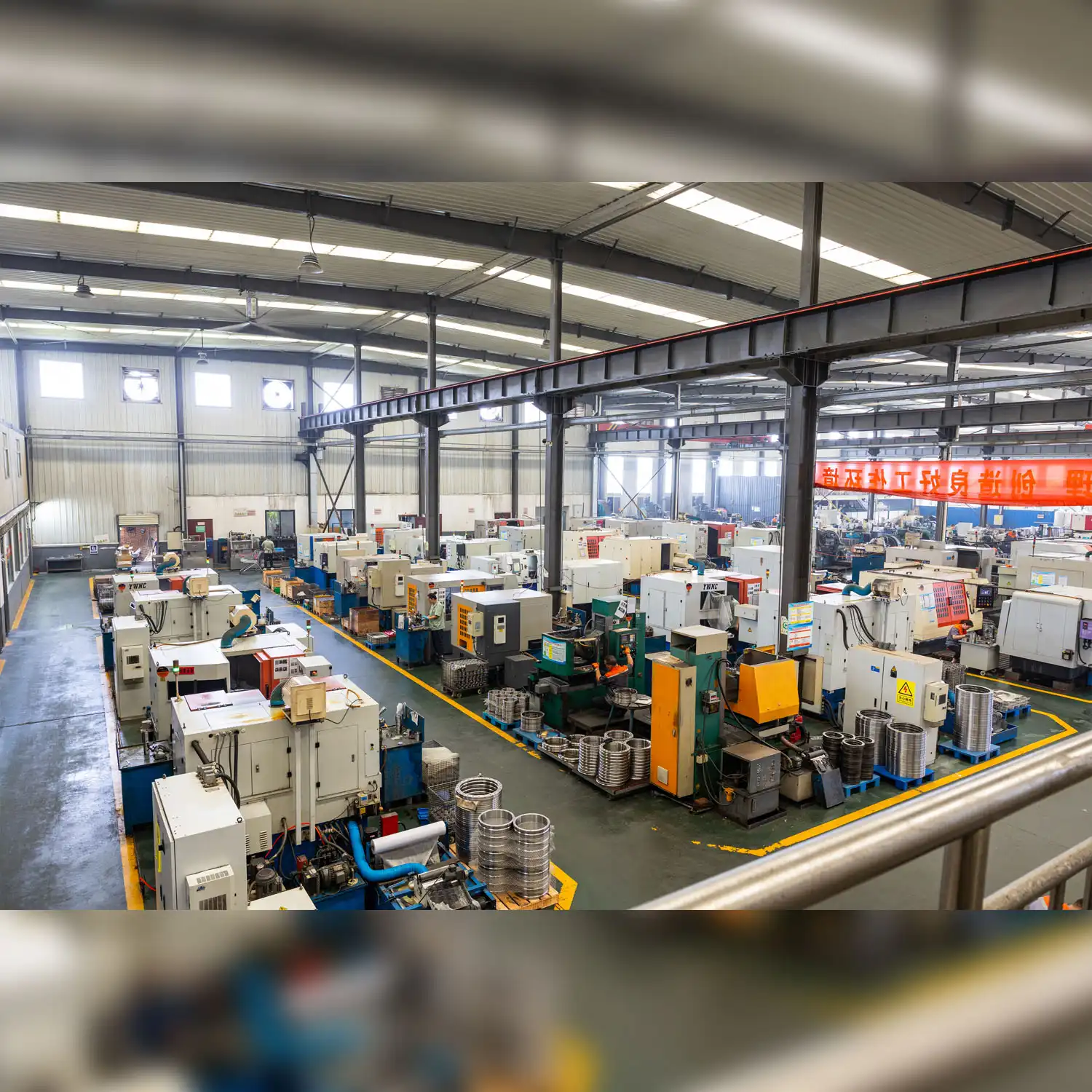
A reliable RA crossed roller bearing provider should have at least ISO 9001 certification. Suppliers that work with auto OEMs should also have IATF 16949 certification. Since 2010, when it grew from a single workshop to six, Luoyang Auto Bearing Co., Ltd. has had both certifications. The company now has 120 employees working in production, research and development, quality control, and assembly.
Technical Support and Lead Time Reliability
When choosing fine RA Crossed Roller Bearings, engineering help is just as important as price. The right supplier will send application engineers to look over load diagrams, figure out the equivalent dynamic load, and suggest the right accuracy class before the order is placed. On the business side, stable sources for raw materials and clear production schedules keep lead times predictable, which is important for OEMs with lean assembly programs.
Cost-Performance Ratio Evaluation
It's more true to look at service life and landing cost per bearing together than just unit price. Even if it costs more at first, a P5-accuracy GCr15SiMn bearing that lasts three times longer than a lower-grade option is cheaper in the long run. Instead of depending on claims that can't be backed up, when looking at RA Crossed Roller Bearing providers, ask for fatigue life data that is linked to ISO 281 figures.
RA Crossed Roller Bearings vs. Other Bearing Types: Making an Informed Choice
Comparison with Angular Contact Ball Bearings
Angular contact ball bearings can only handle combined loads through point contact, which limits how much weight they can hold per unit size. In most robotic joint situations, a single RA series crossed roller bearing can be used instead of two back-to-back angular contact pairs. This cuts down on the length of the joint and the number of parts that need to be used. Crossed rollers have a line contact shape that can handle higher moment loads without the elastic deformation that point-contact bearings show when forces act off-axis.
Comparison with Standard Slewing Rings
Slewing rings are heavy-duty bearings with a large diameter that are designed to work with construction equipment and heavy turntables. They aren't small and aren't made for runout at the micron level. RA Crossed Roller Bearings are used in situations where a slewing ring is too big and a standard deep groove ball bearing is not rigid enough. These situations include moderate diameter, very high precision, and combined loading.
Choosing Based on Application Requirements
The RA series is the best choice for moving parts that need to move quickly, accurately, and with a lot of force. Examples include robot joints, precision rotary tables, and measuring instrument axes. Angular contact ball bearings are still the right choice for steady high-speed spindle movement. The right bearing class is chosen by taking into account the load type, speed, accuracy needs, and room available. There is no one type that is always better.
Conclusion
RA Crossed Roller Bearings have small sizes, can handle loads in multiple directions, and have runout accuracy down to the micron level, which is something that not many other bearing types can match at the same size. The ATLYC RA series has accuracy grades from P6 to P3, inner sizes ranging from 20 mm to 350 mm, and is made of GCr15 or GCr15SiMn. It can be used for all kinds of precise motion tasks. Every package is backed by strict testing of dimensions, materials, and performance at every stage of production. OEMs and producers of industrial equipment who need a steady supply of approved, customizable crossed roller bearings can work with ATLYC, a trusted manufacturing partner with 15 years of experience and a well-documented quality system.
FAQ
1. How long does OEM customization typically take for RA Crossed Roller Bearings?
Standard sizes ship within the agreed lead time. Custom specifications — non-catalog dimensions, tighter-than-P3 tolerances, or special seal configurations — generally require four to eight weeks from drawing approval to first article inspection. Providing a complete load diagram and mounting drawing at the initial consultation speeds up the engineering review phase.
2. What maintenance intervals apply to RA series crossed roller bearings in robot joints?
Pre-greased bearings with lithium soap grease typically need relubrication checks every 1,000 to 2,000 operating hours, depending on cycle rate and load magnitude. Sealed variants in clean environments can run longer between service intervals. Running an open bearing dry is the most common cause of early raceway damage, so confirming grease condition at scheduled intervals is the most important maintenance action.
3. Are these bearings compatible with existing machine housings?
ATLYC can supply RA Crossed Roller Bearings to match existing housing and shaft tolerances. Providing the current drawing or measured bore and shaft dimensions allows the engineering team to confirm fit or suggest the nearest catalog size with a conversion note.
Partner with ATLYC for Your RA Crossed Roller Bearing Supply
ATLYC has been making high-precision RA Crossed Roller Bearings that meet ISO 9001 and IATF 16949 standards for 15 years, in six different workplaces. Our team is ready to help you with your program from the specification stage to delivery, whether you need a standard catalog size or a cross-roller bearing solution that was specially engineered for you. You can email us at auto@lyautobearing.com to get samples, a detailed quote, or to start a long-term supply relationship.
References
1. Harris, T. A., & Kotzalas, M. N. — Rolling Bearing Analysis, Taylor & Francis Group, 2006.
2. International Organization for Standardization — ISO 492: Rolling Bearings — Radial Bearings — Dimensional and Geometrical Tolerances, ISO, 2014.
3. International Organization for Standardization — ISO 281: Rolling Bearings — Dynamic Load Ratings and Rating Life, ISO, 2007.
4. International Automotive Task Force — IATF 16949: Quality Management System Requirements for Automotive Production, IATF, 2016.
5. Hamrock, B. J., Schmid, S. R., & Jacobson, B. O. — Fundamentals of Machine Elements, McGraw-Hill, 2005.
6. Shigley, J. E., & Mischke, C. R. — Mechanical Engineering Design, McGraw-Hill, 2001.
Learn about our latest products and discounts through SMS or email