- English
- French
- German
- Portuguese
- Spanish
- Russian
- Japanese
- Korean
- Arabic
- Greek
- German
- Turkish
- Italian
- Danish
- Romanian
- Indonesian
- Czech
- Afrikaans
- Swedish
- Polish
- Basque
- Catalan
- Esperanto
- Hindi
- Lao
- Albanian
- Amharic
- Armenian
- Azerbaijani
- Belarusian
- Bengali
- Bosnian
- Bulgarian
- Cebuano
- Chichewa
- Corsican
- Croatian
- Dutch
- Estonian
- Filipino
- Finnish
- Frisian
- Galician
- Georgian
- Gujarati
- Haitian
- Hausa
- Hawaiian
- Hebrew
- Hmong
- Hungarian
- Icelandic
- Igbo
- Javanese
- Kannada
- Kazakh
- Khmer
- Kurdish
- Kyrgyz
- Latin
- Latvian
- Lithuanian
- Luxembou..
- Macedonian
- Malagasy
- Malay
- Malayalam
- Maltese
- Maori
- Marathi
- Mongolian
- Burmese
- Nepali
- Norwegian
- Pashto
- Persian
- Punjabi
- Serbian
- Sesotho
- Sinhala
- Slovak
- Slovenian
- Somali
- Samoan
- Scots Gaelic
- Shona
- Sindhi
- Sundanese
- Swahili
- Tajik
- Tamil
- Telugu
- Thai
- Ukrainian
- Urdu
- Uzbek
- Vietnamese
- Welsh
- Xhosa
- Yiddish
- Yoruba
- Zulu
RA Series Crossed Roller Bearing: Top Uses in Robotics
The RA Series Crossed Roller Bearing is one of the most trusted precision bearing solutions in modern robotics. Featuring an outer ring separable design with inner ring rotation, this thin-walled bearing handles radial, axial, and moment loads simultaneously within a single compact unit. Available in inner diameters from 20 mm to 350 mm and manufactured from GCr15 or GCr15SiMn bearing steel, it delivers the rotational accuracy and structural rigidity that robotic joints, precision tables, and automated arms demand. If your application requires precision in a tight space, this bearing type deserves serious consideration.
Understanding RA Series Crossed Roller Bearings and Their Role in Robotics
What Makes the Design Different
The RA Series Crossed Roller Bearing has V-groove raceway surfaces and circular rollers that are placed at 90° angles. Precision spacers separate each roller, which stops them from skewing and stops them from rubbing against each other. This crossed design makes a load distribution pattern of 90° that can't be made by a regular ball bearing in the same space. When this is done, a bearing is made that is much more rigid per unit of weight.
Materials and Accuracy Grades
The bearing is made of GCr15 and GCr15SiMn alloy steel, which are both known for being consistently hard and resistant to wear after being heated. Most raceways are between 58 and 64 HRC hard. There are different levels of accuracy, such as P6, P0, P5, and P4. These cover a wide range of application limits, from general industry use to micron-level precise work in medical and semiconductor equipment.
Size Range and Load Distribution
This family of bearings has inner diameters ranging from 20 to 350 mm, outer diameters ranging from 70 to 540 mm, and widths ranging from 12 to 45 mm. It can be used in machine designs with limited envelope size. The thin-wall cross-section lowers spinning inertia without lowering the load capacity. This is important in robotic arm designs because every gram of weight changes the dynamic reaction. The load is spread out across the V-groove raceways, so the performance stays stable even when loads are added together.
Top Uses of RA Series Crossed Roller Bearings in Robotics
Industrial Robot Joints and Arm Articulation
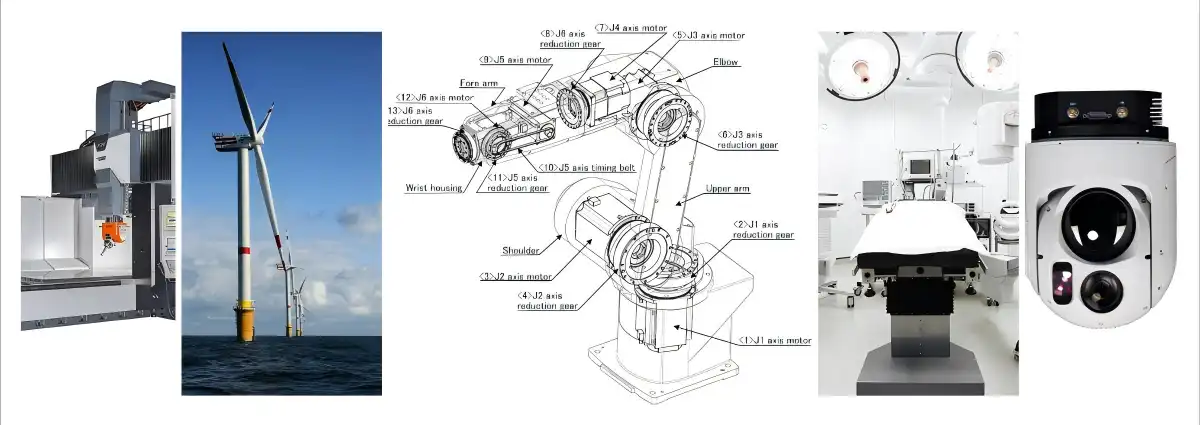
For robot joints to work properly, they need bearings that can handle the arm's weight and keep the position accurate to within a millimeter. The RA Series Crossed Roller Bearing can handle loads in all three directions in a single row: radial, axial, and moment. This gets rid of the need for paired bearing setups and makes the building simpler. The low friction coefficient is especially good for collaborative robots (cobots) because it lowers the power demand and energy use during repeated cycles.
Precision Rotary Tables and Machining Centers
This type of bearing works really well in three main robotic and precision applications, which are shown below:
- Rotary table indexing: In CNC machining centers, the bearing supports the rotary table's full weight plus cutting forces. Its low runout tolerance—achievable at P4 grade—ensures that the table returns to the same angular position within a few arc-seconds on every cycle, directly affecting part quality.
- Semiconductor wafer handling: Wafer transfer robots in cleanroom environments operate with fluorine-based greases and demand sub-micron runout stability. The RA Series crossed roller bearing provides the moment rigidity required to hold wafer orientation during high-speed transfer, reducing misalignment-related yield loss.
- Medical imaging equipment: C-arm X-ray gantries rotate heavy imaging assemblies around the patient. The bearing's compact width keeps the gantry profile slim while its multi-directional load capacity handles the asymmetric weight distribution common in medical imaging arms.
Controlled motion with little play is needed in all three of these areas of use. The RA Series Crossed Roller Bearing regularly meets this need in all three settings.
Manipulator End Effectors and Swivel Points
The wrist joint of a six-axis tool has the least amount of room and the most complicated load combinations. In the past, two angular contact ball bearings were needed to work together. Now, one RA Series bearing does the job. This shortens the axial length at the wrist, makes the manipulator lighter, and makes it easier for OEM makers to create the housing.
Comparing RA Series Crossed Roller Bearings with Alternative Solutions
| Feature | RA Series Crossed Roller Bearing | Angular Contact Ball Bearing | Slewing Ring Bearing |
|---|---|---|---|
| Load Types Supported | Radial + Axial + Moment | Radial + Axial | Radial + Axial + Moment |
| Cross-Section | Ultra-thin | Moderate | Large |
| Runout Accuracy | P4–P6 | P4–P5 | Standard only |
| Weight | Low | Low | High |
| Typical Application | Robot joints, precision tables | Spindles, gearboxes | Heavy slewing cranes |
Rigidity vs. Ball Bearings
When you put two cylinder wheels across each other, they make line contact, while ball bearings make point contact with their raceways. When there is line contact, the load is spread over a larger surface area. This makes the material stiffer and less likely to bend when moment loads are applied. This difference in displacement can be the difference between a reasonable and an unacceptable positional mistake for robotic arms that stretch out horizontally.
Space Efficiency vs. Slewing Rings
Slewing ring bearings can handle big moment loads, but they need thick housing flanges and make the spinning unit a lot heavier. The RA Series Crossed Roller Bearing has the same moment capacity as the standard RB Series, but its walls are about 24–30% thinner. This makes it the best choice when the weight of the structure affects cycle time or motor size.
Long-Term Cost Efficiency
Because the RA Series bearing handles multiple loads in one unit, OEM builders can cut down on the number of bearing positions needed in each unit. There are fewer seals, lubricant points, and upkeep times when there are fewer bearing locations. Over the life of a machine, this decrease in the number of parts lowers both the cost of planned maintenance and the number of times it breaks down without warning.
Procurement Guide for RA Series Crossed Roller Bearings
Supplier Qualification Criteria
Make sure that the company you buy from has both ISO 9001 and IATF 16949 certifications when you need crossed roller bearings for robotics. These certificates show that the company keeps written records of its process controls and measurement accuracy. Request material test reports that include information on the make-up of the GCr15 or GCr15SiMn steel and check the hardness of the raceway surface.
| Procurement Factor | Recommended Specification |
|---|---|
| Quality Certification | ISO 9001 + IATF 16949 |
| Accuracy Grade | P5 minimum for robotics |
| Material | GCr15 or GCr15SiMn |
| Lubrication (standard) | Lithium soap-based grease |
| Lubrication (cleanroom) | Low-outgassing fluorine grease |
| Minimum Order Quantity | Confirm per model with supplier |
Customization and Lead Time Planning
Standard RA Series Crossed Roller Bearings are offered off-catalog in the aforementioned size groups. Before production can begin, engineering must study custom inner diameters, changed flange shapes, and special accuracy grades. Custom orders should take between 4 and 8 weeks, and you should make sure that the provider verifies runout (using Kia and Sia measures) on every batch before sending it out.
Installation and Maintenance Best Practices
A precisely-bored housing is the first step in a proper installation. Because the outer ring can be separated, use the right bolt pressure sequence to clamp it evenly into the housing hole and keep the ring from warping. If the fitting flange is out of line by even a few microns, the preload distribution will change, and the runout performance will get worse. Once the axis is mounted, check the rotary force by hand before turning it on.
Based on the speed factor and operating temperature, re-oil the bearings at the times they tell you to. For most industrial robot uses, putting on lithium soap-based grease every 2,000 to 3,000 hours of operation keeps the film thickness at the track at the right level. During the regular inspection, look for changes in the vibration signature that don't seem right. This is because early-stage raceway wear often shows up as more torque variation before it can be heard.
Conclusion
The RA Series Crossed Roller Bearing solves the most important problem in precision robotics: it has a thin cross-section but is very rigid and can carry loads in multiple directions. Because it is made of GCr15/GCr15SiMn, has accuracy grades from P6 to P4, and an inner diameter range of 20–350 mm, it can be used in a wide range of situations, from small shared robot joints to large-format machining center tables. This type of bearing makes assembly easier and supports long service intervals when installed and kept properly. It doesn't matter if your project is handling wafers, imaging during surgery, or designing heavy manipulators.
FAQ
1. What is the load capacity of the RA Series Crossed Roller Bearing compared to ball bearings?
The RA Series is better for cantilevered robotic arms and spinning tables where moment loads are the most important because it has higher moment stiffness and less deflection under mixed loads.
2. Can this bearing replace two angular contact ball bearings?
Yes. Because it can handle radial, axial, and moment loads in a single row, OEM designers can often use a single RA Series unit instead of two back-to-back or face-to-face angular contact ball bearing pairs. This cuts down on the length of the assembly process and the number of steps needed to put it together.
3. What accuracy grade should I specify for robotic joint applications?
Most industrial robot joints must have at least P5 as a minimum. The P4 grade is good for working with semiconductors and making precise measurements, where runout tolerances need to stay within a few microns.
4. How does the split outer ring affect installation?
The split outer ring makes putting the bearing into the housing easier, but it needs to be clamped evenly to keep the circular shape. To keep the preload from changing and the accuracy of the spin, use a precision-bored case and follow the torque procedure.
5. Is customization available for non-standard bore sizes?
Yes. You can get inner sizes that aren't standard, changed flange shape, and special surface treatments. Send an application drawing and information about how the machine will be used to the manufacturer to get an engineering review and an estimate of the lead time.
Partner with ATLYC for Your RA Series Crossed Roller Bearing Supply
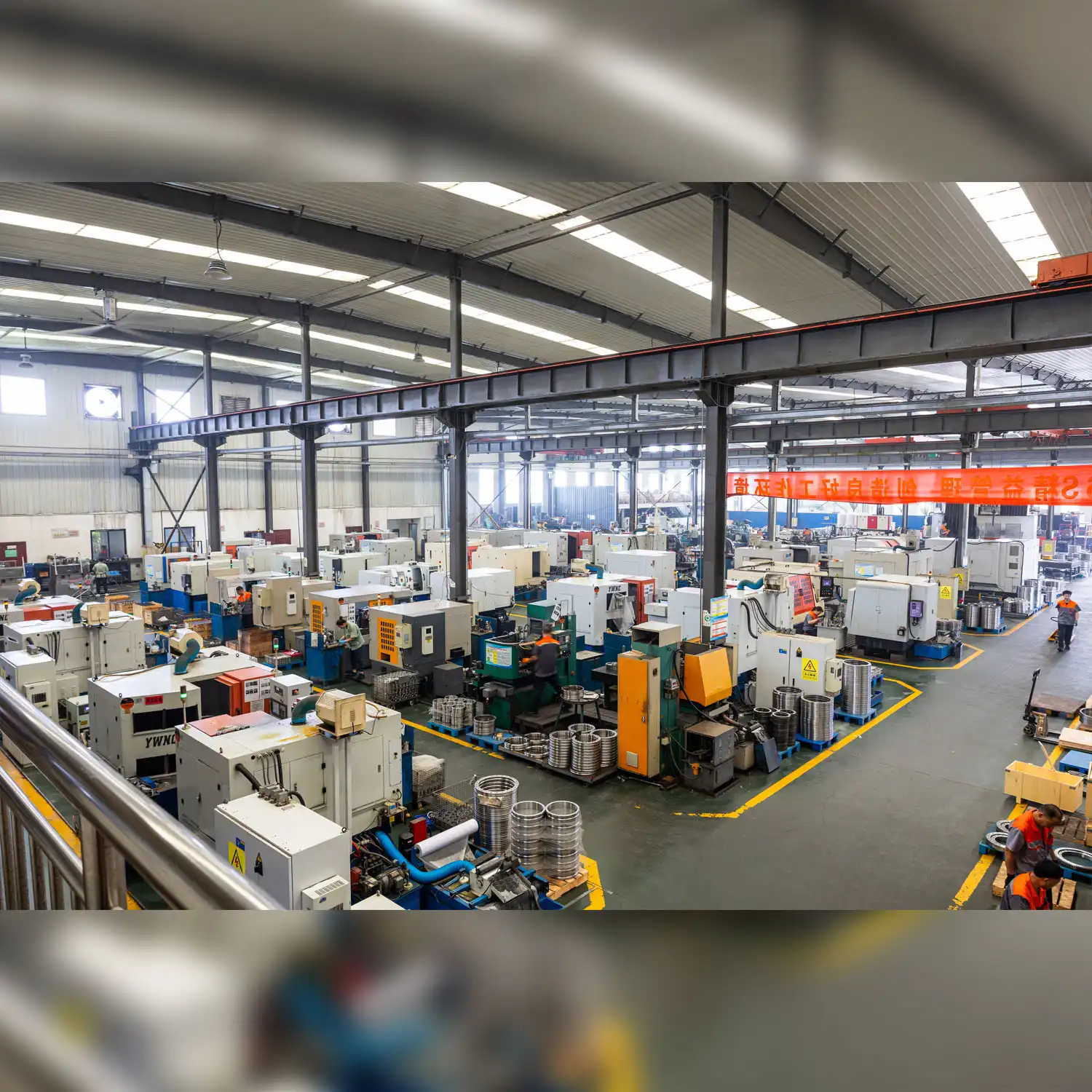
Luoyang Auto Bearing Co., Ltd., an ISO 9001 and IATF 16949-certified company with 15 years of experience making precision bearings, supports ATLYC. They offer the RA Series Crossed Roller Bearing, which has confirmed accuracy grades, GCr15 material tracking, and production that can be scaled up across six workshops. We are a reliable RA Series Crossed Roller Bearing manufacturer that works with customers in the US, Germany, South Korea, and other places. We accept OEM orders as well as bulk orders. To get a price right away, email your requirements to auto@lyautobearing.com.
References
1. Tribology Transactions – "Load Distribution and Rigidity Analysis of Crossed Roller Bearings in Robotic Joint Mechanisms," 2021.
2. Journal of Mechanical Design (ASME) – "Comparative Study of Bearing Types for High-Precision Rotary Axes in CNC Machining Centers," 2020.
3. Robotics and Computer-Integrated Manufacturing – "Bearing Selection Criteria for Collaborative Robot Wrist Joints," 2022.
4. Precision Engineering – "Runout Accuracy and Preload Effects in Thin-Section Crossed Roller Bearings," 2019.
5. International Journal of Advanced Manufacturing Technology – "Performance Evaluation of GCr15 Steel Bearings Under Combined Load Conditions," 2021.
6. Industrial Lubrication and Tribology – "Lubrication Strategies for Crossed Roller Bearings in Cleanroom and Medical Robotics Applications," 2023.
Learn about our latest products and discounts through SMS or email