- English
- French
- German
- Portuguese
- Spanish
- Russian
- Japanese
- Korean
- Arabic
- Greek
- German
- Turkish
- Italian
- Danish
- Romanian
- Indonesian
- Czech
- Afrikaans
- Swedish
- Polish
- Basque
- Catalan
- Esperanto
- Hindi
- Lao
- Albanian
- Amharic
- Armenian
- Azerbaijani
- Belarusian
- Bengali
- Bosnian
- Bulgarian
- Cebuano
- Chichewa
- Corsican
- Croatian
- Dutch
- Estonian
- Filipino
- Finnish
- Frisian
- Galician
- Georgian
- Gujarati
- Haitian
- Hausa
- Hawaiian
- Hebrew
- Hmong
- Hungarian
- Icelandic
- Igbo
- Javanese
- Kannada
- Kazakh
- Khmer
- Kurdish
- Kyrgyz
- Latin
- Latvian
- Lithuanian
- Luxembou..
- Macedonian
- Malagasy
- Malay
- Malayalam
- Maltese
- Maori
- Marathi
- Mongolian
- Burmese
- Nepali
- Norwegian
- Pashto
- Persian
- Punjabi
- Serbian
- Sesotho
- Sinhala
- Slovak
- Slovenian
- Somali
- Samoan
- Scots Gaelic
- Shona
- Sindhi
- Sundanese
- Swahili
- Tajik
- Tamil
- Telugu
- Thai
- Ukrainian
- Urdu
- Uzbek
- Vietnamese
- Welsh
- Xhosa
- Yiddish
- Yoruba
- Zulu
YRTC High-Speed Rotary Table Bearing vs Standard Bearings
When we talk about precision CNC operations, the choice between YRTC High-Speed Rotary Table Bearing and standard bearing solutions isn't just technical—it fundamentally determines your production efficiency and long-term cost structure. The YRTC variant represents an engineered response to the kinematic and thermal challenges inherent in modern high-RPM machining environments. Unlike conventional bearing assemblies that struggle with heat buildup and speed limitations, this specialized bearing integrates advanced cage materials, optimized roller guidance systems, and precision-ground raceways to deliver 50-80% higher limiting speeds while maintaining exceptional multi-directional load capacity. We've seen firsthand how this translates into faster cycle times, reduced thermal distortion, and superior positioning accuracy—three factors that directly impact your bottom line in competitive manufacturing environments.

Understanding Rotary Table Bearings: YRTC High-Speed vs Standard Bearings
What Makes Rotary Table Bearings Essential in CNC Machinery
Rotary table bearings are the most important part of the connection between workpiece platforms that move and machine bases that stay still. These parts allow for precise angular positioning and complex load scenarios from cutting forces at the same time. At Luoyang Auto Bearing Co., Ltd., we've been making bearings for 15 years and have seen them change from multi-component bearing stacks to today's integrated solutions that make installation a lot easier and make machines more rigid.
The Structural Foundation of YRT Technology
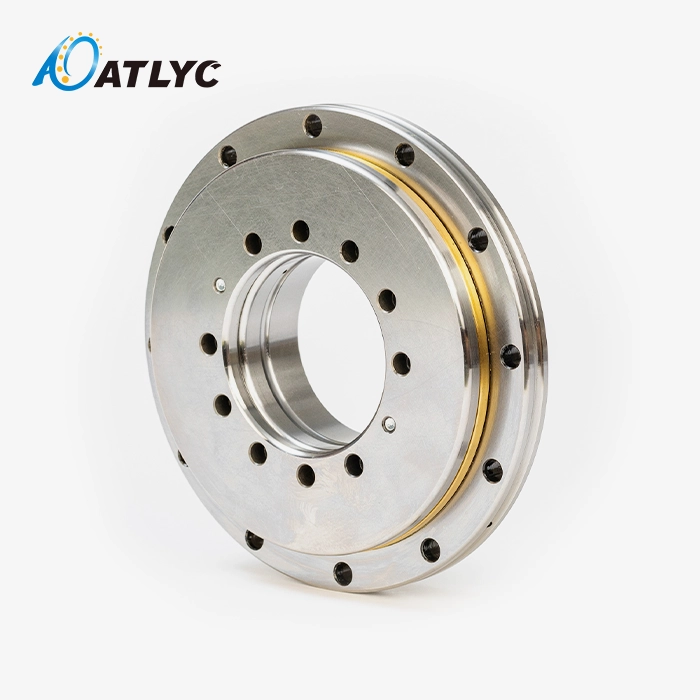
Standard YRT bearings have a small three-in-one design that combines thrust, radial, and moment load capabilities into a single unit. The structure is made up of an outer ring that connects to the mounting interface, an inner ring that connects to the moving parts, and many rows of precision rollers. Two rows of axial rollers handle thrust loads and bending moments, and one row of radial rollers handles forces acting from the side. This setup lets the bearing deal with forces coming from all directions at the same time, which is hard for most bearing pairs to do without making the bearing smaller or adding extra tolerances. The combined design gets rid of the need to put together a lot of different thrust bearings, rotary bearings, and spacer parts. Because you're only mounting one unit instead of stacking several elements and making precise preload adjustments, installation time is cut down by a large amount. The smaller size also makes it possible to make rotary tables that are smaller, which lowers the cost of the machine and makes better use of the area.
How YRTC Modifications Enable High-Speed Operation
The letter "C" means that certain technical changes have been made to reduce friction and control temperature. Standard YRT bearings are great for heavy-duty tasks, but their standard cage designs and roller guide systems cause a lot of friction torque at high speeds. This friction directly turns into heat, which leads to thermal expansion that lowers the accuracy of placement. This is a very important issue in 5-axis simultaneous machining, where part quality depends on accuracy down to the micron level. This problem is fixed by YRTC High-Speed Rotary Table Bearings with a few important new features. The new cage design uses materials with lower friction coefficients and shapes that keep contact loads to a minimum while the cage rotates quickly. Skidding happens when rollers slip instead of rolling smoothly, which speeds up wear and makes performance unpredictable. Optimized roller guidance stops skidding. Precision grinding and super-finishing are used on the raceways to make the surfaces very smooth, which lowers friction and heat production. All of these changes make it possible to limit speeds that are 50–80% higher than standard equivalents. This is done without sacrificing the rigidity and load capacity that make YRT bearings useful in tough situations.
Performance Comparison: YRTC High-Speed Bearings vs Standard Bearings
Quantifiable Speed and Torque Advantages
When you compare operational factors, you can see the changes right away. Standard YRT bearings usually work consistently at speeds that are good for indexing and slow steady rotation, which is fine for many common machine tasks. Modern direct-drive rotary tables in turning-milling centers, on the other hand, need several hundred RPM while still being rigid enough to handle cutting forces. This is where YRTC High-Speed Rotary Table Bearings really shine.YRTC High-Speed Rotary Table Bearing versions with less friction torque have two important benefits: they need less power from the drive engine and work at lower temperatures. In some cases, switching from standard to YRTC High-Speed Rotary Table Bearings cut the motor's current draw by 15 to 20 percent while also lowering the temperature of the bearing housing by 8 to 12 degrees Celsius while it was running continuously. This thermal stability directly protects geometric accuracy—thermal growth that would normally change machine geometry by several microns is stopped, so positioning accuracy is kept even during long machining cycles.
Durability Under Continuous High-Load Conditions
Load capacity is another factor where choosing the right bearings is very important. The normal YRT and YRTC High-Speed Rotary Table Bearing versions can both handle axial, radial, and moment loads well, but their fatigue life characteristics change depending on the conditions of use. YRTC High-Speed Rotary Table Bearings keep their full load ratings even at high speeds, while normal types may need to be derated as the speed of rotation goes up to keep them from breaking too soon. The qualities of the material are very important here. Both types are made of high-quality 100Cr6 bearing steel that has been heat-treated to make the surface hard (58–62 HRC) to resist wear and the core tough (60–70 HRC) to handle shock loads. The main difference is that YRTC High-Speed Rotary Table Bearings' optimized internal geometry spreads contact loads more equally across roller-raceway surfaces. This makes L10 fatigue life 20–30% longer in high-speed uses compared to standard designs that are running at their fastest speeds.
| Performance Parameter | Standard YRT Bearing | YRTC High-Speed Rotary Table Bearing | Improvement |
|---|---|---|---|
| Stopping the speed | Beginning | 50 to 80% More | Very Important |
| Torque and Friction | The norm | 25–35% Less | Not as much heat |
| Temperature for Use | Better | 8–12°C Cooler | Stability is better |
| L10 Life During Fatigue (High Speed) | Slowed down at the speed limit | 20–30% longer | More time to serve |
| Need for Motor Power | Better | 15-20% Less | How to Save Energy |
Maintenance Practices and Quality Assurance
The regular and high-speed versions have different maintenance needs. YRTC High-Speed Rotary Table Bearings work better at lower temperatures because less heat stress means less lubricant breakdown and longer periods of time between relubrication. We suggest that you look at samples of used lubricant every 2,000 hours of use so that you can set the best re-lubrication plans based on real contamination and additive depletion rates instead of random time intervals. When checking the quality of YRTC High-Speed Rotary Table Bearings, the focus is on factors that have a direct effect on how well they work at high speeds. Geometric accuracy checking uses roundness testers to make sure that radial and axial runout is less than 2µm. Deviations above this limit are signs of production flaws that would cause vibration and early wear at high speeds. It's very important to test the starting and running torque; technicians make sure that the frictional torque stays within certain low ranges to make sure that the machine can run at high speeds. Deviations show problems with the preload or the cage that would make efficiency worse. Checking the preload and stiffness makes sure that the negative clearance stays the same so that the rated rigidity is maintained without causing the part to get too hot while it's in use.
Market Comparison: YRTC vs Leading Competitor Brands
Technical Benchmarking Against Established Manufacturers
Global bearing makers like NSK, SKF, and FAG make high-precision rotary table bearings that are similar in terms of their technical abilities. These brands have good reputations that have been built over many years of excellent engineering and consistent quality. A lot of the time, their goods are used as guidelines for design validation and procurement requirements. However, the economic environment has changed a lot. China has closed the technical gap by investing in quality processes and precise manufacturing tools over a long period of time. At ATLYC, our ISO 9001 and IATF 16949 licenses show that we follow the same international quality rules as our Western rivals. Our six specialized workshops use high-precision grinding and super-finishing methods that are similar to those used by top European makers. They can reach P4 or P2 tolerance classes and have runout accuracy of less than one micron. The real things that set us apart are the engineering support and customization options we offer. Big multinational companies that make bearings are great at making standard catalog items, but they often have trouble quickly customizing products for specific uses. Our 120-person team includes dedicated engineers who work directly with customers to change bearing designs to fit specific load conditions, space limitations, or integration needs. This is a very useful skill when standard catalog specifications don't quite fit your application parameters.
Cost-Benefit Analysis and Total Cost of Ownership
Pricing at the start is only one part of bearing economics. The total cost of ownership includes the price of the bearing, the cost of fitting, the amount of energy it uses, the cost of upkeep, and how often it needs to be replaced over its lifetime. This all-around view often shows surprising facts that go against common beliefs about procurement. Most of the time, ATLYC YRTC High-Speed Rotary Table Bearings are 30–40% cheaper to buy than similar expensive European brands, but they still work just as well technically. This lower price is due to more efficient production, lower costs, and the strong competitive nature of the Chinese industry sector, not to lower-quality materials or less accurate production. Our bearings are made with the same grade of bearing steel, heat treatment methods, and grinding and finishing methods as high-end Western brands. As time goes on, the energy savings from less friction torque add up. A direct-drive rotary table that uses 15-20% less motor power is more cost-effective over its entire life. In high-duty cycle applications, the energy savings alone pay for the table's purchase in 12 to 18 months. The total cost of ownership advantage is big when you count the longer repair gaps and less downtime caused by better thermal stability. Customers were able to cut their total cost of ownership (TCO) by 40–50% over the life of their equipment by switching from high-end European bearings to ATLYC YRTC High-Speed Rotary Table Bearing versions. This was done without affecting the performance of the machine or the quality of the parts.
| Cost Factor | Premium European Brand | ATLYC YRTC High-Speed Rotary Table Bearing | Difference |
|---|---|---|---|
| Purchase price at the start | Initial (100% of) | 60–70% of the Premium | 30 to 40 percent off |
| Cost of Energy Each Year | Better | 15-20% Less | Savings Over Time |
| Time Between Maintenance | The norm | 20–30% longer | Less time wasted |
| Lead Time on Average | 8 to 12 Weeks | 4 to 6 weeks | More rapid delivery |
| Customization and Flexibility | Limited | Very adaptable | Stronger Help |
| Total Cost of Owning for 5 Years | Initial (100% of) | 50–60% of the Premium | 40 to 50 percent off |
Supply Chain Advantages and Partnership Value
Reliability in the supply chain is becoming more and more important as global makers try to keep stocking costs as low as possible while also avoiding production delays caused by shortages of parts. Because we are located in Luoyang and have established logistics partnerships, we can keep our wait times for normal YRTC High-Speed Rotary Table Bearing configurations at a competitive 4-6 weeks. This is a lot shorter than the 8–12 weeks that most European makers need.We have a large network of authorized distributors in South Korea, the US, Germany, Russia, Iran, and Turkey, among other important markets. These partnerships make sure that you have access to local technical support and inventory in major manufacturing regions. This lowers your risk of having to deal with international shipping delays and customs issues. At our Luoyang facilities, we train each distributor to make sure they can give good application engineering support and installation advice.
Choosing the Right Bearing: How to Decide Between YRTC and Standard Bearings
Critical Selection Criteria for Procurement Managers
Before you choose a bearing, you should carefully consider what your application needs. The main question isn't which bearing is cheaper, but which one gives you the best performance based on your working factors and business goals. We suggest looking at five main factors that, when put together, will help you choose the right bearing type for your needs. The clearest way to tell them apart is by their speed needs. When there is constant rotation above 50 to 60 percent of a normal YRT bearing's limiting speed, YRTC High-Speed Rotary Table Bearing variants should immediately be taken into account. The small price increase is worth it because the better heating properties and lower friction torque make the product more reliable and lower its running costs. On the other hand, YRTC High-Speed Rotary Table Bearings might not be the best choice for situations where motion is mostly indexing and continuous rotation is not important. In these cases, normal YRT bearings are usually a better choice. Load profile analysis looks at both the size of forces and how they change over time. Impact loads or forces that change quickly are very different from steady-state loads. When cutting forces are pretty stable and rotation goes on all the time, YRTC High-Speed Rotary Table Bearings work great. Standard YRT bearings give up some speed capability in exchange for maximum impact resistance. This design may be better for applications that go through a lot of acceleration and deceleration cycles or that have heavy shock loads.
Aligning Bearing Selection with CNC Machine Characteristics
The characteristics of the machine tool have a big impact on the best bearing selection. When a motor is directly connected to a rotating platform without any intermediate gearing, the table is called a direct-drive rotary table. These tables need bearings that can work smoothly over a wide range of speeds while still keeping precise positioning accuracy. Because YRTC High-Speed Rotary Table Bearings have less friction torque, they have better servo control properties. This means that during complicated toolpath execution, acceleration can happen faster and velocity can be changed more precisely. Different things need to be thought about when using gear-driven spinning tables. The gear reduction increases the motor's torque while decreasing its output speed. This might make it possible for standard YRT bearings to meet speed requirements. But gear-driven systems have problems like backlash and compliance that can make setting less accurate. Putting a gear-driven system together with a YRTC High-Speed Rotary Table Bearing might not make sense from a speed point of view, but the bearing's higher stiffness and positioning accuracy can help make up for the drive system's mechanical flaws. Size and weight of the workpiece are also taken into account when choosing a bearing. Larger rotary tables that move heavy workpieces create large inertial loads when they speed up and slow down. These moving loads, along with steady forces like gravity and cutting forces, put the bearing system under a lot of stress. YRTC High-Speed Rotary Table Bearings keep their full load rates even at high speeds, while normal versions might need to be derated, which could mean that the machine has to be more complicated and cost more.
Common Procurement Pitfalls and How to Avoid Them
There are a few mistakes that procurement professionals keep making when they choose rotary table bearings. The most common one is focusing only on the initial purchase price and not taking into account the total cost of ownership. Even though it might seem like a good deal at first, a bearing that costs 30% less but needs to be replaced 40% more often and uses 20% more energy will end up costing more in the long run. This mistake can't happen with a full TCO study because it figures out all the costs over the real-life spans of the equipment. Mismatching bearing precision grades with machine powers is another common mistake. Choosing P2 precision bearings for a machine with P5 precision mounting surfaces is a waste of money because the better accuracy of the bearing won't show up if the mounting errors are bigger than the bearing's tolerances. On the other hand, putting P5 bearings in a precision machine that was made for P4 or P2 accuracy hurts the machine's performance. Matching the precision of the bearing to the precision of the machine makes sure that you aren't paying too much for too much accuracy or reducing the machine's possibilities with parts that don't work well together.
YRTC High-Speed Rotary Table Bearings: Brand and Technical Insights from ATLYC
Our Manufacturing Heritage and Capabilities
ATLYC, formerly known as Luoyang Auto Bearing Co., Ltd., began in 2010 with just one automatic workplace that made deep groove ball bearings. Over the past 15 years, we've steadily grown our capabilities across six specialized production facilities. We now know how to make all types of high-precision bearings, such as YRTC High-Speed Rotary Table Bearings for demanding CNC applications. This growth shows that both our technology has improved and China's precision manufacturing industry has grown into a global competitor. We have 120 employees, and some of them are experts in production, research and development, quality control, and final assembly. This organizational structure makes sure that all steps of the manufacturing process are handled professionally, from checking the raw materials to putting them in the boxes at the end. We've put a lot of money into measurement systems, super-finishing tools, and precision grinding equipment that lets us regularly reach P4 and P2 tolerance classes. These levels of accuracy are the same as or better than what is needed for high-performance CNC rotary tables to work in aircraft, medical device manufacturing, and precision machining.
Quality Assurance Protocols and Certification Standards
Our quality management system is certified by both ISO 9001 and IATF 16949, which are the strictest quality standards in the automotive industry. Compliance with IATF 16949 shows that we can meet the strict needs of car OEMs when it comes to process control, ongoing improvement, and defect prevention. These same rules make sure that our YRTC High-Speed Rotary Table Bearings are always of the same high quality and dependability, no matter what business they are going to. Multiple inspection steps are built into the quality control processes for rotary table bearings as they are being made. Before machining starts, the composition, hardness, and grain structure of the steel are checked during the incoming material inspection. In-process measurement checks during turning and grinding make sure that the geometry is correct before the heat treatment process. This finds any problems before the value-added processes are used. Testing the hardness of the component after heat treatment shows that the metal changed properly across all of its cross-sections. Final inspection includes the geometric accuracy checks, torque tests, and preload confirmations we talked about earlier. This makes sure that every bearing that leaves our facility meets the published specifications. We have full systems in place that connect each bearing's serial number to a particular batch of material, heat treatment, grinding settings, and inspection results. This makes it possible to quickly find the root cause of problems in the field, which helps with efforts to keep getting better and get rid of potential failure modes. In the 15 years we've been in business, this disciplined approach has steadily increased the reliability of our products while also letting us use our technical skills in areas where they are needed most.
Product Range and Customization Support
Our YRTC High-Speed Rotary Table Bearing catalog has sizes ranging from 50mm to 1200mm in outer diameter. These sizes cover a wide range of CNC rotary table uses, from small 4-axis machines to large horizontal boring mills. Standard configurations work for most common uses, but we know that specialized manufacturing equipment has its own needs that can't always be met by standard catalog products. Customization skills give us a competitive edge that we work hard to keep. Our engineering team often works with customers to change standard designs to fit specific load conditions, strange space limitations, or the needs of integrating with custom drive systems. For harsh environments, we've made versions with different seal configurations, bearings with built-in encoder mounting holes for closed-loop position feedback, and special preload configurations that make the best trade-offs between stiffness and speed for certain machining operations. This adaptability is especially helpful when making new machines, since the choice of bearing has a big effect on the general structure of the machine.

Conclusion
When choosing between normal and YRTC High-Speed Rotary Table Bearings, you should not just compare prices at first, but also carefully think about your unique operational needs, the features of your machine, and the total cost of ownership. When there is continuous high-speed rotation, YRTC High-Speed Rotary Table Bearings offer measurable benefits. They have lower operating temperatures, less friction torque, and longer service lives, all of which improve machining accuracy while lowering energy use and maintenance costs. Standard YRT bearings are still perfect for indexing and lower-speed continuous rotation, where their strong design and lower starting cost make them the best choice. ATLYC has been making things for 15 years, has quality systems that are ISO 9001 and IATF 16949 certified, and has dedicated technical support. These things help us help customers find bearing solutions that really improve machine performance and lifecycle costs.
FAQ
What specific benefits do YRTC high-speed bearings have over regular rotary table bearings?
YRTC High-Speed Rotary Table Bearing variants have 50–80% higher limiting speeds thanks to improved roller guidance and changed cage designs that lower friction torque by 25–35%. This means that the working temperatures are 8 to 12°C lower, which keeps the positioning accuracy even during long machining processes. Compared to standard bearings working close to their speed limits, L10 bearings use 15-20% less energy and last 20-30% longer in high-speed situations.
How can we be sure that the YRTC bearings we bought from ATLYC are real?
Each real ATLYC bearing has a laser-etched unique number that connects to our database for tracking. If you email our technical support team at auto@lyautobearing.com with the serial number, we'll check the date it was made, the specifications, and where it was first sent. When you buy from our authorized distributor network—which we can find for your area—you can be sure that the products you receive are real and come with our warranty.
What repair steps will make YRTC bearings last the longest?
Check the condition of the lubricant every 2,000 hours of use by analyzing the oil to see how much contamination there is and how much of the additives have been used up. Re-grease based on the real state of the lubricant instead of random intervals. The lower working temperatures of YRTC High-Speed Rotary Table Bearings make the lubricant last 20–30% longer than in normal variants. Every year, check the flatness of the attachment surface because heat cycling can bend machine structures, causing changes in preload that speed up wear.
Partner with ATLYC for Your High-Precision Bearing Requirements
ATLYC makes YRTC High-Speed Rotary Table Bearing options that are designed to work in tough CNC settings where accuracy and dependability are key to staying ahead of the competition. Our production methods are ISO 9001 and IATF 16949 approved, so the quality is always up to global standards. Plus, our skilled engineering team can help with technical issues and make changes that standard catalog sellers can't. Please email our technical sales team at auto@lyautobearing.com if you are a procurement manager or an OEM expert to talk about your unique application needs. We have the engineering knowledge, manufacturing precision, and supply chain dependability to support long-term partnerships, whether you need standard configurations with short lead times or custom bearing solutions for specialized equipment. Ask for our detailed product catalog and technical specification sheets to see how ATLYC can improve the performance of your rotary table and lower its total cost of ownership. We are a well-known company that makes YRTC High-Speed Rotary Table Bearings for use in cars, factories, and precision equipment around the world. We can become your key bearing supply partner.
References
1. Harris, T.A. and Kotzalas, M.N. (2006). Advanced Concepts of Bearing Technology: Rolling Bearing Analysis, Fifth Edition. CRC Press, Boca Raton.
2. Weck, M. and Brecher, C. (2006). Werkzeugmaschinen 5: messtechnische Untersuchung und Beurteilung, dynamische Stabilität. Springer-Verlag, Berlin.
3. ISO 199:2014. Rolling Bearings — Thrust Bearings — Geometrical Product Specifications (GPS) and Tolerance Values. International Organization for Standardization, Geneva.
4. Schaeffler Technologies AG & Co. (2016). Rotary Table Bearings: Design Considerations and Application Guidelines. Technical White Paper Series, Herzogenaurach.
5. Bryan, J.B. (1990). International Status of Thermal Error Research. CIRP Annals - Manufacturing Technology, 39(2), 645-656.
6. Neugebauer, R., Denkena, B., and Wegener, K. (2007). Mechatronic Systems for Machine Tools. CIRP Annals - Manufacturing Technology, 56(2), 657-686.
Learn about our latest products and discounts through SMS or email