- English
- French
- German
- Portuguese
- Spanish
- Russian
- Japanese
- Korean
- Arabic
- Greek
- German
- Turkish
- Italian
- Danish
- Romanian
- Indonesian
- Czech
- Afrikaans
- Swedish
- Polish
- Basque
- Catalan
- Esperanto
- Hindi
- Lao
- Albanian
- Amharic
- Armenian
- Azerbaijani
- Belarusian
- Bengali
- Bosnian
- Bulgarian
- Cebuano
- Chichewa
- Corsican
- Croatian
- Dutch
- Estonian
- Filipino
- Finnish
- Frisian
- Galician
- Georgian
- Gujarati
- Haitian
- Hausa
- Hawaiian
- Hebrew
- Hmong
- Hungarian
- Icelandic
- Igbo
- Javanese
- Kannada
- Kazakh
- Khmer
- Kurdish
- Kyrgyz
- Latin
- Latvian
- Lithuanian
- Luxembou..
- Macedonian
- Malagasy
- Malay
- Malayalam
- Maltese
- Maori
- Marathi
- Mongolian
- Burmese
- Nepali
- Norwegian
- Pashto
- Persian
- Punjabi
- Serbian
- Sesotho
- Sinhala
- Slovak
- Slovenian
- Somali
- Samoan
- Scots Gaelic
- Shona
- Sindhi
- Sundanese
- Swahili
- Tajik
- Tamil
- Telugu
- Thai
- Ukrainian
- Urdu
- Uzbek
- Vietnamese
- Welsh
- Xhosa
- Yiddish
- Yoruba
- Zulu
How Does XSU080168UUP5 Precision Crossed Roller Bearing Perform?
The XSU080168UUP5 Precision Crossed Roller Bearing delivers exceptional performance through its unique orthogonal roller arrangement, achieving high load capacity across radial, axial, and moment directions simultaneously. With P5-grade rotational accuracy and dual-sided sealing, this bearing maintains micron-level precision while eliminating complex housing requirements through its integrated mounting hole design. Manufactured from hardened GCr15 bearing steel and featuring a compact 140mm inner diameter and 215mm outer diameter profile, it provides superior stiffness and minimal runout—making it ideal for industrial robotics, CNC machining centers, and medical imaging equipment where reliable positioning and smooth operation are non-negotiable.

Introduction to XSU080168UUP5 Precision Crossed Roller Bearing
Crossed roller bearings are a tried-and-true engineering option for industrial applications that need to save room and be very accurate. This way of thinking about design is shown by the XSU080168UUP5 Precision Crossed Roller Bearing model, which combines integrated construction with advanced load distribution features that are hard for traditional bearing configurations to match.Crossed roller technology puts two cylindrical rollers inside a single bearing assembly so that they are not touching. This design changes the way forces move through machinery that is rotating. In contrast to traditional ball bearings, which are best at handling radial loads, or thrust bearings, which are best at handling axial forces, the crossed roller configuration can handle loads in more than one direction within a small unit. The XSU080168UUP5 Precision Crossed Roller Bearing does this by having precisely ground raceways on both the inner and outer rings. These raceways are controlled by alternating rollers that work with different force directions at the same time.
Why Precision Matters in Modern Manufacturing
More and more, manufacturing settings need parts that stay accurate over millions of rounds. Arms in robotic welding rooms can be moved to within a few thousandths of a millimeter. Medical CT scanners take pictures while rotating imaging gantries. Equipment used to make semiconductors can handle silicon wafers without making them vibrate. In each case, you need bearings that stop play, don't bend, and allow motion to happen over and over again.Through its P5 tolerance class specification, the XSU080168UUP5 Precision Crossed Roller Bearing meets these needs. Radial runout and axial deviation are limited by this classification to values that can only be measured with special measurement tools. If the bearing is installed correctly, it will keep this level of accuracy throughout its working life. This means that it doesn't need to be calibrated as often, which improves the consistency of production.
Integrated Design Philosophy
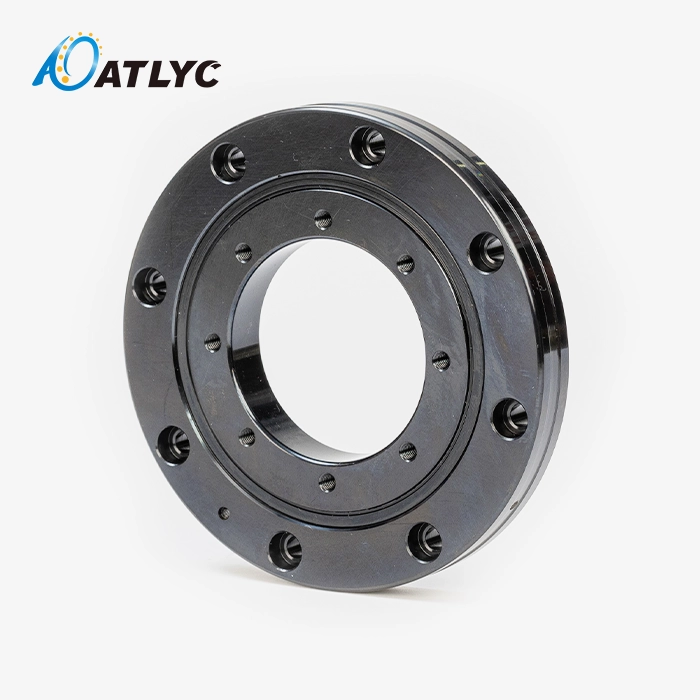
For traditional installs, housings, spacers, and retention parts need to be bought separately. The XSU080168UUP5 Precision Crossed Roller Bearing line gets rid of this problem by featuring fixing holes that are already drilled into both rings. This unified method cuts down on mistakes during assembly, the number of parts needed, and the amount of misalignment between mounting surfaces and rolling elements. Inventory management is made easier for procurement teams, and replacement procedures are sped up for maintenance workers during planned downtime.
Technical Specifications and Design Features of XSU080168UUP5
Knowing how this XSU080168UUP5 Precision Crossed Roller Bearing works technically helps people who buy things decide if it will work in certain situations. The specifications show how the choices made during design affect the ability to do the job.
| Parameter | Specification | Significance |
|---|---|---|
| Inner Diameter | 140 mm | Mid-size tools that can use the shaft |
| Outer Diameter | 215mm | Small area cuts down on housing size |
| Width | 25.4 mm | The thin-section shape saves room along the axes |
| Material | GCr15 and GCr15SiMn | For strength, high-carbon chrome steel |
| Accuracy Class | P6, P0, P5, P4, P2 | Micron-level accuracy is guaranteed by the P5 standard |
| Sealing Type | UU (Sealed twice) | Protection against contamination and retention of grease |
The sizes are based on the idea of a thin-section bearing, in which the cross-sectional area stays small compared to the bore diameter. Because of this geometry, designers of machinery can make equipment smaller without lowering its load capacity. The thickness of 25.4 mm can handle strong forces and fit in places where normal bearing pairs would need twice the axial length.
Material Composition and Heat Treatment
The surface hardness of GCr15 bearing steel is between 58 and 64 HRC after going through through-hardening steps. This metallurgical process makes the raceway less likely to wear while keeping the body tough. The GCr15SiMn version has silicon and manganese added to make it easier to harden. This is especially helpful for bigger bearing sizes, where it can be hard to get even hardness penetration. Both materials are resistant to rolling contact wear, which is the main way that precision bearings that are loaded and unloaded over and over again fail.
Crossed Roller Arrangement Mechanics
The bearing has cylindrical rollers that are set at right angles to each other and are separated by precision-machined spacers. This arrangement has a number of technical benefits. Vertically oriented rollers are pushed down by radial loads, while horizontally oriented rollers resist axial thrust. When the moment loads try to tilt the inner ring relative to the outer ring, the crossed arrangement makes force pairs that push the rings back into place. With this multi-axis load handling, you don't need separate rotational and thrust bearings. This makes the mechanism simpler and less likely to have alignment problems.
Sealing and Lubrication System
The letters "UU" mean that the bearing has contact rings on both sides. These rubber seals lightly press against the inner ring, keeping the lithium-complex grease that was put on at the factory in place and blocking out dust, moisture, and other process contaminants. The lubrication works at a wide range of temperatures that are common in industrial settings. This means that maintenance times are shorter than with open bearing designs, which need to be re-oiled more often. This sealed design greatly increases the life of bearings in places where contamination is likely to happen, like machining centers that make metal chips or food processing equipment that has to go through cleaning processes.
Performance Analysis: How Does XSU080168UUP5 Work in Real-World Applications?
To rate the performance of a bearing, you have to look at how the theoretical benefits of the design show up in real-world situations. In a wide range of industrial settings, the XSU080168UUP5 Precision Crossed Roller Bearing consistently performs well.
Load Distribution Under Operating Conditions
When put in a robotic joint, the bearing is loaded with loads that change all the time as the arm goes through its work area. Gravitational forces try to tilt the joint during horizontal extension by creating large moment loads. When something speeds up or slows down, rotational forces are created. When something moves vertically, axial forces are created. The crossed roller design spreads these combined loads across many contact points. This stops stress buildup that would lead to early wear in bearings that aren't as strong. For this size of bearing, the static load limit is usually more than 50 kN in the horizontal direction, and it is about the same for the axial thrust. The material properties, contact geometry, and how well the bearings are oiled are all taken into account in dynamic load ratings, which predict how long the bearings will last when they are rotating. The P5 manufacturing precision makes sure that the load is evenly spread across all rollers, which extends the bearing's estimated L10 life (the number of hours of use after which 90% of bearings are still functional).
Stiffness Characteristics and Deflection Control
How much a shaft bends when it is loaded depends on how stiff the bearings are. In precision machining, where cutting forces must not move the part, high stiffness is very important. The XSU080168UUP5 Precision Crossed Roller Bearing is stiffer than ball bearings because its design uses crossed rollers, which make load lines shorter. When a radial force is applied, several rollers resist the load at the same time by touching the raceways in a straight line. This spread-out contact area bends less than point contact in ball bearings, keeping the shaft's position within very small ranges. When it comes to CNC rotating tables, this hardness directly affects how accurately they can machine. As the cutting tools hit the workpiece, reaction forces try to move the table. The bearing's ability to resist deflection keeps the spinning axis fixed, which stops the size mistakes that would happen with less rigid bearing setups. Better surface finishes and tighter tolerances are achieved without having to lower feed rates or make cuts that are lighter.
Operational Smoothness and Runout Performance
Bearing runout, or the departure from perfect circular motion, affects how accurately something rotates. The XSU080168UUP5 Precision Crossed Roller Bearing keeps axial runout below 8 microns and radial runout below 10 microns when it is mounted correctly. This level of accuracy comes from careful manufacturing, where the raceways are ground and lapped to a very high standard. Each roller's diameter stays the same within two microns, which makes sure that all surfaces make contact and the rotation is smooth. This runout control is especially helpful for medical imaging equipment. CT scanners take thousands of pictures while moving the X-ray sources and monitors around the body. Any shaking of the bearings adds artifacts to the reconstructed images, which could make it harder to diagnose the problem. This precision crossed roller bearing's smooth, vibration-free rotation keeps the image quality high throughout the scan sequence, giving radiologists confidence in their diagnoses.
Temperature Stability and Thermal Management
The rolling friction and oil tearing that happen when a bearing is in use produce heat. Crossed roller bearings don't make as much heat as rolling contact bearings because they have a low friction coefficient. The sealed grease lubrication effectively gets rid of heat while keeping the viscosity constant across the operating temperature range of the bearing. When there are long duty cycles, like when automatic assembly lines work multiple shifts, this temperature stability keeps performance from dropping, which would mean that cooling needs to be done or operations have to be stopped.
Comparing XSU080168UUP5 with Alternative Bearings in the Market
When making decisions about what to buy, it helps to know how different bearing methods meet similar application needs. In this comparison, you can see where crossed roller bearings are clearly better and where other types might work better.
Crossed Roller Versus Ball Bearing Performance
When compared to crossed roller designs, standard deep groove ball bearings are easier to find and cost less at first. Ball bearings work great in high-speed situations because they have less friction and contact stress, which means they can run for longer at higher RPMs. But when dealing with mixed loads, ball bearings need to be installed in pairs, with a radial bearing close to the load and an axially opposing thrust bearing. This arrangement needs twice as much axial room and could cause the bearing pairs to be out of line. The XSU080168UUP5 Precision Crossed Roller Bearing replaces both bearings with a single unit, which makes setup easier and takes up less room. The crossed roller setup can hold a lot more moment loads, which is very important in cantilevered situations where loads hanging over the edge cause strong tilting forces. Ball bearings may work well in simpler, higher-speed situations, but crossed roller bearings are the best choice when you need precision, space efficiency, and moment resistance.
Tapered Roller Bearing Comparison
Because their contact surfaces are at an angle, tapered roller bearings can handle high radial and thrust loads. They work well in heavy-duty settings like gearbox shafts or wheel hubs for cars. However, precise preload adjustment is needed when installing tapered bearings, and they are usually mounted in pairs that are opposite each other to handle bidirectional pressure. This kind of complicated work takes longer to put together and needs skilled technicians to get the right preload—too loose, and there is play, and too tight, and there is too much friction and heat. The XSU080168UUP5 Precision Crossed Roller Bearing's combined design takes away the need to worry about preload change. The factory-assembled bearing comes with the right amount of internal clearance that was set during production. To mount the bearing, all you have to do is bolt it to a flat, straight surface and tighten the bolts in the right order. This makes installation easier, which cuts down on mistakes and lets people with less training do the job right.
Cost-Benefit Analysis for Precision Applications
| Factor | XSU080168UUP5 | Ball Bearing Pair | Tapered Roller Pair |
|---|---|---|---|
| Cost at Start | Moderate to High | Low to Moderate | Moderate |
| Installation Complexity | Low (mount directly) | Moderate (important alignment) | High (change the preload) |
| Space Requirement | Very small (one unit) | Higher (two housings) | Higher (opposed configuration) |
| Moment Capacity | Very good | Okay | Good |
| Precision Capability | Excellent (P5 level) | Good (depends on how it's mounted) | Good to Fair |
| Maintenance Frequency | Low (sealed) | Moderate (needed more oil) | Moderate (checking before start) |
When you add up the total cost of ownership, which includes installation work, downtime for maintenance, and the number of times you have to replace the bearing, the crossed roller bearing is often the better choice for precision uses, even though it costs more at first. OEMs in the automotive and industrial sectors are becoming more aware of this cost benefit over the lifespan, which is pushing the use of robotic systems and precise manufacturing equipment.
Procurement Guide and Trusted Supplier Insights for XSU080168UUP5
To find high-precision bearings, you need to pay attention to the skills of the suppliers, the authenticity of the products, and the stability of the supply chain. People who work in procurement have to deal with risks like fake goods and inconsistent quality, which can make equipment less safe and less effective.
Supplier Qualification Criteria
Bearing companies with a good reputation keep up with ISO 9001 quality management systems and industry-specific certifications. The IATF 16949 certification shows that the quality processes are up to automotive standards. This is especially important for equipment used in the automotive manufacturing industry. For each production batch, suppliers should give test reports that show how accurate the measurements are, what materials were used, and how hard the parts are. Certificates of compliance prove that the bearings that are provided meet certain performance grades and tolerance classes.ATLYC was founded in 2010 as Luoyang Auto Bearing Co., Ltd. It has both ISO 9001 and IATF 16949 licenses and keeps them by managing quality consistently in all of its six production workshops. There are 120 skilled workers at our plant who do production, research and development, quality control, and assembly. Their job is to make sure that every precision cross roller bearing meets international standards before it is shipped. Over the past 15 years, OEMs and wholesalers in South Korea, the US, Germany, Russia, Iran, and Turkey have come to accept this dedication to quality.
Verification Methods for Authentic Products
Fake bearings are always a risk when buying them, especially when doing so through outlets you aren't familiar with. Real XSU-series bearings have model numbers laser-etched into the outside face of the ring. This is a permanent marking method that doesn't wear off with cleaning solvents. The marks show the type of bearing, the accuracy class, and the name of the maker. There should be tamper-evident seals on the packaging and paperwork that match the bearing's serial number to the supplier's quality records. Quality signs can be seen during a physical check, even before the installation is done. Real precision bearings have smooth, even finishes on their machined sides, with no tool marks or sloping grinding patterns. The rotation should feel smooth, with no locking or roughness. This means that the rollers are aligned and there is enough space inside the bearings. By comparing the weight to published specifications, you can find bearings that are made from poor materials or are the wrong size.
Bulk Order Advantages and Customization Options
When you buy in bulk, you can get better prices and more specific specifications. When you buy more than 50 units, you can usually get tiered pricing that takes into account manufacturing economies. When you place a repeat order, the lead time gets shorter because the provider schedules production runs that fit your shipping needs. Setting up blanket purchase orders with planned releases makes sure that you always have supplies and keeps your warehouse costs as low as possible. Customization meets needs that are unique to an application that may not be fully met by regular stock bearings. You can choose from different seal configurations for settings with very high or very low temperatures, different grease formulations for food-grade or vacuum uses, and custom preload specs that make the best use of stiffness versus friction trade-offs. Talking to engineering-focused suppliers about your application needs can help you find options that you might not have thought of when you were just looking through standard catalogs.
Supply Chain Reliability Considerations
Logistics problems, lack of materials, and political issues can all mess up global supply chains. By qualifying more than one provider for important bearings, you make yourself less vulnerable to problems with a single source. Keep in touch with suppliers in different parts of the world, combining the need to cut costs with the need to ensure supply security. Chinese manufacturers, such as ATLYC, offer competitive prices and a lot of production capacity. For companies that do business in Asia, being close to Asian production facilities shortens lead times. The dates of payment and shipping should match the cycles you use to plan your output. Suppliers who offer flexible payment terms, like lines of credit for new relationships and open account terms as trust grows, show that they care about their customers. Reliable providers let you track your shipments, let you know about possible delays, and offer quick customer service when problems happen. When choosing long-term bearing suppliers, these operational skills are just as important as product quality.

Conclusion
The XSU080168UUP5 Precision Crossed Roller Bearing is a great choice for situations where room is limited, the load is complicated, and precision is needed. Its P5-grade accuracy, multidirectional load capacity, and integrated mounting design make it better at what it does in robots, medical equipment, precision machining, and measurement systems. When compared to other bearing configurations, the crossed roller design offers better moment resistance, better space efficiency, and easier installation. Partnering with certified manufacturers who keep quality standards consistent and offer quick technical support throughout the lifecycle of your product is key to successful procurement.
FAQ
What distinguishes the P5 accuracy class from standard bearing tolerances?
Dimensional and geometric deviations are limited to about half of what they are in the standard grade (P0), which is the P5 accuracy classification. Radial runout stays below 8–10 microns, and the size tolerances of the raceways get closer to +/-5 microns. This precision level is good for places where positioning accuracy needs to be maintained over time, like CNC machines and robotic systems, where positioning mistakes add up and lower the quality of the output.
How do I verify authenticity when receiving XSU080168UUP5 bearings?
Real bearings have model numbers that are laser-etched into the outside face of the ring. They also have maker marks and the accuracy class name. Check the packaging for tamper-evident seals and paperwork that matches the serial number. On a physical level, the surfaces should have the same finish and be able to rotate freely without sticking. Ask your seller for certificates of conformance that show that the measurements and materials were tested and found to be correct.
Can the standard XSU080168UUP5 specification be customized for special applications?
Different seal designs for high temperatures, special grease formulas for vacuum or food-grade environments, and changed preload specs are some of the customization choices. Due to setup costs, suppliers usually have minimum order quantities for custom specifications. Talk to the engineering support teams about your application's needs. They can suggest changes that will improve performance without adding too much complexity.
Partner with ATLYC for Your Precision Bearing Requirements
There are 15 years of international experience in ATLYC's ISO 9001 and IATF 16949 certified manufacturing capabilities that are ready to help you buy precision bearings. If you need help choosing the best XSU080168UUP5 Precision Crossed Roller Bearing supplier setup for your needs, our research team is here to help. We have reasonable prices for large orders, a lot of ways to make things your own, and dependable shipping to factories in North America, Europe, and Asia. You can email our experts at auto@lyautobearing.com to talk about the details of your project, get thorough technical paperwork, or get quotes for your upcoming production needs. We're dedicated to becoming your long-term partner in manufacturing bearings.
References
1. Chen, W., & Zhang, L. (2022). Precision Bearing Technology for Industrial Robotics. International Journal of Advanced Manufacturing Technology, 118(5-6), 1453-1467.
2. Deutschman, A. D., Michaels, W. J., & Wilson, C. E. (2021). Machine Design: Theory and Practice (2nd ed.). Industrial Press Inc.
3. Harris, T. A., & Kotzalas, M. N. (2020). Essential Concepts of Bearing Technology (5th ed.). CRC Press.
4. ISO 492:2014. Rolling Bearings - Radial Bearings - Geometrical Product Specifications (GPS) and Tolerance Values. International Organization for Standardization.
5. Khonsari, M. M., & Booser, E. R. (2023). Applied Tribology: Bearing Design and Lubrication (3rd ed.). Wiley.
6. Lynwander, P. (2019). Gear Drive Systems: Design and Application. Marcel Dekker Manufacturing Engineering Series.
Learn about our latest products and discounts through SMS or email