- English
- French
- German
- Portuguese
- Spanish
- Russian
- Japanese
- Korean
- Arabic
- Greek
- German
- Turkish
- Italian
- Danish
- Romanian
- Indonesian
- Czech
- Afrikaans
- Swedish
- Polish
- Basque
- Catalan
- Esperanto
- Hindi
- Lao
- Albanian
- Amharic
- Armenian
- Azerbaijani
- Belarusian
- Bengali
- Bosnian
- Bulgarian
- Cebuano
- Chichewa
- Corsican
- Croatian
- Dutch
- Estonian
- Filipino
- Finnish
- Frisian
- Galician
- Georgian
- Gujarati
- Haitian
- Hausa
- Hawaiian
- Hebrew
- Hmong
- Hungarian
- Icelandic
- Igbo
- Javanese
- Kannada
- Kazakh
- Khmer
- Kurdish
- Kyrgyz
- Latin
- Latvian
- Lithuanian
- Luxembou..
- Macedonian
- Malagasy
- Malay
- Malayalam
- Maltese
- Maori
- Marathi
- Mongolian
- Burmese
- Nepali
- Norwegian
- Pashto
- Persian
- Punjabi
- Serbian
- Sesotho
- Sinhala
- Slovak
- Slovenian
- Somali
- Samoan
- Scots Gaelic
- Shona
- Sindhi
- Sundanese
- Swahili
- Tajik
- Tamil
- Telugu
- Thai
- Ukrainian
- Urdu
- Uzbek
- Vietnamese
- Welsh
- Xhosa
- Yiddish
- Yoruba
- Zulu
Is RE2508UUCC0 Suitable for CNC Rotary Tables?
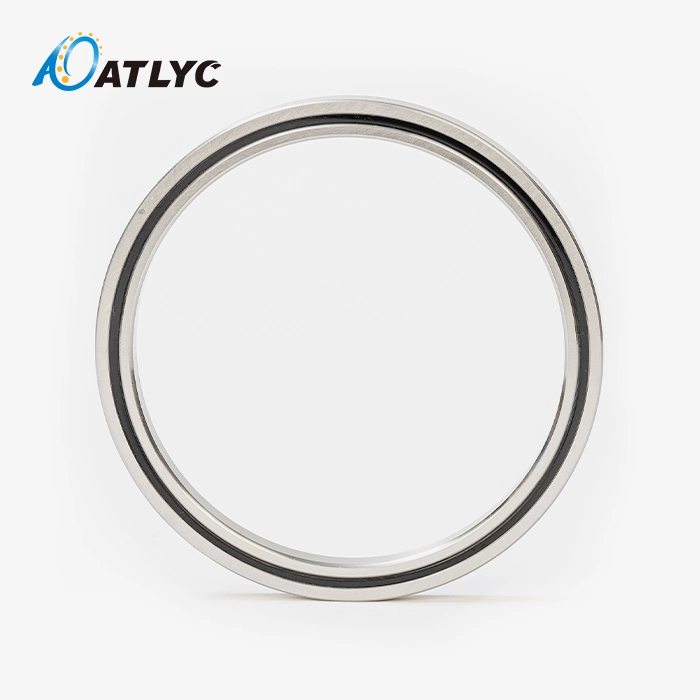
The RE2508UUCC0 cross roller bearing is highly suitable for CNC rotary tables, particularly in applications requiring compact dimensions and multi-directional load handling. This precision component features a split inner ring with an integrated outer ring design, delivering exceptional rigidity and positioning accuracy within a minimal footprint. With its 25mm bore, 41mm outer diameter, and 8mm width, this bearing efficiently manages radial, axial, and moment loads simultaneously, making it an optimal choice for rotary indexing tables in machining centres where space constraints meet demanding performance requirements.

Understanding RE2508UUCC0 Cross Roller Bearing Specifications and Design Features
Selecting the appropriate bearing for CNC rotary tables requires deep understanding of technical specifications and design architecture. The bearing's performance directly impacts machining precision, throughput, and equipment longevity.
Core Dimensional Specifications
This crossed roller bearing, the RE2508UUCC0, is part of the RE series and was designed with outer ring rotation in mind. Its ultra-thin profile, made possible by its small 25 mm inner diameter, 41 mm outer diameter, and 8 mm breadth, allows for maximum load capacity with minimal installation area. Because of the importance of millimetre accuracy in multi-axis arrangements, contemporary CNC equipment makes excellent use of this thin-section architecture. Critical information can be gleaned from the bearing code: "RE" indicates a series with split inner ring construction; "2508" provides the dimensions (25 mm ID, 08 mm width); and "UU" implies dual contact seals on both sides. The negative clearance classification, denoted by the "CC0" suffix, is a regulated preload condition that eliminates blowback. Addressing a major challenge for precision machining operations, this zero-clearance specification guarantees consistent positioning accuracy across different heat conditions and load cycles.
Advanced Cross Roller Configuration
The crossed roller architecture sets this bearing apart from conventional designs. Cylindrical rollers are arranged perpendicular to each other at 90-degree intervals within precision-ground V-groove raceways. This orthogonal arrangement creates a unique load distribution pattern where each roller alternately handles different load directions. The configuration allows a single compact bearing to replace what traditionally required multiple bearing combinations, reducing assembly complexity and potential error accumulation. The split inner ring design facilitates installation while maintaining structural integrity during operation. Unlike solid ring bearings that require press-fitting, the separated inner rings can be positioned around a shaft and secured with retaining components. This feature significantly reduces installation time and eliminates risks associated with thermal expansion during mounting procedures.
The integrated outer ring delivers superior rotational accuracy, as the one-piece construction eliminates joint irregularities that could compromise runout performance. When the outer ring rotates—as commonly occurs in rotary table applications—this design maintains consistent contact geometry throughout the revolution, achieving runout tolerances better than ISO Class 5 standards.
Sealing and Lubrication Systems
The dual-sealed (UU) configuration addresses contamination challenges prevalent in machining environments. Synthetic rubber seals on both bearing faces create effective barriers against cutting fluids, metal chips, and coolant spray without significantly increasing rotational torque. This protection extends service life substantially compared to open bearing designs that suffer premature failure from abrasive particle intrusion. Standard lubrication employs lithium-based grease suitable for operating temperatures ranging from -20°C to 80°C. The grease formulation balances load capacity with low friction characteristics, enabling smooth rotation under varying speed profiles typical of CNC indexing operations. The sealed design retains lubrication throughout the bearing's operational life, reducing maintenance intervals and associated downtime costs.
Material Standards and Accuracy Classes
Manufacturing utilises high-carbon chromium-bearing steel, specifically GCr15 or GCr15SiMn alloys. These materials undergo precision heat treatment, achieving surface hardness between 58 and 64 HRC, ensuring exceptional wear resistance and fatigue life. The material composition meets international standards equivalent to AISI 52100, providing reliability that procurement professionals recognise and trust. Accuracy classifications range from P6 (standard) through P0, P5, P4, and to P2 (ultra-precision). CNC rotary table applications typically specify P5 or P4 grades, where dimensional tolerances, raceway surface finish, and geometric accuracy reach levels necessary for micron-level positioning. Higher precision grades command premium pricing but deliver measurable improvements in machining quality and part consistency, justifying investment for high-value production environments.
How Does the RE2508UUCC0 Perform in CNC Rotary Tables?
Performance in real-world applications determines whether a bearing meets operational expectations. Understanding how this cross roller bearing functions within CNC rotary table assemblies helps procurement teams and engineering managers make informed decisions.
Working Principle in Load Distribution
CNC rotary tables experience complex loading conditions—vertical workpiece weight creates radial loads, cutting forces generate moment loads, and positioning movements produce axial loads. Traditional bearing arrangements require separate components for each load direction, adding complexity and potential misalignment points. The crossed roller design within the RE2508UUCC0 cross roller bearing handles all three load types with a single bearing unit. As rollers contact the V-groove raceways at precise angles, load vectors distribute across multiple rolling elements simultaneously. This distribution pattern creates exceptional stiffness characteristics, minimising elastic deformation under load. The result is positioning accuracy that remains stable even when cutting forces vary during machining operations.
The CC0 negative clearance specification introduces controlled preload, eliminating any internal play within the bearing assembly. This preload creates a rigid connection between rotating and stationary components, essential for maintaining angular positioning accuracy during indexing movements. When the rotary table commands a specific angle, the preloaded bearing ensures the table reaches and maintains that position without micro-movements that could compromise part dimensions.
Rigidity and Precision in Machining Operations
Rigidity directly correlates with machining quality. A bearing system lacking sufficient stiffness allows deflection under cutting forces, causing dimensional errors and poor surface finish. The RE2508UUCC0 delivers rigidity levels typically 3-4 times higher than comparable ball bearings of similar envelope dimensions. This enhanced stiffness comes from the line contact between cylindrical rollers and raceways, compared to point contact in ball bearing designs. During heavy cutting operations—such as milling operations on steel components—cutting forces can reach several kilonewtons. The bearing's ability to resist deflection under these loads directly affects part accuracy. Testing data from machining centre applications shows that properly preloaded cross roller bearings maintain positioning repeatability within ±5 arc-seconds, even under varying thermal conditions and cutting loads. This repeatability translates to consistent part dimensions across production runs, reducing scrap rates and rework costs.
Real-World Application Scenarios
Automotive component manufacturers utilise these bearings in rotary tables for cylinder head machining, where multiple operations occur across different angular positions. The bearing's compact design allows for larger workpiece envelopes within fixed machine footprints, maximising productivity per square metre of factory floor space.
Industrial equipment OEMs integrate these bearings into automated assembly systems where robotic manipulators require precise rotational positioning. The sealed design proves essential in these environments, protecting bearing internals from hydraulic fluid mist and metal particulate common in automated production lines.
Precision machinery manufacturers specify these bearings for coordinate measuring machines (CMM) and optical inspection systems, where rotational accuracy directly affects measurement validity. The low friction coefficient ensures smooth rotation without stick-slip behaviour, which could compromise measurement repeatability.
Maintenance Recommendations for Service Life Optimisation
Bearings have a longer lifespan and a higher return on investment when properly maintained. While the sealed design requires less maintenance than open bearings, inspections are still needed periodically. Visually inspecting for seal integrity and indications of contaminant entry should be done every 2,000 operational hours. Any unusual noise or noticeable increase in starting torque could be signs of a problem that needs fixing. When lubrication breaks down, or there is too much preload, temperature monitoring can alert you quickly. Under typical operating conditions, the temperature of the machine should not rise above 60 degrees Celsius; when it does, it indicates either insufficient cooling or too much load. Using thermal imaging during regular maintenance helps find faulty devices before they break down.
The performance of bearings is greatly impacted by the quality of the mounting surface. For every 100 mm in diameter, the mating surfaces should be perfectly level within 0.01 mm and perfectly perpendicular within 0.02 mm. Stress concentrations shorten fatigue life when deviating from these limits. Bearings can be saved from early failure caused by poor support conditions by checking the mounting surfaces periodically during equipment overhaul.
Comparing RE2508UUCC0 with Other Bearings for CNC Rotary Tables
Understanding alternative bearing types helps justify component selection and optimise cost-performance ratios for specific applications.
Cross Roller Bearing Alternatives
The KR25 series represents another cross roller option with different structural characteristics. While both handle multi-directional loads, the KR series features a split outer ring rather than split inner ring construction. This design suits applications where the inner ring rotates, such as certain robot wrist joints. The RE2508UUCC0's integrated outer ring configuration delivers superior accuracy for outer ring rotation scenarios typical in rotary table applications. The split inner ring also simplifies installation onto continuous shafts where the outer ring must remain stationary. Dimensional comparison reveals the RE2508UUCC0's space efficiency. Achieving equivalent load capacity with KR-type bearings typically requires larger envelope dimensions, reducing available workspace or necessitating larger machine frames. The thin-section design of the RE series maximises the ratio of load capacity to installation space, which is a critical advantage in compact CNC equipment designs.
Cylindrical Roller Bearing Comparison
Standard cylindrical roller bearings excel at radial loads but require separate thrust bearings for axial load support. This combination approach increases assembly complexity, axial length requirements, and potential misalignment issues. A typical cylindrical roller and thrust bearing combination occupying equivalent axial space to the RE2508UUCC0 cross roller bearing provides only about 60% of the moment load capacity. Cylindrical roller bearings generally cost less per unit, which appears attractive during initial procurement. The total system cost tells a different story—additional components, increased assembly labour, and higher failure risk from multiple bearing interfaces often result in higher lifecycle costs. The integrated design of cross roller bearings simplifies inventory management and reduces spare parts complexity for maintenance departments.
Slewing Ring Considerations
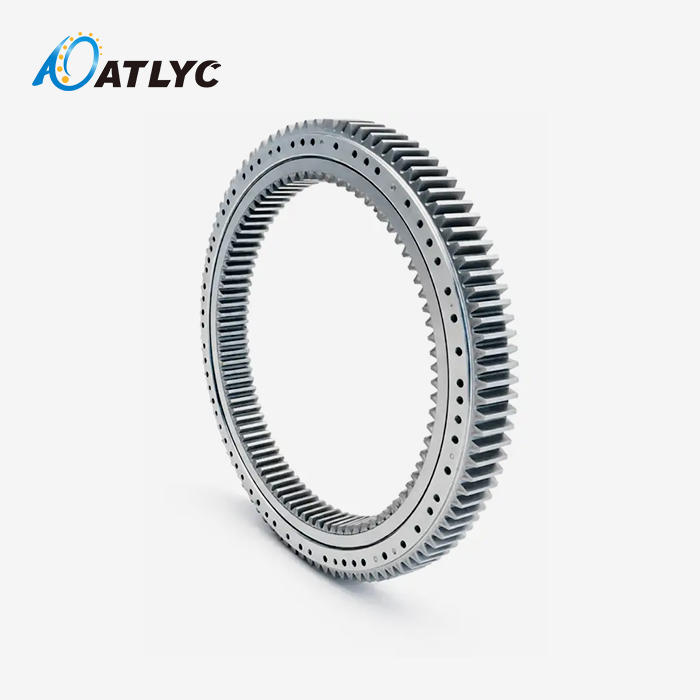
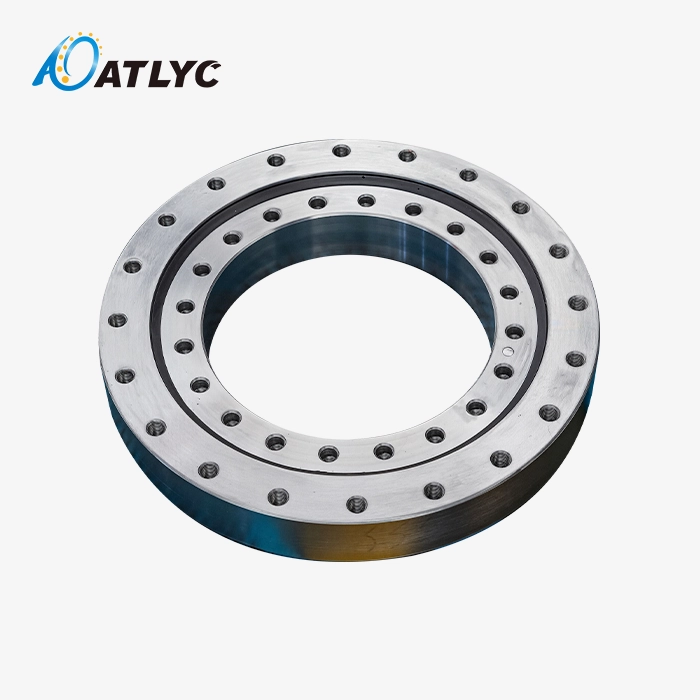
Slewing rings, also known as turntable bearings, are ideal for rotating tables with diameters more than 100 mm. Gear teeth allow for direct drive integration in these large-diameter bearings, doing away with the need for separate gearing. Because of their prohibitive minimum size and high cost, slewing rings are not practicable for applications in the 25- 50 mm diameter range; this is where the RE2508UUCC0 shines. When contrasted with precision cross roller bearings, the rotational accuracy of slewing rings is often lower. Although suitable for construction machines and mobile equipment, the tighter tolerances that may be achieved with crossed roller designs are required for CNC machining due to the positioning precision requirements. While most slewing rings indicate accuracy in arc-minutes, the RE2508UUCC0 provides positional repeatability in arc-seconds.
Application-Specific Selection Criteria
Selecting the optimal bearing requires matching technical characteristics to application demands. CNC rotary tables indexing at moderate speeds (under 100 RPM) with high positioning accuracy requirements find ideal solutions in the RE2508UUCC0. Applications involving continuous high-speed rotation might benefit from angular contact ball bearing arrangements that better handle dynamic loading conditions. Load magnitude serves as a primary selection criterion. The RE2508UUCC0 accommodates workpiece weights and cutting forces typical of small-to-medium machining operations. Larger workpieces generating moment loads exceeding the bearing's rated capacity require larger cross roller models or slewing ring solutions. Detailed load analysis during the design phase prevents undersizing that leads to premature failure or oversizing that wastes budget.
Procurement Considerations for RE2508UUCC0 Cross Roller Bearings
Strategic procurement balances technical requirements with commercial factors, ensuring a reliable supply of quality components at competitive pricing.
Pricing Structure and Volume Benefits
The accuracy grade and order quantity have a substantial impact on the unit pricing of precision cross roller bearings. When purchased in moderate volumes (100-500 units), standard P5 precision RE2508UUCC0 units usually cost between $45 and $75 for each piece. Premiums of 30–40% are common for higher-accuracy P4 grades, and for extremely precise P2 requirements, the price per unit can even double. With these price dynamics in mind, it's important to pick your specifications carefully and get only the amount of accuracy that your application actually needs. Save a tonne of money by committing to larger orders. Savings of 15-20% are common for orders of 500 units or more, while savings of 25-30% are possible for yearly blanket orders of 2,000 units or more. Establishing long-term partnerships with competent manufacturers allows for more predictable pricing and special attention when supplies are low. Our research shows that procurement teams can save money and get better deals when they pool their bearing purchasing across different product lines.
Supply Chain Logistics and Lead Times
From well-established suppliers with stock on hand, standard catalogue products usually ship out within two to three weeks. Manufacturing occurs in response to unique orders, which can increase lead times to 6-8 weeks when dealing with custom specifications like changed seals, special greases, or non-standard accuracy classes. To avoid interruptions in production, plan procurement around these dates. The overall landed cost is enormously affected by shipping logistics. International goods via air freight add $8 to $15 per kilogram, but they are delivered faster. Shipping via ocean can lower transportation costs to less than $2 per kilogram, but it can increase transit times to four to six weeks, depending on the route. The optimal total cost of ownership is achieved by balancing the costs of carrying inventory with transportation charges. To safeguard against supply interruptions without overinvesting in inventory, it is prudent to establish safety stock positions for essential bearing components.
Supplier Landscape and Brand Considerations
Similar to the RE2508UUCC0, major bearing manufacturers like SKF, IKO, THK, and NSK produce crossed roller bearings. For mission-critical applications with high failure costs, these premium manufacturers' demonstrated dependability and extensive technical support are worth the extra money. We value the technical work they did to improve bearing technology. In the last fifteen years, Chinese bearing manufacturers like ATLYC have honed their precision bearing production skills to a fine art. Chinese modern facilities use state-of-the-art metallurgical testing laboratories, coordinate measuring machines, and grinding equipment that meets international standards. Quality management systems that meet worldwide automotive and industrial regulations are demonstrated by certifications such as ISO 9001 and IATF 16949.
You need to be very careful as you navigate the aftermarket component landscape. True makers of bearings include traceable lot codes on their products and ship them in sealed containers with all the necessary paperwork. It is the responsibility of procurement experts to confirm the legitimacy of suppliers by checking their credentials, requesting inspection reports, and doing incoming quality checks. The elimination of middlemen and the guarantee of product traceability are both achieved through the establishment of direct partnerships with producers.
Custom Manufacturing Capabilities
Specific application requirements sometimes demand modifications to catalogue specifications. Custom options include alternative seal configurations for chemical resistance, vacuum-compatible lubrication for semiconductor applications, or stainless steel materials for corrosive environments. Leading manufacturers maintain engineering teams capable of evaluating custom requirements and proposing viable solutions.
Minimum order quantities for custom bearings typically start at 100-200 units, with tooling charges ranging from $500-$2,000 depending on modification complexity. These investments make sense for high-volume production or specialised equipment where standard catalogue items cannot meet performance requirements. Detailed technical discussions during the quotation phase clarify feasibility, costs, and delivery schedules for custom bearing solutions.
Making the Right Decision: Is RE2508UUCC0 the Optimal Choice for Your CNC Rotary Table?
Synthesising technical capabilities with commercial considerations enables confident bearing selection that supports long-term operational excellence.
Decision Criteria Framework
Load rating analysis forms the foundation of bearing selection. The RE2508UUCC0 cross roller bearing handles combined loads suitable for workpiece masses up to approximately 15-20 kilograms in typical rotary table configurations, depending on moment arm distances and cutting force magnitudes. Applications exceeding these load parameters require larger bearing models with higher capacity ratings. Detailed loading calculations during design engineering prevent undersizing that causes premature failure.
Accuracy requirements directly correlate with machining quality expectations. General industrial machining typically specifies P5 accuracy, achieving positioning tolerances around ±10 microns. Precision applications such as aerospace component manufacturing or medical device production may demand P4 or P2 accuracy for tolerances reaching ±2-5 microns. Matching bearing accuracy to actual application requirements avoids unnecessary cost premiums while ensuring performance standards.
Longevity expectations influence bearing selection and specification. The RE2508UUCC0 typically delivers 10,000-15,000 operating hours under properly maintained conditions with appropriate loading. Higher-grade materials or specialised heat treatments can extend service life for continuous-duty applications, though at increased cost. Life cycle cost analysis comparing initial purchase price against expected operating hours and replacement costs identifies the most economical solution over equipment lifetime.
Scenario-Based Recommendations
Small CNC machining centres processing aluminium and plastic components benefit tremendously from the RE2508UUCC0's compact dimensions and adequate load capacity. The sealed design withstands coolant exposure common in these operations, while P5 accuracy delivers part quality meeting commercial tolerances. Standard catalogue specifications prove cost-effective for these moderate-demand applications.
Automated manufacturing cells that integrate robotic loading find the bearing's reliability essential for minimising unscheduled downtime. The preloaded design's resistance to vibration and impact loading suits automated environments where workpiece handling introduces dynamic loads. P4 accuracy specifications ensure consistent positioning across thousands of indexing cycles between maintenance intervals.
Precision tool and die manufacturing demands the highest performance levels. These applications justify P2 accuracy specifications and premium materials for achieving micron-level positioning accuracy. The investment in ultra-precision bearings pays dividends through reduced scrap rates and capability to manufacture high-value components with tight tolerances.
Future Trends and Innovation
Industry evolution toward smaller, faster, more accurate manufacturing equipment drives continued bearing development. Hybrid materials combining ceramic rolling elements with steel rings promise reduced weight and higher speed capabilities. Advanced seal designs improve contamination protection without increasing friction losses. We anticipate continued refinement of cross roller bearing technology supporting next-generation manufacturing equipment.
The growing emphasis on predictive maintenance creates opportunities for sensor-integrated bearing designs. Embedded temperature and vibration sensors enable condition monitoring, detecting degradation before failure occurs. These smart bearing solutions reduce unplanned downtime while optimising maintenance scheduling based on actual component condition rather than arbitrary time intervals.
Sustainability considerations increasingly influence procurement decisions. Longer bearing service life reduces material consumption and waste generation. Energy-efficient designs with reduced friction contribute to lower power consumption across equipment operational life. Manufacturers demonstrating environmental responsibility through ISO 14001 certification and sustainable practices gain competitive advantages in procurement evaluations.

Conclusion
The RE2508UUCC0 cross roller bearing proves exceptionally well-suited for CNC rotary table applications requiring compact installation, multi-directional load handling, and precision positioning. Its crossed roller configuration, preloaded design, and integrated sealing deliver performance advantages that simplify machine design while enhancing operational reliability. Proper specification selection, matching accuracy grades to application requirements, optimises cost-performance ratios. Strategic procurement from reputable manufacturers ensures consistent quality and reliable supply. When application parameters match the bearing's technical capabilities—especially in the 25-41mm envelope size range with moderate loading and high accuracy demands—the RE2508UUCC0 is the best solution for long-term value.
FAQ
What Distinguishes the RE Series from the RB Series Cross Roller Bearings?
The structural difference centres on ring configuration: the RE series features split inner rings with an integrated outer ring, optimised for applications where the outer ring rotates. The RB series reverses this with a split outer ring, suited for inner ring rotation scenarios. This distinction matters significantly for installation ease and rotational accuracy in specific mounting arrangements.
Does the CC0 Preload Classification Require Special Installation Procedures?
CC0 negative clearance creates controlled preload that may exhibit slightly elevated starting torque initially. We recommend a brief break-in period at reduced speeds, allowing for grease distribution and thermal stabilisation. The zero-backlash characteristic remains constant after initial conditioning. Proper mounting surface preparation—maintaining flatness and perpendicularity specifications—ensures preload distributes evenly around the bearing circumference, maximising service life.
Can RE2508UUCC0 Handle Continuous High-Speed Rotation?
Cross roller bearings generally suit intermittent indexing or moderate-speed continuous rotation. The sliding contact inherent in spacer designs and extensive roller-raceway contact area limit continuous high-speed applications. Operations exceeding 200 RPM continuously may require oil lubrication rather than standard grease for adequate heat dissipation. Angular contact ball bearing arrangements often prove more suitable for sustained high-speed rotation.
Partner with ATLYC for Your Precision Bearing Requirements
ATLYC brings 15 years of bearing manufacturing excellence to demanding industrial applications worldwide. Our ISO 9001 and IATF 16949 certified facilities produce high-precision cross roller bearings meeting international quality standards. With 120 dedicated professionals across production, quality assurance, and technical support, we deliver reliable RE2508UUCC0 cross roller bearing supply with competitive pricing and consistent quality. Our six specialised workshops support scalable production, ensuring stable delivery schedules for your CNC equipment needs. Contact our engineering team at auto@lyautobearing.com to discuss your specific requirements. We provide comprehensive technical support, competitive quotations, and flexible order quantities—whether you need prototype quantities or production volumes. As an experienced RE2508UUCC0 cross roller bearing manufacturer, ATLYC combines precision engineering with responsive service, supporting your success in global markets.
References
1. Harris, T.A., & Kotzalas, M.N. (2006). Essential Concepts of Bearing Technology. CRC Press, Rolling Bearing Analysis (5th ed.).
2. ISO 199:2014. Rolling bearings, thrust bearings, geometrical product specifications (GPS) and tolerance values. International Organisation for Standardisation.
3. Weck, M., & Brecher, C. (2006). Machine Tools 4: Metrological Analysis and Performance Tests. Werkzeugmaschinen-Fertigungssysteme (Vol. 4).
4. NSK Ltd. Technical Report (2018). Cross Roller Bearing Technology for Precision Rotary Applications. NSK Motion & Control Technical Journal.
5. Schaeffler Technologies AG & Co. (2019). Rotary Table Bearings: Design Guide for High-Precision Applications. Industrial Engineering Documentation Series.
6. JTEKT Corporation (2020). THK Crossed Roller Bearings: Application Guidelines for CNC Machine Tools. Technical Application Manual, Precision Machinery Division.
Learn about our latest products and discounts through SMS or email