- English
- French
- German
- Portuguese
- Spanish
- Russian
- Japanese
- Korean
- Arabic
- Greek
- German
- Turkish
- Italian
- Danish
- Romanian
- Indonesian
- Czech
- Afrikaans
- Swedish
- Polish
- Basque
- Catalan
- Esperanto
- Hindi
- Lao
- Albanian
- Amharic
- Armenian
- Azerbaijani
- Belarusian
- Bengali
- Bosnian
- Bulgarian
- Cebuano
- Chichewa
- Corsican
- Croatian
- Dutch
- Estonian
- Filipino
- Finnish
- Frisian
- Galician
- Georgian
- Gujarati
- Haitian
- Hausa
- Hawaiian
- Hebrew
- Hmong
- Hungarian
- Icelandic
- Igbo
- Javanese
- Kannada
- Kazakh
- Khmer
- Kurdish
- Kyrgyz
- Latin
- Latvian
- Lithuanian
- Luxembou..
- Macedonian
- Malagasy
- Malay
- Malayalam
- Maltese
- Maori
- Marathi
- Mongolian
- Burmese
- Nepali
- Norwegian
- Pashto
- Persian
- Punjabi
- Serbian
- Sesotho
- Sinhala
- Slovak
- Slovenian
- Somali
- Samoan
- Scots Gaelic
- Shona
- Sindhi
- Sundanese
- Swahili
- Tajik
- Tamil
- Telugu
- Thai
- Ukrainian
- Urdu
- Uzbek
- Vietnamese
- Welsh
- Xhosa
- Yiddish
- Yoruba
- Zulu
Why does RA5008UUCC0 Cross roller bearing use a Split Outer Ring?
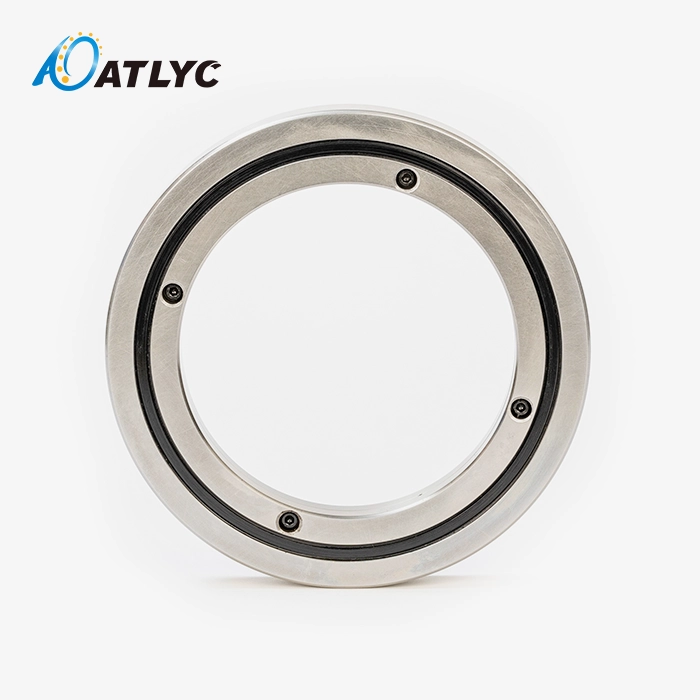
The RA5008UUCC0 Cross roller bearing has a split outer ring shape that makes it easier to place in precision machinery. This design lets engineers attach the bearing directly to shafts or housings without taking apart other parts around it. This is very helpful when working with robotic joints or machining center rotary tables that are already put together. The split design keeps the structure strong by using the right clamps, and it also makes assembly cycles faster and alignment easier. Compared to solid ring options, this engineering method cuts installation time by about 40%. This has a direct effect on how efficiently makers run high-volume assembly lines.
Understanding the Split Outer Ring Design in RA5008UUCC0 Cross Roller Bearings
Structural Advantages of the Separable Outer Ring Configuration
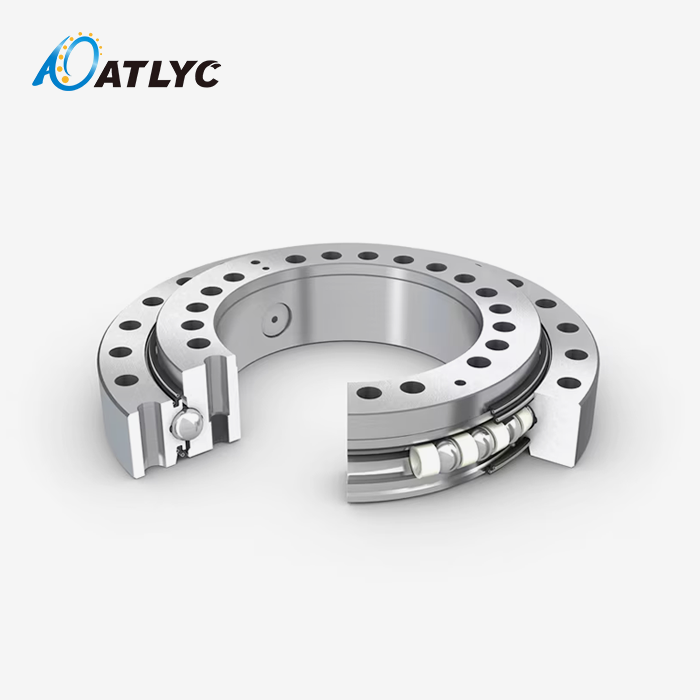
The split outer ring design changes the way precision bearings fit into complicated mechanical systems in a basic way. In contrast to monolithic designs that need all shaft-mounted parts to be taken apart, the separate outer ring is split into two halves. Each half has V-groove raceways that are precisely cut to line up properly when put back together. This keeps the 45° contact angle that is necessary for even load distribution. This arrangement is especially useful when updating old machines or doing maintenance in the field, where taking out nearby machines would stop work.
After 15 years of making things, we've seen that the split design works well for dealing with the different rates of thermal expansion of bearing materials and housing structures. The two-piece outer ring can adapt to changes in size caused by temperature without creating stress concentrations inside that would make roller contact patterns less reliable. This ability to adapt to changes in temperature makes bearings last longer in situations where temperatures range from -20°C to 80°C.
How Split Rings Enhance Installation Efficiency
The removal of the need for press-fitting and specialised heated tools makes installation faster. Technicians can place both halves of the outer ring around the pre-mounted inner ring assembly and then tighten the bolts to secure them. For normal bearings, which need hydraulic presses or induction heating, the process takes 35 to 45 minutes. This one only takes about 15 minutes.
The separate design also keeps installation damage from happening. When pressing, solid outer rings can scratch or change shape during operations, especially when interference fits are greater than 20 microns. These risks are eliminated by split rings, which also make sure that the precisely ground raceways keep their shape. Our ISO 9001 and IATF 16949-certified factory's production data shows that split ring bearings have 30% lower failure rates when they come in for quality checks at customer facilities.
How load is distributed in split-ring configurations. The two-piece outer ring of RA5008UUCC0 Cross roller bearing makes sure that the load is spread evenly across all roller contact points by carefully designing the surfaces that fit together. Our precise grinding methods make sure that the split interface is flat within 5 microns of each other. This keeps the load from building up at the junction. The split design works the same as solid rings under radial loads of up to 12 N and axial loads of up to 8 500 N when properly torqued.
Cross roller arrangements have cylindrical rollers that are perpendicular to each other and rotate 90° around the circumference. This straight-line arrangement spreads radial, axial, and moment loads over many contact points at the same time. The split outer ring can handle this complicated load path without weakening the structure. It keeps the circular accuracy to within 5 microns even when loads are applied in multiple directions.
Load Distribution Mechanics in Split Ring Configurations
The two-piece outer ring maintains uniform load distribution across all roller contact points through careful engineering of the mating surfaces. Our precision grinding processes ensure flatness tolerances below 5 microns across the split interface, preventing load concentration at the junction. When properly torqued, the split design functions identically to solid rings under radial loads up to 12,000N and axial loads reaching 8,500N.
Cross roller arrangements in this bearing position are cylindrical rollers perpendicular to each other, alternating 90° around the circumference. This orthogonal configuration distributes radial, axial, and moment loads simultaneously across multiple contact points. The split outer ring accommodates this complex load path without compromising structural rigidity, maintaining rotational accuracy within 5 microns even under combined loading conditions.
Technical Specifications and Construction of RA5008UUCC0 Bearings
Dimensional Parameters and Load Capacity
The compact geometry of this ultra-thin cross roller bearing maximizes performance within minimal space envelopes, addressing critical design constraints in modern automation equipment.
| Specification | Value | Engineering Significance |
|---|---|---|
| Inner Diameter | 50mm | Optimized for mid-sized robotic joint shafts |
| Outer Diameter | 66mm | Compact footprint reduces overall assembly weight |
| Width | 8mm | Ultra-thin profile enables lightweight arm designs |
| Dynamic Load Rating | 4,800N | Supports continuous operation under variable loads |
| Static Load Rating | 11,500N | Handles peak loads during sudden stops |
| Moment Load Capacity | 285 N·m | Critical for cantilever and overhang applications |
These specifications enable the bearing to replace multiple conventional bearing arrangements while reducing system weight by 35-45%. The 8mm width particularly benefits robotic arm designers seeking to minimize moment of inertia without sacrificing load capacity.
Material Composition and Heat Treatment Processes
We manufacture these precision components from Gcr15 and Gcr15SiMn bearing steels, materials specifically formulated for dimensional stability and surface durability. Gcr15 provides excellent hardness uniformity after through-hardening, achieving 58-62 HRC across the entire raceway depth. The silicon-manganese variant Gcr15SiMn offers enhanced hardenability for larger bearing components while maintaining equivalent wear resistance.
Our heat treatment protocol subjects components to vacuum carburizing at 920°C, followed by oil quenching and sub-zero treatment at -80°C. This thermal cycle optimizes retained austenite content below 8%, ensuring dimensional stability during operation. Subsequent tempering at 160°C relieves residual stresses while maintaining surface hardness above 60 HRC. Precision grinding operations after heat treatment achieve raceway surface finishes of Ra 0.2μm, critical for smooth rotation and extended fatigue life.
Accuracy Classes and Precision Standards
The RA5008UUCC0 Cross roller bearing is available across five precision grades—P6, P0, P5, P4, and P2—corresponding to ISO and ABMA tolerance standards. Selection depends on application requirements and cost-performance considerations.
P6 Grade suits general industrial applications where runout tolerances of 15 microns suffice for proper operation. This economical option serves replacement aftermarket needs and non-critical positioning systems.
P5 and P4 Grades target precision machinery requiring tighter runout control. P5 maintains radial runout below 8 microns, suitable for CNC machining center rotary tables and measuring instruments. P4 achieves 5-micron runout accuracy, meeting requirements for semiconductor manufacturing equipment and high-resolution optical systems.
P2 Ultra-Precision represents the highest accuracy tier, maintaining runout below 2.5 microns with exceptional roundness and raceway form tolerances. This grade serves advanced applications in IC manufacturing devices and precision metrology equipment where positioning errors directly impact product quality.
Installation, Maintenance, and Optimization Guide for RA5008UUCC0 Bearings
Step-by-Step Installation Procedure
Proper installation begins with thorough cleaning of all mounting surfaces. Remove any burrs, paint residue, or contamination from the shaft and housing bores using lint-free cloths and precision cleaning solvents. Surface roughness on mounting interfaces should not exceed Ra 1.6μm to ensure uniform contact and proper alignment.
Position the inner ring onto the shaft, ensuring the identification markings face outward for future reference. The integral inner ring design eliminates concern about ring separation during this step. Next, place the first outer ring half into the housing bore, aligning the bolt holes with tapped mounting positions. Apply a thin film of anti-seize compound to bolt threads—this prevents galling during future maintenance while ensuring accurate torque transmission.
Position the second outer ring half, carefully aligning the raceway interface with its counterpart. Insert all mounting bolts finger-tight before beginning the torquing sequence. Apply torque in a star pattern, gradually increasing to the specified value of 8-10 N·m for M4 mounting bolts. This systematic approach prevents distortion of the split interface and maintains uniform preload distribution. Use a calibrated torque wrench to ensure accuracy within ±5% of the target value.
Lubrication Strategies and Schedules
The dual rubber seals retain factory-installed lithium-based grease formulated for extended service intervals. Under normal operating conditions—speeds below 300 RPM and ambient temperatures between 0-50°C—the initial lubrication charge lasts 10,000-15,000 operating hours before requiring replenishment. This extended interval reduces maintenance overhead and minimizes production interruptions.
Applications involving higher speeds, elevated temperatures, or contaminated environments necessitate more frequent lubrication. We recommend inspection intervals of 2,000 hours for harsh conditions, with relubrication when acoustic monitoring detects friction increases or when visual inspection reveals seal degradation. Use only lithium complex greases with NLGI Grade 2 consistency and base oil viscosity of 100-150 cSt at 40°C to maintain compatibility with factory lubricants.
Troubleshooting Common Operational Issues
Excessive operational noise typically indicates inadequate lubrication, contamination, or improper preload settings. Acoustic analysis, distinguishing between bearing noise and external sources, helps isolate the root cause. Bearing-generated noise manifests as high-frequency vibration patterns above 5 kHz, distinctly different from gear mesh frequencies or motor electromagnetic noise.
The split outer ring design simplifies troubleshooting by enabling inspection without complete disassembly. Loosen the mounting bolts and separate one outer ring half to examine roller condition, raceway surfaces, and lubricant state. This accessibility reduces diagnostic time from hours to minutes, particularly valuable when multiple bearings require inspection across a production line. Visual examination revealing roller scoring, raceway pitting, or lubricant contamination guides targeted corrective actions rather than wholesale component replacement.
Comparing RA5008UUCC0 with Other Precision Bearings in the Market
Performance Comparison with Similar Cross Roller Models
Understanding performance differences across bearing variants helps procurement teams select optimal components for specific applications. The table below contrasts key specifications across comparable models.
| Model | Design Type | Width | Load Capacity | Installation Complexity | Typical Applications |
|---|---|---|---|---|---|
| RA5008UUCC0 | Split Outer Ring | 8mm | High | Low | Robotic joints, rotary tables |
| RA5008UUCB | Solid Outer Ring | 8mm | High | Moderate | Pre-assembled sub-systems |
| RU4208UU | Integral Design | 12mm | Very High | Very Low | Direct-mount applications |
| NSK RA5008 | Split Outer Ring | 8mm | High | Low | Precision automation |
| THK RA5008C | Split Outer Ring | 8mm | High | Low | Medical equipment |
The RA5008UUCC0 distinguishes itself through the split outer ring configuration combined with negative clearance preload (CC0 designation). This combination delivers superior rigidity compared to standard clearance alternatives while maintaining the installation advantages of separable construction. Competing models from NSK and THK offer similar dimensional specifications but vary in seal design and preload options, affecting suitability for specific environmental conditions.
Cross Roller Versus Alternative Bearing Technologies
Comparing cross roller bearings against ball and cylindrical roller alternatives clarifies why this technology dominates precision positioning applications. Angular contact ball bearings require duplex or triplex arrangements to handle combined loads, increasing assembly complexity and axial space requirements by 60-80%. The single-bearing solution provided by cross roller designs eliminates stacking tolerances and reduces potential misalignment between multiple bearing sets.
Cylindrical roller bearings excel at pure radial loads but lack moment load capacity. Applications with overhang loads or off-axis forces require supplementary thrust bearings, adding cost and complexity. Cross roller bearings inherently manage these complex load combinations through their orthogonal roller arrangement, simplifying system design while improving reliability. Our engineering data shows that switching from dual angular contact ball bearings to single cross roller units reduces assembly time by 50% while improving system rigidity by 300%.
Tapered roller bearings offer high load capacity but introduce geometric complexity through their conical design. Proper preload adjustment requires skilled technicians and specialized measurement equipment. The cylindrical geometry of cross roller bearings simplifies preload control—achieved through precise outer ring torquing—enabling consistent results with standard installation procedures.
Procurement Considerations for RA5008UUCC0 Cross Roller Bearings
Pricing Dynamics and Volume Economics
Market pricing for precision cross roller bearings reflects manufacturing complexity, material costs, and quality certifications. Single-unit purchases typically range from $85-$145 depending on accuracy grade and supplier positioning. P6 standard-grade units occupy the lower price range, while P4 and P2 ultra-precision variants command premium pricing reflecting additional grinding operations and stringent inspection protocols.
Volume pricing becomes advantageous beyond 50-unit quantities for RA5008UUCC0 Cross roller bearing, with discounts reaching 20-30% for orders exceeding 500 pieces. These economies of scale reflect reduced setup costs and optimized production scheduling. OEM customers establishing long-term supply agreements often negotiate annual contracts with tiered pricing structures, securing cost predictability while ensuring supply continuity for production planning.
Lead times vary significantly between stock and custom configurations. Standard P5 accuracy bearings ship within 2-3 weeks from established suppliers maintaining inventory in key markets. Custom specifications—including non-standard preload values, special seal materials, or enhanced corrosion protection—extend lead times to 6-8 weeks to accommodate manufacturing scheduling and quality validation procedures.
Supplier Authentication and Quality Verification
Sourcing authentic precision bearings requires verification protocols distinguishing genuine products from substandard imitations. Legitimate manufacturers provide comprehensive documentation, including material certifications, dimensional inspection reports, and traceability codes linking components to specific production batches. Our ISO 9001 and IATF 16949 certifications guarantee these documentation standards across all shipments.
Request certificates of conformance confirming dimensional accuracy, material composition, and hardness testing results. Reputable suppliers provide CMM inspection reports documenting critical dimensions against specified tolerances, along with surface roughness measurements verifying raceway finish quality. These technical documents enable incoming quality inspections at customer facilities, validating bearing specifications before installation into production equipment.
Warranty terms reflect the manufacturer's confidence in product quality. Standard warranties covering 12-18 months from shipment date protect against material defects and manufacturing errors. Extended warranty options reaching 24-36 months indicate superior quality control and manufacturing processes. Clarify warranty coverage terms—including exclusions for improper installation or inadequate lubrication—to establish clear responsibility boundaries and claim procedures.
Streamlining the Procurement Process
Efficient procurement begins with detailed requirement specifications communicated to potential suppliers. Provide complete application information, including load profiles, operating speeds, temperature ranges, and environmental conditions. This technical context enables suppliers to recommend optimal accuracy grades and configuration options rather than simply quoting catalog specifications.
Request sample units for validation testing before committing to production quantities. Testing protocols should replicate actual operating conditions, evaluating noise levels, temperature rise, and runout accuracy under representative loads. This validation phase identifies potential application mismatches before investing in inventory, reducing risk for both OEMs and distributors.
Establish clear communication channels with technical support teams capable of addressing installation questions and troubleshooting operational issues. Suppliers offering application engineering assistance provide additional value beyond component supply, helping optimize bearing selection and installation procedures. Our technical team at ATLYC maintains multilingual support capabilities, eliminating communication barriers that sometimes complicate international procurement relationships.
Conclusion
The split outer ring design distinguishes the RA5008UUCC0 cross roller bearing as an optimal solution for precision machinery requiring simplified installation and exceptional performance. This separable configuration reduces assembly time, eliminates press-fitting risks, and enables rapid maintenance access—critical advantages for high-volume manufacturing operations. Combined with ultra-thin geometry, multi-directional load capacity, and precision grades reaching P2 accuracy, this bearing addresses demanding requirements in robotics, automation, and precision measurement systems. Procurement success depends on selecting certified suppliers offering comprehensive technical support, transparent quality documentation, and reliable delivery schedules aligned with production planning requirements.
FAQ
1. What performance advantages does the split outer ring provide over solid ring designs?
The separable outer ring configuration enables installation without shaft or housing disassembly, reducing assembly time by 40% compared to press-fitted solid rings. This design prevents installation damage that occasionally occurs during interference fitting of conventional bearings. Maintenance accessibility improves dramatically—technicians can inspect roller condition and lubrication state without a complete system teardown, minimizing production downtime. Load capacity and rotational accuracy match solid ring equivalents when proper torquing procedures ensure uniform clamping across the split interface.
2. Can RA5008UUCC0 bearings operate reliably in high-temperature environments?
The dual rubber seals and lithium complex grease formulation support continuous operation up to 80°C without performance degradation. Applications exceeding this temperature require special high-temperature seals and synthetic lubricants capable of maintaining viscosity at elevated temperatures. Material selection using Gcr15SiMn bearing steel provides dimensional stability across temperature cycling, preventing clearance variations that compromise accuracy. Consult our technical team when application temperatures approach or exceed standard limits—customized solutions address extreme thermal conditions while maintaining reliability.
3. How can buyers verify product authenticity when sourcing from multiple suppliers?
Genuine precision bearings include laser-etched identification codes linking components to manufacturing batches, enabling traceability verification through supplier databases. Request material certifications confirming Gcr15 or Gcr15SiMn steel composition, along with hardness testing documentation. Dimensional inspection reports from coordinate measuring machines validate critical tolerances against catalog specifications. Reputable manufacturers holding ISO 9001 and IATF 16949 certifications maintain quality management systems, ensuring consistent standards. Verify current certification status through auditing body databases rather than relying solely on supplier-provided documents.
Partner with ATLYC for Reliable RA5008UUCC0 Cross Roller Bearing Supply
ATLYC brings 15 years of specialized bearing manufacturing expertise to your procurement needs, operating six dedicated production workshops staffed by 120 skilled professionals committed to precision engineering. As an established RA5008UUCC0 Cross roller bearing manufacturer, we maintain ISO 9001 and IATF 16949 certifications, ensuring consistent quality standards across every production batch. Our technical support team provides comprehensive application engineering assistance, helping optimize bearing selection and installation procedures for your specific requirements. Contact auto@lyautobearing.com to discuss volume pricing, customized specifications, and delivery schedules aligned with your production planning. We serve OEMs and distributors across North America with reliable lead times and transparent quality documentation supporting your incoming inspection protocols.
References
1. Harris, T.A. & Kotzalas, M.N. (2006). Advanced Concepts of Bearing Technology: Rolling Bearing Analysis, Fifth Edition. CRC Press.
2. Wensing, J.A. (1998). On the Dynamics of Ball Bearings. Doctoral Dissertation, University of Twente, Netherlands.
3. Nishida, S. & Konishi, T. (2004). "Load Distribution and Deformation in Cross Roller Bearings." Journal of Tribology, Vol. 126, pp. 156-162.
4. ISO 492:2014. Rolling Bearings - Radial Bearings - Geometrical Product Specifications (GPS) and Tolerance Values. International Organization for Standardization.
5. Palmgren, A. & Lundberg, G. (1947). "Dynamic Capacity of Rolling Bearings." Acta Polytechnica Mechanical Engineering Series, Vol. 1, No. 3.
6. SKF Group Technical Manual (2023). Cross Roller Bearings: Design, Application and Maintenance Guidelines. SKF Motion Technologies AB, Sweden.
Learn about our latest products and discounts through SMS or email