- English
- French
- German
- Portuguese
- Spanish
- Russian
- Japanese
- Korean
- Arabic
- Greek
- German
- Turkish
- Italian
- Danish
- Romanian
- Indonesian
- Czech
- Afrikaans
- Swedish
- Polish
- Basque
- Catalan
- Esperanto
- Hindi
- Lao
- Albanian
- Amharic
- Armenian
- Azerbaijani
- Belarusian
- Bengali
- Bosnian
- Bulgarian
- Cebuano
- Chichewa
- Corsican
- Croatian
- Dutch
- Estonian
- Filipino
- Finnish
- Frisian
- Galician
- Georgian
- Gujarati
- Haitian
- Hausa
- Hawaiian
- Hebrew
- Hmong
- Hungarian
- Icelandic
- Igbo
- Javanese
- Kannada
- Kazakh
- Khmer
- Kurdish
- Kyrgyz
- Latin
- Latvian
- Lithuanian
- Luxembou..
- Macedonian
- Malagasy
- Malay
- Malayalam
- Maltese
- Maori
- Marathi
- Mongolian
- Burmese
- Nepali
- Norwegian
- Pashto
- Persian
- Punjabi
- Serbian
- Sesotho
- Sinhala
- Slovak
- Slovenian
- Somali
- Samoan
- Scots Gaelic
- Shona
- Sindhi
- Sundanese
- Swahili
- Tajik
- Tamil
- Telugu
- Thai
- Ukrainian
- Urdu
- Uzbek
- Vietnamese
- Welsh
- Xhosa
- Yiddish
- Yoruba
- Zulu
XU Series Cross Roller Bearing Solutions for OEM Designers
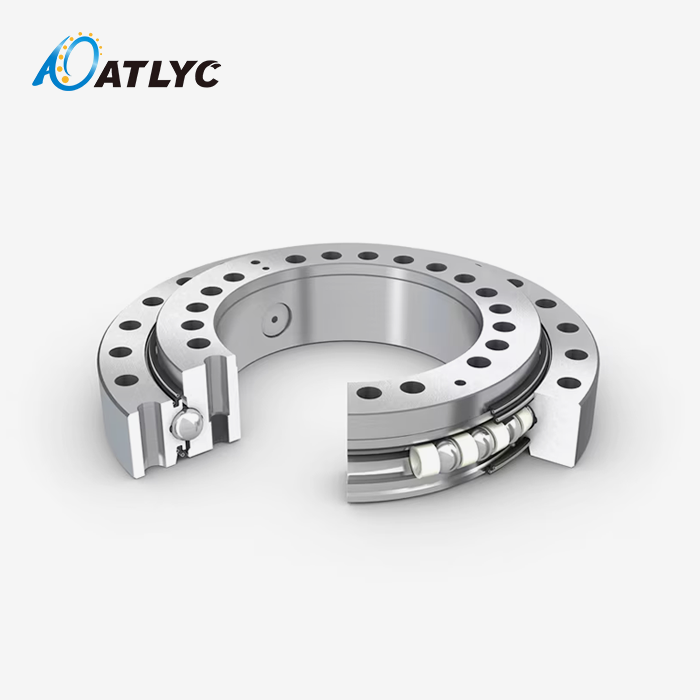
The XU Series Cross Roller Bearing is a game-changing option for OEM designers when they need to address problems in both precision engineering and small design. These special bearings have cylinder-shaped rollers that are arranged orthogonally at a 90-degree angle across V-groove raceways. This lets them handle radial, axial, and moment loads all at the same time in very small areas. The one-piece inner and outer ring structure gets rid of the problems that come with split rings, and the pre-drilled mounting holes make installation easier. This directly meets the industry's ongoing need for space-efficient parts that stay rigid and rotate accurately under complex loading conditions.
Understanding XU Series Cross Roller Bearings: Features and Technical Insights
The Structural Innovation Behind Cross Roller Technology
When it comes to how they are built, cross roller bearings are different from how most bearings are made. In regular ball bearings, contact only happens at one point. The XU Series, on the other hand, uses cylindrical rollers that are placed perpendicular to each other along V-shaped raceways that were carefully made. Line contact, not point contact, is made by this configuration. This spreads loads over a much bigger surface area. The orthogonal arrangement means that different sets of rollers handle different types of loads. One set handles radial forces, and the next set handles axial and moment loads. In our 15 years of manufacturing experience at ATLYC, we've seen that this design can handle up to 30% more load than similar-sized ball bearings. The isolation blocks between the rollers do two things: they keep the rollers from skewing while they're working, and they keep the spacing constant so that the torque characteristics stay the same during all spin cycles.
Material Selection and Manufacturing Standards
Quality starts with the materials you use. Our cross roller bearings are made from GCr15 and GCr15SiMn bearing steel, which are specially designed to stay the same size and prevent wear. About 1% of GCr15 chromium steel is carbon, and 1.5% is chromium. This gives it the hardness needed for raceway surfaces while keeping the core tough. The SiMn version has silicon and manganese added to it, which makes it harder to harden in larger bearing sizes. This is especially important for XU models with outer diameters ranging from 70mm to 1500mm. Strict adherence to international quality standards is required when making these precision parts. ATLYC's factories are certified by ISO 9001 and IATF 16949, which makes sure that every bearing meets the standards for car use. The heat treatments we use make the surface hard (between 58 and 62 HRC) while keeping microstructures below the surface that don't wear down or spall. Dimensional tolerances reach P4 or P2 accuracy classes, which are very important when rotational runout has a direct effect on the performance of the result in situations like handling semiconductor wafers or medical imaging systems.
Installation Best Practices and Maintenance Protocols
Proper mounting procedures directly influence XU Series Cross Roller Bearing service life. The integrated ring design of XU cross roller bearings simplifies installation compared to split-ring alternatives, yet specific protocols remain essential. The mounting holes—available as countersunk or threaded configurations—allow direct bolting to adjacent structures without presser flanges. When securing these bearings, we recommend torque sequences that distribute clamping forces evenly, starting from the center mounting holes and progressing outward in a star pattern. Pre-load adjustment deserves particular attention. Excessive pre-load generates unnecessary friction and heat, while insufficient pre-load permits undesirable axial play. Our technical documentation specifies pre-load values based on application requirements: light pre-load suits high-speed rotation with minimal moment loads, while medium to heavy pre-load accommodates slow rotation under substantial overturning moments. Environmental sealing becomes paramount in contaminated environments—supplementary labyrinth seals or contact seals protect the precision roller surfaces from particulate intrusion that accelerates wear.
Comparing XU Series with Alternative Bearing Solutions: Making the Right Choice
Performance Benchmarking Against Competing Technologies
OEM engineers frequently evaluate multiple bearing architectures before finalizing component selections. Understanding how cross roller bearings stack up against alternatives illuminates their optimal application envelope. Traditional deep groove ball bearings excel in high-speed rotation with moderate radial loads but struggle with combined loading. Their point-contact geometry limits moment load capacity, often necessitating paired arrangements that consume additional axial space. Cylindrical roller bearings offer superior radial load capacity through line contact but require separate thrust bearings to manage axial forces. Tapered roller bearings handle combined radial and axial loads yet demand precise mounting and adjustment procedures. The XU Series consolidates these capabilities into singular compact units. When compared to angular contact ball bearing pairs, cross roller bearings achieve equivalent load ratings while reducing overall envelope dimensions by approximately 40%—a substantial advantage in applications like collaborative robot joints where weight and size directly impact payload capacity.
Decision Criteria for Application-Specific Selection
Choosing the optimal bearing solution requires systematic evaluation across multiple parameters. Load characteristics form the foundation: applications dominated by radial loads with minimal axial components may find cylindrical roller bearings more cost-effective, while combined loading scenarios favor cross roller architectures. Speed requirements matter significantly—cross roller bearings typically operate at lower speeds (under 500 RPM) compared to ball bearings, making them ideal for precision positioning rather than high-velocity rotation. Space constraints often dictate bearing selection. When envelope dimensions are severely restricted yet complex load capacity remains necessary, few alternatives match the space efficiency of integrated cross roller bearings. Environmental factors, including temperature extremes, contamination levels, and vibration exposure, influence material selection and sealing strategies. We've successfully supplied bearings operating in environments ranging from clean room semiconductor fabrication (Class 10 cleanliness) to industrial automation cells with moderate particulate exposure.
Procurement Insights for OEM Designers: Navigating Purchase and Supply
Identifying Qualified Suppliers and Distribution Channels
Sourcing precision bearings demands diligence in supplier qualification. Authorized manufacturers with vertically integrated production control quality more effectively than distributors relying on multiple subcontractors. Direct engagement with manufacturers like ATLYC provides access to engineering expertise during the specification phase, potentially avoiding costly redesigns when performance requirements evolve. Global bearing distributors serve valuable roles in markets requiring immediate availability and smaller quantities. These partners maintain inventory that reduces lead times for prototyping or emergency replacements. However, production-scale procurement benefits from direct manufacturer relationships that offer volume pricing and supply agreements aligned with production forecasting. We've established distribution partnerships across South Korea, the United States, and Germany, ensuring regional support while maintaining centralized quality control at our Luoyang manufacturing base.
Understanding Pricing Structures and Order Parameters
Cross roller bearing pricing reflects multiple factors beyond material costs. Dimensional complexity, accuracy class, production volume, and customization requirements all influence unit costs. Standard XU Series bearings with inner diameters between 30-150mm and P5 accuracy typically range from $50-$300 per unit, depending on size. Larger diameters approaching 500mm with P4 precision can exceed $1,200 per unit. Ultra-precision P2 class bearings command premium pricing due to additional grinding operations and stringent inspection protocols. Minimum order quantities vary by manufacturer and bearing size. Standard configurations often carry MOQs of 10-50 pieces, while custom specifications may require 100+ piece commitments to justify tooling investments. Volume pricing structures typically offer tiered discounts: 5-10% reductions at 100-piece quantities, 12-18% at 500 pieces, and negotiated pricing beyond 1,000 units. These economies of scale make strategic inventory planning financially advantageous for OEMs with predictable demand patterns.
Application Scenarios and Value-Driven Solutions of XU Series Bearings for OEMs
Industrial Robotics and Automation Systems
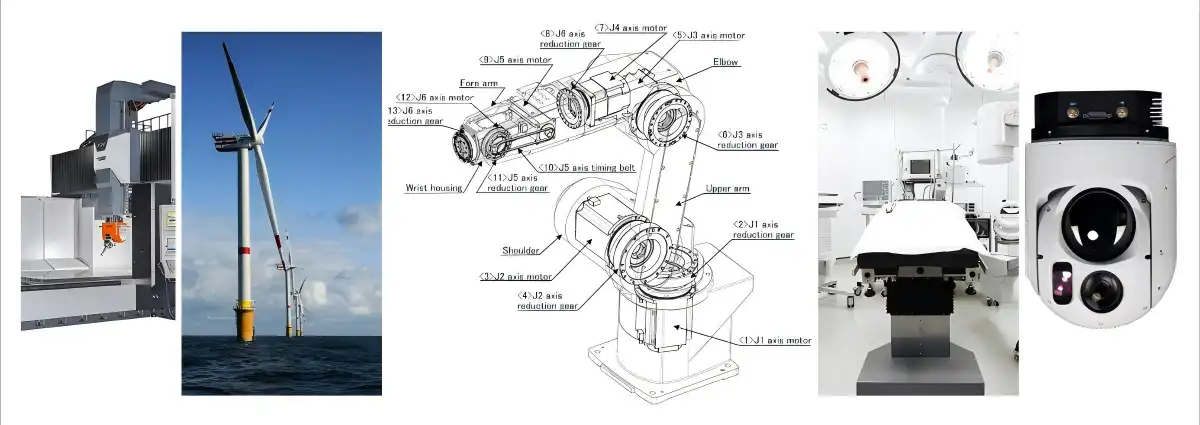
Precision robotics represents perhaps the most demanding XU Series Cross Roller Bearing application environment for cross roller bearings. Six-axis industrial robots require simultaneous control of position, velocity, and acceleration across multiple joints while maintaining repeatable accuracy within ±0.05mm. Joint articulation bearings must resist moment loads generated when the robot arm extends horizontally while carrying payloads, handle radial forces from payload weight, and manage axial thrust during acceleration and deceleration cycles. We've supplied XU Series bearings for collaborative robot manufacturers where joint bearing failures directly impact operator safety. The zero-backlash characteristics of properly preloaded cross roller bearings eliminate positioning errors that accumulate across kinematic chains. In one documented case study, a European robotics OEM replaced paired angular contact ball bearings with single XU Series units, achieving 22% weight reduction per joint while improving moment stiffness by 18%. This modification enabled increased payload capacity without redesigning actuator systems.
Medical Imaging and Diagnostic Equipment
CT scanners and MRI systems demand ultra-smooth rotation with minimal vibration transmission. The gantry bearings supporting rotating X-ray sources and detector arrays must operate continuously for years while maintaining positioning accuracy that directly affects image resolution. Any stick-slip behavior during rotation introduces artifacts that degrade diagnostic quality. Cross roller bearings address these requirements through uniform torque characteristics across full rotation cycles. The alternating roller arrangement minimizes cyclic load variations that cause vibration. Medical equipment manufacturers specify P4 or P2 accuracy classes, ensuring radial runout below 5 microns—essential when detectors require stable positioning relative to radiation sources. The compact design allows larger bore diameters for cable and cooling line routing through the bearing center, simplifying system architecture.
Precision Machine Tool Applications
CNC machining centers utilize rotary indexing tables that position workpieces with angular accuracy measured in arc-seconds. These tables must support substantial workpiece weight (often 500kg+), resist cutting forces that generate overturning moments, and execute rapid indexing movements hundreds of times daily. Bearing performance directly influences machining accuracy and throughput. The XU cross roller bearing's ability to handle combined loading while maintaining high stiffness makes it ideal for these applications. Table deflection under cutting loads must remain below 10 microns to maintain tolerance compliance on finished parts. We've observed that properly specified cross roller bearings achieve stiffness values exceeding 1,000 N/µm in compact footprints, enabling rigid table designs without excessive weight. The pre-drilled mounting holes simplify integration into table casting designs, reducing assembly complexity and potential alignment errors.
Emerging Applications in Semiconductor Manufacturing
The semiconductor industry's progression toward smaller node sizes demands positioning accuracy at nanometer scales. Wafer handling robots, lithography stage positioning, and inspection systems all require bearing solutions that combine precision with long-term stability. Contamination control becomes paramount—any particle generation from bearing wear jeopardizes yield in clean room environments. Specialty sealed cross roller bearings address these requirements through enhanced protection systems and carefully selected lubricants compatible with vacuum environments. The low particle generation characteristics of roller bearings compared to sliding contact alternatives make them suitable for Class 10 clean rooms. As semiconductor fabrication equipment evolves toward larger wafer sizes (300mm standard, 450mm emerging), bearing sizes scale proportionally. Our capacity to manufacture XU Series bearings with outer diameters up to 1500mm positions ATLYC as a capable partner for next-generation equipment development.
Optimizing Performance and Longevity: Best Practices for OEM Designers
Diagnostic Approaches for Performance Monitoring
Proactive bearing health monitoring prevents unexpected failures that disrupt production schedules and damage adjacent components. Vibration analysis represents the most effective diagnostic technique for detecting XU Series Cross Roller Bearing early-stage degradation. Bearing defects generate characteristic vibration frequencies that analysis software can isolate from background noise. Roller surface spalling produces impulses at frequencies determined by bearing geometry and rotational speed, typically detectable months before failure occurs. Temperature monitoring provides complementary insights. Gradual temperature increases suggest lubricant degradation or contamination accumulation, while sudden temperature spikes indicate acute problems like seal failure or inadequate lubrication. We recommend thermographic inspection during routine maintenance intervals, establishing baseline temperature profiles during normal operation for comparison during subsequent measurements.
Lubrication Optimization Strategies
Appropriate lubrication directly impacts bearing longevity and performance consistency. Cross roller bearings typically employ grease lubrication for its simplicity and sealing advantages. Lithium complex greases with polyurea thickeners demonstrate excellent mechanical stability and operating temperature ranges suitable for most industrial applications. Base oil viscosity selection depends on operating speed and load—higher viscosity oils (ISO VG 150-220) suit heavily loaded, slow-speed applications, while lighter oils (ISO VG 32-68) reduce friction in moderate-speed scenarios. Re-lubrication intervals depend on operating conditions. Bearings operating in clean environments at moderate temperatures may function 10,000+ hours between re-greasing, while contaminated or high-temperature environments require intervals as short as 1,000 hours. Over-greasing presents risks equal to under-lubrication—excessive grease generates churning resistance that elevates operating temperatures and accelerates oxidation. We specify precise grease volumes based on bearing internal geometry, typically filling 30-40% of available space.
Addressing Common Failure Modes
Understanding typical bearing failure mechanisms enables preventive design decisions. Contamination causes approximately 40% of premature bearing failures across industrial applications. Particles entering the bearing generate surface indentations that initiate rolling contact fatigue. Effective sealing systems form the primary defense—labyrinth seals provide non-contact protection suitable for moderate contamination levels, while contact seals offer maximum protection at the cost of slight friction increases and periodic replacement. Inadequate lubrication accounts for roughly 30% of failures. Lubricant starvation results from insufficient initial fill, extended re-lubrication intervals, or seal degradation allowing lubricant escape. Conversely, incorrect lubricant selection—particularly incompatible grease types or inappropriate viscosity grades—causes premature wear. We maintain detailed lubrication specifications for each bearing series, eliminating guesswork during maintenance planning.
Conclusion
The XU Series Cross Roller Bearing delivers exceptional value for OEM designers confronting space constraints while maintaining uncompromising performance standards. Through orthogonal roller arrangements and integrated ring construction, these bearings consolidate complex load handling into compact envelopes that simplify machine architecture. ATLYC's 15-year manufacturing progression ensures production consistency backed by ISO 9001 and IATF 16949 certifications, providing the supply reliability essential for long-term OEM partnerships. Strategic bearing selection supported by thorough application analysis, combined with proactive maintenance protocols, maximizes system uptime and return on investment across robotics, medical equipment, and precision automation applications.
FAQ
1. What differentiates XU Series cross roller bearings from standard ball bearings?
Cross roller bearings utilize cylindrical rollers arranged at 90-degree orientations, creating line contact that handles radial, axial, and moment loads simultaneously within compact dimensions. Ball bearings rely on point contact, suitable primarily for radial loads, requiring pairs or clusters to manage combined loading. The integrated ring structure of XU models eliminates split-ring alignment challenges while pre-drilled mounting holes simplify installation compared to bearings requiring separate housings.
2. What accuracy classes are available for precision applications?
XU Series bearings are manufactured in P6, P0, P5, P4, and P2 accuracy grades. P5 class suits general precision machinery with runout tolerances around 10 microns, while P4 grade achieves 5-micron tolerances for high-accuracy robotics. P2 represents ultra-precision specifications below 2.5-micron runout, essential for semiconductor equipment and metrology instruments where positioning errors directly impact process outcomes.
3. What are typical lead times and minimum order quantities?
Standard XU Series configurations ship within 2-4 weeks with minimum orders of 10-50 pieces, depending on size. Custom specifications require 6-12 week lead times with MOQs typically 100+ pieces to justify tooling investments. Volume orders above 500 units often qualify for expedited production scheduling and tiered pricing discounts reaching 12-18% below standard pricing structures.
Partner with ATLYC for Precision XU Series Cross Roller Bearing Solutions
ATLYC brings 15 years of bearing manufacturing excellence to your OEM design challenges. Our ISO 9001 and IATF 16949 certified facilities produce XU Series cross roller bearings spanning 20-1100mm inner diameters with accuracy classes from P6 to P2, matching your exact specifications. Whether you need standard catalog items or customized configurations, our 120-person engineering and production team delivers a reliable supply backed by comprehensive technical support. As a trusted XU Series Cross Roller Bearing manufacturer serving automotive, industrial automation, and precision equipment markets globally, we understand the critical importance of quality consistency and on-time delivery. Contact our team at auto@lyautobearing.com to discuss your application requirements and request detailed specifications with competitive quotations.
References
1. Harris, T.A., & Kotzalas, M.N. (2006). Advanced Concepts of Bearing Technology: Rolling Bearing Analysis, Fifth Edition. CRC Press.
2. ISO 492:2014 - Rolling Bearings - Radial Bearings - Geometrical Product Specifications (GPS) and Tolerance Values. International Organization for Standardization.
3. Wensing, J.A. (1998). On the Dynamics of Ball Bearings. Ph.D. Dissertation, University of Twente, Netherlands.
4. Schaeffler Technologies AG & Co. (2019). Rolling Bearing Failures: Recognition, Analysis and Prevention. Technical Publication WL 82 102/2 EA.
5. Tong, V.C., & Hong, S.W. (2016). Characteristics of Tapered Roller Bearing Subjected to Combined Radial and Moment Loads. International Journal of Precision Engineering and Manufacturing, 17(11), 1489-1498.
6. Lundberg, G., & Palmgren, A. (1952). Dynamic Capacity of Roller Bearings. Acta Polytechnica Mechanical Engineering Series, Royal Swedish Academy of Engineering Sciences.
Learn about our latest products and discounts through SMS or email