- English
- French
- German
- Portuguese
- Spanish
- Russian
- Japanese
- Korean
- Arabic
- Greek
- German
- Turkish
- Italian
- Danish
- Romanian
- Indonesian
- Czech
- Afrikaans
- Swedish
- Polish
- Basque
- Catalan
- Esperanto
- Hindi
- Lao
- Albanian
- Amharic
- Armenian
- Azerbaijani
- Belarusian
- Bengali
- Bosnian
- Bulgarian
- Cebuano
- Chichewa
- Corsican
- Croatian
- Dutch
- Estonian
- Filipino
- Finnish
- Frisian
- Galician
- Georgian
- Gujarati
- Haitian
- Hausa
- Hawaiian
- Hebrew
- Hmong
- Hungarian
- Icelandic
- Igbo
- Javanese
- Kannada
- Kazakh
- Khmer
- Kurdish
- Kyrgyz
- Latin
- Latvian
- Lithuanian
- Luxembou..
- Macedonian
- Malagasy
- Malay
- Malayalam
- Maltese
- Maori
- Marathi
- Mongolian
- Burmese
- Nepali
- Norwegian
- Pashto
- Persian
- Punjabi
- Serbian
- Sesotho
- Sinhala
- Slovak
- Slovenian
- Somali
- Samoan
- Scots Gaelic
- Shona
- Sindhi
- Sundanese
- Swahili
- Tajik
- Tamil
- Telugu
- Thai
- Ukrainian
- Urdu
- Uzbek
- Vietnamese
- Welsh
- Xhosa
- Yiddish
- Yoruba
- Zulu
How Can You Verify RB4510 Quality Before Ordering?
You need to do this systematically to ensure that the RB4510 cross roller bearing is of good quality before you make a purchase. This means looking at the manufacturer’s certificates, the materials used, the accuracy tolerances, and data on how it performs in real-life scenarios. This validation procedure safeguards your investment by providing you with bearings that are ISO 9001 and IATF 16949 certified, with verified P4 to P6 accuracy ratings. You’ll be confident that the RB4510 units will deliver the multi-directional load capacity and exceptional runout accuracy that your industrial robots, machining centers, or precision equipment demand through review of material certificates proving Gcr15 or Gcr15SiMn steel composition, dimensional inspection reports, and manufacturer production capabilities.

Understanding RB4510 Cross Roller Bearing Quality Standards
Quality verification starts with knowing what perfection looks like in cross roller bearing production. RB4510 bearings are a distinct class of precision components developed for applications where space limits and high performance requirements meet.
Core Design Features That Define Quality
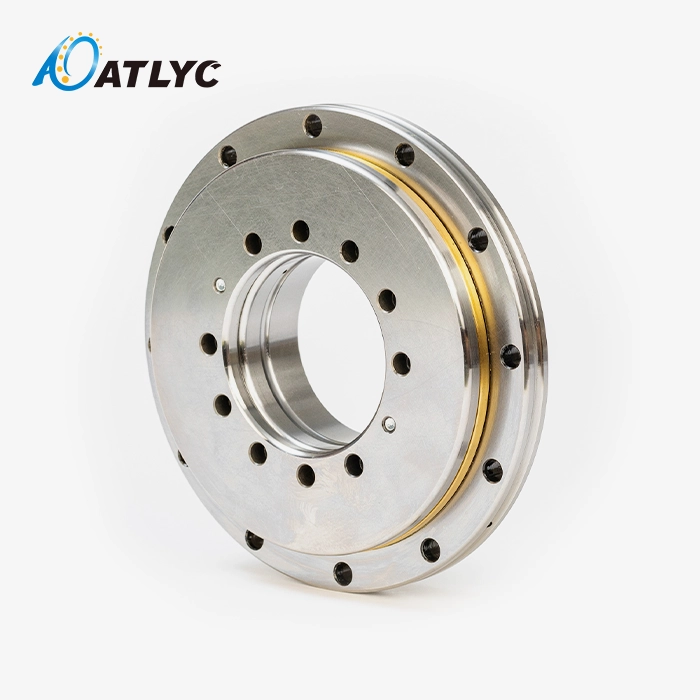
The RB4510 series is characterised by a special outer ring plug that is integrated with the inner and outer rings. This structural design allows optimum roller retention and allows installation in confined assembly situations. Quality bearing cages are precision-machined to hold the cylindrical rollers at precise 90-degree intervals, ensuring constant spacing between the rollers. The crossed-roller arrangement ensures ideal contact geometry on both raceways for simultaneous transmission of radial, axial, and moment loads in one compact unit. Manufacturing expertise is reflected in the quality of the surface finish on the raceways and roller contact surfaces. RB4510 units are finished to mirror-like surfaces by a number of grinding procedures that eliminate tiny flaws that impact the friction and wear properties.
Material Specifications and Heat Treatment Requirements
The selection of bearing steel is a direct factor in performance, lifespan, and load capacity. The actual RB4510 bearings are made of Gcr15 or Gcr15SiMn alloy steel compositions, which are for rolling element applications. The materials undergo regulated heat treatment methods to provide the appropriate distribution of hardness across the cross-sections of the rings. Verification of the quality of the materials involves verification of mill certificates proving the chemical composition and mechanical characteristics. Good producers will have traceability documents tying each batch of production to the steel lot numbers and heat treatment data. Hardness levels on bearing ring surfaces should be in the range of HRC 58-62. Core hardness should be such as to ensure structural integrity under cyclic loading circumstances.
Dimensional Accuracy and Tolerance Verification
The RB4510 series offers a wide variety of sizes to accommodate various industrial applications. Inner diameters from 20mm to 1100mm, exterior diameters from 70mm to 1500 mm, and widths from 12mm to 110mm. Bearing performance characteristics are defined by precise tolerances that classify size categories. Quality verification checks the dimensional conformity of several criteria. The inner and outer diameter tolerances, the width consistency, the raceway shape, and the matching of the roller diameters all add to the bearing accuracy overall. Manufacturers that have better control over these dimension connections provide P4 precision grades instead of the usual P6 or P0 tolerance levels.
| Accuracy Grade | Dimensional Tolerance | Runout Tolerance | Typical Application |
|---|---|---|---|
| P6 | ±15 μm | ±20 μm | General industrial machinery |
| P5 | ±10 μm | ±15 μm | Standard precision equipment |
| P4 | ±5 μm | ±8 μm | High-precision robotics and machine tools |
| P2 | ±2.5 μm | ±4 μm | Ultra-precision measuring instruments |
Understanding these tolerance classes allows procurement teams to define the correct level of accuracy for their application without over-specifying and needlessly driving up prices.
Evaluating Manufacturer Credentials and Production Capabilities
In addition to product requirements, manufacturing certifications are an important proof of the possibility of continuous quality supply. The devotion of bearing manufacturers with a long history is shown by recognised certificates and documented manufacturing procedures.
ISO 9001 and IATF 16949 Certification Importance
Certifications of quality management systems provide third-party assurance of control over the production process. If a company has ISO 9001 certification, it means that the manufacturer has established protocols for design, manufacturing, inspection, and corrective action processes. This is the normal baseline throughout the manufacturing sector. IATF 16949 certification is automotive industry-specific criteria layered on top of the ISO 9001 foundations. This standard provides additional controls applicable to defect avoidance, variation reduction and waste minimisation, especially for large-volume precision component manufacturing. Companies that have IATF 16949 certification show that they can satisfy the demanding needs of automotive OEM supply chains. When you are looking at possible RB4510 suppliers, get current copies of their certification certificates and check that they are valid on the certifying bodies’ databases. The certifications must be unique to the manufacturing plant that produces your bearings—not only the company headquarters or sibling locations.
Production Scale and Technical Capabilities Assessment
Manufacturing capacity has a direct impact on the dependability of supply and consistency in quality. The supplier operating a number of production workshops with special machinery for various classes of bearings has a better capability than single-workshop operations trying to cover all bearing categories. Well-established manufacturers will have dedicated grinding equipment, heat treatment facilities, and quality inspection systems specific to the production requirements of cross roller bearings. CNC grinding centers, coordinate measuring equipment, and automated inspection systems are signs of a strong dedication to precise manufacture. Bearing manufacturing is big on production experience. Ten or more years old, the companies have institutional knowledge that younger businesses lack and have better procedures because of continual improvement cycles. This means higher process stability and fewer quality escapes to consumers.
Quality Control Systems and Testing Protocols
The difference between great and mediocre manufacturers is thorough quality control. Inspection systems at different levels identify faults at various points in the manufacturing process, before final assembly. Incoming material examination to verify steel composition and hardness. Dimensional inspections are performed during grinding operations to evaluate dimensional correctness. Final inspection verifies whole bearing assemblies to specification criteria. State-of-the-art testing facilities offer further quality assurance. Vibration testing detects assembly faults that cause noise or erratic operation. Accelerated life testing gives an estimate of the bearing durability under real service loads. Manufacturers that provide 12 or more key performance metrics show full awareness of parameters impacting bearing quality. Request documentation of testing techniques and acceptance criteria utilised in the manufacture of batches of RB4510. Good manufacturers will gladly provide you with inspection data showing that their product routinely comes in at spec.
Performance Verification Through Technical Documentation
Technical documentation is objective proof of bearing capability and quality standards. Good documentation packages differentiate a professional organization from some fly-by-night provider with no technical capability.
Load Capacity Ratings and Performance Data
Cross roller bearings are great at supporting multi-directional loads but precise capacity figures vary dependent on size and design specifics. Good vendors will have extensive load rating tables showing dynamic and static capacity values for each variant of RB4510 model. Dynamic load ratings are the load at which a bearing will achieve one million rotations with 90% dependability. Static load ratings specify the maximum loads that may be endured without irreversible deformation. Moment load capacity parameters indicate the bearing’s capability to accept tilting moments imposed on the inner or outer ring. Compare published values to application requirements, using relevant safety factors. Suppliers who provide conservative ratings, including with calculation techniques, have more technical integrity than those that provide inflated results with no accompanying documentation.
Friction and Operating Temperature Characteristics
Quality cross roller bearings are distinguished from lesser alternatives by low friction performance. The crossed-roller arrangement naturally delivers reduced friction than traditional ball bearings in multi-directional load environments. Manufacturing accuracy has a large influence on realised friction levels. Quality RB4510 bearings have friction coefficients of around 0.002-0.003 with good lubrication. The minimal friction leads to less heat production, low energy consumption and longer service life. Suppliers that provide friction torque data across the bearing’s operating speed range provide a full performance characterisation. Operating temperature ranges reflect a bearing’s environmental capabilities. Standard bearings are reliable from -20 °C to 120 °C. Special heat treatment methods provide capabilities to 150°C or more for applications near heat sources. Make that the temperature parameters are compatible with your operational environment circumstances.
Runout Accuracy and Positioning Precision
Runout accuracy is the precision with which the bearing can retain its axis of rotation for operation. This property has a significant influence on the positioning accuracy in applications for robots, rotary tables and precision measurement equipment.P4 precision grade RB4510 bearings have a radial runout of 8 micrometres and an axial runout of less than 10 micrometres. Tight tolerances enable repeatable positioning precision even after millions of operation cycles. This dimensional consistency is important for applications needing micron repeatability . Request runout measurement data on real production units rather than specification claims . Good manufacturers will regularly measure and record these characteristics, and will have statistical process control data to demonstrate that they are consistent.
Practical Procurement Verification Methods
In addition to reviewing documents, hands-on verification techniques provide extra quality assurance before negotiating significant transactions.
Sample Testing and Inspection Procedures
Sample orders allow for immediate quality testing before larger commitments. Insist on seeing typical samples from manufacturing lots, not specially prepared units. Dimensional examination in-house using coordinate measuring equipment confirms compliance to requirements. Functional testing under simulated operating circumstances discloses performance characteristics. Place sample bearings in comparable fixtures, apply predicted loads and measure the friction torque, temperature increase and noise level during operation. Compare measured values to supplier documentation and acceptance criteria.Visual examination shows quality indicators of manufacture. Look for any grinding marks or abnormalities in surface finishes. Check roller spacing uniformity and cage integrity. Check the accuracy of marks such as model numbers, grades of precision and manufacturer codes.
Third-Party Validation Services
Independent testing labs provide objective quality evaluation. These facilities are capable of performing dimensional inspection, material analysis, hardness testing and performance assessment as per international standards. Third party evaluations are particularly important for assessing vendors that make bold promises on quality. Spectrographic examination of material composition validates steel alloy standards. Hardness testing of the ring cross sections indicates the heat treatment is correct. Microstructure parameters are determined by metallurgical investigation . Actual bearing performance is documented by testing under controlled settings . In laboratories, bearings are operated at certain loads and their temperature, vibration and wear rates are monitored. Such objective measurements confirm or deny supplier performance claims.
| Verification Method | Information Provided | Cost Range | Timeline |
|---|---|---|---|
| Dimensional Inspection | Diameter, width, runout accuracy | $200-$500 | 2-3 days |
| Material Analysis | Alloy composition verification | $300-$600 | 3-5 days |
| Hardness Testing | Surface and core hardness values | $150-$300 | 1-2 days |
| Performance Testing | Load capacity, friction, temperature | $1000-$3000 | 1-2 weeks |
Such expenditures are useful in risk mitigation when certifying new suppliers or as part of high-value procurement choices.
Supply Chain Verification and Traceability
Authentic quality assurance goes beyond the bearing itself; it includes the integrity of the supply chain. Establish direct ties with producers, not a string of middlemen distributors. Direct contact helps define technical needs and troubleshoot difficulties as they develop. Verify the manufacturer’s manufacturing capabilities via site audits or virtual visits. Seeing real manufacturing equipment, quality control systems, and inventory management techniques gives confidence in the dependability of supplies. Modern facilities with systematic workflows are the reflection of professionalism with an impact on quality consistency.Request traceability documentation showing completed bearings related to the lot of raw material, heat treatment batches and inspection paperwork. This documentation trail allows root cause investigation, if quality concerns occur, corrective action and recurrence prevention.
Application-Specific Quality Considerations
Different industrial uses are related to certain quality features. The customisation of the verification focus confirms quality verification relevant to your use case.
Industrial Robotics and Automation Requirements
Applications of robot joints need high positioning precision and high smoothness of motion characteristics. The RB4510 crossed-roller design offers the stiffness necessary for accurate motion control in multi-axis manipulators. Its small size makes it easier to integrate into robot arm setups with limited space. Quality checks for robot use include runout precision, friction consistency and moment load capacity. These factors impact directly the placement repeatabilty and the smoothness of the action. Suppliers of products to robotics markets are aware of these requirements and provide performance data that is relevant. Long life is even more critical in robotic applications since bearing replacement entails a long downtime and labour expenditure. Good bearings, when used under suitable circumstances, frequently go 10,000 hours or more before needing to be replaced.
Machine Tool and Rotary Table Applications
Rotary tables and indexing systems for machining centers. For accurate placement of workpieces during cutting operations. These applications create high cutting forces that are transferred through the bearing structure while maintaining tight positioning tolerances. The rigidity characteristics influence the extent to which the bearings retain their positioning accuracy under varying loads. The crossed roller arrangement has a high contact ratio giving it improved rigidity over the ball bearing alternatives. Quality verification involves checking the load-deflection properties to ensure appropriate stiffness for certain machining procedures. Vibration resistance impacts the surface finish quality in precision machining applications. For smoother rotation and less vibration gearbox, use bearings with a uniform roller spacing and low internal clearance. Tests under dynamic loading circumstances identify vibration characteristics that impact machining performance.
Medical Equipment and Precision Instrumentation
Medical imaging equipment, surgical robots, and precise measurement devices need ultra-smooth operation with little friction fluctuation. These applications run at lower speeds than industrial machines, but need very high uniformity and dependability. Quality evaluation is focused on the homogeneity of the friction across the working range of the bearing. Friction torque variations lead to positioning mistakes and non-uniform motion characteristics that are not acceptable in medical applications. Tests should record the friction constancy across full rotational cycles at anticipated loads. Uses in medical equipment use cleanliness standards above normal industrial norms. The bearings should be free from any manufacturing debris and well preserved to avoid deterioration during storage. Those of us who have worked in medical device supply chains know that the hygiene demands are higher here.
Building Long-Term Supplier Relationships
Quality verification is not confined to the original purchase decision, but continues during the relationship with the supplier. Creating connections with trusted manufacturers ensures supply consistency and opportunity for continual development.
Communication and Technical Support Capabilities
Great suppliers are known for responsive technical help, not commercial vendor relationships. Good manufacturers have application experts who understand the fundamentals of bearing selection and who can help with suitable size and installation suggestions. Language skills are important when dealing with overseas vendors. Manufacturers supplying international markets have English-speaking technical personnel that provide straightforward communication on specs, customisation needs and quality issues. Good communication eliminates the errors that lead to erroneous goods or unmet expectations. Customisation provides value that goes beyond the typical catalogue offering. Some manufacturers may create customised designs for certain dimensional applications or special performance requirements. This flexibility is especially important for OEM customers designing new equipment designs.
Continuous Improvement and Quality Feedback Systems
Feedback from consumers is highly appreciated by manufacturers and used for continued development. Quality management systems contain mechanisms for corrective and preventative action to solve detected faults and to avoid recurrence. Share performance data from field applications with your bearing supplier. Data on operating circumstances, service life successes, and problems encountered are useful to manufacturers in improving their goods and operations. This collaboration helps both sides by improving the fit of the product application. Regular business evaluations with major suppliers help keep the relationship healthy and find chances for development. These workshops will focus on quality performance trends, delivery dependability, and future application needs. Proactive communication avoids surprises and encourages mutual understanding.

Conclusion
By checking the quality of RB4510 cross roller bearings before you place an order, you preserve your investment and assure dependable performance in difficult applications. The verification procedure considers manufacturer certifications like ISO 9001 and IATF 16949, manufacturing capacity as indicated by facility size and equipment complexity, and technical documentation that substantiates performance claims. Further quality assurance is obtained by sample testing, third party validation and supply chain verification before volume commitments. Verification is driven by use-case specific considerations to the features most relevant to your particular application, whether it robots needing extraordinary positional precision, or machine tools with the best possible stiffness. Long term connections with quality orientated manufacturers provide supply security and continual improvement collaborations that benefit both sides via improved product application matching and proactive problem resolution
FAQ
What certifications should RB4510 manufacturers possess?
Reputable manufacturers hold ISO 9001 quality management certification as a baseline requirement. IATF 16949 certification demonstrates additional automotive industry-specific quality system implementation, particularly valuable for OEM applications requiring documented process control and defect prevention systems. Request copies of current certificates and verify their validity through certification body databases before placing orders.
How do I verify material quality in RB4510 bearings?
Request mill certificates documenting chemical composition and mechanical properties of bearing steel used in production batches. Authentic RB4510 units utilize Gcr15 or Gcr15SiMn alloy steel with hardness values between HRC 58-62 on bearing surfaces. Third-party material analysis through spectrographic testing provides independent verification when qualifying new suppliers or investigating quality concerns.
What precision grade should I specify for my application?
Precision grade selection depends on positioning accuracy requirements. P6 grade suits general industrial machinery with standard tolerance needs. P5 grade serves precision equipment requiring tighter control. P4 grade becomes necessary for high-precision robotics, machine tools, and measuring instruments demanding micron-level positioning repeatability. Specifying higher precision than necessary inflates costs without performance benefits.
Source Quality RB4510 Cross Roller Bearings from ATLYC
ATLYC brings 15 years of precision bearing manufacturing experience to serve your industrial automation, robotics, and machine tool applications. Our ISO 9001 and IATF 16949 certified facilities produce RB4510 cross roller bearings with documented P4 accuracy grades and comprehensive quality testing across 12 core performance parameters. Working with a dedicated RB4510 manufacturer like ATLYC ensures material traceability, dimensional verification, and technical support throughout your procurement process. Our 120-person team specializes in high-precision bearing production serving customers across South Korea, the United States, Germany, and other demanding markets. Contact us at auto@lyautobearing.com to discuss your specific RB4510 requirements, request technical documentation, or arrange sample testing that validates quality before volume commitments.
References
1. Harris, T.A. & Kotzalas, M.N. (2006). Rolling Bearing Analysis: Essential Concepts of Bearing Technology. CRC Press, Taylor & Francis Group.
2. International Organization for Standardization. (2015). ISO 492:2014 - Rolling Bearings - Radial Bearings - Geometrical Product Specifications and Tolerance Values. Geneva: ISO.
3. Society of Automotive Engineers. (2018). Surface Texture Requirements for Rolling Element Bearings. SAE International Technical Paper Series, J448.
4. Bhushan, B. (2013). Principles and Applications of Tribology. Wiley Engineering Publications, Second Edition.
5. Wensing, J.A. (2012). On the Dynamics of Ball Bearings. PhD Thesis, University of Twente, Netherlands.
6. American Bearing Manufacturers Association. (2017). Load Rating and Fatigue Life for Roller Bearings - ANSI/ABMA Standard 11-2017. Washington: ABMA Engineering Committee.
Learn about our latest products and discounts through SMS or email