- English
- French
- German
- Portuguese
- Spanish
- Russian
- Japanese
- Korean
- Arabic
- Greek
- German
- Turkish
- Italian
- Danish
- Romanian
- Indonesian
- Czech
- Afrikaans
- Swedish
- Polish
- Basque
- Catalan
- Esperanto
- Hindi
- Lao
- Albanian
- Amharic
- Armenian
- Azerbaijani
- Belarusian
- Bengali
- Bosnian
- Bulgarian
- Cebuano
- Chichewa
- Corsican
- Croatian
- Dutch
- Estonian
- Filipino
- Finnish
- Frisian
- Galician
- Georgian
- Gujarati
- Haitian
- Hausa
- Hawaiian
- Hebrew
- Hmong
- Hungarian
- Icelandic
- Igbo
- Javanese
- Kannada
- Kazakh
- Khmer
- Kurdish
- Kyrgyz
- Latin
- Latvian
- Lithuanian
- Luxembou..
- Macedonian
- Malagasy
- Malay
- Malayalam
- Maltese
- Maori
- Marathi
- Mongolian
- Burmese
- Nepali
- Norwegian
- Pashto
- Persian
- Punjabi
- Serbian
- Sesotho
- Sinhala
- Slovak
- Slovenian
- Somali
- Samoan
- Scots Gaelic
- Shona
- Sindhi
- Sundanese
- Swahili
- Tajik
- Tamil
- Telugu
- Thai
- Ukrainian
- Urdu
- Uzbek
- Vietnamese
- Welsh
- Xhosa
- Yiddish
- Yoruba
- Zulu
RU Series Cross Roller Bearing Load Ratings Explained
If you work in precision equipment manufacturing or industrial automation, you already know that selecting the wrong bearing can cost far more than the part itself. The RU Series Cross Roller Bearing addresses this challenge directly. It is a single-unit bearing solution that handles radial, axial, and moment loads simultaneously, using cylindrical rollers arranged in a 90-degree crossed pattern between integrated inner and outer rings. With inner diameters from 20 mm to 1,100 mm and accuracy grades from P6 down to P3, load rating data for this bearing type determines whether your machine runs for years or fails prematurely.

Understanding RU Series Cross Roller Bearing Load Ratings
What Dynamic Load Rating Means in Practice
When a bearing group is put under a steady load, the dynamic load rating (C) tells us how long it will last (one million revolutions). Because the RU Series Cross Roller Bearing has crossed rollers, the contact stress is spread over a bigger raceway area than with regular ball bearings. This makes the functional C value higher. Engineers use this number to figure out how long something will last in situations where it is constantly rotating, like robot arm joints or CNC rotary tables.
What Static Load Rating Tells You
The standing load number (C₀) tells you the most weight that can be put on the bearing when it is not moving or is moving slowly. If the contact stress at the roller-raceway junction goes beyond what is allowed, permanent deformation happens. For cross roller bearings that work with heavy preload or impact, like those found in indexing tables and manipulator joints, it is important to check C₀ against the highest loads that can be applied.
How Operating Conditions Shift the Effective Rating
In real life, speed, temperature, and lubrication can all increase or decrease the rated capacity. If it's not taken into account in the hardness standard, high working temperatures can soften GCr15 or GCr15SiMn steel. Surface wear happens faster when there isn't enough grease. Cross roller bearings have a speed factor that engineers must use when the application calls for moderate to high spinning speeds. Going over the stopping speed greatly reduces the load life that was calculated.
Design Features That Affect RU Series Bearing Load Ratings
Ring and Roller Geometry
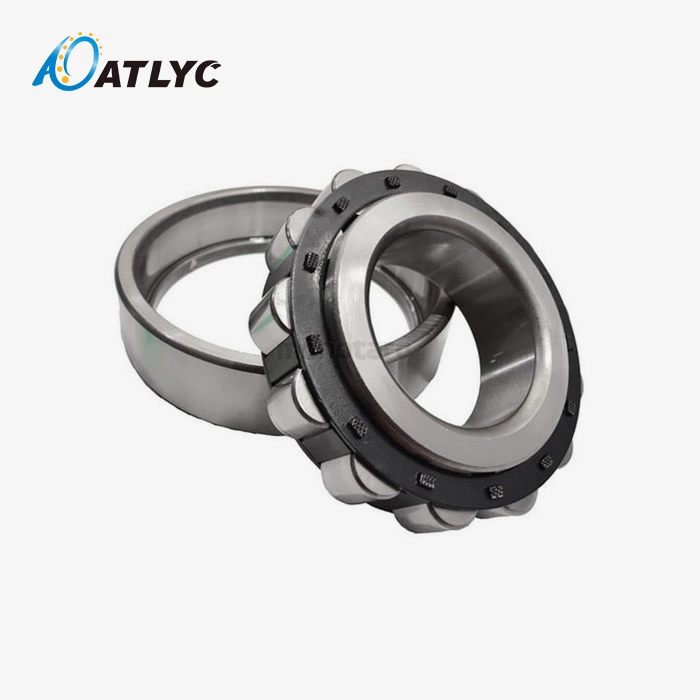
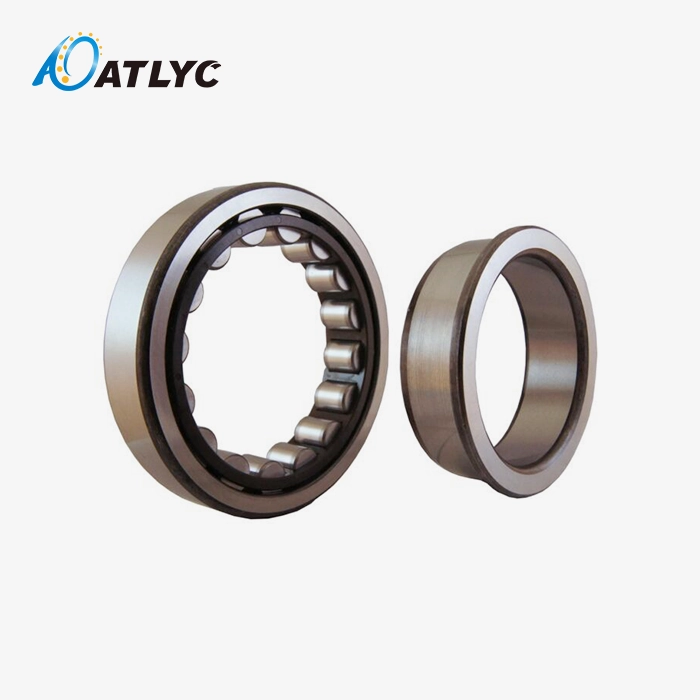
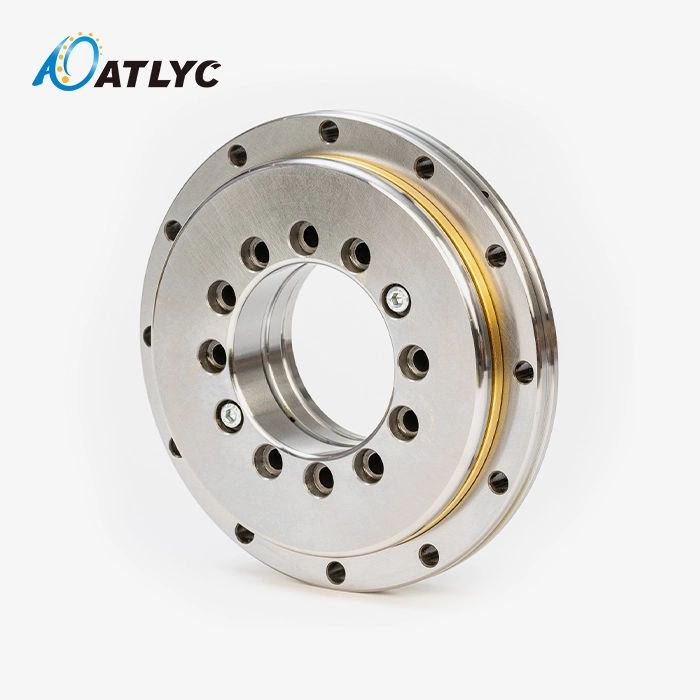
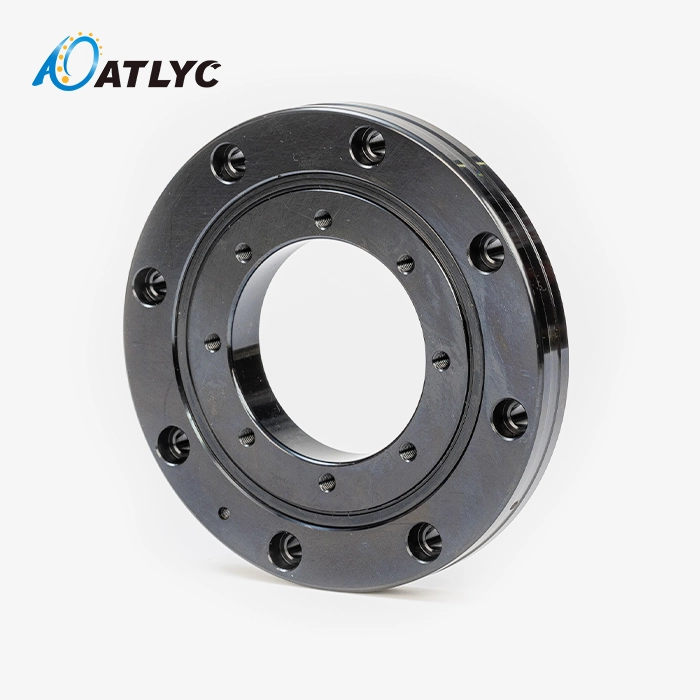
The RU Series Cross Roller Bearing has mounting holes on both the inner and outer rings of its integral ring structure. This one-piece design stops the ring from deflecting, which would move the load away from where it should be. In the RU Series, the V-groove raceways are ground to very tight tolerances, and each cylinder roller is perfectly matched to the groove profile. This creates a line-contact situation that spreads load over a longer surface than point-contact ball bearings can. The inner diameter ranges from 20 to 1,100 mm, the outer diameters from 70 to 1,500 mm, and the widths from 12 to 110 mm. The accuracy grades are P6, P0, P5, P4, and P3. The materials used are GCr15 and GCr15SiMn, and the rollers are crossed at 90° and have precision spacers.
| Design Parameter | RU Series Specification |
|---|---|
| Inner Diameter Range | 20 – 1,100 mm |
| Outer Diameter Range | 70 – 1,500 mm |
| Width Range | 12 – 110 mm |
| Accuracy Grades | P6, P0, P5, P4, P3 |
| Material | GCr15, GCr15SiMn |
| Roller Arrangement | 90° crossed, with precision spacers |
The dimensions and material details that directly affect how the bearing handles force are shown in the table above.
Cage Design and Roller Stability
There are high-precision spacers between each roller and its neighbors to keep the metals from touching directly. This setup keeps friction low, evens out the load distribution, and gets rid of the need to change the charge on a regular basis. The end result is no operational play and reliable torque behavior, which is needed in precision rotary tables and devices used to make semiconductors because location drift is not acceptable.
Material and Heat Treatment
The base of the RU Series Cross Roller Bearing is made of GCr15 high-carbon chromium bearing steel that has been heated to 58–64 HRC. The GCr15SiMn type has silicon and manganese added to it to make it harder in bigger cross-sections. This is important for bearings with an inner diameter of more than 200 mm. Both materials go through controlled rounds of quenching and tempering to make sure that the wear resistance is the same across the whole production batch. This is needed to meet the requirements of ISO 9001 and IATF 16949.
Comparing RU Series Cross Roller Bearings to Other Bearing Types
You don't always need a cross roller bearing. When buying, teams know where the RU Series really does better than other options, so they don't over- or under-specify their bearing choices.
This is how the RU Series stacks up against the three most popular alternatives:
Turntable (slewing ring) bearings handle large-diameter, slow-speed applications such as crane platforms. They carry high moment loads but occupy significantly more axial space and do not offer the runout accuracy that the RU Series provides at P4 or P3 grade. For a robot wrist joint where compactness and precision matter equally, a slewing ring is not a practical substitute.
Angular contact ball bearings offer lower friction at high speeds and suit spindle applications well. However, they require paired mounting to handle bidirectional axial loads. A single RU Series Cross Roller Bearing replaces a back-to-back pair while delivering higher moment stiffness in a smaller envelope.
RAR Series cross roller bearings share the crossed-roller principle but rely on separate inner and outer ring halves secured by a retaining flange. The RU Series' integral ring removes that assembly step entirely, reducing geometric error accumulation and shortening installation time on production lines.
These differences have a direct effect on how things are chosen on the shop floor. For example, a procurement engineer looking for a cross roller bearing for a medical imaging gantry will look at runout accuracy and moment load capacity as the most important factors. The RU Series consistently performs better than the other options listed. It can handle radial, axial, and moment loads, with axial loads being the most common. It can also handle standard or precision runout accuracy. Installation complexity is low for integral rings and moderate for paired sets. It is also very compact. It is commonly used in robotics, precision tables, spindles, pumps, cranes, and excavators.
| Performance Factor | RU Series | Angular Contact Ball | Turntable Bearing |
|---|---|---|---|
| Combined Load Handling | Radial + Axial + Moment | Primarily axial | Primarily moment |
| Runout Accuracy | P3–P6 grades | Standard or precision | Standard |
| Installation Complexity | Low (integral rings) | Moderate (paired sets) | Moderate |
| Compactness | High | High | Low |
| Typical Application | Robotics, precision tables | Spindles, pumps | Cranes, excavators |
Practical Applications and Load Rating Considerations
Industry Sectors That Depend on Accurate Load Ratings
The RU Series Cross Roller Bearing is used in medical machines, measuring tools, IC manufacturing equipment, industrial robot joints, machining center rotary tables, manipulator rotating parts, and precision rotary tables. There is a different load distribution for each section. During extension, a six-axis robot arm applies a combined moment and rotational load, while a CT scanner platform applies a continuous cantilevered moment load. If you match the bearing's stated capacity to these unique load patterns, it won't fail early from fatigue.
Installation and Alignment Practices
Making sure the mounting surface is flat within the IT5 to IT7 range stops the raceway from warping, which moves the load to one side of the roller contact zone. Using a calibrated torque wrench to tighten the mounting hole bolts in a star pattern makes sure that the clamping force is the same all the way across the integral ring. Because the RU Series Cross Roller Bearing doesn't have a separate case, it mounts directly to the surface of the equipment. This means that any change in the shape of the surface affects the geometry of the ring. This means that preparing the surface is an important step that shouldn't be put off until later.
Lubrication and Maintenance Schedules
The standard is lithium soap grease that is filled at the factory. In most industrial settings, re-lubricating every 6 to 12 months keeps the oil film that covers the roller-raceway contact surfaces in good shape. Sealed variants (UU suffix) slow the entry of contaminants but still need to be refilled regularly through the oil hole on the ring. When you do routine checks and make sure the torque stays the same, you can tell right away if the grease is wearing off or the rollers are wearing down, before the load capacity drops significantly.
Procurement Insights: Sourcing and Evaluating RU Series Bearings
Reading Load Rating Data on Supplier Documentation
The RU Series Cross Roller Bearing provider you choose should include both C and C₀ numbers, the top speed, and the moment load rate in the product datasheet. To be sure of the way the numbers were calculated, people who work in procurement should compare these numbers to ISO 76 (static load ratings) and ISO 281 (dynamic load ratings). When catalog data and numbers estimated separately based on bearing geometry don't match, it's time to ask for more information or test samples.
Verifying Certifications and Manufacturing Capacity
When a company has both ISO 9001 and IATF 16949 certifications, it means that they have put in place documented process controls, traceability systems, and corrective action procedures. While these standards don't promise that there will be no errors, they do provide a framework that can be checked and lowers the overall quality risk. Companies that have been around for a while and have more than one workshop can keep batch stability higher than smaller companies that only use one production line.
Lead Times, OEM Sourcing, and Long-Term Supply Strategy
When you buy a lot of cross roller bearings, it's just as important to confirm where the raw materials come from as it is to check the list price. When manufacturers buy and heat treat their own steel, they cut down on the number of steps in the supply chain between the raw material and the finished bearing. This cuts down on wait times and protects manufacturers from quality differences caused by third parties. OEM relationships with documented technical support, such as the ability to make custom dimensions across the entire 20–1,100 mm inner diameter range, give equipment projects that are growing the production freedom they need.

Conclusion
The RU Series Cross Roller Bearing's load rating data is not a detail in the datasheet; it is the main design variable that affects the bearing's service life, system rigidity, and how often it needs to be serviced. Engineers and procurement workers can confidently define when they know the difference between dynamic and static ratings, how the capacity ceiling is set by the material grade and roller geometry, and how the RU Series stacks up against other options. When you combine accurate interpretation of the load rating with a qualified supplier holding recognized certifications, the choice of bearings becomes one of long-term reliability.
FAQ
1. What is the difference between dynamic and static load ratings for cross roller bearings?
The dynamic load rating (C) predicts fatigue life under continuous rotation. The static load rating (C₀) sets the limit for stationary or very slow operation. Both values appear in the bearing datasheet and must be checked against your actual application loads separately.
2. Can a single RU Series Cross Roller Bearing replace a paired angular contact ball bearing arrangement?
Yes, in many cases. The crossed-roller arrangement handles bidirectional axial and radial loads plus moment loads in a single unit, which eliminates the need for back-to-back or face-to-face paired sets used with angular contact ball bearings.
3. What accuracy grade should I specify for a precision rotary table?
P4 or P3 grade is standard for sub-arc-minute positioning applications. P5 covers most general precision machinery. P6 and P0 suit standard industrial rotation where positioning accuracy is less critical.
4. How does ring material affect load capacity?
GCr15 provides consistent hardness and fatigue resistance for most sizes. GCr15SiMn improves hardenability in larger cross-sections, maintaining the 58–64 HRC hardness range required for full load rating across the entire bearing width.
5. What mounting surface tolerance is required?
Surface flatness within IT5 to IT7 tolerance is required to prevent ring distortion. Distortion shifts the load distribution away from the designed contact geometry and reduces effective load capacity below the rated value.
Partner with ATLYC for Your Next RU Series Cross Roller Bearing Order
The RU Series Cross Roller Bearing is available from ATLYC. It has inner diameters ranging from 20 mm to 1,100 mm and accuracy grades P6 to P3. Luoyang Auto Bearing Co., Ltd. has been making precision products for 15 years and is ISO 9001 and IATF 16949 certified. We are a reliable RU Series Cross Roller Bearing maker with customers in the US, Germany, South Korea, and other places. We offer engineering support, OEM capabilities, and stable lead times for bulk purchases. To get a price, email your requirements to auto@lyautobearing.com.
References
1. Harris, T. A., & Kotzalas, M. N. (2006). Rolling Bearing Analysis: Essential Concepts of Bearing Technology. Taylor & Francis.
2. ISO 281:2007. Rolling Bearings — Dynamic Load Ratings and Rating Life. International Organization for Standardization.
3. ISO 76:2006. Rolling Bearings — Static Load Ratings. International Organization for Standardization.
4. Hamrock, B. J., Schmid, S. R., & Jacobson, B. O. (2004). Fundamentals of Machine Elements. McGraw-Hill.
5. Eschmann, P., Hasbargen, L., & Weigand, K. (1985). Ball and Roller Bearings: Theory, Design, and Application. John Wiley & Sons.
6. THK Co., Ltd. (2022). Cross Roller Ring Technical Reference — RU Series. THK Technical Publication.
Learn about our latest products and discounts through SMS or email