- English
- French
- German
- Portuguese
- Spanish
- Russian
- Japanese
- Korean
- Arabic
- Greek
- German
- Turkish
- Italian
- Danish
- Romanian
- Indonesian
- Czech
- Afrikaans
- Swedish
- Polish
- Basque
- Catalan
- Esperanto
- Hindi
- Lao
- Albanian
- Amharic
- Armenian
- Azerbaijani
- Belarusian
- Bengali
- Bosnian
- Bulgarian
- Cebuano
- Chichewa
- Corsican
- Croatian
- Dutch
- Estonian
- Filipino
- Finnish
- Frisian
- Galician
- Georgian
- Gujarati
- Haitian
- Hausa
- Hawaiian
- Hebrew
- Hmong
- Hungarian
- Icelandic
- Igbo
- Javanese
- Kannada
- Kazakh
- Khmer
- Kurdish
- Kyrgyz
- Latin
- Latvian
- Lithuanian
- Luxembou..
- Macedonian
- Malagasy
- Malay
- Malayalam
- Maltese
- Maori
- Marathi
- Mongolian
- Burmese
- Nepali
- Norwegian
- Pashto
- Persian
- Punjabi
- Serbian
- Sesotho
- Sinhala
- Slovak
- Slovenian
- Somali
- Samoan
- Scots Gaelic
- Shona
- Sindhi
- Sundanese
- Swahili
- Tajik
- Tamil
- Telugu
- Thai
- Ukrainian
- Urdu
- Uzbek
- Vietnamese
- Welsh
- Xhosa
- Yiddish
- Yoruba
- Zulu
What Is a Cross Roller Bearing RA Series?
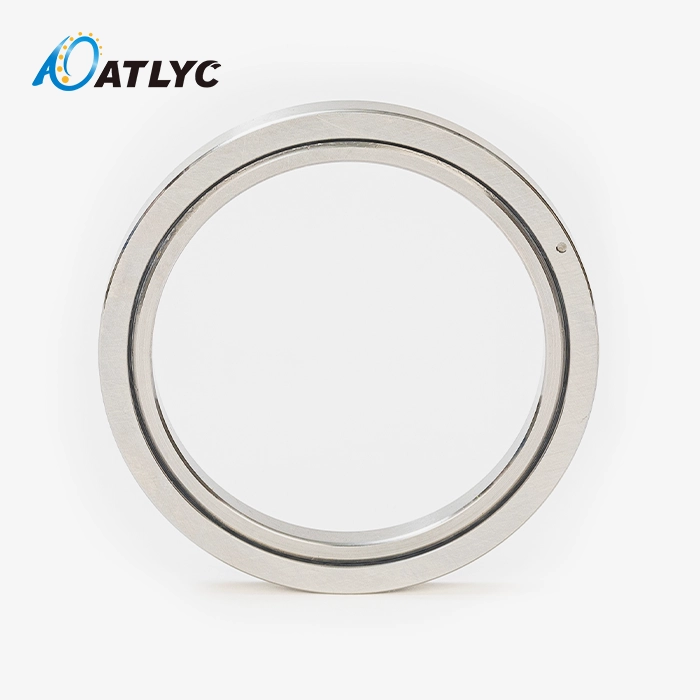
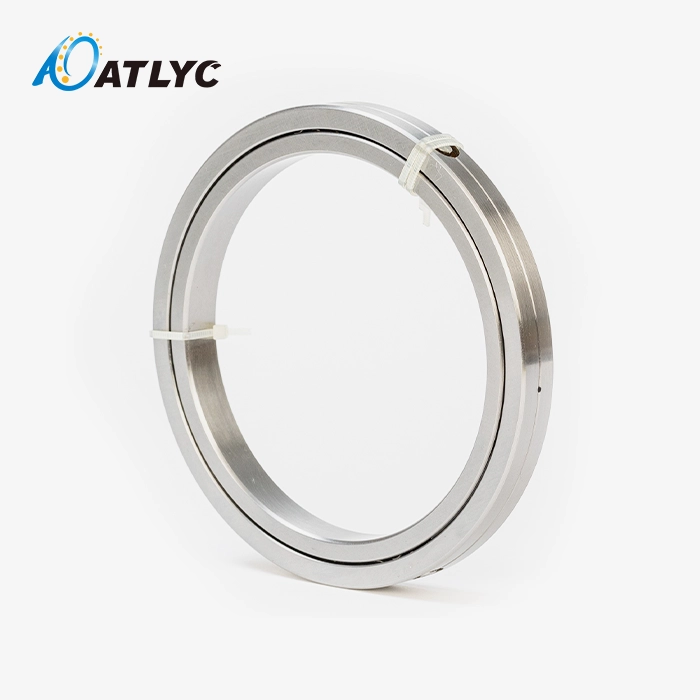
The cross roller bearing RA series is a high-precision, ultra-thin motion control component engineered for applications where space and weight matter most. Unlike standard cross roller bearings, the RA series features a split inner ring paired with an integrated outer ring, with cylindrical rollers arranged orthogonally at 90° intervals inside a V-groove raceway. This structure allows a single RA series cross roller bearing to carry radial, axial, and moment loads at the same time—eliminating the need for multiple bearing setups and reducing total assembly weight significantly.

Understanding the RA Series Cross Roller Bearing
What Makes the RA Series Different?
The RA series cross roller bearing is a type of crossed roller ring that is very thin. RA bearings have 20–40% thinner walls than the normal RB line. This makes them perfect for small assemblies. When the wheels touch the track in a straight line, the stiffness is three to four times higher than with a similar ball bearing under the same load. That stiffness number can be measured and used again and again, which is very important for engineers who need to know how something will work in high-cycle situations.
Materials and Manufacturing Standards
The RA line usually uses GCr15 steel, which is the same as AISI 52100 and has been heat-treated to a surface hardness of 58–62 HRC. This level of treatment is in line with JIS/ISO standards for contact fatigue and guarantees a long service life under cyclic stress. The accuracy grades are based on JIS B 1514 and ISO 492, and there are choices at P5, P4, and P2. These grades relate to tighter dimensional tolerances and lower runout values for uses that need repeatability at the micrometer level.
Structural Architecture Explained
| Feature | RA Series | Standard RB Series |
|---|---|---|
| Inner ring | Split (two-piece) | Integrated |
| Outer ring | Integrated | Integrated |
| Wall section thickness | Ultra-thin (20–40% thinner) | Standard |
| Roller arrangement | 90° orthogonal, V-groove | 90° orthogonal, V-groove |
| Load types supported | Radial + axial + moment | Radial + axial + moment |
| Typical accuracy grade | P5 / P4 / P2 | P5 / P4 |
This is a list of features for the RA Series and the standard RB Series. The inner ring can be split into two pieces or integrated, and the outer ring can be integrated or split into two pieces. The wall section thickness can be ultra-thin (20–40% thinner) or standard, and the roller arrangement can be 90° orthogonal or V-groove. The types of loads that can be applied are radial, axial, and moment. The typical accuracy grade can be P5, P4, or P2.
The split inner ring design lets the roller go in without any special tools. This makes assembly easier and lowers the risk of damage from handling during installation.
Advantages and Applications of RA Series Cross Roller Bearings
There are some technical advantages to the Cross roller bearing RA series that make it useful in real production situations. Here are the main technology benefits that engineers and procurement teams should know about:
High stiffness with low weight: Line contact between the rollers and the raceway makes the stiffness 3–4 times higher than with ball Cross roller bearing RA series, but the very thin profile keeps the assembly mass low, which directly improves the payload-to-weight ratios in robotic arms.
Single-unit multi-directional load handling: One RA series unit replaces configurations that needed two or three separate bearings, which makes the housing simpler and cuts down on the number of parts needed.
Smooth, consistent torque: Spacers between adjacent rollers stop the rollers from skewing and rubbing against each other. This keeps the starting and running torque stable at all temperatures and duty cycles.
Precision grades for cleanroom and vacuum use: If you use the right low-outgassing lubricants, the RA series cross roller bearing can work in semiconductor cleanrooms and vacuum chambers without making any particles dirty.
These benefits directly address the three most common problems in designing high-precision equipment: too much weight, not enough rigidity, and not enough space for housing.
Key Application Areas
The most common use case is for lightweight industrial robot joints. The RA series bearing fits directly onto the rotating joint in collaborative robots (cobots) and light-duty manipulators, which makes it possible to integrate a small motor housing. The shorter cycle times and lower energy use per action are caused by the lower friction.
Zero-clearance rotation is important for diagnostic accuracy in medical imaging and surgical equipment. Portable CT scanners and laparoscopic surgery robots use RA series bearings in their swivel joints because they can fit into small, clean housings and still keep the positional accuracy needed for clear imaging.
Handling semiconductor wafers is another area that needs to be done with great accuracy. Positioning margins for wafer transfer robots and alignment steps are measured in micrometers. The RA series cross roller bearing can handle heavy loads that are hanging off of it and has a high moment capacity. It can also meet sterile contamination standards if the right oil is used.
Maintenance Practices That Extend Service Life
The three care tasks that directly affect the life of a RA series bearing are the right amount of oil, the right preload settings, and regular runout checks. A common mistake is to use too much oil, which raises the temperature and speeds up seal wear. Follow the amount of grease that the manufacturer says to use by weight, not by feel.
RA Series vs. Other Cross Roller Bearings: Making the Right Choice
| Comparison Factor | RA Series | RA1 Series | Standard Ball Bearing |
|---|---|---|---|
| Wall section | Ultra-thin | Thin | Standard |
| Moment load capacity | High | Medium-high | Low |
| Preload adjustability | Yes | Yes | Limited |
| Positioning accuracy | P2–P5 | P4–P5 | P6–P5 |
| Typical price range | Mid-high | Mid | Low-mid |
| Best use scenario | Robots, medical, semiconductor | General automation | General rotation |
Compare the Cross roller bearing RA series and the RA1 Series, which are both types of standard ball bearings. The wall section can be ultra-thin, thin, or standard. The moment load capacity can be high, medium-high, or low. The preload can be adjusted, but only to a limited degree. The positioning accuracy can be P2–P5, P4–P5, or P6–P5. The typical price range is mid-high, mid-high, or low-mid. The best applications are robots, medical devices, semiconductors, general automation, and general rotation.
RA vs. RA1 Series
The RA1 series has a combined inner ring instead of a split design. This makes the radial stiffness a little better but makes the product a little heavier. In situations where the inner ring needs to be securely locked, and there is no chance of the rings coming apart, RA1 is the best choice. The RA series cross roller bearing is still the better choice when weight reduction is the main goal.
RA Series vs. Ball Bearings
Line contact is used for crossed rollers, and point contact is used for ball bearings. The RA series has better moment load resistance because of this geometric difference. A crossed roller unit can usually handle three to four times the moment load of an angular contact ball bearing with a 100 mm shaft when both radial and axial loads are applied.
RA Series vs. Crossed Roller Rings (Full Complement)
Crossed full-complement roller bands can hold more weight at rest, but at higher speeds, they create more friction and heat. With its spacer-separated rollers, the RA series runs more easily at moderate to high speeds and is better suited to uses where accuracy in spinning is more important than peak static capacity.
Procurement Guide: How to Buy RA Series Cross Roller Bearings
If you need to get RA series cross roller bearings for production or replacement, follow these steps to protect quality and lower supply risk.
First, make sure that any possible suppliers are certified by ISO 9001 and IATF 16949. Together, these two standards show that the company has a written quality management system and meets the process control standards for automotive-grade products. This is a good starting point for buying from companies in the industrial and OEM sectors.
For each batch, ask for material certifications and hardness test reports. The technical standard is GCr15 steel with an HRC of 58–62. Deviations from this range affect fatigue life and should be a reason to reject or renegotiate the deal.
When placing a large order, it is better to negotiate the minimum order quantity against a confirmed lead time rather than just the price that was quoted. When it comes to delivery windows, a seller with six production workshops and 120 skilled workers can usually keep them better than a trade company that acts as a go-between.
Last, make sure you know about the help after the buy, including expert documentation, a replacement policy, and direct access to engineering staff. When a bearing design needs to be changed in the middle of a production run, these factors are important.
Trusted RA Series Cross Roller Bearing Manufacturers and Brands
Since 2010, ATLYC, or Luoyang Auto Bearing Co., Ltd., has been making fine bearings. Over the course of 15 years, the business grew from one automated workshop to six specialty production centers that make six types of core bearings. ATLYC keeps tight process control at every stage of production with 120 trained workers working in R&D, production, quality testing, and assembly.
ATLYC is certified by both ISO 9001 and IATF 16949, and its goods are currently sent to South Korea, the US, Germany, Russia, Iran, and Turkey. ATLYC works with a manufacturer whose reputation has been built on reliable output rather than false advertising claims and can meet the needs of procurement teams looking for a Cross roller bearing RA series supplier with proven production scale and international shipping experience.
IKO (Japan), THK (Japan), and Schaeffler (Germany) are some other well-known names in this group. When it comes to medium to large OEM orders, these businesses set standards that qualified Chinese makers can now meet or beat at more reasonable prices.

Conclusion
The Cross roller bearing RA series meets a strict set of engineering needs: it has to be as rigid as possible while taking up as little space as possible; it also has to be able to handle loads in more than one direction in a single unit; and it has to be accurate to a high degree for high-cycle industrial uses. Material certification, accuracy grade proof, and source production ability are the most important things for buying teams to look at when they are looking for replacement or OEM bearings. Supply risk and total cost of ownership are both lower over the lifetime of a product when the maker has official certifications, a history of exporting, and direct engineering support.
FAQ
1. What is the maximum load capacity of RA series cross roller bearings?
The load capacity changes based on the accuracy grade and hole width. To give you an idea, an RA 200 series bearing with a 200mm bore can usually handle more than 100 kN of dynamic rotational load and more than 10 kN·m of static moment load. Always compare the manufacturer's load table to your specific speed, temperature, and duty cycle, as well as the operating conditions.
2. How does the RA series compare to NSK crossed roller bearings?
NSK makes crossed roller bearings with the RB and RA names and sizes that are in line with JIS B 1514. When a qualified Chinese maker makes Cross roller bearings in the RA series to the same JIS/ISO accuracy grades, they use the same tolerance bands. This means that the bearings can be used interchangeably in terms of their dimensions. Not the country of origin, but material approval, hardness verification, and evidence of the quality management system should be the main things used to judge the quality of a product.
3. What lubricant should I use in cleanroom or vacuum applications?
Low-outgassing greases, like those made from perfluoropolyether (PFPE), are common in semiconductor and vacuum settings. Always check with the bearing provider about the grease requirements before putting them into use.
4. How often should RA series bearings be relubricated?
How often you need to re-oil depends on the speed, load, and temperature of the machine. Under normal conditions (≤1,000 rpm, room temperature), relubrication once a year is usually enough. When used in high-cycle or high-temperature situations, this interval is shortened.
Partner with ATLYC for Your Cross Roller Bearing RA Series Needs
For 15 years, ATLYC has sold precision bearings to companies in five countries. As a certified producer of the Cross Roller Bearing RA series with ISO 9001 and IATF 16949 credentials, we can offer grade-specific customization, stable batch quality, and direct technical support. To get a product specification sheet or bulk quote, email our engineering team at auto@lyautobearing.com. On-time delivery. Quality checked. Partnership for a long time.
References
1. Japan Industrial Standards Committee. JIS B 1514: Rolling Bearings — Tolerances. Japanese Standards Association, 2022.
2. International Organization for Standardization. ISO 492: Rolling Bearings — Radial Bearings — Dimensional and Geometrical Tolerances. ISO, 2014.
3. Hamrock, B. J., Schmid, S. R., & Jacobson, B. O. Fundamentals of Machine Elements. McGraw-Hill, 2005.
4. SKF Group. SKF Rolling Bearings Catalogue. SKF, 2023.
5. IKO International Inc. IKO Crossed Roller Bearings Technical Catalogue. IKO, 2021.
6. International Automotive Task Force. IATF 16949:2016 — Quality Management System Requirements for Automotive Production and Relevant Service Parts Organizations. IATF, 2016.
Learn about our latest products and discounts through SMS or email