- English
- French
- German
- Portuguese
- Spanish
- Russian
- Japanese
- Korean
- Arabic
- Greek
- German
- Turkish
- Italian
- Danish
- Romanian
- Indonesian
- Czech
- Afrikaans
- Swedish
- Polish
- Basque
- Catalan
- Esperanto
- Hindi
- Lao
- Albanian
- Amharic
- Armenian
- Azerbaijani
- Belarusian
- Bengali
- Bosnian
- Bulgarian
- Cebuano
- Chichewa
- Corsican
- Croatian
- Dutch
- Estonian
- Filipino
- Finnish
- Frisian
- Galician
- Georgian
- Gujarati
- Haitian
- Hausa
- Hawaiian
- Hebrew
- Hmong
- Hungarian
- Icelandic
- Igbo
- Javanese
- Kannada
- Kazakh
- Khmer
- Kurdish
- Kyrgyz
- Latin
- Latvian
- Lithuanian
- Luxembou..
- Macedonian
- Malagasy
- Malay
- Malayalam
- Maltese
- Maori
- Marathi
- Mongolian
- Burmese
- Nepali
- Norwegian
- Pashto
- Persian
- Punjabi
- Serbian
- Sesotho
- Sinhala
- Slovak
- Slovenian
- Somali
- Samoan
- Scots Gaelic
- Shona
- Sindhi
- Sundanese
- Swahili
- Tajik
- Tamil
- Telugu
- Thai
- Ukrainian
- Urdu
- Uzbek
- Vietnamese
- Welsh
- Xhosa
- Yiddish
- Yoruba
- Zulu
Where to Buy XU Series Cross Roller Bearing for Robotics?
If you're sourcing XU Series Cross Roller Bearings for robotics applications, the most direct path is to work with a certified Chinese bearing manufacturer like Luoyang Auto Bearing Co., Ltd. (ATLYC), which holds ISO 9001 and IATF 16949 certifications and ships globally to the US, Germany, South Korea, and beyond. With inner diameters ranging from 20mm to 1,100mm and precision grades up to P2, the XU Series Cross Roller Bearing covers the full spectrum of robotic joint and rotary table requirements.

Understanding XU Series Cross Roller Bearings in Robotics
What Makes the Design Different
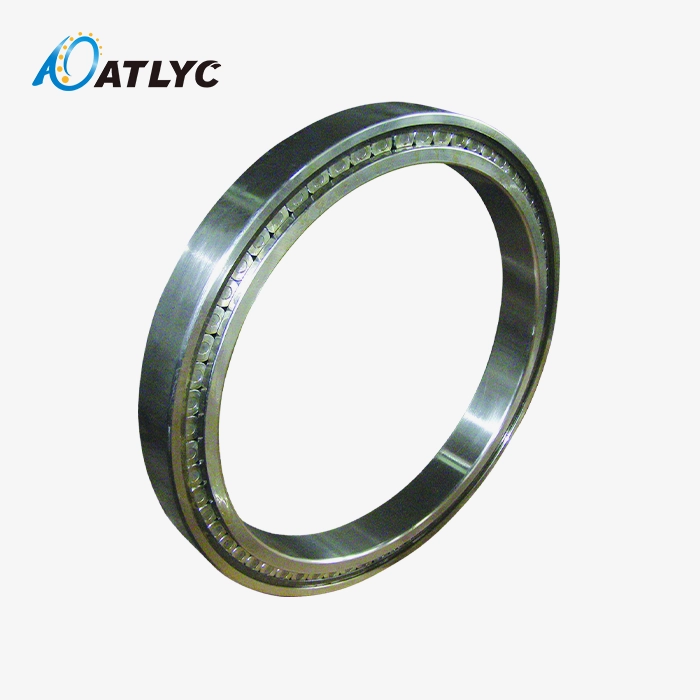
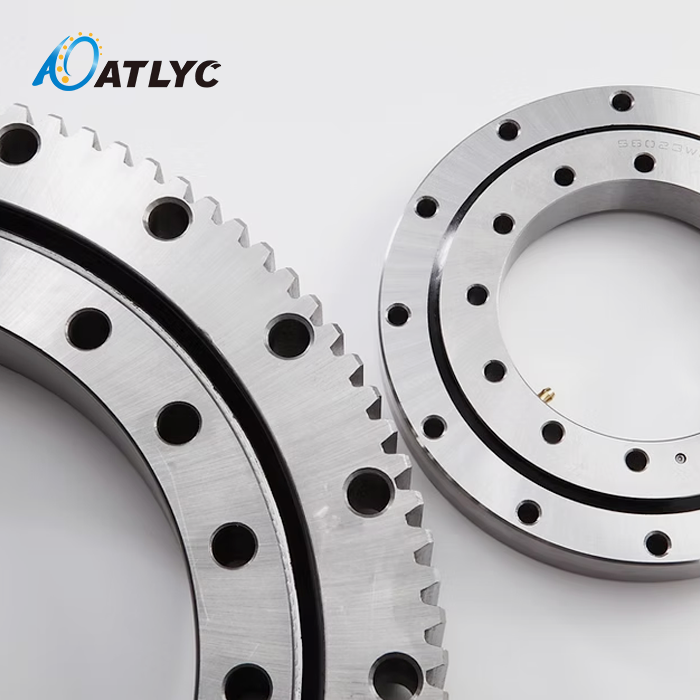
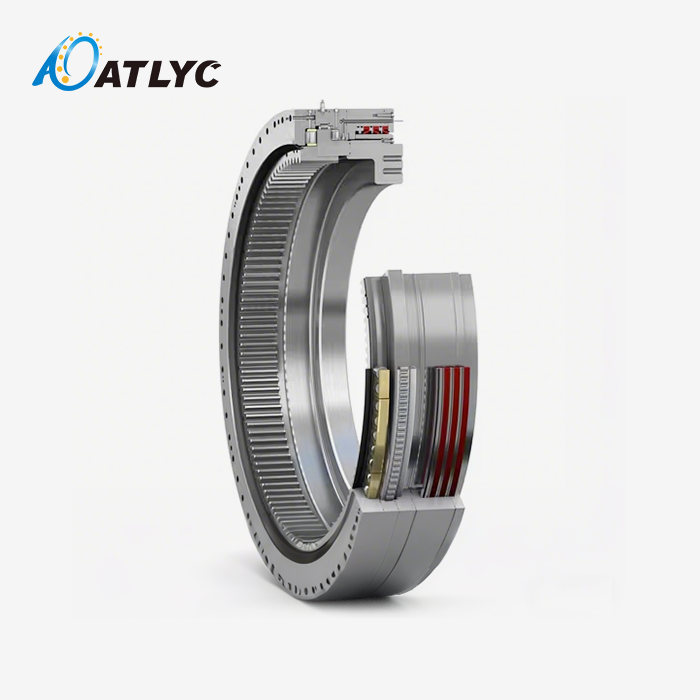
The XU Series Cross Roller Bearing has a track with a 90° V-groove and cylinder-shaped rollers that move back and forth in opposite directions. Every roller in this orthogonal arrangement touches the raceway in a straight line, instead of touching it at an angle like in most ball bearings. This makes the bearings much more rigid per unit of space. This makes a bearing that stays in place under load with a lot less displacement than other choices.
One-Piece Ring Construction
The XU design is different from split-ring cross rollers like the RB or RE series because it combines the inner and outer rings into a single block that is not split. That means the rings won't come apart when they're loaded, the two halves will stay aligned, and the bearing will have more consistent rotational accuracy over its lifetime. Direct face-mounting is possible because both ring sides have mounting holes that have already been made. This means that you don't need any extra housings or presser flanges.
Material and Hardness Standards
The XU Series Cross Roller Bearing is made by ATLYC from GCr15 and GCr15SiMn high-carbon chromium bearing steel that has been heated until the surface is 58–64 HRC hard. This treatment depth makes sure that the track doesn't get worn down or fatigued even when it's loaded and unloaded many times a day, which happens all the time in industrial robot joints and CNC rotary tables.
Why the XU Series Is the Preferred Choice for Robotics
People who work with precision automation like the XU cross roller bearing because it solves multiple load and space issues at the same time without making the hardware more complicated. The main things about its ability that make it stand out are:
Omni-directional load handling: A single XU bearing supports radial, axial, and moment loads concurrently, replacing what would otherwise require dual angular contact bearing pairs. This reduces assembly height and part count.
Rotational accuracy: Available in P6, P0, P5, P4, and P2 tolerance grades, with radial and axial runout often below 2 microns at P4 and P2. This directly supports sub-millimeter repeatability in robotic arms.
Pre-adjusted clearance: Each unit ships with factory-set negative or zero preload, so there is no backlash from initial installation — a detail that matters in medical imaging equipment, IC manufacturing devices, and six-axis robot articulation.
Isolation block design: Spacers between rollers prevent roller skew and friction-induced torque variation, which keeps rotation smooth and torque output predictable.
These features make the robot or machine in which the bearing is installed last longer and require less maintenance. The inner diameter ranges from 20 to 1,100 mm, the outer diameter from 70 to 1,500 mm, and the widths from 12 to 110 mm. The material is GCr15/GCr15SiMn, and the hardness ranges from 58 to 64 HRC. The accuracy grades are P6, P0, P5, P4, and P2. The roller arrangement is 90° cross, line contact.
| Specification | Value |
|---|---|
| Inner Diameter Range | 20 – 1,100 mm |
| Outer Diameter Range | 70 – 1,500 mm |
| Width Range | 12 – 110 mm |
| Material | GCr15 / GCr15SiMn |
| Hardness | 58 – 64 HRC |
| Accuracy Grades | P6, P0, P5, P4, P2 |
| Roller Arrangement | 90° cross, line contact |
Where to Buy XU Series Cross Roller Bearings — Global Supplier Landscape
Sourcing from Certified Manufacturers
If you want to buy a precision cross roller bearing, the safest way is to deal directly with an ISO-certified maker. If you buy from wholesalers who aren't qualified, you might get bearings that don't meet dimensional or metallurgical standards. This can cause problems in robots or other automatic equipment that are later put together. Since the beginning of its business, ATLYC has had ISO 9001 approval. It later added IATF 16949 to meet the quality standards for car parts.
Bulk Orders and MOQ Flexibility
ATLYC can handle both small-batch sampling and full production runs for OEMs and industrial distributors who need to handle large orders. Managers in charge of buying things can ask for specific ranges of inner diameter, bore tolerances, or preload settings. Lead times depend on how complicated the design is, but normal XU Series Cross Roller Bearing models can usually be quoted within 24 to 48 business hours.
Shipping and Logistics to the US and Europe
ATLYC sells its goods in the US, Germany, South Korea, Russia, Iran, and Turkey. Export-grade anti-corrosion standards are used for the packaging, and each bearing is individually covered and tagged with its batch number so that it can be tracked. For buyers in the US, sea freight is the standard way to send large orders, while air freight can be used for urgent prototype or replacement orders.
How to Choose the Right Supplier for Your Robotics Procurement
There's more to picking a cross roller bearing provider than just the price per unit. Total cost of ownership includes the cost of unplanned downtime if a bearing breaks early, the cost of expert support, and the rate at which the installation went well.
Before you decide on a supplier, I suggest you look at these factors:
Quality certifications: ISO 9001 is a baseline. For automotive and industrial-grade applications, IATF 16949 is the higher bar. ATLYC holds both.
Inspection capability: Suppliers should be able to provide CMM-verified dimensional reports, rotational torque test data, and material hardness certifications per batch. ATLYC performs eddy current testing and magnetic particle inspection (MPI) to detect subsurface defects in raceways.
Customization depth: Not every robotics application uses a catalog size. A capable XU Series Cross Roller Bearing supplier should handle non-standard inner diameters, hole patterns, and tolerance classes.
After-sale support: Technical engineers who can advise on installation procedures, preload selection, and lubrication schedules reduce the learning curve significantly.
| Supplier Evaluation Criteria | What to Verify |
|---|---|
| ISO / IATF Certification | Certificate number, issuing body, expiry |
| Inspection Documentation | CMM reports, hardness certs, runout data |
| Customization Capability | Non-standard sizes, tolerance grades |
| Lead Time Transparency | Standard vs. custom order timelines |
| Export Experience | Countries served, logistics partners |
ISO 9001 is the standard when it comes to quality ratings. In the world of cars and factories, IATF 16949 is the higher standard. Both belong to IATF.
Maximizing the Value of Your XU Series Bearing Purchase
Installation Best Practices
First, make sure that there are no burrs or dirt in the places where the XU Series Cross Roller Bearing is attached. Since the one-piece ring design has to be face-mounted through holes that have already been made, the order and consistency of the tightening have a direct effect on how well the preload stays in place. The ring won't bend if you use accurate torque tools and tighten the bolts according to the manufacturer's instructions.
Maintenance and Lubrication Schedule
The XU cross roller bearing works better when it is oiled every so often with grease that is safe for the speed and temperature of the application. Lubricating computer parts that move back and forth a lot should be done based on real working hours instead of scheduled hours. This makes the service life much longer. The technical team at ATLYC can help you figure out what kind of grease to use and how often to re-grease based on how often you use the tool.
Planning for Future Scalability
As robots get better, the bearings in old models may need to be changed so they can handle more weight or more accurate measurements. It's easier for your seller to grow with your product line if you buy from a company that makes a lot of different sizes. For example, the XU series has inner widths that range from 20 mm to 1,100 mm.

Conclusion
For a long time, the XU Series Cross Roller Bearing has been used in robots, precision machinery, and automation tools that need to be very stiff, turn very precisely, and fit into small areas. ATLYC has been making things for 15 years, has six workshops, and is certified by both ISO 9001 and IATF 16949. This gives buying teams a good idea of the quality standard and makes it easy to get technical information. It will take less time to find a bearing if you let them know about your needs early on, whether you need a standard stock bearing or one that has been modified to fit a certain robot joint.
FAQ
1. What is the XU Series Cross Roller Bearing used for in robotics?
It's used in rotary tracking tables, CNC machine frames, precision end-effectors, and robotic joints that can move in different ways. Because it can handle radial, axial, and moment loads at the same time, it works well for joints that have to deal with complex, changing force lines while they are working.
2. What accuracy grades are available for the XU cross roller bearing?
ATLYC makes XU Series bearings with tolerances of P6, P0, P5, P4, and P2. It is common for semiconductor equipment, medical imaging devices, and high-precision robotic uses to require grades P4 and P2. In these cases, runout must stay below 2 microns.
3. What is the minimum and maximum size available?
The inside diameters are 20 mm to 1,100 mm, the outside sizes are 70 mm to 1,500 mm, and the widths are 12 mm to 110 mm.
4. How do I verify the quality of a bearing before a bulk order?
Ask for inspection documents that are specific to the batch, such as CMM dimension reports, rotational torque test data, and material hardness certifications. These are common forms that ATLYC gives out for overseas orders.
5. Can ATLYC supply non-standard configurations?
Yes, ATLYC lets you change the hole shapes, accuracy grades, and special preload settings to meet the needs of OEMs and engineers. Send your model or specification sheet to auto@lyautobearing.com.
Get Your XU Series Cross Roller Bearing Quote from ATLYC
Precision bearings from ATLYC have been sold to OEMs and wholesalers in the US, Germany, and South Korea for more than 15 years. We are a direct producer and seller of XU Series Cross Roller Bearings. We offer full inspection documentation, flexible MOQs, and expert help from our engineering team. Please send your requirements to auto@lyautobearing.com to get a price. We answer all business-to-business questions in one business day.
References
1. Hamrock, B. J., Schmid, S. R., & Jacobson, B. O. Fundamentals of Machine Elements. McGraw-Hill, 2014.
2. Harris, T. A., & Kotzalas, M. N. Rolling Bearing Analysis: Essential Concepts of Bearing Technology. CRC Press, 2006.
3. International Organization for Standardization. ISO 492: Rolling Bearings — Radial Bearings — Tolerances. ISO, 2014.
4. International Electrotechnical Commission. IEC 60068-2: Environmental Testing for Industrial Components. IEC, 2021.
5. Society of Manufacturing Engineers. Handbook of Manufacturing Engineering and Technology. Springer, 2015.
6. Bearing Technology International Journal — Special Issue on Precision Bearings in Industrial Robotics. Vol. 12, 2022.
Learn about our latest products and discounts through SMS or email