- English
- French
- German
- Portuguese
- Spanish
- Russian
- Japanese
- Korean
- Arabic
- Greek
- German
- Turkish
- Italian
- Danish
- Romanian
- Indonesian
- Czech
- Afrikaans
- Swedish
- Polish
- Basque
- Catalan
- Esperanto
- Hindi
- Lao
- Albanian
- Amharic
- Armenian
- Azerbaijani
- Belarusian
- Bengali
- Bosnian
- Bulgarian
- Cebuano
- Chichewa
- Corsican
- Croatian
- Dutch
- Estonian
- Filipino
- Finnish
- Frisian
- Galician
- Georgian
- Gujarati
- Haitian
- Hausa
- Hawaiian
- Hebrew
- Hmong
- Hungarian
- Icelandic
- Igbo
- Javanese
- Kannada
- Kazakh
- Khmer
- Kurdish
- Kyrgyz
- Latin
- Latvian
- Lithuanian
- Luxembou..
- Macedonian
- Malagasy
- Malay
- Malayalam
- Maltese
- Maori
- Marathi
- Mongolian
- Burmese
- Nepali
- Norwegian
- Pashto
- Persian
- Punjabi
- Serbian
- Sesotho
- Sinhala
- Slovak
- Slovenian
- Somali
- Samoan
- Scots Gaelic
- Shona
- Sindhi
- Sundanese
- Swahili
- Tajik
- Tamil
- Telugu
- Thai
- Ukrainian
- Urdu
- Uzbek
- Vietnamese
- Welsh
- Xhosa
- Yiddish
- Yoruba
- Zulu
RU Series Cross Roller Bearing vs. Standard Bearings: Which Wins?
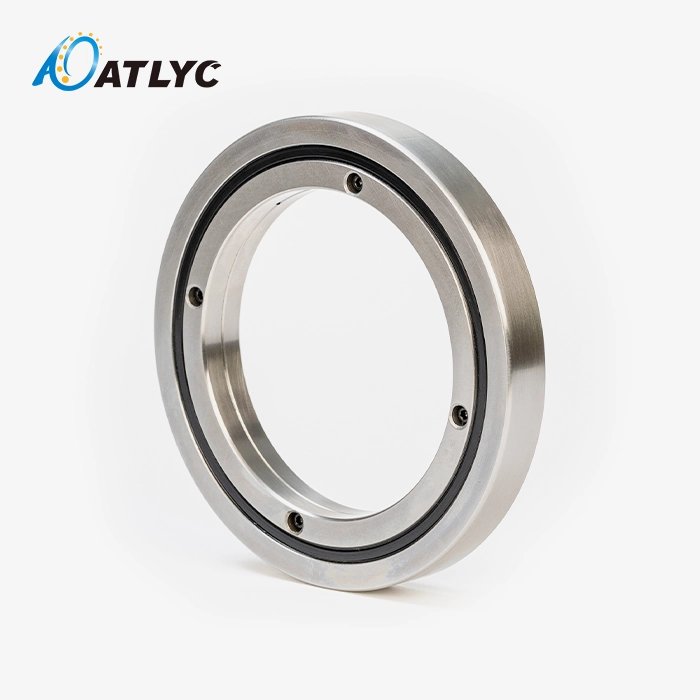
When precision and load capacity both matter, the RU Series Cross Roller Bearing wins decisively over standard bearings. Unlike conventional deep groove ball bearings or angular contact bearings, the RU Series handles radial, axial, and moment loads simultaneously within a single compact unit. Its integral inner and outer ring structure—complete with mounting holes—removes the need for extra housings, cutting assembly time and reducing geometric error. For OEMs, automation builders, and industrial equipment manufacturers who need zero-backlash performance in tight spaces, the RU cross roller bearing is the more capable choice.

Understanding RU Series Cross Roller Bearings
What Is the RU Cross Roller Bearing?
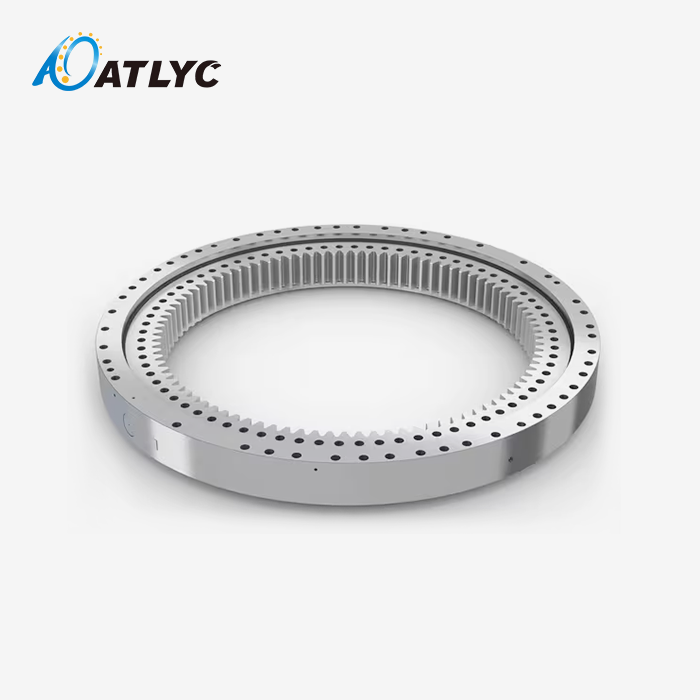
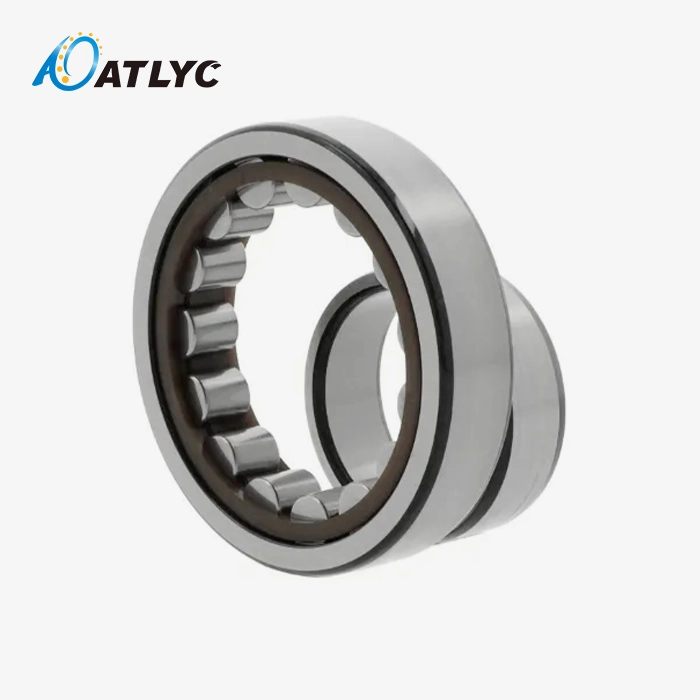
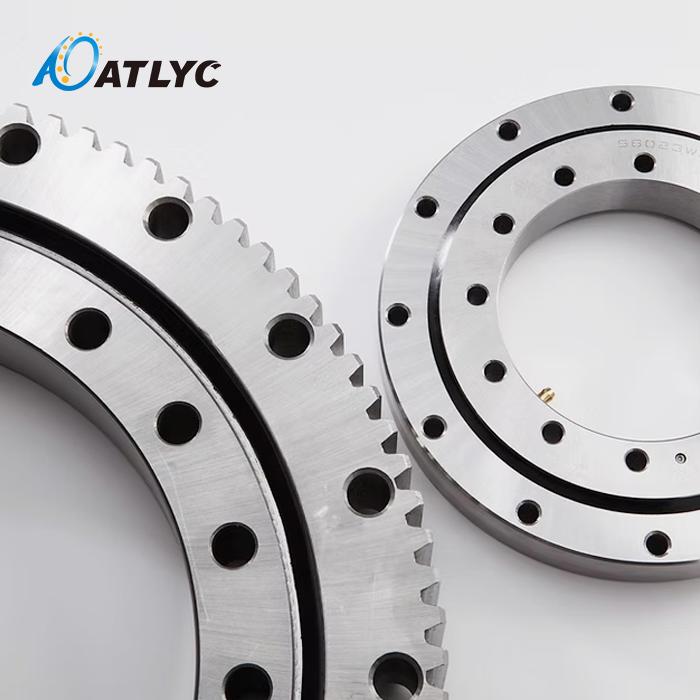
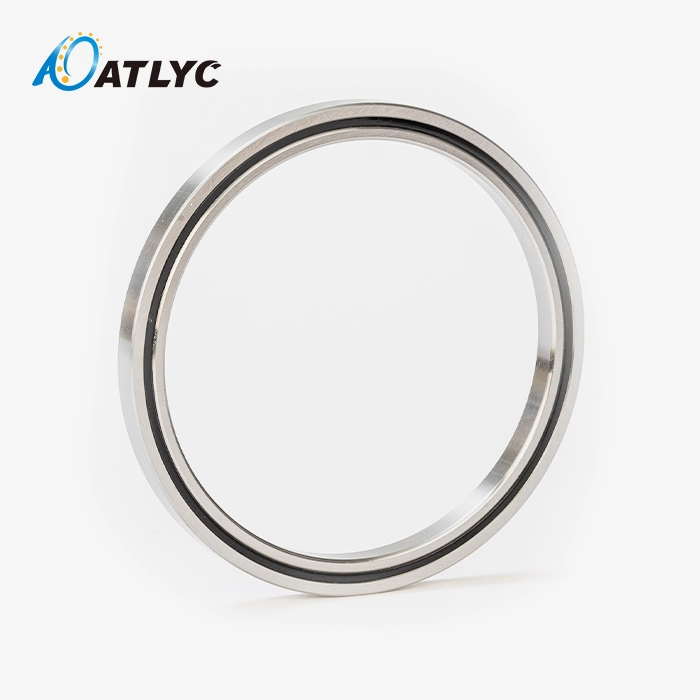
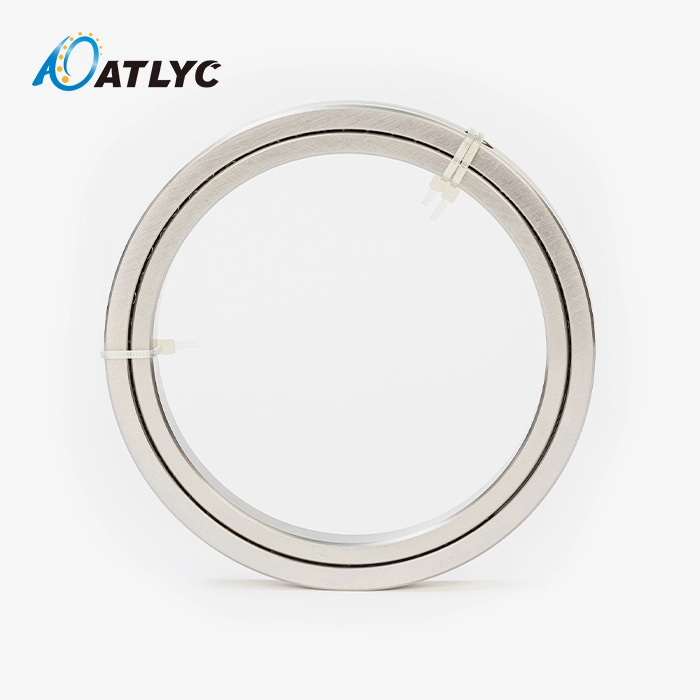
The RU cross roller bearing is a precision rolling element that has an outer ring and an inner ring that are both built-in and have fixing holes in them. Between V-groove raceways, cylindrical rollers are set up orthogonally, changing at 90-degree angles. This stepped design makes four-point load contact, which means the bearing can handle radial, axial, and moment loads all at once, without the need for a second bearing unit.
Size Range and Accuracy Grades
RU cross roller bearings are made by ATLYC in a wide range of sizes:
The inner diameter is 20 mm to 1,100 mm, the outer diameter is 70 mm to 1,500 mm, and the width is 12 mm to 110 mm. The accuracy grades are P6, P0, P5, P4, and P3.
| Parameter | Range |
|---|---|
| Inner Diameter | 20 mm – 1,100 mm |
| Outer Diameter | 70 mm – 1,500 mm |
| Width | 12 mm – 110 mm |
| Accuracy Grades | P6, P0, P5, P4, P3 |
There is a clear specification path from general industrial use (P6/P0) to sub-micron uses (P4/P3) with these grades, which are in line with ISO precision standards.
Material and Construction
Heat-treated to 58–64 HRC, GCr15 and GCr15SiMn high-carbon chromium bearing steel is used by ATLYC to make RU Series Cross Roller Bearings. There are high-precision spacers between each roller, which keep them from touching directly and keep the load evenly spread along the whole length of the raceway. The design of an integral ring gets rid of the structural flex points that show up in split-ring or flanged options.
Comparing RU Series and Standard Cross Roller Bearings
Load Capacity and Rigidity
In most deep groove ball bearings, the balls and raceways touch at a point. Under moment loads or mixed loads, they bend in a way that can be measured, and they need to be paired up or primed. The RU cross roller bearing has line contact along the entire length of the rollers. This makes it stiffer than angular contact ball bearing pairs of the same size, according to studies in bearing tribology (SKF Bearing Catalog, 2022).
Precision and Runout Accuracy
In the RU series, rotational runout can be kept within a few micrometers at the P4 and P3 grades. Runout values that are two to three times higher are common for standard angular contact ball bearings of the P5 grade. This gap is very important for artificial joints, precision rotary tables, and IC production tools where positioning errors build up along multiple axes.
Maintenance and Service Life
Because ball bearings aren't made to handle moment loads well, standard bearings need to be replaced more often in combined-load situations. The RU series roller design spreads contact stress out evenly, which makes the fatigue life longer in real-world situations. In high-temperature or high-load settings, GCr15SiMn steel is also better at resisting rolling contact wear than standard 52100-equivalent types.
Evaluating Market Solutions: RU Series vs. Other Bearing Types
When purchasing managers look at different types of cross roller bearings, they will see the RU along with the RB, RE, and RA models. To help you see where each product fits, here is a straight comparison:
| Feature | RU Series | RB/RE Series | Standard Ball Bearing |
|---|---|---|---|
| Mounting Holes | Yes (both rings) | No (requires flange) | No |
| Multi-axis Load | Radial + Axial + Moment | Radial + Axial + Moment | Radial or Axial only |
| Assembly Complexity | Low | Medium | Low |
| Precision Grade | P6 to P3 | P5 to P2 | P6 to P4 |
| Typical Application | Robots, rotary tables, medical | Thin-section precision | General machinery |
Even though the RB and RE series are very accurate, they need presser flanges or extra housings to be installed, which increases the cost and the number of steps needed to put them together. This is no longer needed with the RU series. This difference has a direct effect on the total purchase cost for buying teams that have to keep track of both the cost of labor for installation and the cost of bearings.
The RU series has the best accuracy, load range, and ease of installation for robot joints, slewing mechanisms on machining centers, and small automation modules. Standard angular contact or deep groove ball RU Series Cross Roller Bearings are still a good value for simple radial uses that don't require moment loads.
Installation & Maintenance Guide for RU Series Bearings
Correct Fitting Procedure
There's no need for flanges or housings with the RU cross roller bearing because it mounts directly through holes on both rings. Align the mounting holes with the surfaces of the two parts that fit together, and then use a calibrated torque wrench to tighten the bolts in a crosswise star pattern. To keep the raceway from warping, make sure the level of the attachment surface is between IT5 and IT7. The main reason why cross roller bearings fail too soon is distortion from uneven pressing.
Lubrication Schedule
As a standard fill, ATLYC suggests lithium soap-based grease, which is the same as Alvania EP2. If you work in an industry setting with a modest load and an air temperature below 80°C, you should replace the grease every 6 to 12 months. Shorten the time between checks to every 3 to 6 months if the bearing works in high temperatures or under heavy loads all the time. You can get to the grease nipples on either the inner or outer ring, depending on the type.
Common Troubleshooting Points
An unusual rise in torque during operation is generally a sign of pollution or the wrong preload. Make sure the fixing surface hasn't been over-torqued and that the grease port hasn't let any unwanted objects in. When there is too much radial runout after fitting, it usually means that the connecting part is not flat enough, not that the bearing is broken. Most problems in the field can be avoided by checking the flatness of the surface before putting it together.
Why Choose RU Series Bearings? Value Analysis for B2B Buyers
Certified Quality You Can Document
ATLYC is certified by both ISO 9001 and IATF 16949. This means that every batch of RU cross roller bearings is made and checked using a quality management system that is approved by automotive OEMs and Tier 1 suppliers. Records of defects and sizes can be found for each lot, which helps with supplier audits and the inspection process when the goods come in.
15 Years of Manufacturing Scale
ATLYC began in 2010 as a single workplace. Since then, it has grown to six production lines with 120 committed workers doing research and development, quality control, assembly, and production. With this scale, procurement managers can be sure that orders will be filled for both spot and blanket buy plans. Cross roller bearings from our company are currently used by people in South Korea, the US, Germany, Russia, Iran, and Turkey.
Applications That Confirm Performance
Here are the main areas of use where the RU series has been shown to work:
The waist and elbow axes of industrial robot joints are as follows: The bearing can handle a lot of different moment loads when the arm is extended, and it can keep zero-backlash accuracy for welding and assembly processes.CNC machining center rotary tables: Mounting directly through integral holes makes the table-to-base connection stronger, which lowers vibrations during high-speed milling and raises positioning accuracy to levels below one arc minute.
CT scanners and other medical imaging gantries: The bearing holds the weight of the scanner heads that are hanging off of it smoothly, with little runout and friction. This is needed for diagnostic picture quality.- Devices and tools for making ICs and measuring tools: At the P4 and P3 levels of accuracy, runout is kept to a few micrometers, which meets the needs of semiconductor process tools for precise placement.
Industrial robot joints (waist and elbow axes): The bearing carries complex moment loads during arm extension while maintaining zero-backlash repeatability for welding and assembly cycles.
CNC machining center rotary tables: Direct mounting via integral holes stiffens the table-to-base connection, reducing vibration during high-speed milling and improving positioning accuracy to sub-arc-minute levels.
Medical imaging gantries (CT scanners): The bearing supports the cantilevered weight of scanner heads smoothly, with low friction and minimal runout—both requirements for diagnostic image quality.
IC manufacturing devices and measuring instruments: At P4 and P3 accuracy grades, runout is controlled within micrometers, meeting the positioning demands of semiconductor process equipment.
The RU cross roller bearing is not a general-purpose product, as shown by these uses. It is a specially designed product for places where performance standards must be met.

Conclusion
The RU Series Cross Roller Bearing is better than regular bearings in all the ways that matter for precise industrial applications: it can hold more weight, rotates more accurately, is easier to install, and has a longer service life. Its integral ring design with mounting holes makes it easy to put together, and the use of GCr15 and GCr15SiMn steel in its construction ensures consistent fatigue resistance. OEMs and procurement teams looking at cross roller bearing options can see that the RU series is more cost-effective than both standard ball bearings and flanged cross roller options. This bearing works well when you need accuracy in more than one direction of load.
FAQ
1. How does the RU series differ from the RB or RE series?
The main change is the way the two are mounted. RU cross roller bearings don't need any flanges or housings to be installed because the fixing holes are built into both the inner and outer rings. For the RB and RE series, presser flanges are needed, which adds steps to the assembly process and the chance of an alignment error.
2. Can RU bearings handle continuous high-speed rotation?
Cross roller bearings are made to rotate at low to medium speeds or with irregularities. The dmn value is limited by standard grease lubrication. For some uses, oil-mist lubrication can make this value longer. Check the speed needs against the model's estimated dmn before making a specification.
3. What preload setting should I specify?
Set the negative clearance (V1 preload) for robotic joints that need to be very stiff. Standard clearance (CC0) is right for systems that move in general and where low friction is more important than maximum stiffness. For the exact RU model and size, look at the load-torque chart.
4. What is the minimum order quantity for bulk procurement?
Get in touch with ATLYC at auto@lyautobearing.com to talk about the minimum order quantity, wait times, and bulk prices for certain models and accuracy grades. We can take both small prototype orders and large blanket orders for the long term.
5. Are RU bearings compliant with automotive supply chain standards?
Yes. IATF 16949 is the minimum quality standard that all car component suppliers around the world must meet. ATLYC's manufacturing method is certified to this standard.
Request a Quote from ATLYC — Your RU Cross Roller Bearing Supplier
ATLYC makes RU Series Cross Roller Bearings that meet ISO 9001 and IATF 16949 standards. They have been exporting these bearings to OEMs and wholesalers in the US, Germany, South Korea, and other places for 15 years. Our engineering team can help you with all of your technical needs, whether you need a normal catalog size or a custom design. You can email us at auto@lyautobearing.com to get a price or talk about the needs of your application.
References
1. SKF Group. SKF Rolling Bearings Catalogue. SKF, 2022.
2. Harris, T. A., & Kotzalas, M. N. Essential Concepts of Bearing Technology. CRC Press, 2006.
3. ISO. ISO 492: Rolling Bearings — Radial Bearings — Dimensional and Geometrical Tolerances. International Organization for Standardization, 2014.
4. Eschmann, P., Hasbargen, L., & Weigand, K. Ball and Roller Bearings: Theory, Design and Application. John Wiley & Sons, 1985.
5. NSK Ltd. NSK Precision Machine Components Catalogue. NSK Technical Report, 2020.
6. IATF. IATF 16949:2016 — Quality Management System Requirements for Automotive Production and Relevant Service Parts Organizations. International Automotive Task Force, 2016.
Learn about our latest products and discounts through SMS or email