- English
- French
- German
- Portuguese
- Spanish
- Russian
- Japanese
- Korean
- Arabic
- Greek
- German
- Turkish
- Italian
- Danish
- Romanian
- Indonesian
- Czech
- Afrikaans
- Swedish
- Polish
- Basque
- Catalan
- Esperanto
- Hindi
- Lao
- Albanian
- Amharic
- Armenian
- Azerbaijani
- Belarusian
- Bengali
- Bosnian
- Bulgarian
- Cebuano
- Chichewa
- Corsican
- Croatian
- Dutch
- Estonian
- Filipino
- Finnish
- Frisian
- Galician
- Georgian
- Gujarati
- Haitian
- Hausa
- Hawaiian
- Hebrew
- Hmong
- Hungarian
- Icelandic
- Igbo
- Javanese
- Kannada
- Kazakh
- Khmer
- Kurdish
- Kyrgyz
- Latin
- Latvian
- Lithuanian
- Luxembou..
- Macedonian
- Malagasy
- Malay
- Malayalam
- Maltese
- Maori
- Marathi
- Mongolian
- Burmese
- Nepali
- Norwegian
- Pashto
- Persian
- Punjabi
- Serbian
- Sesotho
- Sinhala
- Slovak
- Slovenian
- Somali
- Samoan
- Scots Gaelic
- Shona
- Sindhi
- Sundanese
- Swahili
- Tajik
- Tamil
- Telugu
- Thai
- Ukrainian
- Urdu
- Uzbek
- Vietnamese
- Welsh
- Xhosa
- Yiddish
- Yoruba
- Zulu
What Makes RE Series Crossed Roller Bearing So Reliable?
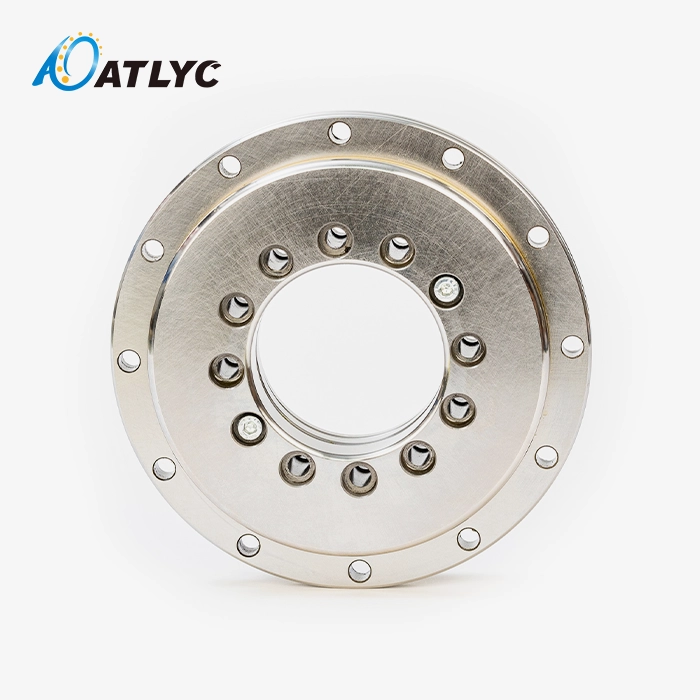
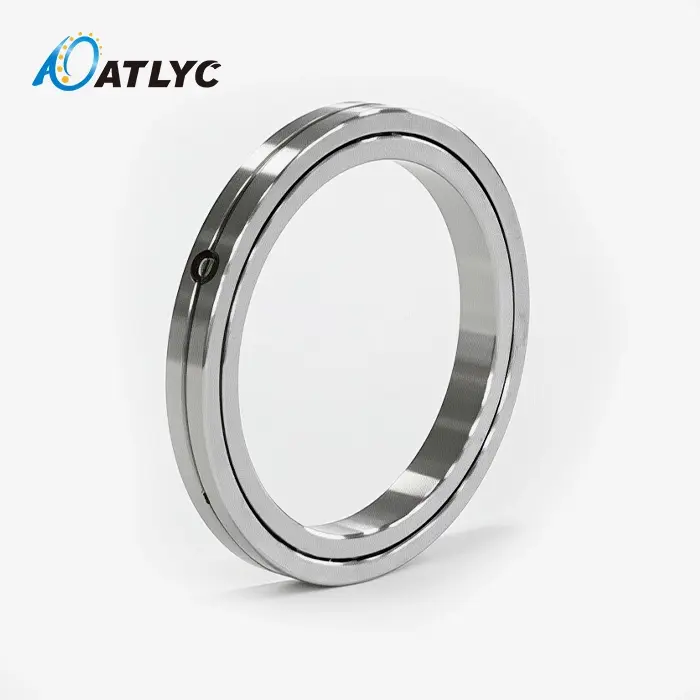
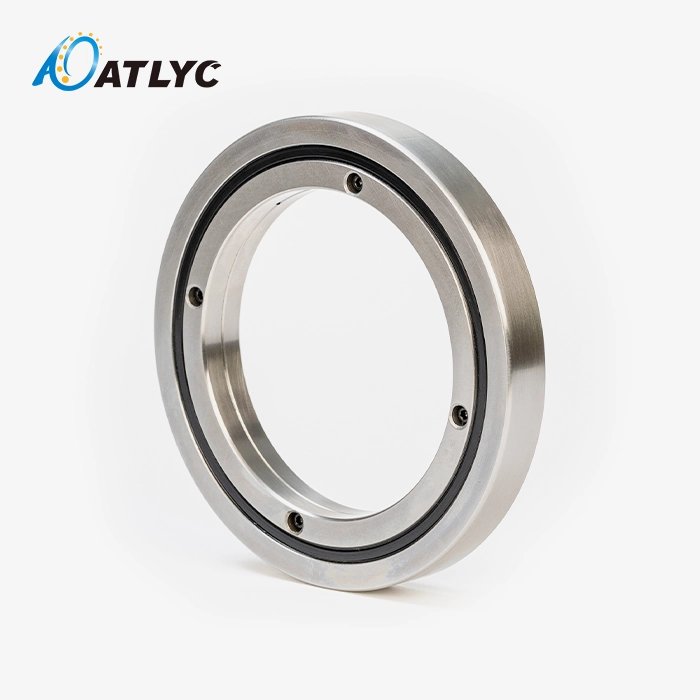
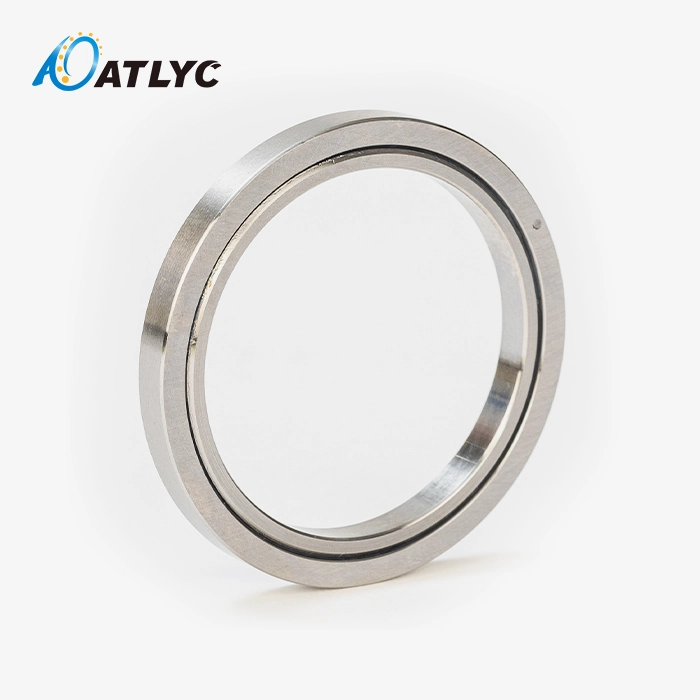
The RE Series Crossed Roller Bearing is famous for its structural design that is capable of handling radial, axial, and moment stresses in one compact unit. The integrated outer ring combined with a split inner ring makes the raceway geometry constant under stress conditions, and the precision-ground V-groove channels keep the rollers aligned for millions of cycles. This crossed roller bearing is manufactured from GCr15 or GCr15SiMn bearing steel and is available in accuracy grades from P6 to P3. It gives the micron-range runout accuracy needed for automation systems, robotic joints, and precision rotary tables.

Understanding RE Series Crossed Roller Bearing Reliability
The Orthogonal Roller Arrangement
The RE Series Crossed Roller Bearing has precision-ground V-groove raceways in which cylindrical rollers are held at 90 degrees to each other. This configuration along a straight line allows line contact in different directions of the load. This implies the bearing does not bend and does not require a separate support system. The contact angle design equalizes tension across each roller. This prevents localized fatigue and boosts the service interval considerably over normal ball bearing configurations.
Integral Outer Ring and Split Inner Ring Design
This is distinct from the RB series in that the construction is backward. The outer ring is a solid piece, but the inner ring may be assembled by dividing it in half. This arrangement holds the outer raceway in position while it turns, and allows the preload to be set accurately during installation. This form is useful for engineers designing machining center rotary tables or robotic wrist joints, since it retains the runout limits within 5 to 10 micrometers, even when moment loads alter.
Material and Hardness Standards
Each ATLYC RE Series Crossed Roller Bearing is produced from high carbon chromium bearing steel GCr15 or GCr15SiMn, hardened to HRC 58–64. With heavy cyclic loads, its hardness prevents surface wear and propagation of fractures below the surface. The choice of materials directly supports longer greasing intervals and replacement cycles. This reduces total cost of ownership in high-volume manufacturing environments where downtime costs money.
Comparing RE Series Crossed Roller Bearings with Other Bearing Types
Procurement teams frequently ask how a crossed roller bearing justifies its price point against more common alternatives. The answer lies in load versatility and dimensional economy. The table below compares key performance factors across four bearing types relevant to precision industrial applications.
| Bearing Type | Multi-Direction Load | Moment Capacity | Typical Runout Accuracy | Relative Footprint |
|---|---|---|---|---|
| RE Crossed Roller | Yes | High | P3–P6 | Compact |
| Deep Groove Ball | Radial + Light Axial | Low | P6–P0 | Compact |
| Cylindrical Roller | Radial Only | Very Low | P5–P6 | Moderate |
| Slewing Ring | Yes | High | P0–P6 | Large |
Load Capacity Comparison
A standard deep groove ball bearing of equivalent bore size carries roughly 15–20% of the moment load that a crossed roller bearing handles. Cylindrical roller bearings handle radial loads well but cannot sustain axial or moment loads without additional thrust components. The RE Series eliminates the need for supplementary bearings in many layouts, which directly lowers assembly complexity and reduces potential failure points in the drivetrain.
Precision and Runout Accuracy
Ball bearings in standard P0 grade show runout values in the 15–20 micrometer range. The RE Series crossed roller bearing in P4 or P3 grade achieves 3–5 micrometers of radial runout, which matters enormously in IC manufacturing equipment or coordinate measuring machines where position error accumulates across multiple axes.
Cost-Performance Ratio Over Service Life
The unit price of a crossed roller bearing exceeds that of a standard ball bearing, but the total cost comparison shifts over time. Replacing two or three conventional bearings with one crossed roller bearing reduces housing machining costs, assembly labor, and maintenance downtime. For OEMs producing industrial robots or precision tables in volume, this lifecycle arithmetic favors the RE Series.
Applications and Benefits of RE Series Crossed Roller Bearings
RE Series Crossed Roller Bearings are suitable for applications requiring accommodation of a range of loads without loss of precise rotation. They’re engineered for genuine gains in quality and output in robotics, precision machining, and medical instruments.
These are the key application areas where you may get meaningful performance improvements with this bearing:
Manipulator arms and industrial robot joints: The short section height and high moment load rating allow the designer of the robot arm to put the bearing directly at the joint, minimizing arm weight and backlash. Servo motors with a coefficient of friction of 0.002–0.004 provide fine torque control.
Rotary tables in machining centers: Radial and axial runout precision within P3-P5 tolerances provides constant workpiece placement over long production runs. The stiff raceway shape resists cutting forces without any observable table deflection.
Medical imaging and measuring instruments: CT scanner gantries and coordinate measuring arms can’t tolerate low torque variation, and they can’t afford to rotate smoothly from start to finish. The split inner ring design provides a regulated preload that eliminates play without straining the motor drive.
IC production and semiconductor equipment: Product yield is dependent on micron precision in wafer handling and lithography steps. The RE Series bearing’s P3 precision grade and steady operating torque enable these narrow process windows.
These are industrial robot joints and robot arms: The section is compact in height and has a high moment load rating, allowing robot arm designers to locate the RE Series Crossed Roller Bearing precisely at the joint. This leads to a lighter arm and less backlash. Servo motors are able to manage power extremely accurately in the range of 0.002-0.004 of friction values.
Selecting and Procuring RE Series Crossed Roller Bearings for Your Business
Size Range and Specification Matching
The RE Series covers everything from 20 mm to 1,100 mm interior diameter, 70 mm to 1,500 mm exterior diameter, and 12 mm to 110 mm breadth. The range covers everything from a little robot wrist to a large rotary table on a vertical cutting center. Accuracy levels are dependent on the accuracy level required for each application (P6, P0, P5, P4, and P3). P3 is ideal for the toughest placement duties.
The chart below is a simple guide to help you choose the correct grade for the project. It also lists the accuracy grade, normal application, and maximum radial runout for each. The grades are: P6 for general industrial machinery (15 µm), P0 for conventional automation equipment (10 µm), P5 for precision rotary tables (8 µm), P4 for robotic joints and measurement instruments (5 µm), and P3 for IC production and medical devices (3 µm).
| Accuracy Grade | Typical Application | Max Radial Runout |
|---|---|---|
| P6 | General industrial machinery | 15 µm |
| P0 | Standard automation equipment | 10 µm |
| P5 | Precision rotary tables | 8 µm |
| P4 | Robotic joints, measuring instruments | 5 µm |
| P3 | IC manufacturing, medical devices | 3 µm |
Procurement, Logistics, and Customization
ATLYC lets you buy in bulk and has flexible minimum order quantities (MOQs) for standard catalog sizes. They also offer engineering advice for bore or width sizes that aren't standard. Lead times for standard sizes are usually between 2 and 4 weeks, and OEM programs that need a steady supply can get priority scheduling. Certain preload classes, special cage materials for cleanrooms, and surface treatments for corrosive working conditions are all customization choices.
Quality Assurance and Certification
ATLYC is certified by both ISO 9001 and IATF 16949, which set rules for controlling the whole process, from checking the raw steel to making sure the final measurements are correct. Before it is shipped, each bearing is measured for runout, its dimensions are checked, and its toughness is tested. This quality system helps meet the zero-defect supply needs of customers in the semiconductor and car industries.
Why Choose RE Series Crossed Roller Bearings from Trusted Manufacturers
When you purchase crossed roller bearings from a firm that uses in-depth quality techniques, you can be certain that the parts you are utilizing are authentic and the tolerances are consistent. IKO, THK, NSK, KOYO, and Nachi are long-term suppliers that have earned their reputations on their ability to trace their materials and maintain consistent dimensions. ATLYC has been in operation since 2010 and has evolved from one workshop to six. Today it has 120 manufacturing and IT personnel serving clients in South Korea, the US, Germany, Russia, Iran, and Turkey.
Request material certifications, hardness test results, and dimensional inspection reports with each shipment to ensure the authenticity of everything. These papers are provided via approved wholesalers and direct plant purchases, not spot buys from unreliable sources. But that paperless approach is an unacceptable risk whether your application is a medical robot arm or a five-axis machining facility.

Conclusion
The RE Series Crossed Roller Bearing has a solid outer ring for raceway stabilization, a split inner ring geometry for precise preload, composed of GCr15 steel hardened to HRC 58-64, and precision grades down to P3. It replaces several bearing arrangements in robotics, machining, medical, and semiconductor equipment with a single tiny unit, simplifying assembly and reducing maintenance intervals. For purchasing teams, the total cost of ownership, a product's long life, uniform dimensions, and ISO-certified supply chain assistance from organizations like ATLYC make the argument for investment apparent.
FAQ
1. What is the primary structural difference between RE and RB series bearings?
The outer ring of the RE Series Crossed Roller Bearing is one piece, and the inner ring is split. This makes it suitable for uses where the inner ring needs to rotate. This is not true for the RB series, which has a split inner ring design that makes it easier for the outer ring to rotate. Picking the right series relies on which ring your housing holds and which ring moves with the load.
2. Can one RE Series bearing handle moment loads alone?
Yes. It can handle radial, axial, and moment loads at the same time without a paired bearing because the orthogonal roller setup makes a wide effective load span within a single bearing width. This is the main reason why crossed roller bearings are used instead of matched angular contact pairs in machining center tables and robot joints.
3. What lubrication does the RE Series require?
A lot of the RE Series Crossed Roller Bearings come with lithium soap-based grease already on them, like Alvania EP2. Low-outgassing options are needed for cleanroom and vacuum applications, and ATLYC can provide them upon request. Re-lubrication times vary with the speed and temperature of the machine, but in normal industrial settings, they are usually between 3,000 and 5,000 hours.
4. Is customization available for non-standard dimensions?
Yes. The engineering team at ATLYC can handle unique bore sizes, widths, and preload requirements that aren't in the normal stock range. Lead times for custom configurations depend on the need for custom tools. Customers should call the factory directly to make sure the configuration is possible and to find out when it can be delivered.
Partner with ATLYC for Your Next RE Series Crossed Roller Bearing Order
For 15 years, ATLYC has sold precision bearings to companies in the US, Germany, South Korea, and other places. We are a verified producer of the RE Series Crossed Roller Bearing and have ISO 9001 and IATF 16949 certifications. We offer direct factory prices, flexible order amounts, and quality records with every shipment. You can email our engineering team at auto@lyautobearing.com to get a quote or talk about your needs right away.
References
1. Harris, T. A., & Kotzalas, M. N. Essential Concepts of Bearing Technology. CRC Press, 2006.
2. International Organization for Standardization. ISO 492: Rolling Bearings — Radial Bearings — Dimensional and Geometrical Tolerances. ISO, 2014.
3. International Organization for Standardization. ISO 9001: Quality Management Systems — Requirements. ISO, 2015.
4. IATF. IATF 16949: Quality Management System Requirements for Automotive Production and Relevant Service Parts Organizations. IATF, 2016.
5. Eschmann, P., Hasbargen, L., & Weigand, K. Ball and Roller Bearings: Theory, Design and Application. John Wiley & Sons, 1985.
6. Hamrock, B. J., Schmid, S. R., & Jacobson, B. O. Fundamentals of Machine Elements. McGraw-Hill, 2005.
Learn about our latest products and discounts through SMS or email