- English
- French
- German
- Portuguese
- Spanish
- Russian
- Japanese
- Korean
- Arabic
- Greek
- German
- Turkish
- Italian
- Danish
- Romanian
- Indonesian
- Czech
- Afrikaans
- Swedish
- Polish
- Basque
- Catalan
- Esperanto
- Hindi
- Lao
- Albanian
- Amharic
- Armenian
- Azerbaijani
- Belarusian
- Bengali
- Bosnian
- Bulgarian
- Cebuano
- Chichewa
- Corsican
- Croatian
- Dutch
- Estonian
- Filipino
- Finnish
- Frisian
- Galician
- Georgian
- Gujarati
- Haitian
- Hausa
- Hawaiian
- Hebrew
- Hmong
- Hungarian
- Icelandic
- Igbo
- Javanese
- Kannada
- Kazakh
- Khmer
- Kurdish
- Kyrgyz
- Latin
- Latvian
- Lithuanian
- Luxembou..
- Macedonian
- Malagasy
- Malay
- Malayalam
- Maltese
- Maori
- Marathi
- Mongolian
- Burmese
- Nepali
- Norwegian
- Pashto
- Persian
- Punjabi
- Serbian
- Sesotho
- Sinhala
- Slovak
- Slovenian
- Somali
- Samoan
- Scots Gaelic
- Shona
- Sindhi
- Sundanese
- Swahili
- Tajik
- Tamil
- Telugu
- Thai
- Ukrainian
- Urdu
- Uzbek
- Vietnamese
- Welsh
- Xhosa
- Yiddish
- Yoruba
- Zulu
What Is a Pitch Bearing and How Does It Improve Turbine Life?
A massive slewing bearing, called a pitch bearing, sits between the blade root and hub of a wind turbine. Each blade can spin on its own axis; thus, the control system may change the angle of the blades to harvest electricity or get them out of the path of the wind during storms. A properly selected pitch bearing can deal with aerodynamic loads, accommodate coupled forces, and not wear out when tiny, frequent motions occur. That means less stress on the blades, hub, drivetrain, and tower, which helps the turbine last longer and cost less to maintain. Here I tell about how it works, how to pick one, and what purchasers should look for. This reference is for turbine OEMs, component engineers, purchasing teams, distributors, and operators who need to discover replacement components.

What Is a Pitch Bearing in a Wind Turbine?
Role at the Blade Root
Each blade of a modern turbine is connected to the hub by a pitch bearing. The blade may rotate along its longitudinal axis, and the bearing receives axial loads, radial loads, and overturning moments from the rotor. It adjusts the blade angle for start-up, regular operation, strong wind, shutdown, and emergency feathering. It achieves this by interacting with the pitch motor, gearbox, pinion, and control system. This combination of varying aerodynamic loads, outside pollution, and frequent low-speed oscillation is not something a standard-purpose industrial bearing is used to deal with. That is why I think of the pitch bearing as an element of motion, but also a structural junction between hub and blade. Knowing the duality makes it simpler to make decisions later.
How a Pitch Bearing Works
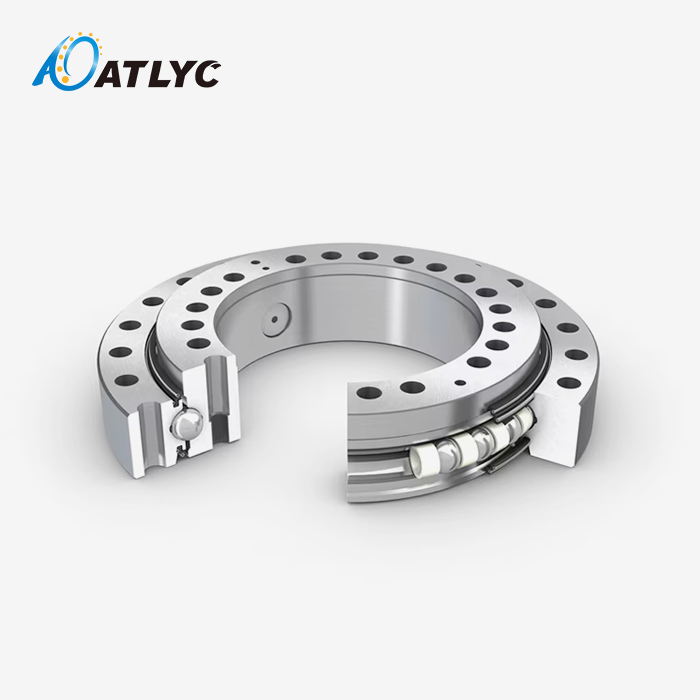
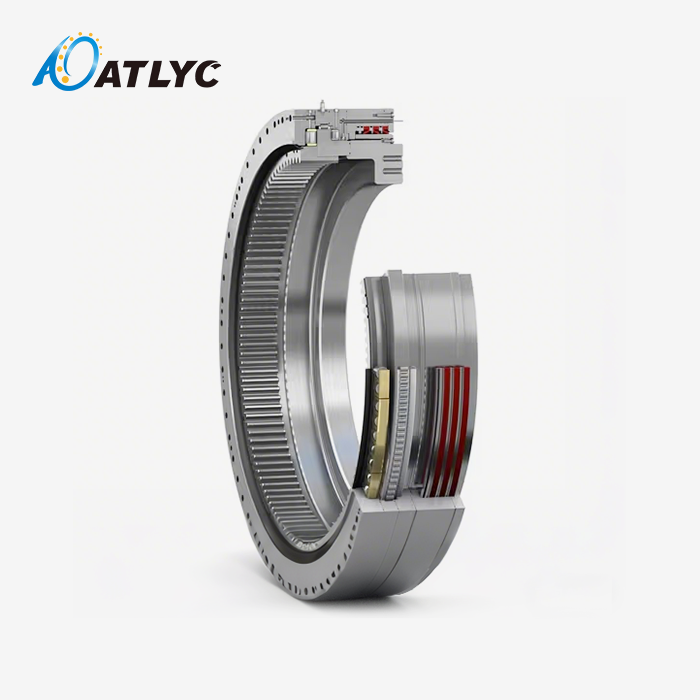
A bearing comprises an inner ring, an outer ring, raceways, rolling components, seals, mounting holes, and holes for lubrication. A cut gear ring on one of the rings is engaged by a pinion on the pitch drive. This causes the blade to rotate. The loads are transferred from the blade flange to the hub flange via the rolling components. The double-row four-point contact ball bearing and the full complement cylindrical roller bearing are the two prevalent structures. Both can carry huge weights from blades that travel back and forth a lot. Pitch response, control stability, and noise are affected by the quality of the machining, the hardness of the raceways, the friction, the stiffness, and the accuracy of the gears. Then I’ll tell you how the drive links depend on the way the gears are built up.
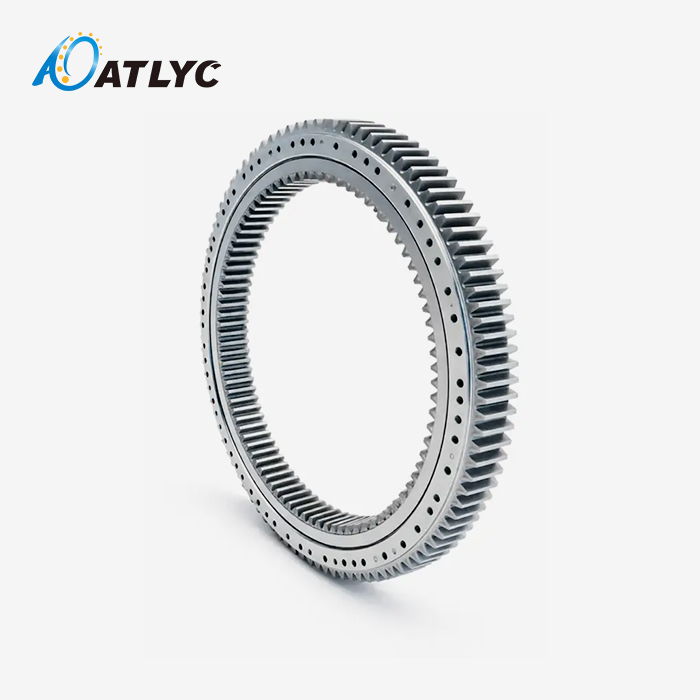
Internal Gear, External Gear, and Ungeared Layouts
There are three alternative designs for the pitch bearing. This kind of bearing contains teeth on the inner ring so they are kept within the hub for protection. With an external gear, the teeth are on the outer ring, making them easy to clean & examine. An ungeared bearing has no teeth and employs a separate drive. The configuration of the pitch drive, the area available for installation, and the maintenance plan determine the optimum option. ATLYC pitch bearings use a built-in gear ring for more precise blade angle adjustment. Replacement units should be the same form as the originals. Generally, unless you are re-designing the whole pitch system.
How Does a Pitch Bearing Improve Turbine Life?
Controlled Blade Angle Reduces Load Transfer
The control system pitches the blades to limit the aerodynamic force the rotor can take in when the wind speed goes above the rated level. This keeps the output of power steady and lowers the loads on the blades, hub, main shaft, gearbox, generator, tower, and base. Each command is carried out by the pitch bearing, so friction, stiffness, and backlash have a direct impact on how accurately the blade responds. When the weather is bad, the bearing lets the blades feather, which protects the unit. Over many years of use, smaller load peaks slow the wear and tear on all the parts that are connected. This is the primary way that a good Pitch Bearing increases the life of the turbine.
Hardness, Lubrication, and Sealing Protect the Bearing
Because pitch bearings mostly oscillate rather than rotate, new lubricant has a hard time getting to the area where the rolling elements and raceways touch. False brinelling and fretting wear can happen in these situations. Part of the problem is fixed by making the raceways all the same hardness. ATLYC uses non-soft zone quenching to get rid of soft spots that wear out too quickly when loads move back and forth. A better lubrication design keeps the grease spread out even when the parts move a lot. Multiple layers of sealing keep out water and dirt, which is especially important offshore, where salt spray and high humidity are common. Load range, bolt preload, mounting accuracy, and operating temperature are some of the other things that affect how long a bearing lasts.
Condition Monitoring Catches Problems Early
Even a well-made bearing needs to be looked at. To find wear before it causes the machine to shut down, operators can keep an eye on pitch motor torque, vibration, backlash, temperature rise, and grease condition. Increasing torque is often a sign of dirt or poor lubrication, while increasing backlash can mean that the raceway or gear teeth are wearing down. When you record results across a fleet, you can see patterns, like a site that has seal problems over and over again. Because ISO 281 methods were made for rotating bearings, NREL's DG03 guideline on yaw and pitch rolling bearing life changes the way standard life calculations are done for oscillating motion. Pitch bearing replacement typically requires removing a blade and using a crane, so early detection is important. A planned repair costs a lot less than a failure that wasn't planned.
Pitch Bearing Designs and Selection
Ball and Roller Designs Compared
In pitch applications, double-row four-point contact ball bearings are often used. They carry combined loads in a small space and help many turbines find a good balance between cost and capacity. Full complement cylindrical roller bearings are good for designs that need more stiffness and load capacity. This is because the rollers spread the contact stress along a line instead of a point. There are trade-offs between friction, weight, cost, and the need for lubrication. When the load is light, a single row may work, but when the load is heavy, more rows are usually needed. When making things with a large diameter, there are extra problems to deal with, like machining tolerances, bolt loads, handling, and making sure the parts are installed correctly. People who want to buy should give the manufacturer full load data before they choose a type.
Data to Collect Before Selection
It's not enough to just match the outside diameter or part number. First, decide on the type of turbine, its operating environment, the features of its blades and hub, and how long it should last. Next, make sure you know if the project is an OEM supply, a replacement, a retrofit, or a custom development. Sizes of the bearings, the bolt pattern, the shape of the flange, the gear module, the number of teeth, the position of the gear, and the compatibility of the actuator should all be included in the interface data. Axial and radial forces, tilting moments, load spectra, static safety factors, and emergency situations are all part of load evaluation. Lastly, before you place an order, check the inspection records, heat treatment, accuracy of the gear, sealing, and the ability to track the materials used.
ATLYC Pitch Bearing Product Overview
ATLYC Pitch bearing characteristics for wind power applications are summarized here.
| Item | Detail |
|---|---|
| Typical structures | Double-row four-point contact ball bearing; full complement cylindrical roller bearing |
| Outer diameter range | 1000 mm to 2500 mm |
| Heat treatment | Non-soft zone quenching for uniform raceway hardness |
| Gear design | Integrated gear ring |
| Lubrication | Refined design for frequent mechanical movement |
| Sealing | Multiple sealing layers |
| Sizing | Adjusted to blade weight and load for megawatt-class turbines |
These features are meant to work with the modern turbines' oscillating motion and complicated load spectra. Our engineers can look over the application with you if your blade weight or load is different from standard sizes.
Failure Symptoms, Maintenance, and Bearing Comparisons
Common Failure Symptoms and Root Causes
Blade movement, torque, noise, vibration, temperature, or grease condition are frequently the first signs of a pitch bearing problem. The following table shows how common symptoms are likely to be caused.
| Symptom | Possible causes |
|---|---|
| Excess backlash | Raceway wear, rolling-element damage, gear tooth wear, loose bolts, incorrect preload |
| Rising pitch motor torque | Insufficient grease, contamination, seal damage, misalignment, gear interference |
| Noise or irregular rotation | Fatigue, spalling, false brinelling, deformation, uneven tightening |
A diagnosis that uses visual inspection, data from the control system, torque readings, and grease analysis all at the same time finds the problem faster than any single check.
Maintenance and Installation Requirements
Lubrication is the first step in maintenance. Follow the recommended re-lubrication schedules, paying special attention to the raceways and open gears. Use the right type of grease, the right amount, and make sure it works with the part. Check for corrosion, backlash, rotation torque, seals, raceways, gear teeth, mounting bolts, and backlash. Write down the results for fleet analysis. Quality of installation is just as important. Make sure the flange is flat, the bolt holes are lined up, the surface is clean, and the bolts are tightened in a controlled way. Regularly retorquing the mounting bolts helps keep the ring from distorting and fretting. Protect spare units during transport, keep them from rusting while they're being stored, get the right lifting equipment, and make sure everything works with the scheduled turbine service.
Pitch Bearing vs. Yaw Bearing and Standard Bearings
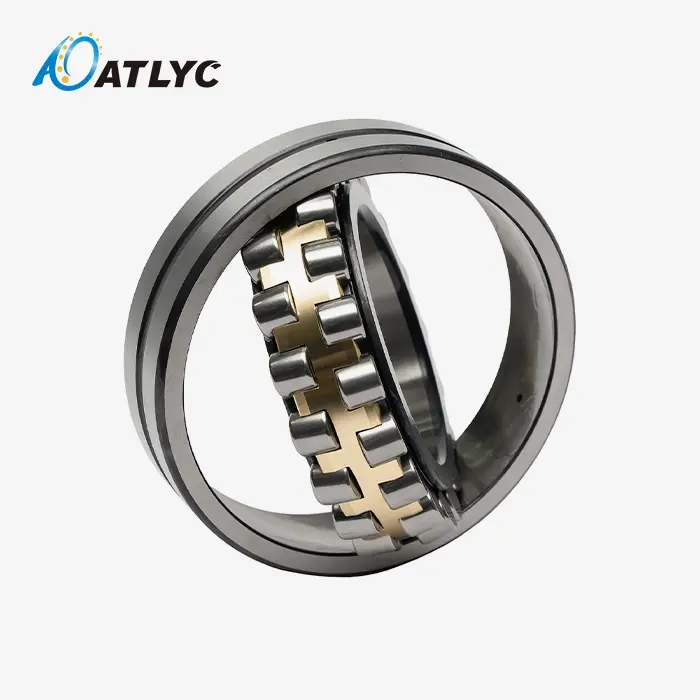
There is a yaw bearing between the nacelle and the tower that turns the nacelle so that it faces the wind. A single blade is rotated by a pitch bearing at each blade's root. Yaw bearings are typically bigger, while pitch bearings typically have an outer diameter of 1000 mm to 2500 mm. Both types of bearings slew, but they have different control, sealing, load ranges, and gear arrangements. Without engineering approval, a standard industrial bearing should not be used to replace a pitch bearing. It might not have enough moment capacity, the wrong gearing, a short fatigue life, too much backlash, or mounting dimensions that don't work with each other.
Procurement Guide and Manufacturer Support
Preparing a Complete RFQ
A clear RFQ cuts down on the time it takes to get quotes and stops wrong matches. Include the model of the turbine, the bearing position, the original part number, drawings, the interface dimensions, details about the gears, load data, the amount, the delivery location, the certification needs, the inspection expectations, and the target date. Engineers can also make sure the bearing and nameplate are compatible by taking pictures of them. The price is based on the diameter, weight, gear configuration, material, testing, paperwork, lead time, and logistics. I recommend that U.S. buyers confirm the export packaging and shipping terms as soon as possible. Total lifecycle risk should be taken into account along with unit price, since a cheap bearing that breaks down quickly can cost a lot more in crane work and downtime.
Evaluating a Supplier
Look for experience in the wind industry, the ability to make large diameters, engineering support, quality system certification, process traceability, warranty terms, and service after the sale. This is Luoyang Auto Bearing Co., Ltd. ATLYC was founded in 2010. We now have six workshops with 120 skilled workers who do things like production, R&D, quality control, and assembly. Our clients come from South Korea, the US, Germany, Russia, Iran, and Turkey. We are certified by ISO 9001 and IATF 16949. You should get material certificates and inspection reports from all of your suppliers, including us, and then compare them to what you want.
How a Qualified Manufacturer Supports Turbine Life
Before, during, and after production, a good manufacturer adds value. According to the engineering review, the types of bearings, loads, gear geometry, materials, mounting interfaces, and replacement compatibility are all looked at. Inspection of raw materials, CNC machining, heat treatment, raceway grinding, gear cutting, hardness testing, runout measurement, dimensional inspection, and final assembly checks should all be part of production controls. Buyers can ask for pictures, datasheets, certificates of materials, inspection reports, quality certificates, packing lists, and information about the warranty. Fleet owners can stick to one design because of stable lead times, consistent batch quality, and spare part support. This makes planning maintenance easier across all sites.
Conclusion: Selecting the Right Pitch Bearing for Longer Turbine Life
Each blade is mounted to the hub with a pitch bearing, which also takes a combination of axial, radial, and overturning stresses. The control system can adjust the blade angle to either produce electricity or shield it from the wind. It extends turbine life by reducing drivetrain and tower load and by preventing wear via constant raceway hardness, correct lubrication, and excellent sealing. Four-point contact balls and full complement cylindrical rollers allow for customisation for varied load and stiffness needs. It is contingent upon what sort of load, size, and configuration of the gears and the surroundings. Proper installation, condition monitoring and periodic maintenance will identify concerns before they become problems. Complete RFQ and prudent supplier qualification will minimise lifetime risk. Value isn’t only the lowest unit price.
FAQ
What does a pitch bearing do?
The control system can set the angle of each blade by letting them spin on their axes. It also holds axial loads, radial loads, and moments of overturning between the blade and the hub.
Why does pitch bearing life vary between turbines?
Life depends on the type of load, how well it is mounted, how much preload is on the bolts, how well contamination is controlled, and the temperature. The level of maintenance can also change the results, so even two turbines with the same bearing can age in different ways.
What causes most failures?
Some common reasons are contamination, poor lubrication, bad mounting, gear wear, and too much load. False brinelling is also more likely when there is oscillating motion.
Can a standard slewing bearing replace it?
Not until engineering proves it. Moment capacity, gearing, backlash, and the size of the mounting hole might not all be the same.
What do you need for a quotation?
Send the model of the turbine, the number of the existing bearing, drawings or photos, key dimensions, gear specifications, load information, the amount, and the address where the goods will be delivered.
Request a Pitch Bearing Technical Review or Quotation
Are you planning a turbine project or looking for replacements? Pitch bearing manufacturer ATLYC has six workshops, engineers who are ready to look over your drawings, and ISO 9001 and IATF 16949 certification. Get in touch with auto@lyautobearing.com with your turbine model, bearing number, dimensions, gear data, load information, quantity, and delivery location. We will respond with feedback on your application, details about the quote, and information about the lead time. You can find out more at https://aotezhoucheng.aixdb.cn/ as well.
References
1. ISO 281: Rolling Bearings — Dynamic Load Ratings and Rating Life, 2007
2. IEC 61400-1: Wind Energy Generation Systems — Part 1: Design Requirements, 2019
3. NREL, Wind Turbine Design Guideline DG03: Yaw and Pitch Rolling Bearing Life, 2009
4. Wind Energy Handbook (Burton, Jenkins, Sharpe, Bossanyi), 2011
5. U.S. Department of Energy, Land-Based Wind Market Report: 2023 Edition, 2023

6. ISO 9001: Quality Management Systems — Requirements, 2015
Learn about our latest products and discounts through SMS or email