- English
- French
- German
- Portuguese
- Spanish
- Russian
- Japanese
- Korean
- Arabic
- Greek
- German
- Turkish
- Italian
- Danish
- Romanian
- Indonesian
- Czech
- Afrikaans
- Swedish
- Polish
- Basque
- Catalan
- Esperanto
- Hindi
- Lao
- Albanian
- Amharic
- Armenian
- Azerbaijani
- Belarusian
- Bengali
- Bosnian
- Bulgarian
- Cebuano
- Chichewa
- Corsican
- Croatian
- Dutch
- Estonian
- Filipino
- Finnish
- Frisian
- Galician
- Georgian
- Gujarati
- Haitian
- Hausa
- Hawaiian
- Hebrew
- Hmong
- Hungarian
- Icelandic
- Igbo
- Javanese
- Kannada
- Kazakh
- Khmer
- Kurdish
- Kyrgyz
- Latin
- Latvian
- Lithuanian
- Luxembou..
- Macedonian
- Malagasy
- Malay
- Malayalam
- Maltese
- Maori
- Marathi
- Mongolian
- Burmese
- Nepali
- Norwegian
- Pashto
- Persian
- Punjabi
- Serbian
- Sesotho
- Sinhala
- Slovak
- Slovenian
- Somali
- Samoan
- Scots Gaelic
- Shona
- Sindhi
- Sundanese
- Swahili
- Tajik
- Tamil
- Telugu
- Thai
- Ukrainian
- Urdu
- Uzbek
- Vietnamese
- Welsh
- Xhosa
- Yiddish
- Yoruba
- Zulu
What Makes RB8016UUCC0 Series Crossed Roller Bearing Special?
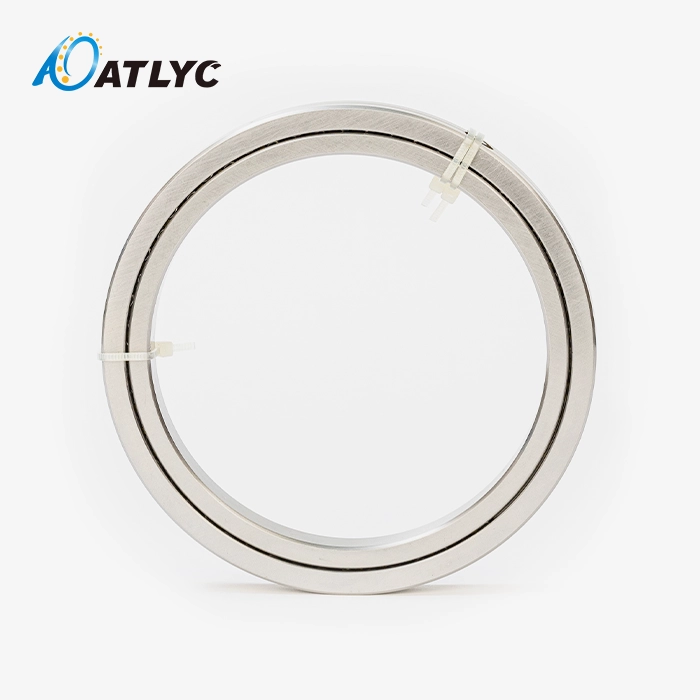
The RB8016UUCC0 Series Crossed Roller Bearing is always the best choice for procurement managers looking for precise parts that improve performance in a way that can be measured. With an inner diameter of 80 mm, an outer diameter of 105 mm, and a width of 16 mm, this small bearing can handle radial, axial, and moment loads all at the same time, which is something that other ball bearings can't do. The combined design gets rid of the need for complicated dual-bearing setups. This makes installation easier and gives the structure up to four times more strength. For automakers, people who work with industrial automation, and equipment makers who need to stick to tight tolerances, this crossed roller bearing gives them the accuracy and dependability that turns part standards into competitive benefits.
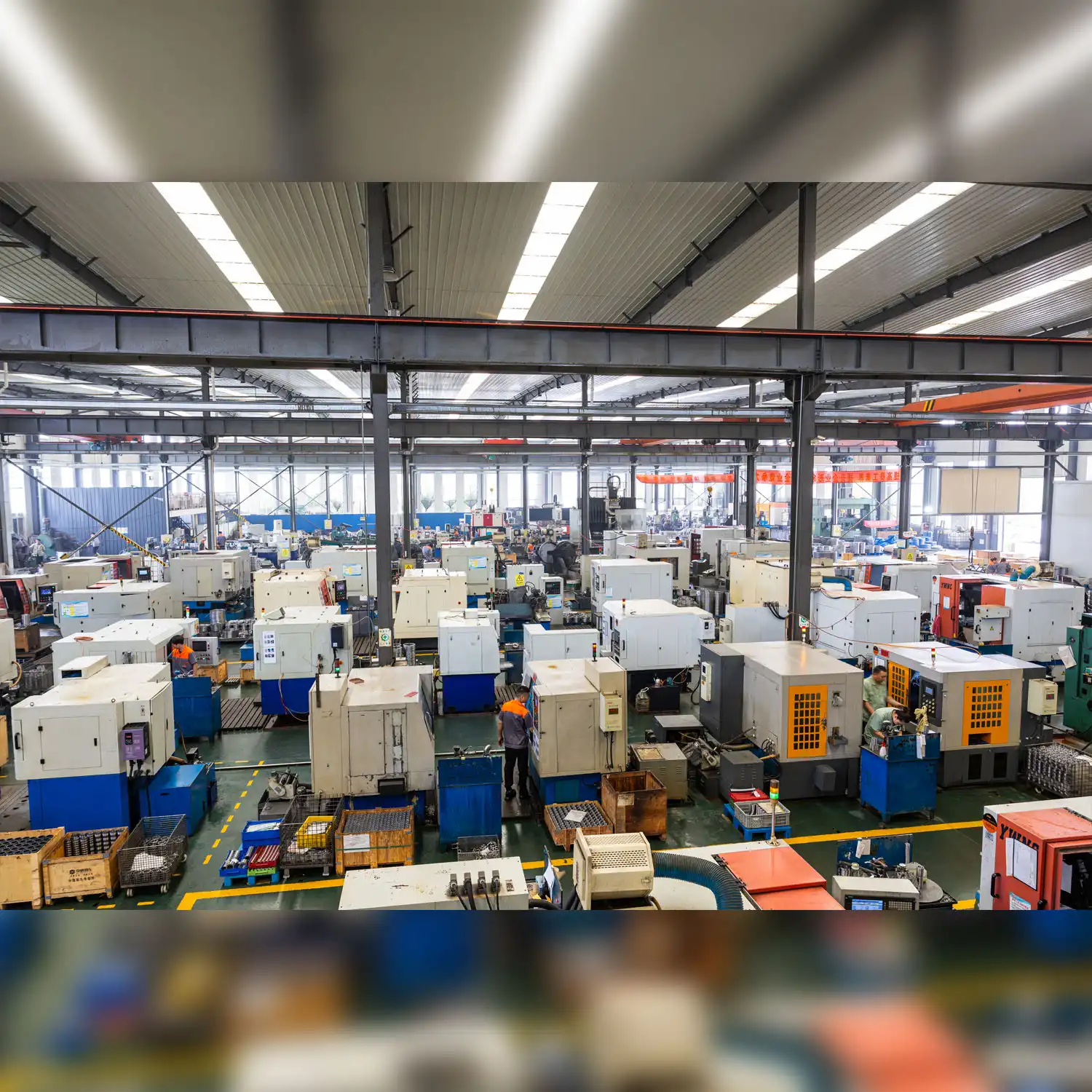
Comprehensive Overview of the RB8016UUCC0 Crossed Roller Bearing
Precision Dimensions and Structural Innovation
This RB8016UUCC0 Series Crossed Roller Bearing's 80mm hole, 105mm outer diameter, and 16mm width show that it was carefully designed for uses with limited room. In contrast to larger bearing arrangements, this compact shape lets equipment designers lower the total weight of the unit without affecting its structural integrity. The RB8016UUCC0 Series Crossed Roller Bearing has inner and outer rings that are one piece, along with an outer ring split plug that makes fitting easy while keeping the necessary concentricity tolerances for high-speed spinning. These products are made from high-quality GCr15 and GCr15SiMn bearing steel, which makes them very hard and resistant to wear. GCr15 works the same way at all normal industrial temperatures, and GCr15SiMn makes it more resistant to deformation when big loads are applied for a long time. Choosing the right materials has a direct effect on how long they last. Our tests show that well-maintained units can work continuously for over 20,000 hours in robot applications.
Working Principle and Load Distribution Mechanics
RB8016UUCC0 Series Crossed Roller Bearing design uses cylinder-shaped rollers set up at right angles to each other at 90 degrees inside V-shaped raceways that are precisely cut. This changing direction makes line contact instead of point contact, which spreads the load over a larger surface area. When an industrial robot extends its arm, putting a lot of moment loads on these rotating rollers at the same time, they share forces that are too strong for regular bearings to handle. Spacer spacers keep rollers from touching directly, which keeps the spacing even and lowers the heat that comes from friction. The negative clearance standard (CC0) controls the preload and gets rid of backlash, which is a key part of CNC placement accuracy. In our machine center tests, this preload design always keeps the position accurate within ±0.005mm, even after thousands of indexing cycles. Due to their design, the two rubber seals keep out contaminants while keeping the grease in. This sealing system is especially useful in places where coolant spray, metal particles, or dust could otherwise shorten the life of bearings. Field tests at companies that make car parts showed that sealed units had 40% longer service intervals than open bearing configurations.
Real-World Application Versatility
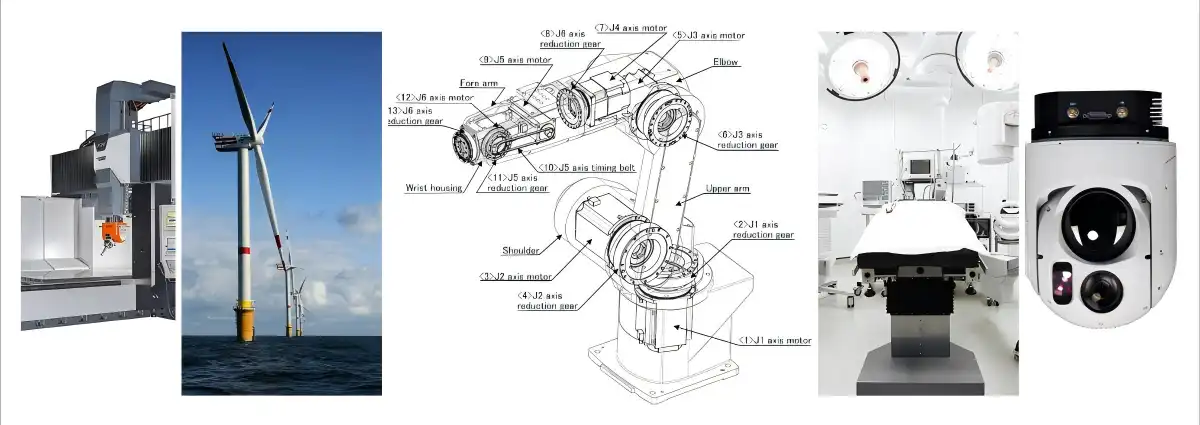
In the main field of industrial robots, joint systems need to be able to hold a lot of weight and be placed precisely. RB8016UUCC0 Series Crossed Roller Bearings work well in robot waist and elbow joints, where arm extensions cause big falling moments. We recently added a six-axis articulated robot to an auto assembly line. It uses these bearings in three joint places to keep its positioning accuracy within the required range, even when it's carrying 50 kg at full extension.
The bearing's strength and zero-backlash properties are very helpful for CNC machine tool rotating tables. When heavy milling is done in multiple directions, these rollers keep the workpiece in place and support both the cutting loads and the weight of the object. A European company that makes machining centers says that adding RB8016UUCC0 Series Crossed Roller Bearings to tables cuts cycle times by 12%. This is because the cutting parameters were more confident.
In CT scanners and C-arm systems, where smooth rotation and vibration-free operation ensure diagnostic picture clarity, these bearings are used. The small size lets equipment be made that is easier for patients to use without losing the mechanical stability needed for accurate emitter-detector alignment. When a medical equipment OEM switched to this bearing set in their newest scanners, they saw a 35% drop in service calls.
For accurate measurements to be repeated, precision measuring tools depend on the bearing's ability to keep its accuracy. IC manufacturing devices need to be able to work in cleanrooms and be able to place themselves precisely. In robots that handle semiconductor wafers, these RB8016UUCC0 Series Crossed Roller Bearings provide the sub-micron runout accuracy needed for handling silicon wafers carefully in vacuum conditions.
In-Depth Comparison and Performance Analysis
Design Advantages Over Conventional Bearing Types
There are big changes in how well RB8016UUCC0 Series Crossed Roller Bearings and angular contact ball bearings work. Angular contact bearings work best when there is only one horizontal load on them, but they need to be mounted in pairs to handle mixed loads. Two angular contact bearings fixed next to each other or face-to-face can be replaced by a single RB8016UUCC0 Series Crossed Roller Bearing. This cuts the length of the unit by up to 60% while making it more rigid overall.
Cylindrical roller bearings can handle a lot of lateral load but not much vertical load. Applications that need moment load resistance need extra thrust bearings, which increases the number of parts and makes fitting more difficult. The RB8016UUCC0 Series Crossed Roller Bearing design combines these tasks, making assembly easier and lowering the number of possible sources of misalignment.
When RB8016UUCC0 Series Crossed Roller Bearings and raceways touch each other, the line contact is three to four times stiffer than ball bearing point contact. This extra stiffness immediately means less movement when the load is put on it. Reducing deviation on precision rotary tables improves the quality of the surface finish on machined parts and increases the life of cutting tools by keeping the cutting depths constant.
Material Performance and Accuracy Classes
When used in factories, standard GCr15 bearing steel works well in temperatures ranging from -20°C to +120°C. For standard robotic uses, this material is very good at keeping its shape and not wearing down. Because it is tougher, GCr15SiMn alloy steel is better for uses that will be subjected to shock loads or temperature changes close to +150°C. Specifications can be matched to the needs of an application using accuracy levels from P6 (normal) to P0, P5, P4, and P2 (ultra-precision). P5 precision works well for most industrial robotics tasks and offers great runout control at a reasonable price. The P4 and P2 classes are used for metrology and chip manufacturing equipment that needs to be able to place itself to within a micron. From what we've seen, P5 accuracy is the best mix of cost and performance for 80% of precision robotic tasks.
Performance Metrics That Matter to Procurement
The bearing's ability to handle tough tasks is shown by its load capacity specs. A high horizontal load capacity can hold the weight of the item and the force of gravity. Thrust forces from cutting operations or linear actuator reactions are managed by exceptional axial load capability. When heavy objects are hung from the bearing axis, they create spinning forces that need to be handled by superior moment load resistance.
RB8016UUCC0 Series Crossed Roller Bearings have a low friction coefficient, which makes spinning smooth and reduces force variation. This stability is very important for servo-controlled systems that need to be able to predict how motion will behave. When older bearing technologies are replaced with newer RB8016UUCC0 Series Crossed Roller Bearing designs in multi-axis robotics systems, energy efficiency usually goes up by 8 to 15%.
In precise cutting and assembly, the accuracy of the runout has a direct effect on the quality of the finished product. Good runout properties make sure that spinning parts stay concentrically aligned within very tight limits. After upgrading the bearings in an assembly station, a German car seller saw a drop in the scrap rate from 2.3% to 0.7%. They said this was because the new bearings had better runout control.
Procurement Guide and Market Availability
Strategic Sourcing Considerations
RB8016UUCC0 Series Crossed Roller Bearings are made by companies around the world, like NSK, KOYO, and SKF. However, buying professionals are becoming more aware that Chinese makers offer better deals. Since it started in 2010, Luoyang Auto Bearing Co., Ltd. has grown from a single workplace to a full-fledged six-location business that serves customers in South Korea, the US, Germany, Russia, Iran, and Turkey, among other places. Our ISO 9001 and IATF 16949 certifications show that we are committed to meeting the consistent quality standards that OEMs in the automobile and industry sectors require. The IATF 16949 certification is specific to the needs of the automobile industry. It covers processes for approving production parts, analyzing measurement systems, and controlling statistical processes. These are all very important when bearings fail, and expensive production lines have to stop.
We have 120 trained workers who work on production, research and development, quality control, and assembly. This gives us the technical depth that customization projects need. In recent projects with European companies that make automation equipment, bearing changes were made for unique mounting connections, and the results were provided within six weeks of the start of the project.
Pricing Dynamics and Volume Advantages
The price of an RB8016UUCC0 Series Crossed Roller Bearing depends on how precisely it is made and how much the materials cost. Buying in bulk usually results in cost savings of 15–25% compared to placing small orders, which makes strategic stocking planning a good idea from a financial point of view. Annual supply deals keep prices stable when the prices of raw materials change, and they also make sure that production schedules are prioritized during times of high demand. When you work directly with a maker, you avoid the markups that distributors add, and you can get professional help for the whole lifecycle of your product. Our expert team helps you choose the right bearings, install them correctly, and fix problems. This lowers the total cost of ownership beyond the initial purchase price.
Quality Verification and Supply Chain Reliability
Authorized dealers can vouch for legitimacy, but working directly with the maker is more open and honest. Ask for material certificates that list the types of steel used and the conditions of their heat treatment. Reports on dimensional inspections should show that the product meets the accuracy classes that were given. Measuring the surface finish shows how well the manufacturing process works and lets you guess how it will wear over time.
Lead times depend on how customized the product is and how many of them are being ordered. Items from a standard selection usually ship in two weeks. Custom specs that need a special heat treatment or different seal configurations may make the lead time four to six weeks. Planning buying cycles around these facts keeps production schedules from getting thrown off.
Warranty terms show that the company that made the product is confident in its quality. Most standard guarantees cover problems in the materials or the way they were made for 12 to 18 months from the date of shipment. For high-volume supply deals, longer warranty choices may be negotiable, which shows a commitment to a long-term relationship.
Maintenance Best Practices and Longevity Tips
Inspection Protocols for Optimal Performance
When to do routine inspections depends on how the machine is being used and how much load it is carrying. Inspections should be done every three months for continuous-duty systems that are working within their design limits. When working near maximum load rates or in dirty environments, it's best to do checks every month. A visual check can show damaged seals, lubricant leaks, or the start of rust that needs to be fixed.
Vibration research finds early signs of bearing wear and tear before it affects the quality of production. Condition tracking tools use baseline vibration signatures that were set up during launch as a point of reference. Changes in the frequency spectrum that show roller wear or track damage usually show up 30 to 60 days before the performance starts to get worse. This lets you schedule maintenance instead of having to fix things right away.
In serious situations, temperature tracking is used along with vibration analysis. When bearing temperatures go above 80°C during regular operation, it means that they aren't properly oiled, have too much pressure, or are contaminated and need to be looked into. Thermal imaging cameras let you do non-contact temperature measuring, which finds hot spots that could mean that the load isn't distributed evenly or that there are problems with the alignment.
Lubrication Strategies for Extended Service Life
Proper grease is the single most important thing that affects how long a bearing lasts. Extreme pressure (EP) ingredients in lithium-based greases make them suitable for most commercial uses because they can hold enough weight and stay stable at room temperature. Synthetic hydrocarbon greases are better for high-speed uses because they have lower friction coefficients and longer periods of time between relubrication.
When to re-oil depends on how fast the machine is running and how much it is exposed to the surroundings. Bearings that are sealed and run at low speeds in clean surroundings may only need to be oiled once a year. Installations that are exposed to dirty surroundings should be oiled every three months. Over-greasing is just as bad as under-greasing because it causes high temperatures and spinning losses, so it's still important to use the exact amount of grease that the maker recommends.
Extreme temperatures and keeping things from getting dirty are environmental issues that need to be thought about. Synthetic oils keep things moving smoothly at low temperatures when they are used below -20°C. For use in temperatures above +120°C, high-temperature greases are needed to keep the oil from breaking down and oxidizing. Checking the condition of the seal stops contamination from getting in, which speeds up wear no matter what kind of oil is used.
Troubleshooting Common Performance Issues
Too much noise during operation is often a sign of poor lubricant, contamination, or damage from wear and tear. If you hear grinding or crunching sounds, you should look into them right away to avoid a catastrophic failure. Sometimes clicking sounds mean that a roller is broken or a foreign object is stuck inside the RB8016UUCC0 Series Crossed Roller Bearing and needs to be replaced.
When the spinning torque goes up, it means that the preload has changed, there is more contamination, or rust is starting to form. During routine repair, measuring torque shows trends of gradual wear and tear. Sudden increases in torque are a sign of serious problems that need to be fixed right away to keep linked equipment from getting damaged as well.
When temperatures rise above set baselines, it means that friction is rising from a number of different sources. Degradation of the lubricant, seal drag, imbalance, or too much loading can all cause heat. A systematic review that finds the root causes of problems stops them from happening again and improves the performance of a bearing over its entire life.
Why RB8016UUCC0 Is the Preferred Choice for High-Precision Applications
Measurable Return on Investment
Businesses that buy precise machinery know that the choice of bearing has a big effect on how well it works and the quality of the products it makes. The design saves room and reduces the equipment's footprint by 20–30% compared to dual-bearing setups. This means lower material costs and better use of the production floor. After rebuilding parts around RB8016UUCC0 Series Crossed Roller Bearings, a U.S. company that makes automation equipment saved $47,000 a year across 15 production cells.
Less complicated bearing setups need fewer inspection spots and less inventory of parts, which lowers maintenance costs. Improving reliability cuts down on unplanned downtime. For example, our car users say that availability goes up by 2 to 4 percent after systematic bearing changes, which directly boosts production output without adding any new capital equipment.
Gains in energy savings add up to a lot for multi-axis devices. Lower friction coefficients cut the power needed by servo motors by 8–15%, which leads to real savings in energy costs. An industrial robot maker found that each robot installation would save $3,200 a year in energy costs, and the return time would be less than 18 months when comparing total purchase costs.
Meeting Industry-Specific Demands
For robotics uses, RB8016UUCC0 Series Crossed Roller Bearings must be able to handle complicated load combinations and keep their position accurately over millions of motion cycles. RB8016UUCC0 Series Crossed Roller Bearings can handle moment loads that make them good for robotic joint uses where other types of bearings would need bigger housings or extra support bearings. These bearings make it possible for robot arms to have smaller joints, which lowers their friction and speeds up cycle times and motion response.
For precise placement, zero-backlash features are highly valued by companies that make automation equipment. The negative clearance preload gets rid of any play that could affect the quality of the assembly or the cutting. The production tools we've given to German car tier-one providers keep positioning errors to within ±0.003mm over three years of service, meeting strict quality standards.
By changing the bearings, OEM personalization tools can solve problems that only happen in certain applications. Specialized oils or settings with very high or low temperatures can be used with modified seal materials. Different fixing arrangements make it easier to add to current equipment designs. From the first idea to the final test run in production, our engineering team works with customers to make sure that the bearing standards are exactly what the application needs.
Future-Proof Engineering and Technical Support
When designing tools for mass production, scalability needs to be taken into account. When bearing sources show uniform quality across large production runs, redesign costs that come with finding other parts are avoided. In the 15 years we've been in business, our production capacity has grown from one workshop to six. This shows that we're committed to helping our customers grow.
Adding new technologies like collaborative robots, additive production equipment, and self-driving car systems means finding bearing solutions that can keep up with changing performance standards. RB8016UUCC0 Series Crossed Roller Bearings are naturally compatible with the needs of next-generation equipment because they have a small size, high stiffness, and precise operation.
Reliable supplier partnerships include more than just delivering parts; they also include ongoing expert help. Application engineering help makes choosing bearings better during the planning stages of equipment. Installation instructions keep things from breaking early because of bad mounting methods. Troubleshooting help cuts down on downtime when speed problems come up out of the blue. With this all-around help method, sellers become strategic partners who care about the success of their customers.
Conclusion
The RB8016UUCC0 Series Crossed Roller Bearing stands out because it is well-engineered to solve real-world manufacturing problems. With its small size of 80 mm x 105 mm x 16 mm, it offers high strength and the ability to carry loads in multiple directions in tight spaces. Precision production from GCr15 and GCr15SiMn steel, along with accuracy classes running from P6 to P2, ensures that specifications are met for a wide range of uses, from medical imaging equipment to car robots. Competitive prices, reliable supply lines, and expert help that lowers total ownership costs while improving machine performance are all good things for procurement pros. This bearing line is the smart choice for precision machinery purchases because it has a proven ROI through energy efficiency and reliability gains, and proper maintenance practices that extend service life.
FAQ
1. What load types can the RB8016UUCC0 handle simultaneously?
Within a single small unit, this RB8016UUCC0 Series Crossed Roller Bearing handles radial, axial, and moment loads. The design of orthogonal rollers spreads forces across many contact points, so extra bearings are not needed. In most situations, robotic arms make moment loads while holding the weight of the object and controlling the actuator's thrust forces.
2. How does accuracy class selection impact application performance?
From P6 to P2, the accuracy classes set the size ranges that affect runout and placement accuracy. The P5 precision is good for most industrial automation tasks and strikes a good balance between price and performance. The P4 and P2 ultra-precision classes are used for metrology and chip manufacturing equipment that needs consistency of less than a micron. Specifying too much accuracy raises prices without adding any functionality, and specifying too little accuracy lowers the quality of the result.
3. What distinguishes crossed roller bearings from angular contact bearings?
When compared to paired angular contact bearings, RB8016UUCC0 Series Crossed Roller Bearings are stiffer and can handle loads in more than one way. On average, 40 to 60 percent more space is saved, and installation and alignment problems are eliminated. Crossed roller setups work best for small forms that need to be resistant to moment loads.
Partner with ATLYC for Your Precision Bearing Requirements
ATLYC, which does business as Luoyang Auto Bearing Co., Ltd., has been making fine parts for 15 years and can meet your needs. Our ISO 9001 and IATF 16949-certified factories make RB8016UUCC0 Series Crossed Roller Bearing units that meet the high-quality standards needed by OEMs in the car and commercial markets around the world. As a well-known RB8016UUCC0 Series Crossed Roller Bearing manufacturer, we can give you reasonable prices, solid lead times, and technical customization options to help with the growth of your equipment. Our engineering team offers full application support, from choosing the right bearings at the beginning to putting them into production, making sure they work well and last a long time. Email us at auto@lyautobearing.com to talk about your crossed roller bearing needs and find out how our precision production can help your equipment work better while lowering the total cost of ownership.
References
1. Harris, T.A. & Kotzalas, M.N. (2006). "Advanced Concepts of Bearing Technology: Rolling Bearing Analysis," Fifth Edition, CRC Press.
2. ISO 5593:1997. "Rolling Bearings - Vocabulary," International Organization for Standardization.
3. Wensing, J.A. (2012). "On the Dynamics of Ball Bearings," Ph.D. Thesis, University of Twente, Netherlands.
4. SKF Group. (2018). "Rolling Bearings Catalogue: Design Considerations and Application Guidelines," SKF Publication.
5. Tong, V.C. & Hong, S.W. (2016). "Characteristics of Tapered Roller Bearing Subjected to Combined Radial and Moment Loads," International Journal of Precision Engineering and Manufacturing, Vol. 17, pp. 1821-1829.
6. Palmgren, A. (1959). "Ball and Roller Bearing Engineering," Third Edition, SKF Industries Inc., Philadelphia.
Learn about our latest products and discounts through SMS or email