- English
- French
- German
- Portuguese
- Spanish
- Russian
- Japanese
- Korean
- Arabic
- Greek
- German
- Turkish
- Italian
- Danish
- Romanian
- Indonesian
- Czech
- Afrikaans
- Swedish
- Polish
- Basque
- Catalan
- Esperanto
- Hindi
- Lao
- Albanian
- Amharic
- Armenian
- Azerbaijani
- Belarusian
- Bengali
- Bosnian
- Bulgarian
- Cebuano
- Chichewa
- Corsican
- Croatian
- Dutch
- Estonian
- Filipino
- Finnish
- Frisian
- Galician
- Georgian
- Gujarati
- Haitian
- Hausa
- Hawaiian
- Hebrew
- Hmong
- Hungarian
- Icelandic
- Igbo
- Javanese
- Kannada
- Kazakh
- Khmer
- Kurdish
- Kyrgyz
- Latin
- Latvian
- Lithuanian
- Luxembou..
- Macedonian
- Malagasy
- Malay
- Malayalam
- Maltese
- Maori
- Marathi
- Mongolian
- Burmese
- Nepali
- Norwegian
- Pashto
- Persian
- Punjabi
- Serbian
- Sesotho
- Sinhala
- Slovak
- Slovenian
- Somali
- Samoan
- Scots Gaelic
- Shona
- Sindhi
- Sundanese
- Swahili
- Tajik
- Tamil
- Telugu
- Thai
- Ukrainian
- Urdu
- Uzbek
- Vietnamese
- Welsh
- Xhosa
- Yiddish
- Yoruba
- Zulu
Why Buy Tapered Roller Bearing 32 series for Heavy Loads?
When equipment is subjected to harsh combined radial and axial stresses, choosing the improper bearing accelerates failure and increases maintenance costs. This is exactly what the Tapered Roller Bearing 32 series – described in ISO 355 and DIN 720 – is there for. This series is designed for high-carbon chromium steel (GCr15/52100) heat-treated to HRC 60–64 to provide the structural stiffness and fatigue resistance that demanding industrial situations need. For procurement managers and OEM engineers looking for heavy-duty bearing solutions, the 32 series is a technically solid, cost-effective investment supported by decades of worldwide field validation.
Understanding the Tapered Roller Bearing 32 Series
The 32 series is a family of metric single-row tapered roller bearings, including the sub-series 320xx, 322xx, 323xx, and 329xx. Each variation has a detachable cone (inner ring), cup (outer ring), and tapered rolling parts that are held in place by a precision cage. The geometry of the raceways and the rollers is such that they all intersect at the same point, the apex of the bearing axis, and therefore genuine rolling motion with low friction is achieved. This is also the reason why the tolerance criteria are set by ISO 492.
How the 32 Series Manages Combined Loads
The tapered roller bearing 32 series is capable of carrying simultaneous radial and axial stresses in a small environment, when ball bearings would be at their structural limit. The premium versions include a logarithmic roller profile that distributes the Hertzian contact stress uniformly throughout the rolling surface, hence minimizing the edge-loading failure scenario due to slight misalignment of the shaft or housing deflection. This geometric perfection is a direct extension of the L10-certified fatigue life for continuous heavy-duty use.
32 Series vs. 30, 33, and 40 Series: Key Dimensional Differences
Understanding sub-series differences supports informed bearing selection:
| Series | Section Width | Load Capacity | Typical Application |
|---|---|---|---|
| 30xx | Narrow | Moderate radial | Light-to-medium machinery |
| 32xx | Medium-wide | High combined | Heavy industrial, automotive |
| 33xx | Wide | Very high combined | Mining, heavy gearboxes |
| 40xx | Extra-wide | Maximum axial | Railway axleboxes, cranes |
The 32 series occupies the optimal balance point—sufficient load capacity for demanding applications without the oversized cross-section that limits installation flexibility.
Why the 32 Series Excels for Heavy Loads: Benefits and Performance
Heavy-load bearing failures cost U.S. manufacturers an estimated $50 billion annually in unplanned downtime, according to the Machinery Failure Prevention Technology Society (2022). The Tapered Roller Bearing 32 series tapered roller bearing directly addresses this vulnerability through a combination of material engineering and geometric precision.
Here are the core performance advantages that make this series the preferred choice for heavy-load conditions:
- Superior combined load handling: The tapered contact geometry carries radial and thrust loads simultaneously, achieving dynamic load ratings (Cr) significantly higher than those of equivalent-bore ball bearings. In heavy-duty differential pinion applications, the 322xx sub-series routinely handles axial thrust generated by hypoid gears at high torque without raceway fatigue.
- Adjustable internal clearance: Unlike deep groove ball bearings, clearance or preload in the 32 series is set during installation via shims or adjusting nuts—allowing engineers to optimize shaft rigidity for each specific application, a critical advantage in precision gearboxes.
- Advanced heat and contamination resistance: Manufactured from GCr15/52100 steel with raceway surface roughness Ra below 0.2µm, these bearings sustain stable hydrodynamic lubrication films at elevated temperatures, reducing scoring risk on roller ends and flanges.
These performance characteristics translate directly into extended maintenance intervals and reduced total cost of ownership across heavy industrial deployments.
The single most important maintenance variable is proper lubrication. At higher speeds, circulating oil or oil-mist systems work better than grease in actively dispersing the heat created at the cone rib-flange contact zone. Routine vibration inspections of Andersometers (according to S0910 standards) identify raceway waviness in the early stages, before spalling leads to catastrophic failure, which is a proactive technique in line with IATF 16949 quality management regulations.
Selection Criteria: How to Choose the Right 32 Series Bearing
Selecting the correct tapered roller bearing 32 series variant requires evaluating three interconnected factors: load rating alignment, dimensional compatibility, and environmental conditions.
| Selection Parameter | Key Consideration | Standard Reference |
|---|---|---|
| Dynamic Load Rating (Cr) | Must exceed the calculated equivalent dynamic load P | ISO 281 |
| Bore & OD Tolerance | Verify shaft/housing fit class (H7/k6 typical) | ISO 492 |
| Speed Factor (ndm) | Oil lubrication preferred above ndm > 500,000 | ISO 15312 |
| Temperature Range | Standard steel: –20°C to +120°C continuous | ISO 683-17 |
| Contamination Factor | Sealed or shielded variants for dirty environments | ISO 4406 |
You can't compromise on dimensional precision. The bore (d), outer diameter (D), and assembly width (T) have to be checked to ISO 355 tolerances to ensure interchangeability of the product across worldwide supply chains. If your procurement cycles are tight, choose a 32 series tapered roller bearing provider that has confirmed dimensional lots in stock to shorten qualifying periods.
The best Tapered Roller Bearing 32 series are produced by the best manufacturers in the world, like Timken, SKF, and NTN. However, Chinese bearing producers with proven manufacturing capability have become essential partners for mid-to-large OEMs seeking affordable prices without compromising on ISO 9001 and IATF 16949 adherence. Metallurgical hardness testing (HRC 60-64), measurement of retained austenite, and Andersometer noise-grade verification all attest to production integrity. Documented quality control is the key differentiator.
Purchasing and Procurement: How to Buy 32 Series Bearings Efficiently
Strategic procurement of 32-series tapered roller bearings starts with supplier qualification, not just price comparison. Verified manufacturers offering OEM customization—custom bore dimensions, cage materials, or surface coatings—add measurable value beyond catalog offerings.
Procurement managers targeting assembly-line continuity should prioritize these supplier evaluation criteria:
- Documented ISO 355 dimensional compliance with full traceability per lot
- Production capacity is sufficient to absorb volume spikes without lead-time disruption
- Post-sale technical support, including application engineering and failure analysis
Bulk order negotiations should factor in seasonal production cycles. Locking in supply agreements during Q1 typically yields better lead-time commitments from manufacturers managing annual capacity planning. Logistics evaluation—including port-of-origin flexibility and Incoterms alignment—further protects assembly-line continuity for global OEM buyers.
Practical Use Cases and Industry Applications of the 32 Series
The 32 series bearing is a fundamental component used in a variety of heavy-duty applications. The modular design facilitates field maintenance, while its high stiffness makes it well suited for precise shaft guiding in important drivetrain applications.
In automobile gearboxes and differentials, the 322xx sub-series manages tremendous axial force from hypoid gear sets, while retaining exact gear mesh shape under high torque—a condition that ball bearings cannot consistently achieve. The 322xx and 323xx versions are designed for heavy-duty mining and conveyor gearboxes, absorbing the shock loads and vibration characteristic of continuous crushing operations and providing a longer L10 life than cylindrical roller alternatives. The 32 series is used on agricultural wheel hubs on tractors and harvesters where the detachable design allows field repacking with specialist heavy-duty grease, and is used in severely polluted situations.
The 32 series is ideal for the production of conveyor systems, since it maintains a constant shaft alignment in spite of different radial and axial loads, thereby decreasing belt tracking errors and prolonging conveyor service intervals.

Conclusion
The Tapered Roller Bearing 32 series consistently outperforms alternatives in applications where combined heavy loads, thermal stress, and contamination converge. Its adjustable preload capability, ISO-compliant dimensional precision, and material integrity make it the rational choice for automotive OEMs, industrial machinery builders, and aftermarket distributors seeking dependable long-term performance. When selected correctly and maintained properly, the 32 series delivers measurable reductions in unplanned downtime and total bearing replacement costs across global heavy-duty operations.
FAQ
Q1: How do I adjust internal clearance in a 32 series tapered roller bearing?
Clearance is not preset at the factory. During installation, you set it by adjusting the axial distance between the cone and cup using shims or lock nuts. This flexibility lets engineers dial in preload precisely for shaft guidance requirements.
Q2: Can the 32 series handle shaft misalignment?
Standard designs tolerate approximately 2–4 minutes of arc. Premium variants with crowned rollers accommodate slightly higher misalignment without significant fatigue life reduction.
Q3: What lubrication works best at high speeds?
Circulating oil or oil-mist systems are preferred over grease at elevated speeds because they actively remove heat from the cone rib-flange contact zone, preventing scoring failure.
Q4: What are the primary failure indicators?
Watch for raceway spalling (pitting from fatigue), roller-end scoring from insufficient lubrication, or elevated Andersometer vibration readings indicating raceway waviness.
Q5: Are OEM custom dimensions available?
Yes. Reputable tapered roller bearing 32 series manufacturers offer custom bore diameters, cage materials, and surface treatments. Document your application requirements clearly to streamline the engineering review process.
Partner With ATLYC for Your Tapered Roller Bearing 32 Series Supply
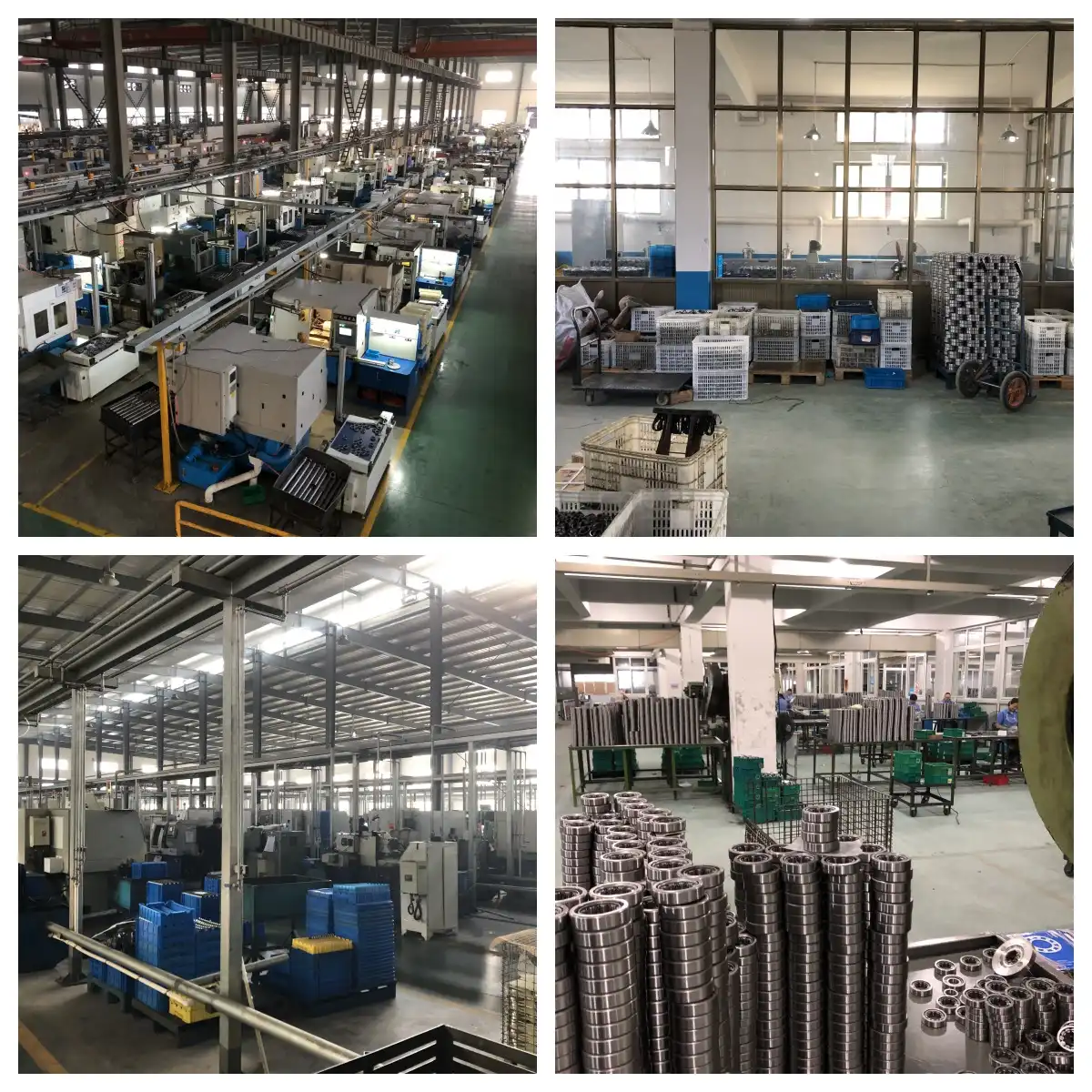
ATLYC — Luoyang Auto Bearing Co., Ltd. — has delivered ISO 9001 and IATF 16949 certified bearings to OEMs across the USA, Germany, South Korea, and beyond since 2010. As a trusted Tapered Roller Bearing 32 series supplier, we combine 15 years of precision manufacturing experience, six production workshops, and 120 skilled engineers to meet your volume and customization requirements. Contact our team at auto@lyautobearing.com to request a technical consultation and competitive quotation today.
References
1. Timken Company. (2023). Tapered Roller Bearing Catalog. The Timken Company.
2. SKF Group. (2023). Rolling Bearings Technical Handbook. SKF.
3. ISO. (2014). ISO 355:2007 — Tapered Roller Bearings — Boundary Dimensions and Series Designations. International Organization for Standardization.
4. Machinery Failure Prevention Technology Society. (2022). Bearing Failure and Unplanned Downtime Cost Analysis. MFPT.
5. NTN Bearing Corporation. (2022). Tapered Roller Bearing Application Guide. NTN.
6. IATF. (2016). IATF 16949:2016 — Quality Management System Requirements for Automotive Production. International Automotive Task Force.
Learn about our latest products and discounts through SMS or email