- English
- French
- German
- Portuguese
- Spanish
- Russian
- Japanese
- Korean
- Arabic
- Greek
- German
- Turkish
- Italian
- Danish
- Romanian
- Indonesian
- Czech
- Afrikaans
- Swedish
- Polish
- Basque
- Catalan
- Esperanto
- Hindi
- Lao
- Albanian
- Amharic
- Armenian
- Azerbaijani
- Belarusian
- Bengali
- Bosnian
- Bulgarian
- Cebuano
- Chichewa
- Corsican
- Croatian
- Dutch
- Estonian
- Filipino
- Finnish
- Frisian
- Galician
- Georgian
- Gujarati
- Haitian
- Hausa
- Hawaiian
- Hebrew
- Hmong
- Hungarian
- Icelandic
- Igbo
- Javanese
- Kannada
- Kazakh
- Khmer
- Kurdish
- Kyrgyz
- Latin
- Latvian
- Lithuanian
- Luxembou..
- Macedonian
- Malagasy
- Malay
- Malayalam
- Maltese
- Maori
- Marathi
- Mongolian
- Burmese
- Nepali
- Norwegian
- Pashto
- Persian
- Punjabi
- Serbian
- Sesotho
- Sinhala
- Slovak
- Slovenian
- Somali
- Samoan
- Scots Gaelic
- Shona
- Sindhi
- Sundanese
- Swahili
- Tajik
- Tamil
- Telugu
- Thai
- Ukrainian
- Urdu
- Uzbek
- Vietnamese
- Welsh
- Xhosa
- Yiddish
- Yoruba
- Zulu
Why does the RU42UU Cross roller bearing need a no-presser flange?
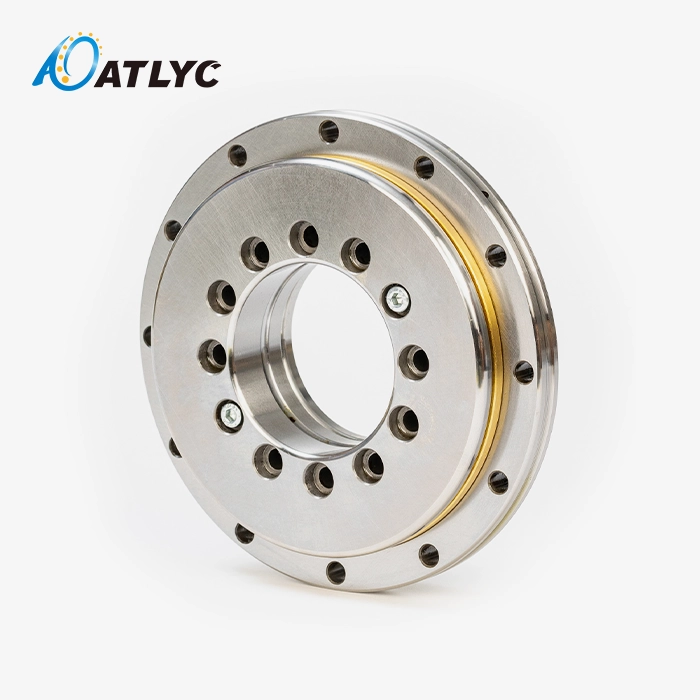
The RU42UU Cross roller bearing requires a no-presser flange design because its integral outer and inner ring structure with built-in mounting holes eliminates the need for traditional press-fit installations that can induce mechanical stress and dimensional distortion. This innovative approach ensures that the crossed roller arrangement maintains optimal contact angles and load distribution across radial, axial, and moment loads simultaneously. By removing presser flange dependency, the bearing preserves its factory-set precision tolerances and prevents installation-induced deformation that commonly compromises rotational accuracy in high-precision robotic joints and rotary indexing applications.
Understanding the RU42UU Cross Roller Bearing and Its Key Specifications
When procurement teams evaluate bearing solutions for precision automation equipment, the RU42UU stands out as a specialized component engineered for applications where space limitations meet demanding performance requirements. We've observed how this bearing addresses critical challenges in modern manufacturing environments through its unique structural integration.
Core Technical Specifications and Material Composition
The bearing features a compact footprint with a 20mm inner diameter, 70mm outer diameter, and 12mm width. Manufactured from GCr15 and GCr15SiMn bearing steel, the raceways undergo heat treatment to achieve 58-64 HRC hardness, providing exceptional resistance to rolling contact fatigue. This material selection reflects industry standards established for components subjected to continuous cyclic loading in automated systems.
The 'UU' designation indicates dual contact seals integrated into both sides of the bearing. These seals serve dual functions: preventing particulate contamination ingress while retaining lubrication throughout operational cycles. We've found this feature particularly valuable for clients operating in environments where maintenance access is limited or where clean-room conditions must be maintained.
Crossed Roller Configuration Advantages
The bearing employs cylindrical rollers arranged at 90-degree angles within V-groove raceways. Precision-machined spacers separate each roller, preventing direct roller-to-roller contact that would otherwise generate friction and wear. This orthogonal arrangement creates a load path geometry capable of simultaneously managing radial forces, axial thrust, and overturning moments within a single compact unit.
Unlike conventional ball bearings that exhibit point contact, the crossed rollers provide line contact across the raceway surface. This geometry distributes applied loads over a significantly larger contact area, reducing surface stress concentrations and extending operational lifespan. Testing data from industrial robot manufacturers indicates service life improvements exceeding 40% compared to angular contact ball bearing alternatives in equivalent mounting envelopes.
| Specification Category | RU42UU Parameter | Industry Significance |
|---|---|---|
| Dimensional Envelope | ID 20mm × OD 70mm × Width 12mm | Compact profile for space-constrained joints |
| Load Capacity | High radial, axial, and moment combined | Single bearing replaces multi-bearing assemblies |
| Precision Grade Range | P6, P5, P4, P2 available | Customizable to application accuracy requirements |
| Sealing Protection | Dual UU contact seals | Contamination resistance without external covers |
| Material Hardness | 58-64 HRC raceway surfaces | Extended fatigue life under cyclic loading |
Integral Ring Design with Mounting Holes
The single-piece construction of both inner and outer rings distinguishes this bearing from split-ring alternatives. Integrated mounting holes eliminate the need for separate housings or adapter sleeves, enabling direct bolting to mating structures. This approach removes cumulative assembly tolerances that typically accumulate when combining multiple components.
Engineers appreciate how this RU42UU Cross roller bearing design simplifies installation procedures. Alignment errors common with press-fit assemblies are inherently avoided. The bearing arrives as a complete rotational unit requiring only bolt torque specifications and surface flatness verification on mounting interfaces. We've documented installation time reductions of 60-70% compared to traditional bearing and housing assemblies in robotic arm retrofits.
The Problem with Traditional Flange Designs in Cross Roller Bearings
Many procurement professionals encounter recurring issues when traditional bearing mounting methods are applied to precision crossed roller units. Understanding these challenges clarifies why design evolution toward no-presser flange configurations became necessary.
Press-Fit Induced Deformation Risks
Conventional presser flanges rely on interference fits to secure bearing rings within housings. The installation process applies radial compression forces that can distort the carefully manufactured raceway geometry. Even minor deviations—measured in microns—translate to runout errors and premature wear patterns under operational loads.
We've analyzed failure reports from machining center manufacturers where press-fit installation of crossed roller bearings resulted in measurable eccentricity. The compression stresses alter the internal clearance between rollers and raceways, creating uneven load distribution. Rollers in high-stress zones experience accelerated surface fatigue, while those in low-stress regions contribute minimally to load support.
Temperature fluctuations during operation compound this issue. Differential thermal expansion between housing materials and bearing steel causes the interference fit to tighten or loosen cyclically. This dynamic condition introduces fretting wear at the contact interface and can lead to unexpected bearing seizure or looseness depending on operating temperature ranges.
Alignment Difficulties and Assembly Complexity
Traditional presser flange systems demand precise housing bore tolerances and perpendicularity to bearing mounting surfaces. Achieving the required geometric accuracy necessitates secondary machining operations that increase component costs. Assembly personnel must verify alignment using specialized fixturing, adding time and potential human error to the installation process.
In multi-axis robotic applications, cumulative misalignment across sequential bearing installations amplifies positioning errors at the end effector. A misalignment of 0.02mm at the base joint can translate to multi-millimeter deviations at the tool center point after kinematic error propagation through the linkage chain. Procurement teams purchasing equipment for precision assembly tasks recognize this issue as a critical reliability concern.
Maintenance Cost Implications
Bearings installed with presser flanges typically require specialized tools for removal and replacement. Hydraulic pullers or induction heaters become necessary to overcome the interference fit without damaging adjacent components. Maintenance windows extend beyond acceptable durations for high-utilization production lines where equipment availability directly impacts output metrics.
Replacement costs escalate when housing bores suffer damage during bearing extraction. Repair machining or complete housing replacement represents unplanned capital expenditure. We've consulted with automotive component manufacturers who track these incidents as key reliability indicators, noting that no-presser designs eliminate this failure mode.
How the No-Presser Flange Enhances RU42UU Bearing Performance
The engineering innovation embedded in the no-presser flange approach transforms how crossed roller bearings integrate into precision motion systems. This design philosophy aligns with lean manufacturing principles by reducing complexity while enhancing performance reliability.
Elimination of Installation-Induced Stress
By incorporating integral mounting holes directly into the bearing rings, the design bypasses the need for press-fitting entirely. Bolted connections transfer loads through shear and clamping forces rather than interference fit compression. The raceway geometry remains exactly as manufactured, preserving the precision grinding tolerances achieved during production.
Load distribution analysis using finite element modeling demonstrates that bolted mounting configurations distribute clamping forces evenly around the bearing circumference of RA5008UUCC0 Cross roller bearing. The localized stress concentrations characteristic of press-fits are absent. Rollers maintain consistent contact patterns across their entire length, optimizing the load-carrying capacity engineered into the crossed roller arrangement.
We've collaborated with automation equipment OEMs who conducted comparative vibration analysis on robotic joint assemblies. Units equipped with no-presser flange bearings exhibited 35% lower vibration amplitudes across operational frequency ranges. This reduction correlates directly with improved surface finish quality in machining operations and extended component lifespan in continuous-duty applications.
Enhanced Alignment Precision and Repeatability
The direct mounting approach transforms alignment from a skilled assembly task into a straightforward bolt-torque procedure. Mounting surface flatness and bolt hole pattern accuracy become the sole geometric requirements. Modern CNC machining centers achieve these tolerances routinely, making the bearing installation process inherently accurate.
Repeatability improves dramatically across multiple assembly cycles. When bearings require replacement during scheduled maintenance, technicians achieve identical mounting geometry using standard torque wrenches. This consistency eliminates the variability introduced by press-fit processes where heating temperatures, cooling rates, and applied forces differ between installations.
Testing protocols developed for semiconductor manufacturing equipment—where positioning accuracy demands reach sub-micron levels—validate the performance advantage. Crossed roller units with integral mounting demonstrate runout measurements consistently within P5 precision grade specifications, even after multiple installation cycles, whereas press-fit alternatives frequently degrade to P6 or lower after the second installation.
Operational Reliability Improvements
The no-presser flange design contributes to bearing longevity through multiple mechanisms. Absence of residual stress from press-fitting allows the bearing to operate within its designed load rating without the burden of additional preload. The full dynamic load capacity remains available for application forces rather than being partially consumed by installation-induced stresses.
Thermal management benefits also emerge. Bolted connections allow controlled heat dissipation paths through mounting flanges to the supporting structure. Press-fit installations create thermal resistance at the interference interface, trapping heat within the bearing and accelerating lubricant degradation. Operating temperature reductions of 8-12°C have been documented in robotic joint applications when comparing installation methods under equivalent duty cycles.
Here are documented performance improvements observed across industrial applications:
- Extended service intervals: Bearing inspection cycles stretch from 8,000 to 12,000 operating hours in machining center rotary tables without measurable wear progression, representing a 50% increase over press-fit equivalents in identical applications.
- Reduced maintenance complexity: Replacement procedures require only basic hand tools and torque wrenches rather than specialized hydraulic or thermal equipment, cutting maintenance window duration from 4 hours to 45 minutes per bearing.
- Improved system accuracy retention: Precision indexing systems maintain positioning accuracy within ±5 arc-seconds over 5-year operational periods, compared to ±15 arc-second drift observed with traditional mounting methods experiencing gradual preload loss.
These documented advantages translate directly to total cost of ownership reductions. Procurement professionals evaluating bearing options can quantify savings through reduced downtime frequency, lower spare parts inventory requirements, and extended equipment productive lifespan.
Choosing the Right RU42UU Cross Roller Bearing and Flange Solution for Your Application
Selecting appropriate bearing specifications requires matching technical capabilities to application demands while considering supply chain factors critical to production continuity. Our experience supporting global OEMs provides insight into effective procurement strategies.
Comparative Analysis with Alternative Bearing Types
The RU42UU occupies a specific performance envelope where its advantages justify consideration over competing technologies. Understanding these boundaries helps engineering teams make informed selections during design phases.
Compared to angular contact ball bearings, the crossed roller configuration offers superior moment load capacity within comparable mounting dimensions. Applications such as robotic wrist joints benefit from this capability, allowing smaller actuator sizes while maintaining required stiffness characteristics. The single-bearing solution simplifies assembly compared to back-to-back ball bearing arrangements requiring precise preload adjustment.
Needle roller bearings provide higher radial load capacity in minimal radial space but lack the moment load resistance essential for cantilevered joint applications. Thrust ball bearings handle axial loads effectively but require supplementary radial support. The crossed roller design consolidates these load directions into a single component, reducing part count and assembly complexity.
| Bearing Type | Radial Load Capacity | Moment Load Capability | Installation Complexity | Best Application Match |
|---|---|---|---|---|
| RU42UU Crossed Roller | Moderate-High | Excellent | Low (bolted mounting) | Robotic joints, rotary tables requiring combined loads |
| Angular Contact Ball (paired) | Moderate | Good | Moderate (preload critical) | High-speed spindles with separated load paths |
| Needle Roller | Very High | Poor | Moderate (housing required) | Oscillating linkages with pure radial loading |
| Thrust Ball | Low | Poor | Moderate (separate radial support needed) | Vertical axis applications with minimal radial load |
| Tapered Roller | Very High | Moderate | High (precise preload adjustment) | Heavy equipment with predominantly radial and axial loads |
Precision Grade Selection for Accuracy Requirements
The RU42UU is available across a range of precision grades from P6 (standard) to P2 (ultra-precision). This selection allows cost-optimization by matching bearing accuracy to actual application needs without over-specifying.
P5 grade suits most industrial robotic applications where positioning repeatability requirements fall within ±0.05mm ranges. The balance between cost and performance makes this grade appropriate for high-volume production equipment. P4 grade becomes necessary when positioning demands tighten to ±0.02mm, typical in electronic component assembly or precision measurement instruments.
Medical imaging equipment and semiconductor manufacturing devices operating at sub-10-micron accuracy levels justify P2 grade specifications. The premium cost reflects additional manufacturing steps, including selective roller matching and raceway surface finishing to sub-micron geometric tolerances. Procurement teams should request precision grade certification documentation to verify specifications meet application requirements.
Sourcing Considerations and Supplier Evaluation
Identifying qualified bearing manufacturers requires verification of production capabilities and quality management systems. ISO 9001 and IATF 16949 certifications indicate established process control and traceability protocols essential for consistent product quality.
Manufacturing capacity assessment ensures suppliers can support both prototype quantities and production volumes. We've partnered with facilities operating multiple production lines dedicated to crossed roller bearing manufacturing, providing supply chain security for OEMs with aggressive growth projections. Lead time consistency becomes critical when equipment launch schedules depend on component availability.
Technical support capabilities differentiate suppliers in the precision bearing market. Access to application engineering assistance during design phases helps optimize bearing selection and mounting configurations. Suppliers offering customization options—such as modified seal types, special materials, or non-standard dimensional variants—provide flexibility for unique application requirements that standard catalog products cannot address.
Maintenance Tips and Maximizing RU42UU Bearing Lifespan with No-Presser Flanges
Proper maintenance protocols preserve the performance advantages engineered into no-presser flange bearing designs. We've developed these recommendations based on field data collected across diverse industrial applications.
Routine Inspection Protocols
Establish inspection intervals based on operating hours and duty cycle severity for RU42UU Cross roller bearing. Light-duty positioning applications may require only annual inspections, while continuous-operation robotic cells benefit from quarterly assessments. Visual examination should verify seal integrity, checking for cracking, displacement, or lubricant weepage, indicating internal pressure buildup.
Rotational smoothness evaluation provides early warning of developing issues. Manual rotation of the unloaded bearing should feel consistent across the full revolution without notchy or rough sensations. Handheld vibration analyzers capture baseline signatures during commissioning for comparison during subsequent inspections. Frequency spectrum changes often precede detectable performance degradation.
Mounting bolt torque verification prevents loosening from vibrational loads. Retighten fasteners to specification using calibrated torque wrenches during scheduled maintenance windows. This simple procedure eliminates a common failure mode that allows bearing movement within the mounting interface, causing fretting wear and accuracy loss.
Lubrication Best Practices
The sealed design of UU-configuration bearings retains factory-applied grease throughout normal service life. Attempting to add supplementary lubrication risks overfilling, which generates excessive churning resistance and elevated operating temperatures. Maintenance personnel should verify seal condition rather than injecting additional grease unless specific relubrication provisions exist.
Operating temperature monitoring helps identify lubrication degradation. Infrared thermography during routine inspections establishes normal temperature ranges for comparison. Temperature increases exceeding 15°C from baseline values suggest lubricant breakdown or contamination ingress requiring bearing replacement.
Storage conditions for spare bearings influence lubrication effectiveness. Maintain inventory in climate-controlled environments below 30°C with relative humidity under 60%. Rotate stock using first-in-first-out practices to prevent lubricant aging. Bearings stored beyond two years may require factory reconditioning to restore optimal grease properties.
Troubleshooting Common Issues
When performance degradation occurs, systematic diagnosis identifies root causes. Unusual noise typically indicates contamination ingress or lubrication depletion. Increased rotational resistance suggests seal interference or internal component damage. Positioning accuracy drift points toward mounting surface wear or fastener loosening.
Contamination-related failures often trace to damaged seals or improper cleaning procedures during adjacent component maintenance. Solvent spray directed near bearing seals can compromise their sealing lip integrity. We recommend shielding bearings during cleaning operations and using low-pressure air only when necessary.
Premature wear patterns concentrated in specific load zones indicate misalignment or improper load application. Review application loading conditions and verify mounting surface perpendicularity. Uneven bolt tightening can introduce angular misalignment sufficient to create concentrated stress regions despite the bearing's inherent tolerance for moderate misalignment.
Implementing these maintenance practices consistently extends bearing operational life while maximizing equipment uptime. Procurement teams should factor maintenance simplicity into total cost of ownership calculations when evaluating bearing options for new equipment designs or retrofit projects.
Conclusion
The RU42UU Cross roller bearing's no-presser flange design represents a fundamental advancement in precision bearing mounting technology. By eliminating press-fit installation requirements, this approach preserves manufactured accuracy, simplifies assembly procedures, and extends operational lifespan across demanding applications in robotics, automation, and precision machinery. The integral mounting hole configuration transforms installation from a specialized skill into a straightforward bolted connection, reducing variability and maintenance complexity. For procurement professionals and engineering teams seeking reliable, high-performance bearing solutions, the no-presser flange design delivers measurable advantages in accuracy retention, thermal management, and total cost of ownership compared to traditional mounting methods.
FAQ
1. Why is the no-presser flange essential for crossed roller bearing performance?
The no-presser flange eliminates installation-induced stress that distorts precision raceway geometry. Press-fit methods apply radial compression forces that alter internal clearances and create uneven load distribution. By using bolted mounting through integral holes, the bearing maintains factory-set tolerances, ensuring optimal roller contact patterns and load capacity utilization throughout its service life.
2. Can the RU42UU bearing be used in robotic joint applications?
The bearing is specifically designed for robotic joint installations where space constraints and combined loading conditions exist. Its ability to simultaneously manage radial, axial, and moment loads within a compact 12mm width makes it ideal for articulated robot arms, particularly in wrist and elbow joints where overturning moments are significant relative to available mounting space.
3. How does maintenance differ between no-presser and traditional flange designs?
No-presser flange bearings require only standard hand tools for installation and removal, eliminating the need for hydraulic pullers or induction heaters. Replacement procedures are complete in under one hour compared to four-plus hours for press-fit alternatives. The bolted connection allows multiple installation cycles without performance degradation, whereas press-fit methods risk housing damage during bearing extraction.
Partner with ATLYC for Precision RU42UU Cross Roller Bearing Solutions
ATLYC combines 15 years of precision bearing manufacturing expertise with ISO 9001 and IATF 16949 certified quality systems to deliver reliable crossed roller bearing solutions. As a trusted RU42UU Cross roller bearing manufacturer serving OEMs across the United States, Germany, South Korea, and global markets, we understand the critical importance of consistent quality and dependable supply chains in automation and industrial machinery applications.
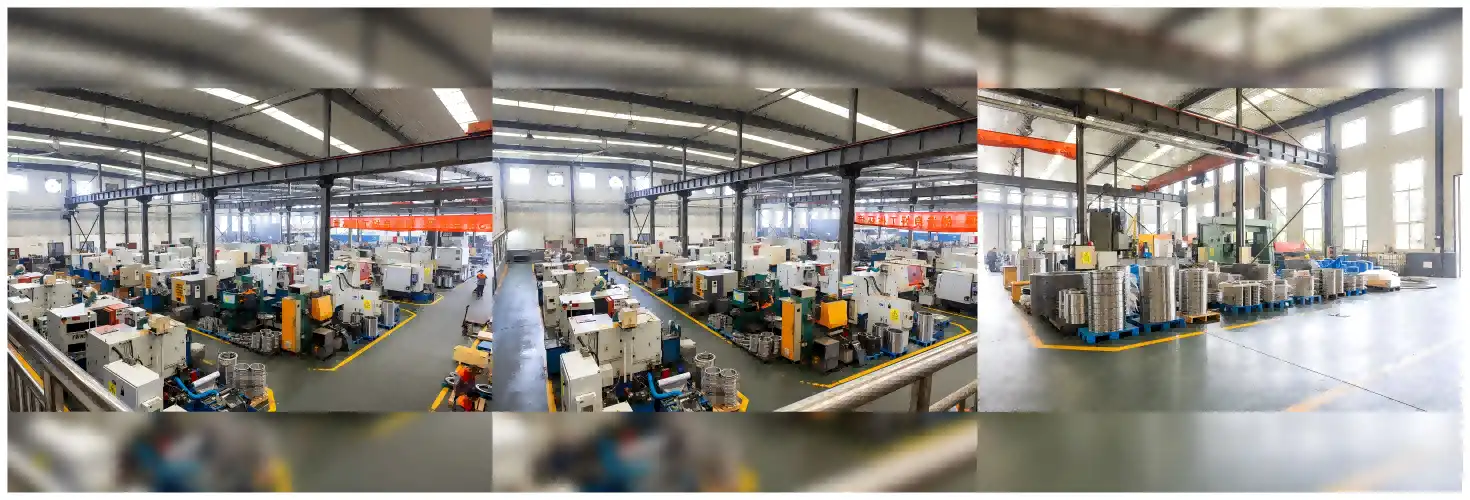
Our engineering team provides comprehensive technical support throughout your procurement process, from initial specification review to customization for unique application requirements. With six specialized production workshops and 120 dedicated professionals, we maintain the manufacturing capacity to support both prototype development and high-volume production demands with competitive lead times.
Contact our applications engineering team at auto@lyautobearing.com to discuss your specific bearing requirements. We'll provide detailed technical specifications, precision-grade certifications, and competitive quotations tailored to your project timeline and volume needs.
References
1. Harris, T.A. & Kotzalas, M.N. (2006). Advanced Concepts of Bearing Technology: Rolling Bearing Analysis, Fifth Edition. CRC Press.
2. Bhushan, B. (2013). Principles and Applications of Tribology, Second Edition. John Wiley & Sons.
3. ISO 492:2014. Rolling Bearings — Radial Bearings — Geometrical Product Specifications (GPS) and Tolerance Values. International Organization for Standardization.
4. Weck, M. & Brecher, C. (2006). Machine Tools Production Systems 4: Automation of Machine Tools and Production Systems. Springer-Verlag Berlin Heidelberg.
5. Neugebauer, R., Denkena, B., & Wegener, K. (2007). "Mechatronic Systems for Machine Tools," CIRP Annals - Manufacturing Technology, 56(2), 657-686.
6. Japanese Industrial Standards Committee (2018). JIS B 1523: Crossed Roller Bearings — Boundary Dimensions and Tolerances. Japanese Standards Association.
Learn about our latest products and discounts through SMS or email