- English
- French
- German
- Portuguese
- Spanish
- Russian
- Japanese
- Korean
- Arabic
- Greek
- German
- Turkish
- Italian
- Danish
- Romanian
- Indonesian
- Czech
- Afrikaans
- Swedish
- Polish
- Basque
- Catalan
- Esperanto
- Hindi
- Lao
- Albanian
- Amharic
- Armenian
- Azerbaijani
- Belarusian
- Bengali
- Bosnian
- Bulgarian
- Cebuano
- Chichewa
- Corsican
- Croatian
- Dutch
- Estonian
- Filipino
- Finnish
- Frisian
- Galician
- Georgian
- Gujarati
- Haitian
- Hausa
- Hawaiian
- Hebrew
- Hmong
- Hungarian
- Icelandic
- Igbo
- Javanese
- Kannada
- Kazakh
- Khmer
- Kurdish
- Kyrgyz
- Latin
- Latvian
- Lithuanian
- Luxembou..
- Macedonian
- Malagasy
- Malay
- Malayalam
- Maltese
- Maori
- Marathi
- Mongolian
- Burmese
- Nepali
- Norwegian
- Pashto
- Persian
- Punjabi
- Serbian
- Sesotho
- Sinhala
- Slovak
- Slovenian
- Somali
- Samoan
- Scots Gaelic
- Shona
- Sindhi
- Sundanese
- Swahili
- Tajik
- Tamil
- Telugu
- Thai
- Ukrainian
- Urdu
- Uzbek
- Vietnamese
- Welsh
- Xhosa
- Yiddish
- Yoruba
- Zulu
XU200250UU/P4 Crossed Roller Slewing Bearing: OEM Buying Guide
If you are in need of a high-precision rotary component for industrial automation, robotics, or CNC machines, then the XU200250UU/P4 Crossed Roller Slewing Bearing is a solution you should pay close attention to. This OEM purchasing guide will lead you through its essential specs, structural benefits, selection criteria, and procurement method. If you’re a procurement engineer assessing suppliers or a design engineer confirming component fit, this guide provides you with the technical footing and sourcing clarity you need to make a confident, well-informed choice.
Understanding XU200250UU/P4 Crossed Roller Slewing Bearing Specifications and Features
Core Dimensions and Precision Grade
Basic specifications of the XU200250UU/P4 crossed roller slewing bearing are: 200 mm inner diameter, 250 mm outer diameter, and 32 mm breadth. The P4 designation is similar to ABEC-7, with dimensional tolerances and rotational runout controlled to microns, and corresponds to ISO precision class 4. This level of accuracy cannot be handled by the placement of equipment such as optical inspection equipment, IC production machines, and precision rotary tables since cumulative error directly affects the quality of the output.
| Specification | Value |
|---|---|
| Inner Diameter | 200 mm |
| Outer Diameter | 250 mm |
| Width | 32 mm |
| Precision Grade | P4 (ISO Class 4 / ABEC-7) |
| Material | GCr15, GCr15SiMn |
| Sealing | Dual UU rubber contact seals |
| Raceway Hardness | 58–64 HRC (induction hardened) |
| Available Accuracy Classes | P6, P0, P5, P4, P2 |
The material selection—GCr15 and GCr15SiMn high-carbon chromium bearing steel—provides excellent fatigue resistance and surface hardness. Raceways are induction-hardened to 58–64 HRC, which sustains a long service life under cyclic loading conditions common in automation equipment.
Structural Design and Operating Principle
The XU series has an integrated ring design, with both inner and outer rings being created as single, solid parts. There are no split points; hence, there is no possibility of ring deformation as occurs in split ring designs under severe moment loads. Pre-drilled mounting holes (countersunk or threaded) are provided on the end faces for direct bolting to matching surfaces without the need for flanges or housings. This integrated mounting solution offers a real benefit for robotic joints with limited space as it minimizes the number of parts and compresses the assembly height.
The raceways are V-grooves and are set alternately to 90 degrees with cylindrical rollers. This cross-roller shape provides line contact across a broad effective load-bearing area. The isolation spacers between rollers prevent roller skewing and ensure constant load distribution, which stabilizes output torque and decreases friction. The result is a single compact device that concurrently handles radial loads, axial loads, and tilting moments, avoiding the requirement for stacked bearing arrangements that add weight and complexity to the assembly.
Comparison and Selection Criteria for XU200250UU/P4 Bearings
XU200250UU/P4 vs. XU200200UU/P4
The XU200200UU/P4 has the same 200 mm bore, but a 200 mm outside diameter and lower breadth. The XU200250UU/P4 Crossed Roller Slewing Bearing has a broader outer ring and more breadth at 32 mm, which leads to a higher moment load capacity and better tilting rigidity. If your application requires longer arm reach, larger payload, or more aggressive angular acceleration (such as a 6-axis robotic elbow joint), the extra material cross-section of the XU200250 shape gives you a tangible structural buffer.
Crossed Roller vs. Tapered Roller: A Procurement Perspective
Tapered roller bearings handle combined loads effectively and are widely available at lower unit cost. However, they require paired mounting, precise axial preload adjustment, and larger axial space. The XU200250UU/P4 crossed roller slewing bearing addresses all three load directions in one compact unit, simplifies assembly, and holds P4 rotational accuracy that tapered rollers cannot match by design. For OEM applications where positional repeatability and assembly simplicity carry more weight than unit price, the crossed roller format delivers a superior cost-performance ratio over the product lifecycle.
Procurement Insights for Buying XU200250UU/P4 Slewing Bearings
Strategic procurement of a precision bearing like the XU200250UU/P4 crossed roller slewing bearing requires evaluating more than the price per unit. Supply continuity, certification compliance, and technical responsiveness are equally decisive factors.
Here are the core procurement evaluation criteria that experienced OEM buyers prioritize:
- Certification verification: Confirm the supplier holds both ISO 9001 and IATF 16949 certifications. These credentials validate the quality management system and process control capability. IATF 16949 is particularly relevant for automotive-adjacent applications where defect rates and traceability requirements are stringent.
- Production capacity and lead time: A supplier operating multiple production workshops with documented capacity can commit to realistic lead times. For high-volume OEM programs, ask about batch size flexibility and safety stock policies.
- Customization capability: Some applications require modified preload, non-standard mounting hole patterns, or alternative sealing materials. A manufacturer with an in-house engineering team can provide these adaptations without routing orders through third-party intermediaries.
- After-sales technical support: Suppliers who provide installation guidance, lubrication specifications, and failure analysis support reduce your total cost of ownership, not just the purchase price.
These criteria separate a transactional vendor from a genuine long-term supply partner. When sourcing a crossed roller slewing ring for critical machinery, the latter relationship protects your production continuity far more effectively.
| Evaluation Criterion | What to Verify |
|---|---|
| Quality Certifications | ISO 9001, IATF 16949 certificates with valid dates |
| Precision Grade Compliance | P4 runout test reports per ISO 492 |
| Material Traceability | GCr15 / GCr15SiMn mill certificates |
| Lead Time Commitment | Standard and expedited lead time in writing |
| Customization Scope | Mounting hole patterns, preload, sealing options |
| Warranty Terms | Defect coverage period and return protocol |
Maintenance and Application Best Practices
Recommended Lubrication Protocol
This crossed roller slewing ring is designated UU for dual-contact rubber seals on either side. The bearing is sent pre-lubricated with a lithium soap-based grease suited for normal industrial temperatures. After 6-12 months of continuous operation, refilling grease via the oil port will provide a sufficient lubrication coating at the roller-raceway contact. For high-temperature or high-pollution operating conditions, refer to the manufacturer for grease specification modifications.
Key Application Sectors
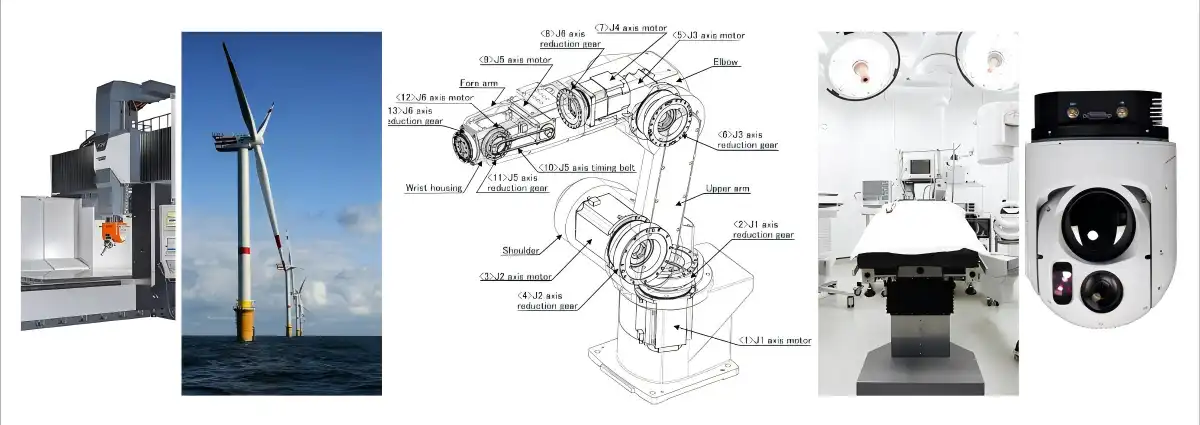
The XU200250UU/P4 Crossed Roller Slewing Bearing is used in many demanding B2B industrial applications. In precision CNC rotary indexing tables, this bearing directly supports the table plate, and a P4 angular accuracy eliminates positioning error during multi-axis machining of aerospace or automotive components. For industrial robot joints, notably waist and elbow joints, the bearing’s moment load stiffness prevents the arm from sagging under loads, and the integrated mounting holes allow for compact joint packaging. Sealed lubrication ensures smooth, low-torque rotation and provides a contamination-free environment that fulfills the operating criteria for medical CT scanners and optical inspection equipment.
Regular checks for radial runout and axial play may identify early wear before it compromises positioning precision. If torque becomes erratic or rotational resistance rises abruptly, check roller spacers and raceway surface for contamination or micro-pitting. Addressing these symptoms early often increases service life beyond the design baseline.
Building Trust and Making the Smart OEM Choice
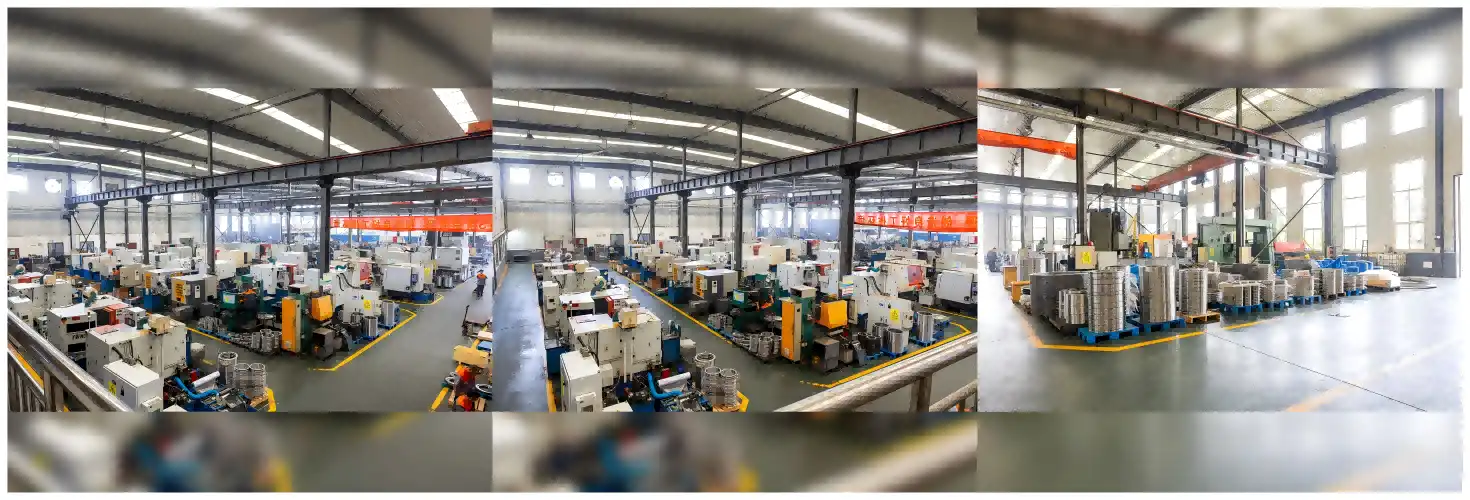
Luoyang Auto Bearing Co., Ltd. was founded in 2010. It has 15 years of experience from one automatic production workshop to six professional factories. The firm is ISO 9001 and IATF 16949 certified and has 120 trained staff in manufacturing, R&D, quality inspection, and assembly. Its crossed roller slewing bearing products are used by OEM clients in South Korea, the USA, Germany, Russia, Iran, and Turkey, where strict incoming quality requirements are applied. This regional export depth is a true reflection of production consistency, not a small local footprint.
Industry 4.0 integration is already in the operating picture. Process monitoring in precision grinding, automatic dimensional inspection, and digital quality records satisfy the traceability requirements of worldwide OEM supply chains. At this stage of maturity, working with a manufacturer helps to decrease your audit load and speed up certification deadlines.
Conclusion
The XU200250UU/P4 Crossed Roller Slewing Bearing is a technically mature, application-proven component for precision industrial automation, robotics, and CNC machining. Its integrated ring structure, P4 rotational accuracy, and simultaneous multi-directional load capacity make it a compact and reliable solution. Procurement decisions should prioritize certified manufacturers with engineering support and scalable capacity over the lowest unit price. Selecting the right supply partner early in the program protects both product quality and long-term supply continuity.
FAQ
Q1: What distinguishes P4 from P5 accuracy in a crossed roller slewing ring?
P4 (ISO Class 4) holds tighter tolerances on dimensional variation and rotational runout compared to P5 (ISO Class 5). For CNC indexing or optical alignment systems, P4 minimizes cumulative angular error in ways that P5 cannot guarantee. If your application requires positional repeatability within single-digit microns, P4 is the appropriate specification.
Q2: Does the XU200250UU/P4 require a separate housing?
No. The XU series features pre-drilled mounting holes on both inner and outer rings, allowing direct bolting to machine bases and rotating tables without additional flanges or housings.
Q3: What are realistic lead times for OEM volume orders?
Standard production lead times vary by order quantity and customization scope. Contacting the manufacturer directly with your volume and delivery schedule will yield a committed timeline. Suppliers with multi-workshop capacity can often accommodate expedited requirements.
Q4: Can this bearing handle high-speed rotation?
Crossed roller bearings are optimized for precision positioning and high stiffness at low-to-medium rotational speeds. They are not designed to compete with spindle bearings at high RPM. Confirm your target speed range with the manufacturer during application review.
Q5: What lubrication is pre-applied, and how often should it be replenished?
The bearing is pre-greased with lithium soap-based grease. Under standard continuous operation, replenishing through the oil port every 6–12 months is the general guideline. Harsh environments may require shorter intervals.
Partner with ATLYC for Your XU200250UU/P4 Crossed Roller Slewing Bearing Supply
ATLYC and Luoyang Auto Bearing deliver ISO 9001- and IATF 16949-certified precision bearings to OEM customers worldwide. As a trusted XU200250UU/P4 Crossed Roller Slewing Bearing manufacturer with 15 years of export experience, we support your sourcing with verified quality documentation, engineering consultation, and scalable production capacity. Send your drawings or quantity requirements directly to auto@lyautobearing.com to request a tailored quote today.
References
1. International Organization for Standardization. (2014). ISO 492: Rolling bearings — Radial bearings — Dimensional and geometrical tolerances. ISO.
2. SKF Group. (2023). Bearing steel and heat treatment: Technical handbook. SKF.
3. Schaeffler Group. (2022). Crossed roller bearings: Design and application guidelines. Schaeffler Technologies.
4. Timken Company. (2023). Engineering manual: Tapered roller bearing selection and design. The Timken Company.
5. International Federation of Robotics. (2023). World robotics 2023: Industrial robots report. IFR Statistical Department.
6. International Automotive Task Force. (2016). IATF 16949:2016 — Quality management system requirements for automotive production and relevant service parts organizations.
Learn about our latest products and discounts through SMS or email
