- English
- French
- German
- Portuguese
- Spanish
- Russian
- Japanese
- Korean
- Arabic
- Greek
- German
- Turkish
- Italian
- Danish
- Romanian
- Indonesian
- Czech
- Afrikaans
- Swedish
- Polish
- Basque
- Catalan
- Esperanto
- Hindi
- Lao
- Albanian
- Amharic
- Armenian
- Azerbaijani
- Belarusian
- Bengali
- Bosnian
- Bulgarian
- Cebuano
- Chichewa
- Corsican
- Croatian
- Dutch
- Estonian
- Filipino
- Finnish
- Frisian
- Galician
- Georgian
- Gujarati
- Haitian
- Hausa
- Hawaiian
- Hebrew
- Hmong
- Hungarian
- Icelandic
- Igbo
- Javanese
- Kannada
- Kazakh
- Khmer
- Kurdish
- Kyrgyz
- Latin
- Latvian
- Lithuanian
- Luxembou..
- Macedonian
- Malagasy
- Malay
- Malayalam
- Maltese
- Maori
- Marathi
- Mongolian
- Burmese
- Nepali
- Norwegian
- Pashto
- Persian
- Punjabi
- Serbian
- Sesotho
- Sinhala
- Slovak
- Slovenian
- Somali
- Samoan
- Scots Gaelic
- Shona
- Sindhi
- Sundanese
- Swahili
- Tajik
- Tamil
- Telugu
- Thai
- Ukrainian
- Urdu
- Uzbek
- Vietnamese
- Welsh
- Xhosa
- Yiddish
- Yoruba
- Zulu
CRBC Series Crossed Roller bearing Load and Accuracy Guide
The CRBC Series Crossed Roller bearing is a high-performance rotary motion component designed for applications that need multi-directional radial, axial, and moment load support in a single compact unit. The series of bearings has 20–30% more stiffness than other split-ring designs because of the integrated inner and outer ring construction. With precise grades for P4/P2 and a metal cage certified to 120°C, the CRBC Series Crossed Roller bearing is a precision workhorse for CNC machining machines, robotic joints, and high-accuracy indexing systems where dimensional stability and extended service life are non-negotiable.
Understanding Load Capacity and Accuracy in CRBC Series Crossed Roller Bearings
How Load Types Affect Bearing Selection
Industrial equipment rarely imposes a single, clean load on a bearing. In practice, a bearing seat in a robotic welding arm experiences radial force, thrust force, and tilting moment simultaneously. The CRBC Series Crossed Roller bearing resolves this challenge through an orthogonal roller arrangement — cylindrical rollers positioned at 90° alternating angles between the raceways — creating a 45° contact angle that distributes all three load types evenly across the rolling elements.
This geometry gives the bearing an effective moment arm substantially larger than its physical width. According to ISO 76:2006, the static load rating of a crossed roller bearing reflects its resistance to permanent deformation under combined loading [1]. For procurement engineers specifying bearings in heavy-duty CNC machining centers or large-scale precision indexing tables, understanding this distinction prevents costly under-specification.
Accuracy Grades and Tolerance Levels
The RBC Series Crossed Roller bearing is manufactured to ISO precision classes P5, P4, and P2. At P2 grade, radial runout of the inner ring is controlled to micron-level tolerances, which directly affects the positional repeatability of any rotating component it supports.
| Precision Grade | Inner Ring Radial Runout | Typical Application |
|---|---|---|
| P5 | ≤ 5 µm | General industrial machinery |
| P4 | ≤ 3 µm | CNC rotary tables, automation joints |
| P2 | ≤ 1.5 µm | Medical imaging, aerospace alignment |
Balancing load capacity against accuracy grade is not optional — it is structural reasoning. A bearing operating beyond its dynamic load rating will experience raceway fatigue that degrades precision far ahead of its rated L10 life. Selecting the correct precision class from the start protects both the bearing and the surrounding machine structure.
Key Design Features and Material Composition Enhancing CRBC Series Bearing Performance
Integral Ring Construction and Raceway Geometry
The most significant structural departure in the CRBC series from standard CRB variants is the abandonment of a split outer ring. Both inner and outer rings are machined as single-piece components from high-carbon chromium bearing steel (GCr15/SUJ2), heat-treated to 58–64 HRC. This eliminates the assembly gap inherent in split-ring designs and increases overall structural rigidity by 20–30%.
The raceway incorporates a slight curvature profile. This subtle geometry expands the contact area between each roller and its raceway, distributing stress more uniformly. The result is reduced peak contact pressure, lower wear rates, and a measurably longer fatigue life under heavy, sustained loads.
Metal Cage Technology and Thermal Stability
Here are the core material advantages that distinguish the CRBC series from conventional crossed roller designs:
- Brass or steel cage construction replaces polymer cage alternatives, maintaining dimensional integrity at continuous operating temperatures up to 120°C — a threshold that causes plastic cages to deform and lose roller guidance precision.
- High-carbon chromium steel raceways resist micropitting and brinelling under shock loads, which are common in robotic welding arms and high-speed indexing tables.
- A labyrinth seal combined with grease injection ports allows scheduled re-lubrication without disassembly, cutting planned maintenance time and protecting bearing life in contaminated environments.
These material choices collectively reduce unplanned downtime, which remains one of the most significant cost drivers in industrial equipment operation. For OEMs supplying European and North American markets, the thermal and load stability of this design directly supports equipment uptime commitments.
Comparing CRBC Series Crossed Roller Bearings with Other Bearings
CRBC vs. Angular Contact Ball Bearings
In robotics and automation, space is constrained, and load conditions are complex. Angular contact ball bearings require paired mounting to achieve moment load resistance, consuming axial space and adding assembly complexity. The RBC Series Crossed Roller bearing manages combined loads in a single unit, achieving 3 to 4 times the rigidity of a comparable angular contact ball bearing arrangement — a performance gap that becomes decisive in six-axis articulated robots and direct-drive rotary tables.
CRBC vs. Standard CRB Series
The CRB series uses a split outer ring that facilitates roller insertion but introduces a structural discontinuity. Under heavy moment loads, split-ring designs can exhibit micro-deflection at the joint line. The integral ring structure of the CRBC series eliminates this vulnerability, making it the preferred choice where continuous precision under sustained loading is mandatory.
| Feature | CRB Series | CRBC Series |
|---|---|---|
| Outer Ring | Split | Integral |
| Rigidity | Baseline | +20–30% |
| Max Operating Temp | ~80°C (plastic cage) | 120°C (metal cage) |
| Precision Grade | Up to P4 | Up to P2 |
| Ideal For | Light-duty precision | Heavy-duty, long-cycle operation |
Global manufacturers such as THK and IKO produce competitive crossed roller bearings with strong brand recognition. However, for procurement teams evaluating cost-performance ratio alongside ISO 9001 and IATF 16949 compliance, sourcing from a certified Chinese bearing manufacturer with documented export experience in Germany, South Korea, and the USA offers meaningful cost advantages without sacrificing precision grades.
Procurement Guide and Support for CRBC Series Crossed Roller Bearings
Purchasing crossed roller bearings through unauthorized channels introduces the risk of counterfeit products, missing quality documentation, and voided warranty coverage. Procurement professionals should verify that their supplier holds current ISO 9001 and IATF 16949 certifications — both of which are independently audited quality management frameworks relevant to bearing manufacturing.
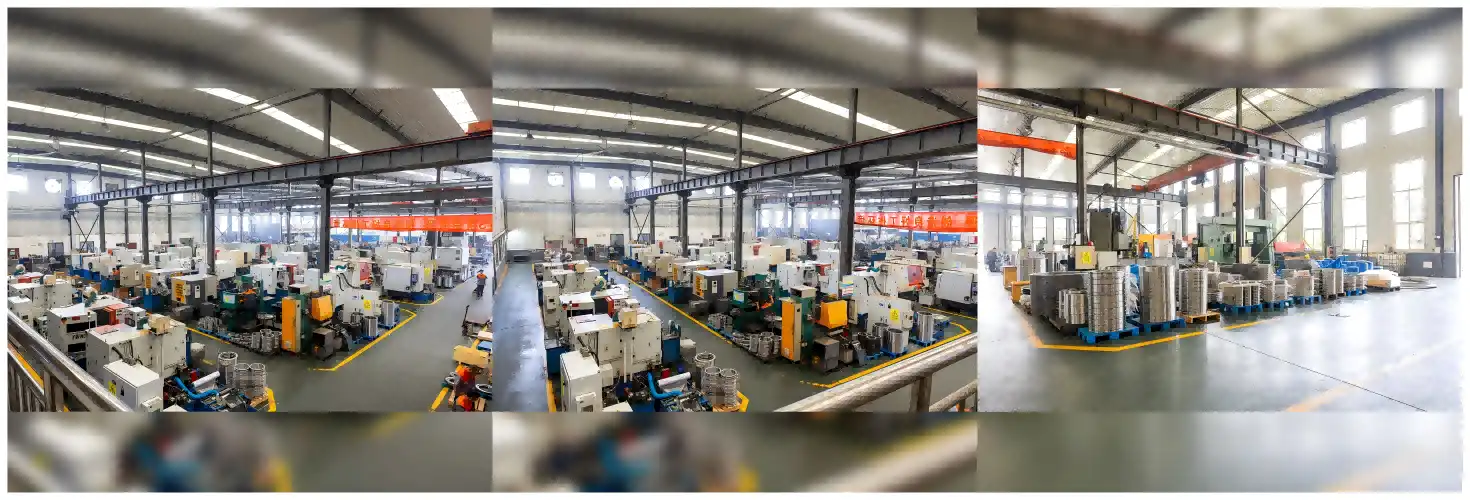
Luoyang Auto Bearing Co., Ltd. (ATLYC), established in 2010, has expanded from a single workshop to six production facilities over 15 years, with 120 skilled employees across production, R&D, quality inspection, and assembly. The company holds both ISO 9001 and IATF 16949 certifications and exports to South Korea, the USA, Germany, Russia, Iran, and Turkey. Bulk orders benefit from structured lead-time commitments, volume pricing, and direct technical support for application-specific customization of the CRBC Series Crossed Roller bearing.
Practical Applications and Benefits of Using CRBC Series Crossed Roller Bearings
This range of bearings has industrial use in many high-demand areas. The integrated ring construction in heavy-duty CNC machining centers is able to sustain the continuous cutting forces without dimensional deviation. In robotic welding arms, the metal cage controls the temperature and vibrational environment of repeating weld cycles. P2-grade runout tolerances provide the constant positioning accuracy that image quality relies on in CT scanners and precision alignment systems.
Bearing stiffness that lowers vibration transmission into spindles and guideways results in a measurable reduction in maintenance expenses. The labyrinth seal and grease injection technology provides for longer re-lubrication intervals, therefore lowering labor hours and limiting production disruptions. For B2B customers operating high-utilization equipment over numerous shifts, these operational benefits immediately translate into a reduced total cost of ownership.

Conclusion
The RBC Series Crossed Roller bearing delivers a structurally sound answer to the combined demands of high rigidity, thermal stability, and micron-level precision. Its integral ring construction, metal cage technology, and P2/P4 accuracy grades make it a reliable workhorse in environments where conventional bearings reach their performance ceiling. For manufacturers and OEMs in automotive, robotics, and industrial machinery, specifying this bearing series represents a deliberate investment in reduced downtime and sustained precision.
FAQ
1. Why does the CRBC series use an integral ring instead of a split outer ring?
The integral ring eliminates the structural discontinuity that split-ring designs inherently carry. Under heavy moment loads, this gap in split-ring bearings allows micro-deflection that erodes positioning accuracy over time. The integral construction of the CRBC series increases overall rigidity by 20–30%, making it suitable for long-cycle, high-load applications.
2. What lubrication does the CRBC Series Crossed Roller bearing require?
EP (Extreme Pressure) lithium-based grease is the standard recommendation. The line-contact geometry of cylindrical rollers generates higher contact pressure than point-contact ball bearings, making EP additives necessary to prevent metal-to-metal contact and micro-welding under load.
3. How does precision grade affect bearing selection?
P4 grade suits CNC rotary tables and automation joints where runout must stay within 3 µm. P2 grade targets medical imaging and aerospace applications requiring sub-2 µm inner ring radial runout. Selecting a lower precision grade than the application demands will compromise positional repeatability over time.
4. Can CRBC bearings operate at elevated temperatures?
Yes. The metal cage — brass or steel — maintains dimensional stability at continuous operating temperatures up to 120°C, unlike plastic cage designs that deform and lose roller guidance accuracy at lower thermal thresholds.
Partner with ATLYC for Your CRBC Series Crossed Roller Bearing Supply
ATLYC brings 15 years of precision bearing manufacturing experience, ISO 9001 and IATF 16949 certifications, and proven export reliability to your supply chain. As a trusted RBC Series Crossed Roller bearing manufacturer, we offer application-specific customization, competitive bulk pricing, and dedicated technical support. Contact us today at auto@lyautobearing.com to discuss your specifications and request a quote.
References
1. International Organization for Standardization. (2006). ISO 76:2006 – Rolling Bearings: Static Load Ratings. ISO.
2. NSK Ltd. (2023). Roller Bearing Technical Handbook. NSK Technical Publications.
3. THK Co., Ltd. (2022). Crossed Roller Bearing General Catalog. THK Product Documentation.
4. International Automotive Task Force. (2016). IATF 16949:2016 – Quality Management System Requirements for Automotive Production. IATF.
5. Weck, M., & Brecher, C. (2006). Machine Tools – Volume 2: Construction and Calculation. Springer.
6. Eschmann, P., Hasbargen, L., & Weigand, K. (1985). Ball and Roller Bearings: Theory, Design and Application (3rd ed.). Wiley.
Learn about our latest products and discounts through SMS or email