- English
- French
- German
- Portuguese
- Spanish
- Russian
- Japanese
- Korean
- Arabic
- Greek
- German
- Turkish
- Italian
- Danish
- Romanian
- Indonesian
- Czech
- Afrikaans
- Swedish
- Polish
- Basque
- Catalan
- Esperanto
- Hindi
- Lao
- Albanian
- Amharic
- Armenian
- Azerbaijani
- Belarusian
- Bengali
- Bosnian
- Bulgarian
- Cebuano
- Chichewa
- Corsican
- Croatian
- Dutch
- Estonian
- Filipino
- Finnish
- Frisian
- Galician
- Georgian
- Gujarati
- Haitian
- Hausa
- Hawaiian
- Hebrew
- Hmong
- Hungarian
- Icelandic
- Igbo
- Javanese
- Kannada
- Kazakh
- Khmer
- Kurdish
- Kyrgyz
- Latin
- Latvian
- Lithuanian
- Luxembou..
- Macedonian
- Malagasy
- Malay
- Malayalam
- Maltese
- Maori
- Marathi
- Mongolian
- Burmese
- Nepali
- Norwegian
- Pashto
- Persian
- Punjabi
- Serbian
- Sesotho
- Sinhala
- Slovak
- Slovenian
- Somali
- Samoan
- Scots Gaelic
- Shona
- Sindhi
- Sundanese
- Swahili
- Tajik
- Tamil
- Telugu
- Thai
- Ukrainian
- Urdu
- Uzbek
- Vietnamese
- Welsh
- Xhosa
- Yiddish
- Yoruba
- Zulu
Four Point Contact Ball Slewing Bearing Benefits Explained
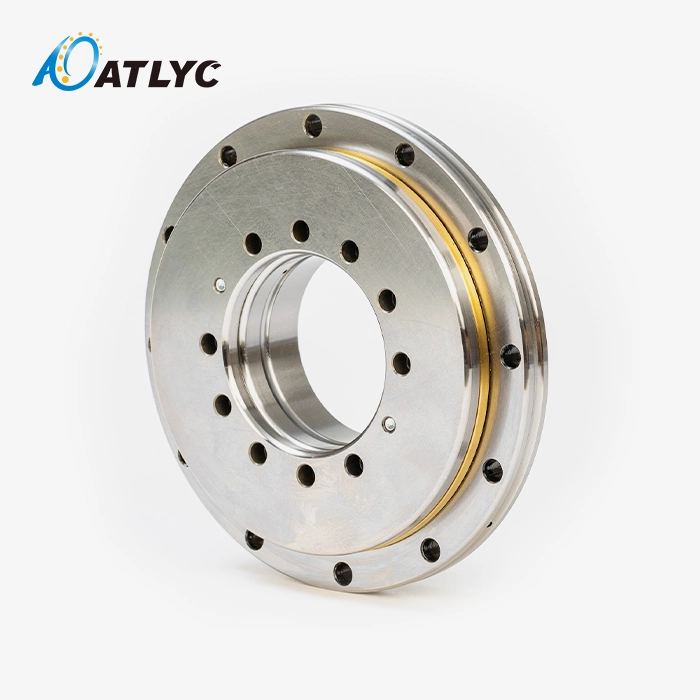
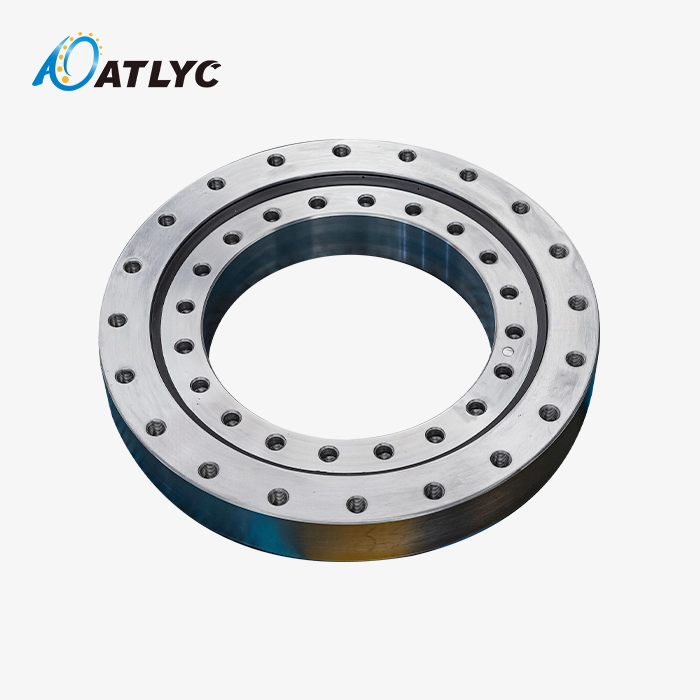
A Four Point Contact Ball Slewing Bearing can carry axial load, radial load and tilting moment at the same time. The contour of the raceway allows each ball to contact the rings at as many as four places. This implies that one bearing substitutes numerous pieces. “That saves space and weight and steps in putting it together.” You may choose external gear, internal gear or no gear at all depending on your drive. The results are still dependent on the accuracy of load calculation, flatness of mounting surfaces and quality of bearing oiling. Tools that have to rotate with big loads are well suited for this. This tutorial covers the design, fundamentals of loads, the usage and purchase process.ATLYC (Luoyang Auto Bearing Co.,Ltd.) works together with OEMs, distributors and maintenance teams operating machinery such as excavators, cranes, wind turbines, solar trackers, rotary tables, robots and tools for moving objects around. Their questions keep popping up. Will there be enough space for the Four Point Contact Ball Slewing Bearing, will it be durable enough, and will it get there in time? All of these are answered in the portions below.

What Is a Four Point Contact Ball Slewing Bearing?
Construction and Contact Geometry
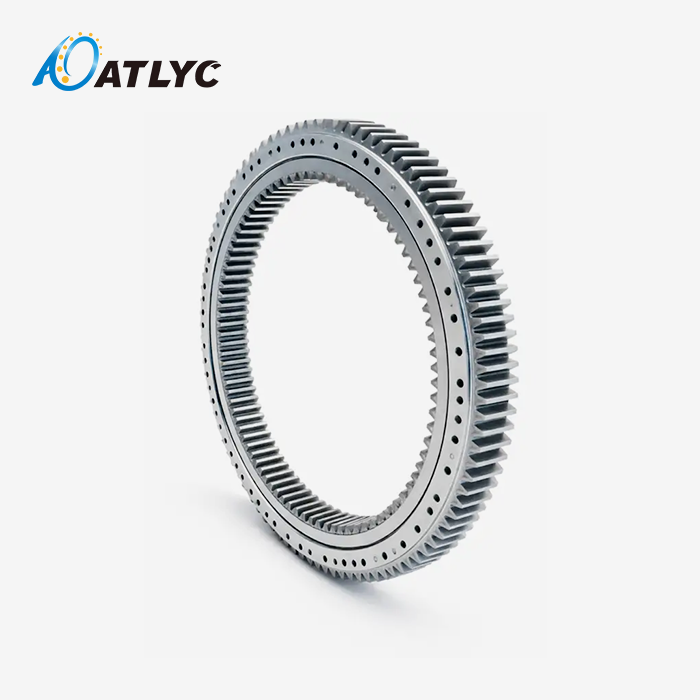
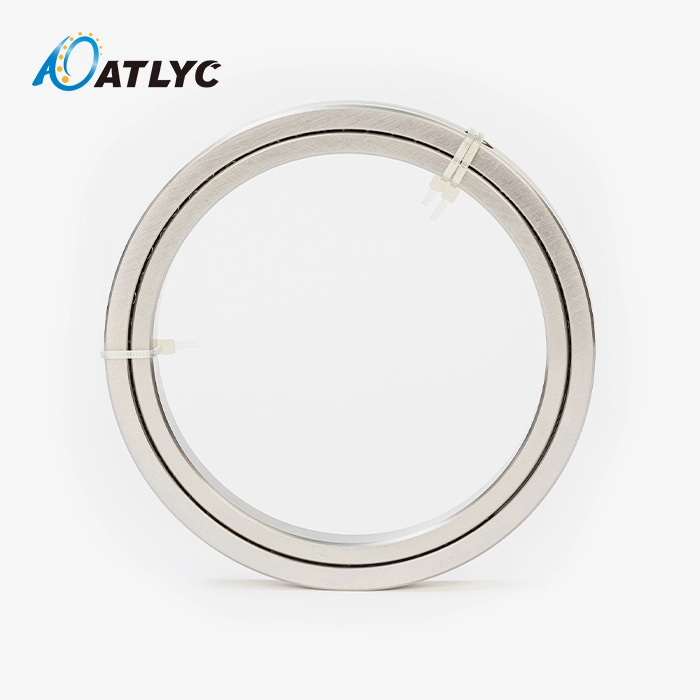
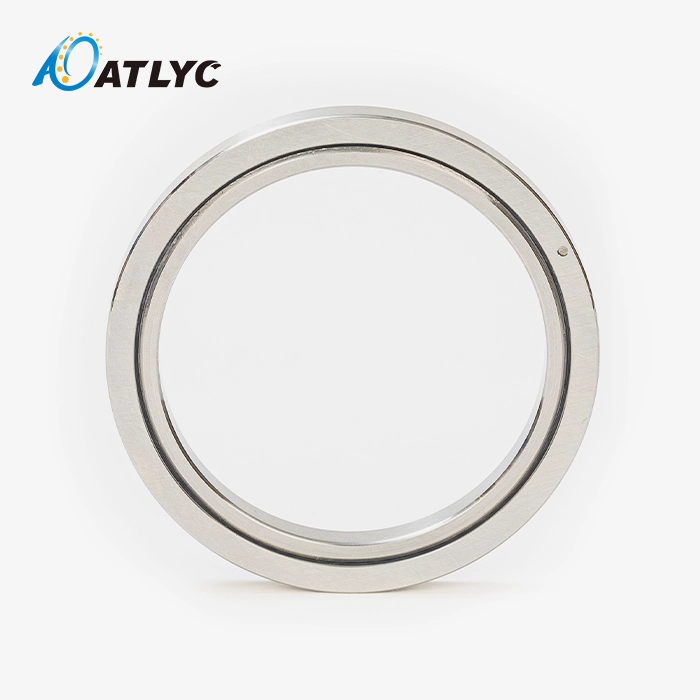
Two rings, steel balls, and cages or separators between the balls make up a Four Point Contact Ball Slewing Bearing. The unit has seals, mounting holes, and an optional gear that can be added. The raceways are shaped in a certain way, and the contact angle is usually 35°. Any radial load makes each ball touch the raceway four times. It drops to two points when there is a one-way axial load. The bearing can handle axial loads in both directions and a certain amount of tilting moment. This means that it has features of both single-row and double-row angular contact ball bearings.
Gear Configurations and Size Range
The Four Point Contact Ball Slewing Bearing can come with an external gear, an internal gear, or no gear at all. An external gear fits a pinion that meshes with the outside of the ring. The teeth of an internal gear are inside the gear, which can make it easier to close the drive. For plans that turn the ring in a different direction, a gearless unit will work. The size ranges we have now are shown in Table 1.
| Type | Inner Diameter (mm) | Outer Diameter (mm) | Weight (kg) |
|---|---|---|---|
| No gear | 260-4272 | 480-4726 | 55-4000 |
| Internal gear | 458-4272 | 662-4726 | 94-4000 |
| External gear | 470-4272 | 694-4726 | 93.1-4000 |
Before you send a drawing, make sure that these ranges match up with your installation envelope.
Materials and Quality Checks
You can get rings made of 50Mn, 42CrMo, S48C, 42CrMo4, or 16Mn. We make sure you know which choice is best based on your load, shock, and gear needs when we quote. Because the inner ring is split in half, the outer ring with its balls and cage can be put on without the inner ring halves. That makes maintenance and assembly easier. Ultrasonic testing of forgings, magnetic particle testing after heat treatment, raceway hardness, dimensions and runout, and clearance are some of the things that are usually part of procurement quality control. You can get these records from any supplier.
Four Point Contact Ball Slewing Bearing Benefits Explained
One Bearing for Three Load Types
The main benefit is that it integrates the load. The axis is pushed across by radial loads. Along it, loads act in both directions. Moments of tilt move around the center of the bearing. Designers don't need to buy separate thrust and radial bearings because a Four Point Contact Ball Slewing Bearing can do all three. When you have fewer parts, you have fewer surfaces to machine, tolerances to stack, and items to keep in stock. The shape of the contact also spreads the load across the contact points. This keeps stress from building up in one place and prevents uneven wear. Buyers in the aftermarket also get an easier way to replace parts.
Space, Weight, and Assembly Savings
There is no middle ring in this bearing like there is in a double-row design. It only has two rings, the inner and the outer. This leads to a shorter axial height, less weight, easier mounting interfaces, and lower costs for installation. Different types of gears give you more choices: an external gear for an outside pinion, an internal gear for a compact drive, and gearless for other drive configurations. Less parts and easier assembly can lower the total cost of ownership of a machine over its lifetime, not just the price of buying it. People who only compare unit prices miss that chance to save a lot of money.
Limits You Should Know
Any design won't work all the time. It's not just the size of the bearing that affects its performance. The load calculation, mounting accuracy, lubrication, alignment, clearance, and operating conditions are also important. If the mounting surface isn't flat, the rings can get bent and last less long. The bearing needs to keep two-point contact at high speeds for it to work right. If the job needs to be very precise, have very little runout, or be very stiff, a different design might work better. The application data for a Four Point Contact Ball Slewing Bearing should be complete before we quote. Our engineers look over that data to make sure we give you the best price.
Four Point Contact Ball Slewing Bearing Load Capacity and Alternative Designs
Axial, Radial, and Moment Loads
Engineers check three numbers first when they size a Four Point Contact Ball Slewing Bearing: the axial load, the radial load, and the overturning moment. Moment is equal to force times distance, which is written as M = F × L. A 10 kN force acting 2 m from the center of the bearing, for example, makes a 20 kN·m moment. That number is just a sample, it's not a rating for any model. After that, you should add temperature, shock, vibration, speed, and duty cycle. Based on ISO 76 and ISO 281, slewing bearings are given a static load rating and a rating life. Supplier calculations then apply these ideas to slewing bearings.
Static Limits and Fatigue Life
There are two different checks: static capacity and fatigue life. Raceways don't get permanent dents from heavy or shock loads when static limits are in place. The fatigue life shows how many load cycles something can handle over time, and the safety factors connect both to real-world use. It also depends on the shape of the raceways, the size of the balls, the quality of the materials, how well they are oiled, and how stiff the mounting is. A bendy flange can bend when it's under moment load, which puts stress on a few balls and shortens their life. That's why I need the drawing of the supporting structure as well as the load numbers.
Comparison with Cross Roller and Double-Row Designs
Not every type can do every job. As a whole, Table 2 shows how first screenings compare.
| Feature | Four Point Contact Ball Slewing Bearing | Cross roller | Double-row ball |
|---|---|---|---|
| Rolling element | Balls, up to four contact points | Rollers, line contact | Balls in two rows |
| Rigidity | Moderate | Higher | Moderate to high |
| Axial height | Compact | Compact | Larger |
| Best fit | Combined loads, cost-conscious designs | Precision and stiffness | Heavier axial or moment loads |
Use the table to make a short list, and then do a load calculation to make sure. Every type is affected by mounting deformation and lubrication.
How to Choose a Four Point Contact Ball Slewing Bearing
Define the Operating Scenario
Find out how the machine moves before you ask for a Four Point Contact Ball Slewing Bearing. Write down whether the ring spins continuously or oscillates, as well as the speed, duty cycle, temperature range, and exposure to salt, water, dust, and vibration. To do this, write down the gear module, mounting dimensions, bolt hole pattern, axial and radial loads, overturning moment, clearance, backlash limit, and desired service life. Based on where your drive is, you can pick inside gear, outside gear, or no gear. For example, a bearing in a muddy excavator needs a different seal than one in an indoor rotary table. So, make sure that the material, heat treatment, and corrosion protection are all right for the job.
Information Needed for an Accurate Quotation
The price is based on the size, shape, material, heat treatment, design of the gear, its accuracy, clearance, sealing, inspection, packaging, quantity, and any special requests. We need information about the equipment, drawings, axial and radial loads, moment loads, speed, duty cycle, environment, service life, gear requirements, certificates, and a delivery schedule in order to give you an accurate quote. Without data, you have to make assumptions, and those assumptions can lead to extra work. Send us what you have, and we'll let you know if there are any gaps. Instead of just looking at the lowest price, compare the total cost of ownership, which takes into account things like service life, downtime, and spare parts.
Supplier Evaluation and Custom Options
Check a supplier's ability to make things, the accuracy of their raceways and gears, their engineering support, their quality documents, their experience with exporting, and their OEM experience. Since its founding in 2010, Luoyang Auto Bearing Co., Ltd. has grown to have 120 employees, six workshops, and certifications from both ISO 9001 and IATF 16949. People from South Korea, the US, Germany, Russia, Iran, and Turkey buy from us. Sometimes a custom Four Point Contact Ball Slewing Bearing is the best choice when mounting patterns, gear modules, space limits, or the ability to replace a standard model don't work with each other. Before going into production, I think prototypes should be tested using agreed upon acceptance criteria.
Applications of Four Point Contact Ball Slewing Bearings
Excavators and Cranes
In excavators, the bearing connects the bottom part of the machine to the top part. Heavy-duty seals are important because it works in mud, dust, and sand and absorbs the shock of digging. Four Point Contact Ball Slewing Bearings are found between the chassis and the boom of trucks and mobile cranes. They handle the overturning moment when loads are lifted at a long radius. Because it's not very tall, designers can keep the center of gravity low. Check with your supplier about safety, gear wear, and sealing for both machines.
Wind Turbines and Solar Trackers
A yaw system on a wind turbine turns the nacelle so that it faces the wind. The bearing is subject to changes in temperature, vibration, and long periods of small oscillating motion. To protect it from corrosion, a zinc or phosphate coating is used. Fatigue analysis and condition monitoring are also important. Performance in cold temperatures should also be looked at. The NREL design guideline on yaw and pitch bearings explains how to figure out how long these joints will last. Solar trackers need to be able to withstand being outside, have low friction, and stay in place. For both uses, the bearing needs to be approved by engineers who know how to work with that particular application.
Rotary Tables, Robots, and Material Handling
Precision, low backlash, repeatability, and a lot of operating cycles are important for rotary tables, robot bases, and material handling systems. Life can be shortened by dust and coolant, so sealing and easy access for maintenance are important. Compare the design to a cross roller bearing, as shown in Table 2, if you need very high accuracy. Another slow-moving use is in water treatment, where long life and a good seal are important. No matter what, we recommend that you have an engineer look over the load profile before you approve a model.
Installation, Lubrication, Maintenance, and Troubleshooting
Installation Steps That Protect Service Life
Before you put in a Four Point Contact Ball Slewing Bearing, you should clean the areas where it will go. Check to see if the flange is flat and stiff. Rings will not fit properly if the flange is bent or weak. Line up the holes for the bolts without using force. Use the right grade of bolt and tighten it in the steps the manufacturer tells you to, one step at a time across the ring. If the fit isn't right, don't force it. The tension of the bolts can bend the raceway. Once the bearing is in place, slowly turn it and feel for any tight spots before you load it.
Lubrication and Routine Inspection
Pick a grease that works with the bearing's temperature, load, speed, and water exposure, and make sure it matches the grease that's already there. Determine how often to re-oil based on the manufacturer's instructions and the conditions at your site; rough sites need shorter intervals. As you do your checks, make sure you look for noise, vibration, backlash, gear wear, grease leaks, damaged seals, loose bolts, and changes in temperature. Every time, take a reading at the same spot so that trends are easy to see. Replace based on measured wear and a review of the root cause, not just the number of hours it was used.
Troubleshooting Common Problems
If you see signs of backlash, noise, vibration, high torque, or early failure, do these five things: find, measure, write down, fix, and check. Some of the most common reasons are worn raceways or gears, poor lubrication, contamination, corrosion, deformation of the mounting, loose bolts, misalignment, too much preload, shock loads, and incorrect load calculations. Bearing damage and its causes are categorized by ISO 15243. This helps tell the difference between normal wear and abnormal wear. Every time you measure, use the same method. Fix the problem's cause, or it will come back.

Conclusion
A Four Point Contact Ball Slewing Bearing usually has a 35° contact angle and can handle axial, radial, and moment loads all in one small two-ring unit. It has an inner diameter of 260 mm and an outer diameter of 4726 mm. It has external gear, internal gear, and gearless types. Its main benefits are having fewer parts, a lower axial height, and being easier to put together. Some of its limitations are that it is sensitive to changes in speed, lubrication, and the shape of the mounting. Cross roller designs may be better for some precise jobs. Not just size, but also moment calculation, safety factors, and fatigue life determine how much weight something can hold. Excavators, cranes, wind turbines, and other similar machines have service lives that depend on how well they are chosen, installed, oiled, and inspected.
FAQ
What loads can this bearing carry?
In one unit, it can carry axial loads in two directions, radial loads, and tilting moments. The shape of the raceway lets the balls touch the rings up to four times, which makes the load more even.
How does it differ from a cross roller bearing?
It uses balls and suits to combine loads at a fair price. Cross roller designs use rollers and usually give more rigidity for work that needs to be precise. Instead of trying to find a winner that works for everyone, match the design to the way you load it.
Is high speed a problem?
The bearing needs to keep two-point contact at high speeds for it to work right. More lubrication and clearance are also needed when the speed goes up. Let us know your speed.
Which materials are available?
We have rings made of 50Mn, 42CrMo, S48C, 42CrMo4, and 16Mn. That depends on the load, shock, and gear needs.
What data do I send for a quotation?
Send information about the type of equipment, its dimensions, axial and radial loads, speed, duty cycle, gear choice, environment, and how long it will last. Full data makes the quote go faster.
Request a Four Point Contact Ball Slewing Bearing Recommendation
Need a reliable company to make Four Point Contact Ball Slewing Bearings for export, OEM, or replacement projects? Send ATLYC the type of equipment you have, drawings of it, loads, overturning moment, speed, preferred gears, and the environment in which it will be used. At Luoyang Auto Bearing Co., Ltd., our engineers will look over the information and make a quote. Feel free to email auto@lyautobearing.com or go to https://aotezhoucheng.aixdb.cn/ to make your request.
References
1. International Organization for Standardization. ISO 76: Rolling Bearings — Static Load Ratings, 2006.
2. International Organization for Standardization. ISO 281: Rolling Bearings — Dynamic Load Ratings and Rating Life, 2007.
3. International Organization for Standardization. ISO 15243: Rolling Bearings — Damage and Failures — Terms, Characteristics and Causes, 2017.
4. National Renewable Energy Laboratory. Wind Turbine Design Guideline DG03: Yaw and Pitch Rolling Bearing Life, 2009.
5. International Organization for Standardization. ISO 9001: Quality Management Systems — Requirements, 2015.
6. International Automotive Task Force. IATF 16949: Quality Management System Requirements for Automotive Production and Relevant Service Parts Organizations, 2016.
Learn about our latest products and discounts through SMS or email