- English
- French
- German
- Portuguese
- Spanish
- Russian
- Japanese
- Korean
- Arabic
- Greek
- German
- Turkish
- Italian
- Danish
- Romanian
- Indonesian
- Czech
- Afrikaans
- Swedish
- Polish
- Basque
- Catalan
- Esperanto
- Hindi
- Lao
- Albanian
- Amharic
- Armenian
- Azerbaijani
- Belarusian
- Bengali
- Bosnian
- Bulgarian
- Cebuano
- Chichewa
- Corsican
- Croatian
- Dutch
- Estonian
- Filipino
- Finnish
- Frisian
- Galician
- Georgian
- Gujarati
- Haitian
- Hausa
- Hawaiian
- Hebrew
- Hmong
- Hungarian
- Icelandic
- Igbo
- Javanese
- Kannada
- Kazakh
- Khmer
- Kurdish
- Kyrgyz
- Latin
- Latvian
- Lithuanian
- Luxembou..
- Macedonian
- Malagasy
- Malay
- Malayalam
- Maltese
- Maori
- Marathi
- Mongolian
- Burmese
- Nepali
- Norwegian
- Pashto
- Persian
- Punjabi
- Serbian
- Sesotho
- Sinhala
- Slovak
- Slovenian
- Somali
- Samoan
- Scots Gaelic
- Shona
- Sindhi
- Sundanese
- Swahili
- Tajik
- Tamil
- Telugu
- Thai
- Ukrainian
- Urdu
- Uzbek
- Vietnamese
- Welsh
- Xhosa
- Yiddish
- Yoruba
- Zulu
How Long Does Tapered Roller Bearing 32 series Last?
Properly Tapered Roller Bearing 32 series tapered roller bearings may provide an L10 life of 20,000 to over 100,000 working hours under normal industrial operating settings, depending on load magnitude, lubricant quality, accuracy of mounting, and grade of material. In automobile powertrain applications, these bearings may typically see more than 150,000 miles of vehicle service. When correctly fitted, 32 series tapered roller bearings in large industrial gear reducers and mining conveyors commonly run for five to ten years of continuous service before planned replacement is required. Supplier quality and production standards are still the key variable for obtaining those upper-bound statistics.

Understanding the Life Expectancy of Tapered Roller Bearing 32 Series
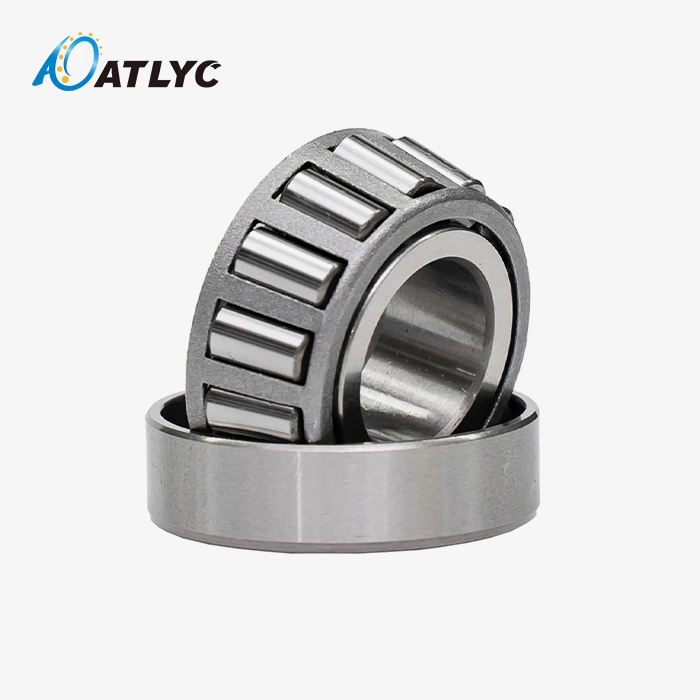
The 32 series tapered roller bearing is a single row metric bearing of the family according to ISO 355 and DIN 720, consisting of the sub-series 320xx, 322xx, 323xx and 329xx. Each sub-series has its own cross section and load rating. These elements are able to have genuine rolling motion with minimal friction because the raceways and rolling elements intersect at a similar apex on the bearing axis, a geometric concept that directly increases fatigue life relative to sliding-contact designs [SKF Bearing Catalog, 2022].
How Load Conditions Shape Service Life
The characteristic problem for this class of bearings is both radial and axial loads. The broader cross-sectioned 322xx sub-series deals with greater cumulative load cycles and has a higher dynamic load rating (C) than the thinner 320xx. If the load you apply is within 30% of the rated dynamic capacity, L10 life might increase considerably – often double the baseline estimate. Exceeding that threshold promotes subsurface fatigue initiation, the primary cause of spalling on raceways [Timken Engineering Manual, 2019].
Material Grade and Heat Treatment
Premium 32 series bearings are manufactured from high carbon chromium steel (GCr15/AISI 52100) and heat treated to HRC 60-64. The contents of retained austenite are maintained below 12% to avoid dimensional instability during thermal cycling. The smaller dimensional dispersion results in a smaller variation of the Hertzian contact stress across the roller set, which in turn yields a much longer fatigue life for bearings made according to ISO 492 tolerance class P5 or better.
| Sub-Series | Typical Cross-Section | Load Rating Orientation | Common Application |
|---|---|---|---|
| 320xx | Thin / Compact | Moderate combined load | Automotive transmissions |
| 322xx | Wide / Robust | Heavy combined load | Industrial gearboxes |
| 323xx | Medium | Balanced radial/axial | Agricultural wheel hubs |
| 329xx | Narrow angle | Higher axial proportion | Machine tool spindles |
Key Design Features Affecting the Durability of the 32 Series
Two design attributes separate long-lasting Tapered Roller Bearing 32 series tapered roller bearings from average performers: logarithmic roller crowning and the separable cone-and-cup architecture.
Logarithmic Roller Profile
Logarithmic crowning distributes Hertzian contact pressure equally down the length of the roller, reducing the edge-loading stress concentration that usually begins fatigue fractures under modest shaft misalignment or housing deflection. Without this feature, even small angle deviations of 2-4 arc-minutes may shorten service life by 30-50% [NSK Technical Report, 2020]. Premium manufacturers use this profile as standard, although budget-quality bearings typically forego this feature to save grinding expenses.
Separable Design and Preload Adjustment
The cup and cone are independently mountable in the 32 series, unlike deep groove ball bearings. A shim thickness/locknut position is set during assembly to provide internal clearance or intentional preload. Accurate preload avoids shaft whip in machine tools and pinion supports and immediately enhances the dimensional accuracy and reduces the vibration-generated fatigue. Improper preload, either too much or too little, is one of the three most common reasons for premature bearing failure in industrial gearboxes.
Comparing the 32 Series with Other Bearing Types for Longevity and Suitability
Procurement engineers routinely benchmark the 32 series tapered roller bearing against adjacent options before committing to a sourcing decision. The comparison below captures the critical differences.
Here are the key longevity and suitability distinctions across common bearing categories:
- 32 Series vs. 30 Series: The 30 Series carries a shallower contact angle, prioritizing radial load capacity. The 32 series offers a steeper angle, delivering superior axial thrust resistance — essential in differential pinion and conveyor drive applications where thrust forces dominate.
- 32 Series vs. 33 Series: The 33 series provides a wider width-to-bore ratio and higher axial rigidity, but the 32 series strikes a better balance between envelope size and combined load capacity for most medium-duty industrial machinery, keeping housing dimensions manageable without sacrificing rating.
- 32 Series vs. Cylindrical Roller Bearings: Cylindrical roller bearings excel at pure radial loads and high-speed operation, but they require a separate thrust element in most shaft arrangements. The 32 series eliminates that secondary component, reducing total assembly cost and axial space requirements.
- 32 Series vs. Deep Groove Ball Bearings: Ball bearings suit lighter loads and higher speeds. At moderate-to-heavy combined loads, the line contact between tapered rollers and raceways distributes stress over a larger area, yielding a substantially longer L10 life.
These distinctions clarify that the 32 series tapered roller bearing occupies a well-defined performance niche — and selecting the wrong category can silently cut bearing service life in half.
Maintenance Best Practices to Maximize 32 Series Bearing Life
Correct installation, disciplined lubrication, and systematic inspection form the three pillars of life extension for any Tapered Roller Bearing 32 series bearing assembly.
Lubrication Selection by Operating Speed
NLGI Grade 2 lithium complex grease is suitable for most industrial applications at modest speeds and has an operating range of –30°C to +150°C. At higher speeds, circulating oil or oil-mist lubrication is advised to relieve the frictional heat produced at the cone rib flange — the interior surface most subject to scoring from poor lubrication [FAG Rolling Bearing Lubrication Guide, 2021].
Recognizing Early Failure Signals
Raceway spalling generates a specific increase in wideband noise that may be recognized by vibration analysis equipment calibrated to S0910 (Andersometer) standards. The thermal imaging reveals localized heat signatures over 90°C consistent with roller-end scoring due to poor rib lubrication. Early detection of any of the symptoms may make the difference between a scheduled replacement and an unanticipated line closure.
| Failure Mode | Root Cause | Detection Method | Corrective Action |
|---|---|---|---|
| Raceway spalling | Fatigue, overload | Vibration analysis | Reduce load or increase bearing size |
| Roller-end scoring | Insufficient lubrication | Thermal imaging | Upgrade lubricant grade, increase frequency |
| Brinelling | Impact during installation | Visual inspection | Use a hydraulic press or an induction heater |
| Fretting corrosion | Loose fit, micro-movement | Dimensional check | Correct interference fit per ISO 286 |
Procurement Insights: How to Source 32 Series Bearings for Optimal ROI
Sustainable sourcing of tapered roller bearings in the 32 series is more than a competitive unit cost. Mid-to-large OEMs’ procurement teams should consider four factors, including certification status, production capability, customisation depth, and supply chain resilience.
ISO 9001 and IATF 16949 certifications are the very minimum requirements for automotive-grade supply chains. IATF 16949 deals with the automobile production part approval procedures (PPAP), control plans, and measurement system analysis, all of which directly cut defect rates and contain warranty costs. Bulk purchase agreements with qualified manufacturers sometimes include tiered pricing, reducing the per-unit cost by 8–15% for quantities above 5,000 units, while maintaining verifiable quality records.

Conclusion
The service life of a Tapered Roller Bearing 32 series tapered roller bearing is not a number; it’s a supply chain choice. The material grade, the production tolerance class, the accuracy of the roller crowning, and the quality management certification decide whether your bearings last 20,000 hours or more than 100,000. The lowest unit price doesn’t always result in a cheaper Total Cost of Ownership than buying from a certified manufacturer with verifiable metallurgical controls and proven conformance to IATF 16949. The design intelligence of the 32 series is realized only when manufacturing execution meets engineering intent.
FAQ
1. How often should a 32-series tapered roller bearing be replaced?
Replacement intervals depend on the application duty cycle and operating environment. In automotive differentials, replacement typically aligns with manufacturer service intervals or symptom onset. In continuous industrial duty, L10 life calculations — based on actual load and speed — should guide scheduled replacement before fatigue initiation.
2. What are the clear signs that a 32 series bearing needs replacement?
The most reliable indicators are elevated broadband vibration amplitude, detectable raceway spalling noise, thermal anomalies above 90°C at the bearing housing, and visible roller-end scoring during disassembly inspection. Any single indicator warrants prompt investigation.
3. Does lubrication quality genuinely extend service life?
Yes, measurably. Adequate lubrication film thickness — expressed by the viscosity ratio κ (kappa) — must exceed 1.0 for full separation of contact surfaces. When κ drops below 1.0, metal-to-metal contact accelerates surface fatigue, potentially reducing L10 life by 40–60% compared to properly lubricated operation [SKF Bearing Catalogue, 2022].
4. Can internal clearance adjustment affect longevity?
Absolutely. Correct preload eliminates axial play, reduces vibration, and improves shaft guidance precision. Excessive preload generates heat and accelerates fatigue; insufficient preload allows roller skewing under load, both scenarios shortening service life significantly.
Partner with ATLYC — Your Trusted Tapered Roller Bearing 32 Series Manufacturer
ATLYC (Luoyang Auto Bearing Co., Ltd.) has delivered precision bearings across six manufacturing workshops since 2010, holding both ISO 9001 and IATF 16949 certifications. Our Tapered Roller Bearing 32 series meets ISO 355 dimensional standards, with raceway roughness consistently below Ra 0.2µm. Serving OEM clients in the US, Germany, South Korea, and beyond, we offer competitive bulk pricing, customization, and reliable lead times. Contact our engineering team at auto@lyautobearing.com to request a quote today.
References
1. SKF Group. SKF Rolling Bearings Catalogue (PUB BU/P1 10000/2 EN). SKF, 2022. https://www.skf.com/group/products/rolling-bearings/principles/bearing-selection-process/bearing-life
2. Timken Company. Timken Engineering Manual (Order No. 5701). Timken, 2019. https://www.timken.com/resources/timken-engineering-manual/
3. NSK Ltd. NSK Technical Report: Rolling Bearing Life Assessment. NSK, 2020. https://www.nsk.com/common/data/ctrgPdf/e1102m.pdf
4. Schaeffler Group / FAG. Rolling Bearing Lubrication: Principles and Practice. Schaeffler Technologies, 2021. https://www.schaeffler.com/en/products-and-solutions/industrial/knowledge-base/lubricants/
5. ISO. ISO 355:2019 — Rolling Bearings: Tapered Roller Bearings — Boundary Dimensions and Series Designations. International Organization for Standardization, 2019. https://www.iso.org/standard/65269.html
6. Bearing Engineers Ltd. Tapered Roller Bearing Application and Maintenance Guide. Bearing Engineers Ltd., 2021. https://www.bearingengineers.com/tapered-roller-bearings
Learn about our latest products and discounts through SMS or email