- English
- French
- German
- Portuguese
- Spanish
- Russian
- Japanese
- Korean
- Arabic
- Greek
- German
- Turkish
- Italian
- Danish
- Romanian
- Indonesian
- Czech
- Afrikaans
- Swedish
- Polish
- Basque
- Catalan
- Esperanto
- Hindi
- Lao
- Albanian
- Amharic
- Armenian
- Azerbaijani
- Belarusian
- Bengali
- Bosnian
- Bulgarian
- Cebuano
- Chichewa
- Corsican
- Croatian
- Dutch
- Estonian
- Filipino
- Finnish
- Frisian
- Galician
- Georgian
- Gujarati
- Haitian
- Hausa
- Hawaiian
- Hebrew
- Hmong
- Hungarian
- Icelandic
- Igbo
- Javanese
- Kannada
- Kazakh
- Khmer
- Kurdish
- Kyrgyz
- Latin
- Latvian
- Lithuanian
- Luxembou..
- Macedonian
- Malagasy
- Malay
- Malayalam
- Maltese
- Maori
- Marathi
- Mongolian
- Burmese
- Nepali
- Norwegian
- Pashto
- Persian
- Punjabi
- Serbian
- Sesotho
- Sinhala
- Slovak
- Slovenian
- Somali
- Samoan
- Scots Gaelic
- Shona
- Sindhi
- Sundanese
- Swahili
- Tajik
- Tamil
- Telugu
- Thai
- Ukrainian
- Urdu
- Uzbek
- Vietnamese
- Welsh
- Xhosa
- Yiddish
- Yoruba
- Zulu
Is RE Series Crossed Roller Bearing Right for Your Design?
If you’re creating equipment that requires micron-level rotational precision and can manage loads in many directions simultaneously, the RE Series Crossed Roller Bearing is probably the solution. This kind of bearing has a single-piece outer ring and a two-piece inner ring. It can take radial, axial, and moment loads concurrently, all inside a compact unit. It is applicable for anything from IC fabrication devices to robotic joints, with the available inner diameters ranging from 20 mm to 1,100 mm and the precision grades from P6 to P3.

Understanding RE Series Crossed Roller Bearings
Structural Design
The RE Series Crossed Roller Bearing has a full outer ring and a two-piece distinct inner ring. Cylindrical wheels are aligned one after the other at 90 degrees within precision-ground V-groove raceways. This orthogonal design allows one bearing to carry all direction loads at the same time. The split inner ring allows for easy assembly of the rollers and exact preload modification during mounting. This directly affects the operating power and service life.
Technical Specifications
Sizes range from 20 mm to 1,100 mm diameter inside, 70 mm to 1,500 mm diameter outside, and 12 mm to 110 mm breadth. The rings are manufactured from high-carbon chromium bearing steel GCr15, or GCr15SiMn, reinforced to HRC 58-64 for extended stress life. Available precision grades include P6, P0, P5, P4, P3. This allows engineers to tailor the level of precision required for each application.
| Parameter | Specification |
|---|---|
| Inner Diameter | 20 – 1,100 mm |
| Outer Diameter | 70 – 1,500 mm |
| Width | 12 – 110 mm |
| Material | GCr15 / GCr15SiMn |
| Precision Grades | P6, P0, P5, P4, P3 |
| Friction Coefficient | 0.002 – 0.004 |
Maintenance and Lifespan
The roller separators prevent the neighboring rollers from contacting each other, thereby preventing heat buildup and damage. Standard units are pre-lubricated with a lithium soap-based grease that performs well in most industrial applications. Low-outgassing grease may be supplied for cleanroom or vacuum usage on request. The preload and the raceway condition, checked regularly, maintain the runout accuracy within the necessary limits over the whole service life of the bearing.
Comparing RE Series Crossed Roller Bearings with Other Bearing Types
Selecting the proper RE Series Crossed Roller Bearing type means knowing how each design performs under the particular load, space, and precision requirements of your application. The RE crossed roller bearing is compared below with typical alternatives, considering the criteria that are most important to engineers and procurement teams:
| Bearing Type | Moment Load Capacity | Axial + Radial in One Unit | Compactness | Typical Precision |
|---|---|---|---|---|
| RE Crossed Roller | High | Yes | High | P3 – P6 |
| Angular Contact Ball | Moderate | Paired units needed | Moderate | P4 – P5 |
| Cylindrical Roller | Low | No | Moderate | P5 – P6 |
| Thin Section Ball | Low | Limited | Very High | P5 |
| Cross Roller Slewing | High | Yes | Low | P5 – P6 |
Versus Angular Contact Ball Bearings
Angular contact bearings require matching pairs to accommodate two-way axial stresses, which complicates the case and takes longer to put together. That setup is replaced with one RE Series unit, which reduces the design size by up to 60% and enhances moment stiffness. This differential is crucial for robot joints and rotating tables when space is limited.
Versus Thin Section Bearings
Thin section bearings have the shortest cross section, but can only take modest quantities of moment stress. Under long or unequal design loads in force, they deflect more than crossed roller kinds. Its line-contact rollers are more resistant to elastic bending than its point-contact ball elements, making the RE crossed roller bearing able to maintain its runout precision better than under the same load conditions.
Versus Cylindrical Roller Bearings
Cylindrical roller bearings can carry enormous loads in the radial direction, but they need a separate push bearing to carry stresses in the axial direction. This split configuration makes the unit longer and harder to line up. The RE design integrates the two functions into one, reducing the total number of parts and simplifying the supply chain for OEMs that need to manage large numbers of bearing part numbers.
Applications and Benefits of RE Series Crossed Roller Bearings
The RE crossed roller bearing is the best choice when you want great positional precision, a limited fitting space, and the capacity to carry combined loads without movement.
Below are the key locations where this sort of bearing routinely provides demonstrable results:
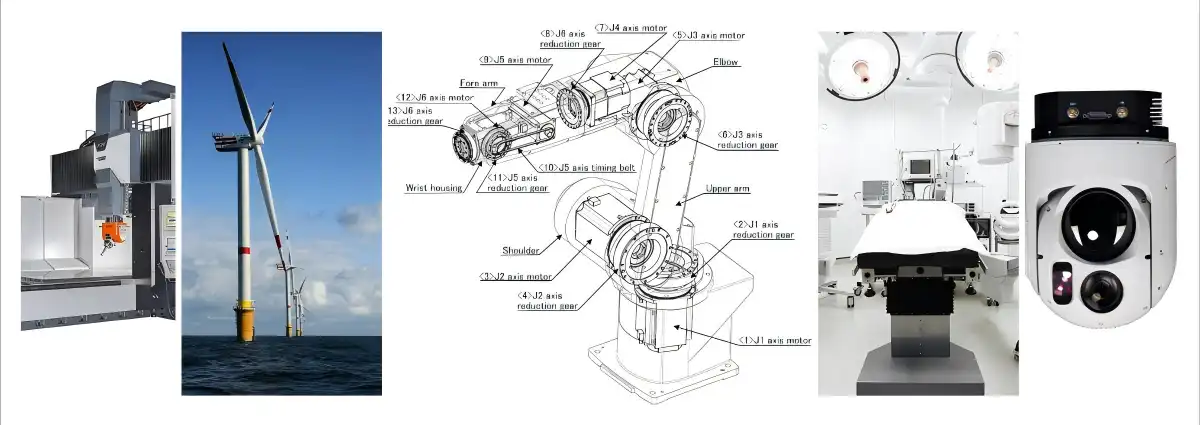
Industrial robot joints and arm pivots. Robot joints are subjected to fast changes of direction and the cantilevered load of the tool. The crossed roller arrangement reduces backlash and guarantees the repeatability of the joint of ±0.01 mm, which is necessary for welding, assembly, and inspection robots.
Rotary tables in machining centers: High-precision rotary tables must have smooth, low-torque spinning under the weight of the workpiece and cutting forces. The low friction coefficient of 0.002–0.004 minimizes the drive motor requirements as well as the angular positioning requirements.
Medical imaging and measurement instruments: CT scanners, coordinate measuring machines, and semiconductor inspection equipment need zero-backlash rotation and micron-level runout control. RE Series Crossed Roller Bearings P4 and P3 grades satisfy these demands without increasing the shaft length.
IC manufacturing devices: Wafer handling and lithography stages in cleanroom conditions where contamination and vibration should be as close to zero as possible. Roller separators offer smooth, steady rotation that immediately contributes to consistent yield.
These advantages address the most common production challenges that automation engineers face, such as limited envelope space, mixed load situations, and the cost of unexpected downtime caused by bearing failure.
Procurement Considerations for RE Series Crossed Roller Bearings
Supplier Qualification
When looking for crossed roller bearings for large-scale output, it's important that the provider is certified. Look for companies that have been certified by ISO 9001 and IATF 16949. These standards make sure that the supplier keeps track of processes, keeps records of them, and has programs for ongoing growth. These are requirements that protect the quality of your production.
Lead Times and Delivery Planning
Standard sizes in GCr15 steel usually ship in 4–6 weeks from a maker with a lot of stock. It could take 8–12 weeks for custom sizes or exact grades that aren't common. Include this in your plan to buy things, especially when you're making new machines and bearing availability is very important.
Total Cost of Ownership
The purchase price isn't the only thing that's taken into account. When you replace two bearings with a single RE crossed roller unit, the cost of making the case, the work needed to put it together, and the alignment tools all go down. Precision-grade units with longer service intervals require less upkeep. This cost consolidation adds up to a big budget win over several production years for OEMs that make a lot of parts.
Is the RE Crossed Roller Bearing the Right Choice for Your Design?
If the following three are true of your design, the RE Series Crossed Roller Bearing is right for you: The application must support a combined load in a small space. Rotational accuracy of less than 10 micrometers is important for the output of the system. Replacing multiple bearing parts with one unit makes the system more reliable or reduces the cost of assembly.
If it is mostly fast-speed rotation, mild loads, and no huge moment loads, then a deep groove ball bearing or thin section design may be cheaper and accomplish the same purpose. If all of your loads are radial and extremely heavy, a full-complement cylindrical roller bearing might perhaps take greater static stress for less money per unit.
The RE cross roller bearing is still one of the most cost-effective solutions for sectors such as robotics, medical equipment, and semiconductor production that need rigidity, precision, and compactness. This also applies to the precision grades P3 to P6.
Conclusion
Choosing the right type of bearing is a technical and purchasing choice that impacts the accuracy of the system, the cost of upkeep, and its dependability over time. The RE Series Crossed Roller Bearing meets the needs for combined load requirements, a small footprint, and precise positioning all in one unit. With an inner diameter range of 20 mm to 1,100 mm and precision grades from P6 to P3, it can be used in a lot of different industrial settings. This type of bearing always does what it's supposed to do when your design needs strength, accuracy, and space efficiency all at the same time.
FAQ
1. What is the difference between RE and RB series crossed roller bearings?
The RE Series Crossed Roller Bearing has an integral outer ring and a split inner ring, making it the preferred choice when the inner ring rotates. The RB series reverses this configuration with a split inner ring and integral outer ring, optimizing it for outer ring rotation. Choosing the wrong series for your rotation direction can reduce accuracy and preload consistency.
2. Can one RE bearing handle moment loads without a second support bearing?
Yes. The orthogonal roller arrangement creates an effective contact span that resists moment loads within a single unit. This eliminates the need for a secondary support bearing in most robotic and rotary table applications.
3. What lubrication does the RE crossed roller bearing use?
Standard units ship pre-packed with lithium soap-based grease. For vacuum environments or cleanrooms, specify low-outgassing grease at the time of order.
4. What precision grade should I select for a robot joint application?
P4 or P3 grade is standard for industrial robot joints and precision rotary tables. P5 and P6 grades suit general automation where absolute positional accuracy is less critical.
5. Is preload adjustment possible during installation?
Yes. The split inner ring design allows preload setting during assembly. For high-precision positioning, negative clearance preload removes backlash. For higher-speed applications, slight positive clearance prevents thermal overload.
Partner with ATLYC for Your RE Series Crossed Roller Bearing Supply
ATLYC has been making high-precision bearings since 2010 and is certified by both ISO 9001 and IATF 16949. We make RE Series Crossed Roller Bearings in all sizes and send them to OEMs and wholesalers in the US, Germany, South Korea, and other places. We have six production sites with 120 dedicated manufacturing professionals. To get a quote from a real RE Series Crossed Roller Bearing maker, email our engineering team at auto@lyautobearing.com.
References
1. Harris, T. A., & Kotzalas, M. N. — Rolling Bearing Analysis, Taylor & Francis, 2006.
2. ISO 492:2014 — Rolling Bearings — Radial Bearings — Dimensional and Geometrical Tolerances, International Organization for Standardization, 2014.
3. JTEKT Corporation — Crossed Roller Bearing Technical Catalog, JTEKT Engineering Journal, 2019.
4. SKF Group — SKF Rolling Bearings Catalogue, SKF, 2018.
5. Hamrock, B. J., Schmid, S. R., & Jacobson, B. O. — Fundamentals of Machine Elements, McGraw-Hill, 2005.
6. NSK Ltd. — Precision Machine Components Catalog: Crossed Roller Bearings, NSK Technical Publication, 2021.
Learn about our latest products and discounts through SMS or email