- English
- French
- German
- Portuguese
- Spanish
- Russian
- Japanese
- Korean
- Arabic
- Greek
- German
- Turkish
- Italian
- Danish
- Romanian
- Indonesian
- Czech
- Afrikaans
- Swedish
- Polish
- Basque
- Catalan
- Esperanto
- Hindi
- Lao
- Albanian
- Amharic
- Armenian
- Azerbaijani
- Belarusian
- Bengali
- Bosnian
- Bulgarian
- Cebuano
- Chichewa
- Corsican
- Croatian
- Dutch
- Estonian
- Filipino
- Finnish
- Frisian
- Galician
- Georgian
- Gujarati
- Haitian
- Hausa
- Hawaiian
- Hebrew
- Hmong
- Hungarian
- Icelandic
- Igbo
- Javanese
- Kannada
- Kazakh
- Khmer
- Kurdish
- Kyrgyz
- Latin
- Latvian
- Lithuanian
- Luxembou..
- Macedonian
- Malagasy
- Malay
- Malayalam
- Maltese
- Maori
- Marathi
- Mongolian
- Burmese
- Nepali
- Norwegian
- Pashto
- Persian
- Punjabi
- Serbian
- Sesotho
- Sinhala
- Slovak
- Slovenian
- Somali
- Samoan
- Scots Gaelic
- Shona
- Sindhi
- Sundanese
- Swahili
- Tajik
- Tamil
- Telugu
- Thai
- Ukrainian
- Urdu
- Uzbek
- Vietnamese
- Welsh
- Xhosa
- Yiddish
- Yoruba
- Zulu
Need a Complete Precision Bearing Guide for Robotics?
It can be hard to find your way around the world of precision bearings for robotics, especially if your operations require that you don't skimp on accuracy, load capacity, or operational life. This Precision Bearing Guide talks about the important things you need to think about when choosing, buying, and maintaining bearings. These things make the difference between high-performance robotic systems and ones that have problems like downtime and positional drift. Whether you're building rotary sorting tables, adding flexible robot joints, or selecting parts for automated assembly lines, knowing the ins and outs of bearing technology has a direct effect on the stability, output, and total cost of ownership of your equipment. We have put together information from 15 years of manufacturing experience and partnerships with companies around the world to help OEMs, automation engineers, and procurement managers make decisions that are in line with ISO 9001 and IATF 16949 standards.
Understanding Precision Bearings in Robotics
What Are Precision Bearings and Why Do Robotics Demand Them?
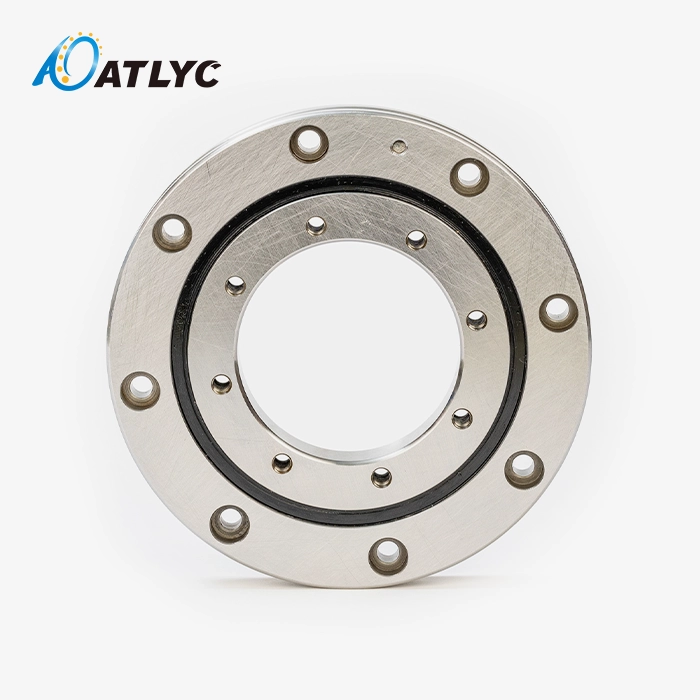
When it comes to rolling elements, precision bearings are a special kind that are made to keep very tight size tolerances—often within micrometers—while supporting complex load combinations in small spaces. Standard bearings for general machinery can't handle radial forces, axial thrust, and moment loads at the same time. They also have to keep friction-induced heat to a minimum and stop elastic displacement that leads to positioning errors. Bearings used in robotics have to deal with special operational stresses, such as rapid acceleration and deceleration cycles in pick-and-place systems, 24/7 operation in automotive welding cells, and vibration-sensitive environments in medical imaging gantries. The XSU080188UUCC0 Precision Cross Roller Bearing and other cross-roller geometries use cylinder-shaped rollers spaced at 90-degree intervals along V-grooved raceways. This makes it possible for a single bearing to replace two angular contact setups while cutting radial space by up to 40%. This unified design gets rid of mounting mistakes and achieves rotational accuracy meeting P5, P4, or P2 grades, which is necessary when robot end-effectors have to return to positions within ±0.01mm tolerances over and over again.
Core Design Features That Enable Robotic Performance
Material choice is the first step in making sure that precision bearings are structurally sound. Heat treatment makes high-grade GCr15 (equal to AISI 52100) bearing steel 58–64 HRC hard, which gives it the wear strength needed for millions of load cycles. Ceramic choices are becoming more popular in high-speed spinning uses because they have 60% less mass than steel. This lowers centrifugal forces and allows for 20–30% higher turning speeds without affecting stiffness. In industrial settings, sealing technology directly affects how long bearings last. The "UU" name on the RA15008UUCC0 Precision Cross Roller Bearing means that it has two rubber seals that keep Alvania Grease No. 2 or similar oils in while keeping out common machine shop contaminants like metal chips, dirt, and coolant. This very thin bearing has an 8mm cross-section but can handle combined loads within a single assembly. This helps with space issues in collaborative robot designs where weight reduction and miniaturisation are necessary.
Material Science: Balancing Performance and Durability
When choosing bearing materials, you have to weigh the benefits and drawbacks of cost, mechanical strength, and heat stability. Steel alloys are still the standard because they are reliable and don't cost too much. They can be used in 80% of robotic joint applications that run at speeds below 3,000 rpm. Silicon nitride (Si3N4) and other ceramics work well in high-speed and corrosive environments, but they are fragile and need to be installed carefully. Hybrid designs combine steel rings with ceramic rolling elements to get the thermal benefits of ceramics while keeping the toughness of steel raceways. Compared to all-steel assemblies, these configurations lower operating temperatures by 15 to 20°C. This increases the life of the grease and lowers problems with thermal expansion in precision gantry systems that need to be very straight down to the micron level.
Key Performance Factors for Robotics Precision Bearings
Decoding Accuracy Grades: ISO and ABEC Standards Explained
Accurate bearings are a direct link to robotic repetition, which means that a robot can go back to the same spot over and over again. Tolerances for inner diameter, outer diameter, width, and runout are set by the ISO accuracy classes (P0, P6, P5, P4, P2) and the ABEC scale (ABEC 1, 3, 5, 7, 9). A P5/ABEC 5 bearing keeps the bore tolerances within ±4 microns and the radial runout below 5 microns, which is good enough for most industrial robot arms that lift up to 50 kg. For even higher precision, medical robotics and semiconductor handling systems often ask for P4 or P2 grades, where runout is kept to 2.5 microns or less. The 7220AC Super Precision Bearing is often used in CNC rotating tables that need to reference the 4th and 5th axes. During quality checks, its dimensions are checked against P4 standards. Before accepting exports, procurement officers use coordinate measure tools to check radial runout (Kia/Kea values) to make sure that the limits for bore (d) and OD (D) are met.
Load Capacity and Speed Ratings: Matching Bearings to Application Demands
Understanding how loads move keeps bearings from breaking down too soon. Radial loads work perpendicular to the shaft line. For example, the weight of a robot arm pushing down on the shoulder joint bearing is an example of a radial load. Axial loads are forces that act parallel to the shaft. One example is the thrust that is created when a robotic gripper presses two parts together during assembly. Cross-roller bearings are great at handling combined loads. For example, the XU100140UU Precision Cross Roller Bearing can handle high moment loads in multi-axis articulated robot waist assemblies while still being stiff enough for repeat positioning within 0.02mm. Speed ratings depend on the size of the bearing, how it is oiled, and how it handles heat. Precision Bearing Guide. In high-speed pick-and-place robots, angular contact bearings set up in pairs or twin setups can handle speeds of more than 10,000 rpm. However, they need oil-air greasing systems to get rid of the heat that builds up from friction. Lower-speed uses, like collaborative robots that work at speeds below 500 rpm, work consistently with sealed grease-packed designs like those with the "CC0" preload classification, which uses negative internal clearance to get rid of elastic displacement and keep starting torque stable.
Vibration Control and Noise Mitigation in Sensitive Applications
Medical CT machines lose picture quality when they are vibrated too much, robotic cleaning cells lose surface shine, and nearby mechanical parts wear out faster. Vibration in bearings is caused by uneven raceways, cages, and rollers that aren't the same size. Structure-generated noise is measured by an Anderon meter during production, and super-finished raceways achieve Ra values below 0.2 microns to reduce oscillations. The mounting holes in XU-series cross-roller bearings get rid of fastening plates that can act as vibration transmission paths, directly connecting the bearing to robot link castings. This rigid coupling makes the natural frequency characteristics better and lowers resonance amplification. This is very important when robots are working close to sensitive equipment or when camera-guided vision systems need stable imaging conditions.
| Performance Parameter | Standard Bearing | Precision Bearing (P5) | Super Precision (P4) |
|---|---|---|---|
| Bore Tolerance (μm) | ±8 | ±4 | ±2 |
| Radial Runout (μm) | 15 | 5 | 2.5 |
| Typical Applications | Conveyor systems | Industrial robots | Medical/semiconductor |
| Cost Multiplier | 1x | 2-3x | 4-6x |
Comparing Precision Bearings: Making the Right Choice for Robotics
Precision vs. Standard Bearings: Performance Trade-offs That Matter
Standard bearings made to P0/ABEC 1 tolerances work well in places where positional accuracy beyond ±0.1mm is not needed, like in general-purpose gearboxes, conveyor rollers, and fan assemblies. Robotics requires more precise control. For example, a joint robot teaching pendant needs to record places within 0.05mm in order to consistently repeat assembly tasks. This means that all of its bearings must be P5 or better. Durability differences go beyond the accuracy of dimensions. Precision bearings go through super-finishing processes that make the surface smoother, to Ra 0.1–0.2 microns. This makes the raceways look like mirrors, which reduces stress concentrations and increases fatigue life by 30–50% compared to standard finishes. Rockwell C testing (HRC 60–64) confirms that the depth and uniformity of the heat treatment create a uniform hardness that stops the metal from breaking too soon when bearings experience shock loads during emergency stops or collisions.
Ceramic vs. Steel: Material Selection for Specific Operating Conditions
Automotive and big industrial machines use steel bearings because they have a good cost-performance ratio and have been used for a long time. A GCr15 steel cross-roller bearing is 40–60% cheaper than a ceramic equivalent, but it works well enough in 90% of situations when the speed is less than 3,000 rpm, and the temperature is less than 80°C. Ceramic bearings are more expensive, but they are worth it in certain situations. For example, silicon nitride's electrical insulation properties help cleanroom robots handle semiconductors without damaging sensitive wafers with electrostatic discharge. High-speed delta robots that can make more than 200 picks per minute use ceramic's low density to lower centrifugal forces and speed up by 25% without overworking the motor's torque capacity. Because ceramics are thermally stable, they can keep their shape in places where steel bearings would expand and lose preload, like in robotic systems that work in hot foundries or cold freezers.
Leading Bearing Manufacturers: Evaluating Brand Performance in 2024
Global bearing manufacturers set themselves apart by the range of products they make, the technical support they offer, and how reliable their supply chains are. SKF and NSK both have a lot of technical resources. For OEMs making their own robotic systems, they offer bearing selection tools and application-specific customisation. Timken's knowledge of tapered roller bearings is useful for industrial robots that have to carry heavy loads and have high moment rigidity. Japanese companies like THK and IKO are experts in linear motion and crossed-roller technologies, and they dominate the precision machine tool and medical device markets. Chinese companies that make bearings, including well-known ones with ISO 9001 and IATF 16949 certifications, offer great options for mid- to large OEMs that want to cut costs without sacrificing quality. Incoming inspection protocols are very strict and check the dimensions, surface finish, and preload requirements of each bearing. This makes sure that the bearings meet the same functional requirements as premium brands but cost 30–50% less to buy. For partnerships to work, there must be clear technical requirements, validation of samples, and regular discussion about tolerance stack-ups and mounting interfaces.
| Bearing Type | Load Capacity | Speed Rating | Typical Robotics Application | Cost Range |
|---|---|---|---|---|
| Angular Contact | Moderate | High (10,000+ rpm) | Delta robots, spindles | |
| Cross-Roller | High | Low-Medium (500-1,500 rpm) | Joint rotation, rotary tables | $ |
| Deep Groove Ball | Moderate | Medium (3,000-6,000 rpm) | Conveyor systems, general motion | $ |
| Ceramic Hybrid | Moderate-High | Very High (15,000+ rpm) | High-speed pick-and-place |
Procurement and Supply Chain Insights for Robotics Precision Bearings
Navigating Distribution Channels: Authorized Dealers vs. Direct Sourcing
When you buy precision bearings from an authorised dealer, you get expert help, guarantee protection, and the paperwork you need for ISO compliance to show that the bearings can be tracked. Major distributors keep regional hubs for their inventory, which cuts lead times for standard sizes to one to two weeks. But wholesaler profits usually add 25–40% to manufacturer prices, which is a big deal when you need to buy hundreds of bearings for production lines. OEMs with established engineering teams that can set bearing specs on their own should buy directly from makers. Precision Bearing Guide B2B platforms now let you order in bulk, and for orders over 500 units, you can get discounts of up to 15–30%. However, buyers have to spend time finding a reliable vendor, testing samples, and negotiating a supply agreement. The rise of Chinese bearing makers with foreign licenses has increased the number of places to get bearings, especially for projects where the ability to compete on price determines the market's profitability.
Understanding Pricing Structures and Negotiation Leverage
Costs of materials, precise grade, and output rate all affect the prices of bearings. A P5-grade steel cross-roller bearing costs two to three times as much as a P0 equivalent because it has to go through more grinding steps, stricter inspection rules, and lower production yields. Upgrading to P4 or P2 grades doubles the cost again, and is only worth it when the application really needs runout tolerances of less than 2 microns. Material choices have a big effect on prices; ceramic hybrid bearings are 3–5 times the price of steel equivalents, and full-ceramic options are close to 6–8 times standard bearing prices. After 100 units, volume savings can be negotiated, and prices level off at 500, 1,000, and 5,000 pieces. When you sign an annual purchase agreement with expected volumes, you can get bigger discounts and get production scheduled first, which is helpful when you need to launch a new robotic platform quickly.
Lead Times and Logistics: Planning for Just-in-Time Manufacturing
Standard bearing sizes can be shipped within one to three weeks from the warehouses of regional distributors, which helps with developing prototypes and making small amounts of products. Custom bearings—those with changed seals, special preload, or dimensions that aren't in the catalog—need 6 to 12 weeks for tooling, production, and quality control. Due to vertical integration, Chinese manufacturers can often match or beat European and American lead times for standard sizes and offer competitive lead times for custom bearings. Shipping methods balance cost and urgency: ocean freight takes 4–6 weeks to get from Asian ports to North American distribution centers, but costs 70–80% less than air freight. Express air shipping gets the package to you in 5 to 7 days, which makes the extra cost worth it when production line downtime costs more than $10,000 per day. Setting up contract inventory programs with key suppliers lowers the risk of wait times by putting bearings at customer sites and delaying payment until they are used. This is perfect for robotic assembly operations that need to do a lot of work quickly.
Maintenance Best Practices for Robotics Precision Bearings
Recognizing Early Warning Signs of Bearing Degradation
To start proactive maintenance, you should listen for strange noises, temperature increases, and changes in the size of vibrations. When it's working right, a precision bearing makes noises that are below 55 dB when tested at 1 metre. Grinding or squealing sounds mean that the bearings are not properly oiled or that there are foreign particles between the rolling elements and the raceways. Temperature rises of more than 10°C above baseline can mean that there is too much pressure, not enough space, or a breakdown in lubrication, all of which speed up wear by a factor of ten. Vibration research using accelerometers can find problems with bearings before they fail. Damage to the outer race causes vibrations at frequencies equal to (number of rolling elements × shaft speed) / 2, while damage to the inner race causes higher-frequency marks. Setting up baseline vibration profiles during commissioning lets you look at trends. When amplitudes go above 120% of normal readings, maintenance tasks are triggered, usually giving you two to four weeks' notice before the system stops working.
Lubrication Strategies for Extended Service Life
Grease lubrication works well for 90% of robotic bearing uses because it is easy to use and doesn't let dirt get into the bearings. Lithium-based greases with an NLGI Grade 2 consistency, like Alvania or Shell Gadus, are good for lubricating bearings that work below 3,000 rpm and 80°C. Relubrication times depend on speed and temperature. For example, bearings that run at 500 rpm and 40°C need new grease every 8,000 to 10,000 hours, while bearings that run at 2,000 rpm and 60°C need service every 2,000 to 3,000 hours. For high-speed applications that go over 5,000 rpm, oil lubrication is needed to get rid of frictional heat effectively. Oil-air systems give exact amounts of oil—usually between 0.01 and 0.05 ml per hour—mixed with compressed air. This keeps the film thickness at the right level while minimising spinning losses. Sealed bearings, like the RA15008UUCC0, don't need to be oiled from the outside. This trades serviceability for resistance to contamination, making them perfect for medical robotics where particulate generation must stay below cleanroom Class 100 limits.
Installation and Handling Procedures That Prevent Premature Failure
Precision bearings need to be handled carefully from the time they are received until they are installed. Keeping things in climate-controlled places (20-25°C, 40-60% relative humidity) stops moisture condensation, which starts corrosion on super-finished raceways. Protective packaging should remain intact until installation, with technicians wearing lint-free gloves to avoid transferring skin oils that attract contaminants. Thermal installation methods—heating bearings to 80-100°C using induction heaters or oil baths—allow interference-fit mounting without mechanical force that can dent raceways or distort rings. In shaft installations, the same amount of expansion can be achieved by cooling them with liquid nitrogen. With hydraulic nuts and precision pullers, you can control the mounting pressure and avoid shock loads that leave Brinell indentations. Verifying preload after installation using torque wrenches or dial indicators ensures bearings operate within designed clearance ranges, preventing both excessive friction and unwanted play that degrades positional accuracy.
Conclusion
When choosing and maintaining precision bearings for robotics, you have to balance technical requirements with cost limits and the reliability of the supply chain. This Precision Bearing Guide has explored the fundamental differences between standard and precision grades, material trade-offs between steel and ceramic options, and procurement strategies that optimize total cost of ownership. Engineers can choose bearings that meet the needs of an application without spending too much on features that aren't necessary or add little value if they know about accuracy grades, load capacities, and sealing technologies. Proactive maintenance—monitoring vibration trends, adhering to lubrication schedules, and following proper installation procedures—extends bearing service life by 40-60%, reducing unplanned downtime and protecting your manufacturing investments.
FAQ
When should we choose precision bearings over standard bearings for robotic applications?
Precision bearings become necessary when positional repeatability requirements fall below ±0.05mm, or when operating speeds exceed 3,000 rpm. Applications involving vision-guided assembly, medical imaging equipment, or semiconductor handling demand P5 or better accuracy grades to maintain functional performance. Standard bearings suffice for non-critical conveyor systems and material handling robots where positional tolerances beyond ±0.1mm are acceptable.
What factors most significantly affect precision bearing lifespan in robotics?
Operating temperature, contamination exposure, and lubrication quality dominate bearing longevity. Bearings running 20°C above design temperature experience 50% reduction in L10 fatigue life. Particulate contamination—even fine dust below 10 microns—acts as a lapping compound, accelerating raceway wear. Proper sealing and maintaining lubricant cleanliness can extend service life from 20,000 hours to 40,000+ hours in demanding industrial environments.
Can precision bearings be customized for unique robotic applications?
Reputable manufacturers offer customization, including modified seals, special preload configurations, non-standard dimensions, and mounting hole patterns. Custom orders typically require a 6-12 week lead time and minimum order quantities of 50-100 units, though established suppliers may accommodate smaller batches for prototype validation. Providing detailed application data—load profiles, speed ranges, environmental conditions—enables engineers to optimize bearing design for your specific requirements.
Partner with ATLYC for Your Precision Bearing Needs
ATLYC brings 15 years of manufacturing expertise and ISO 9001/IATF 16949 certification to serve mid-to-large OEMs, automation equipment manufacturers, and global bearing distributors across North America. Our engineering team understands the critical balance between performance specifications and cost targets that defines successful robotic platforms. We manufacture precision cross-roller bearings, angular contact assemblies, and custom configurations within our six specialized workshops, supported by 120 skilled professionals dedicated to quality inspection, assembly, and continuous improvement. Contact our technical specialists at auto@lyautobearing.com to discuss your robotics bearing requirements. We provide sample evaluation programs, detailed application engineering support, and competitive quotations backed by reliable lead times and volume pricing structures. Whether you need P5 cross-roller bearings for collaborative robot joints or super-precision assemblies for medical imaging gantries, ATLYC delivers the dependable manufacturing partnership your supply chain demands. Connect with a Precision Bearing Guide manufacturer who combines Chinese production efficiency with international quality standards—request your technical consultation today.
References
1. Harris, T.A. and Kotzalas, M.N. (2006). Rolling Bearing Analysis: Essential Concepts of Bearing Technology, 5th Edition. CRC Press, Boca Raton, FL.
2. ISO 492:2014. Rolling bearings — Radial bearings — Geometrical product specifications (GPS) and tolerance values. International Organization for Standardization, Geneva, Switzerland.
3. Schwarz, B.J. and Richardson, M.H. (2009). "Experimental Modal Analysis for Rotating Machinery," Sound and Vibration, Vol. 43, No. 6, pp. 12-17.
4. Khonsari, M.M. and Booser, E.R. (2017). Applied Tribology: Bearing Design and Lubrication, 3rd Edition. John Wiley & Sons, Hoboken, NJ.
5. Wensing, J.A. (1998). On the Dynamics of Ball Bearings. Ph.D. Dissertation, University of Twente, Enschede, Netherlands.
6. Neale, M.J. (Editor) (2001). The Tribology Handbook, 2nd Edition. Butterworth-Heinemann, Oxford, UK.
Learn about our latest products and discounts through SMS or email