- English
- French
- German
- Portuguese
- Spanish
- Russian
- Japanese
- Korean
- Arabic
- Greek
- German
- Turkish
- Italian
- Danish
- Romanian
- Indonesian
- Czech
- Afrikaans
- Swedish
- Polish
- Basque
- Catalan
- Esperanto
- Hindi
- Lao
- Albanian
- Amharic
- Armenian
- Azerbaijani
- Belarusian
- Bengali
- Bosnian
- Bulgarian
- Cebuano
- Chichewa
- Corsican
- Croatian
- Dutch
- Estonian
- Filipino
- Finnish
- Frisian
- Galician
- Georgian
- Gujarati
- Haitian
- Hausa
- Hawaiian
- Hebrew
- Hmong
- Hungarian
- Icelandic
- Igbo
- Javanese
- Kannada
- Kazakh
- Khmer
- Kurdish
- Kyrgyz
- Latin
- Latvian
- Lithuanian
- Luxembou..
- Macedonian
- Malagasy
- Malay
- Malayalam
- Maltese
- Maori
- Marathi
- Mongolian
- Burmese
- Nepali
- Norwegian
- Pashto
- Persian
- Punjabi
- Serbian
- Sesotho
- Sinhala
- Slovak
- Slovenian
- Somali
- Samoan
- Scots Gaelic
- Shona
- Sindhi
- Sundanese
- Swahili
- Tajik
- Tamil
- Telugu
- Thai
- Ukrainian
- Urdu
- Uzbek
- Vietnamese
- Welsh
- Xhosa
- Yiddish
- Yoruba
- Zulu
RA Series Crossed Roller Bearing OEM Sourcing Guide
If you are seeking an RA Series Crossed Roller Bearing for OEM applications, this guide provides you with the technical details, supplier assessment criteria, and procurement tactics you need to make an informed selection. The RA series is a thin-walled, outer-ring detachable crossed roller bearing for high-stiffness applications in space-constrained environments. This bearing type can take radial, axial, and moment stresses all at once - all in one small unit. From industrial robot joints to IC fabrication equipment. This book provides specs, comparisons, sourcing reasoning, and maintenance basics to provide your procurement team clarity to go ahead.

Understanding RA Series Crossed Roller Bearings: Specifications and Features
Structural Design
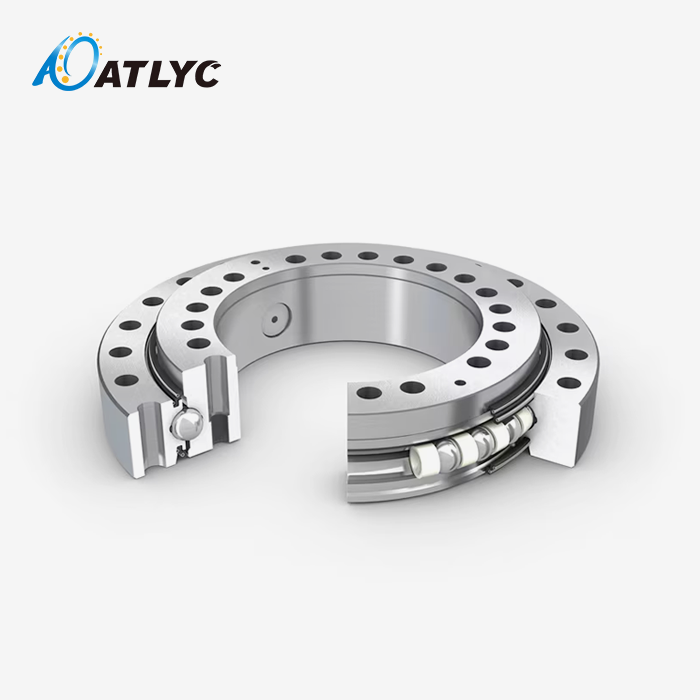
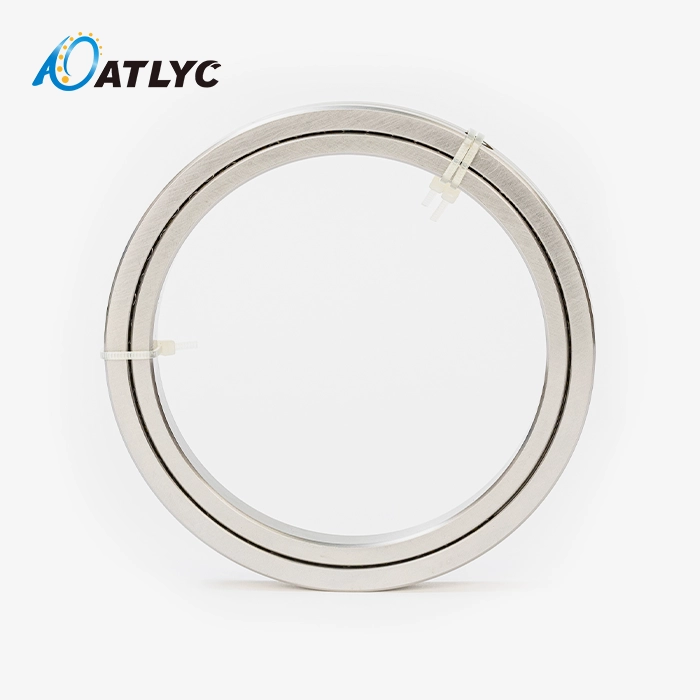
The RA series crossed roller bearing features a separable outer ring and a rotating inner ring. On V-groove raceway surfaces, the rollers are cylindrical and are arranged at right angles to one another, with precise spacers between each roller. This crossing design applies pressure to four contact zones simultaneously, allowing the use of a single bearing in tight assemblies instead of many bearings. The cross-section is a thin wall and is 24-30% thinner than the RB series, so it reduces weight without hampering the support capability.
Size Range and Material
| Parameter | Range |
|---|---|
| Inner Diameter | 20 mm – 350 mm |
| Outer Diameter | 70 mm – 540 mm |
| Width | 12 mm – 45 mm |
| Accuracy Grades | P6, P0, P5, P4 |
| Material | GCr15, GCr15SiMn |
GCr15 and GCr15SiMn are high-carbon steels that contain chromium and are commonly used in precision rolling elements. After being heated, both have raceway hardness in the 58–64 HRC range, which directly helps them last a long time and not wear down on the surface.
Performance Advantages
The three efficiency advantages of crossed rollers are the things that OEM engineers worry about most. These are the principal loads which this kind of bearing can support:
Multi-Directional Load Support: High radial load capacity from perpendicular roller contact, good axial resistance in both directions, best-in-class moment load management, all in one bearing position.
Low coefficient of friction: Precision-ground raceway surfaces and optimized roller spacing provide low friction torque for smooth rotation even under combined load circumstances.
Runout tolerance: 1. The RA series offers micron-level positional precision with minimized radial and axial runout tolerances, which are critical for semiconductor handling and surgical robots.
These gains result in fewer bearing points per assembly, a simplified housing, and a lighter overall system. These features let OEM design engineers jump between generations of goods.
Comparing RA Series Crossed Roller Bearings with Alternatives: Making the Right Choice
RA vs. Standard Crossed Roller Bearings
The RB series and the RA series both use crossed rollers, but the RA series has a wall cross-section that is much thinner. Because of this, the RA series is the best choice for robot arm joints and medical image gantries with limited space around the edges. The RA series is smaller and lighter than the RB series, but the RB series has higher absolute load values for the same bore size.
RA vs. Angular Contact Ball Bearings
To handle moment loads, angular contact ball bearings need to be mounted in pairs or back-to-back. Those multi-bearing setups can be replaced with a single RA Series Crossed Roller Bearing, which takes up less horizontal room. This change often speeds up assembly and lowers the number of precise-fit housing bores that need to be made in machining center rotary tables. This saves OEM manufacturers money and time.
Cost vs. Performance Considerations
When buying in bulk from an OEM, a crossed roller bearing costs more per unit at first than a normal deep groove ball bearing. The total cost of ownership changes in a good way, though, when you take into account simpler housing, fewer bearing points, and longer service times. Downtime for replacing bearings is expensive in precision applications like machines that handle IC wafers or coordinate measuring machines. Longer bearing life directly protects production output.
OEM Sourcing Considerations: How to Choose the Right Supplier
Certifications and Quality Standards
As a starting point, ISO 9001 and IATF 16949 certifications are what you should look for in a RA Series Crossed Roller Bearing maker. These certifications show that the supplier has a written quality management system with inspection records that can be found. IATF 16949 is very important for automotive and industrial OEM users because it covers systems for approving production parts, controlling processes, and taking corrective actions that are unique to the car supply chain.
Key Supplier Evaluation Criteria
A bad choice of precision crossed roller bearing supplier may interfere with your manufacturing schedule and reduce the quality of your end product. The following aspects allow business-to-business buyers to analyze suppliers in a disciplined way:
Manufacturing capacity: Make sure the supplier has specific manufacturing lines for thin-section crossed roller bearings, not general bearing lines.
Inspection capability: Require documentation of runout testing (Kia, Sia), radial clearance measurement, and surface roughness metrology on V-groove raceways.
Customization support: Confirm that the provider can provide customization of the bore diameter, outside diameter, accuracy grade, and lubrication type for your application.
Reliability of lead times: For OEM projects, consistent lead time is more important than the lowest price provided. Check production schedule and inventory buffer procedures.
Global OEM clients are more likely to remain with a supplier if the provider can share first item inspection results, offer FAI documentation, and continue to provide dedicated account engineers.
MOQ and Pricing Structure
For standard grades, the minimum order quantity (MOQ) for RA series bearings is usually between 10 and 50 pieces per size. Manufacturers who keep finished goods in stock may be able to offer lower MOQs. Most of the time, volume pricing starts when you buy 100 or more items. By negotiating blanket purchase orders with planned releases, you can lock in prices and protect yourself from changes in the cost of raw materials.
Installation and Maintenance Best Practices
Correct Installation Procedure
The RA Series Crossed Roller Bearing has a removable outer ring design for ease of installation, without compromising housing accuracy. The outer ring has to be clamped into a housing hole with an H7 tolerance or larger. If the pressure on the mounting is improper, the thin ring will be deformed, and the preload will be different, which also leads to premature failure. Tighten all mounting nuts evenly in a star pattern. Check for runout with a dial gauge after fitting before proceeding to final assembly.
Lubrication and Service Intervals
Almost all RA series bearings are delivered greased with a lithium soap-based lubricant (e.g., Alvania No. 2). Standard re-lubrication periods are 2000 to 5000 hours of operation depending on load, speed, and ambient temperature. Request fluorine-based greases or greases with minimal outgassing characteristics for clean environments such as vacuum or sterile environments such as those used in semiconductors and medicine.
Troubleshooting Common Issues
| Symptom | Likely Cause | Corrective Action |
|---|---|---|
| Abnormal noise during rotation | Roller skewing or contamination | Inspect spacers; clean and re-lubricate |
| Increased runout after installation | Housing bore out of tolerance | Re-machine housing; re-check clamping torque |
| Premature raceway fatigue | Overload or incorrect preload | Review load calculation; adjust preload |
| Stick-slip rotation | Insufficient or degraded lubrication | Replace grease; verify viscosity grade |
Taking care of these problems as soon as they appear stops damage from spreading to nearby parts and avoids unplanned downtime in production environments with a lot of work to do.
Bulk Purchase and OEM Ordering Process
Verifying Suppliers and Avoiding Counterfeits
Fake crossed roller bearings are a serious threat when purchasing products throughout the globe. You should request material certifications (mill certs for GCr15 steel), heat treatment records, and measurement inspection reports for each batch. Reputable manufacturers would be pleased to provide you with this documentation. It is normal and recommended practice to request sample batches for independent CMM inspection as a means to qualify a new vendor before committing to large volume orders.
OEM Customization and Lead Time Management
The RA series allows you to choose the precision level (P6 to P4), the lubrication method, the surface coating, and the packing type. Established producers provide private label packaging and part number engraving for OEM projects that use branded parts. Place your purchase orders to align with the machine build cycles to reduce expenses associated with carrying too much inventory and to ensure you don't run out of stock during busy production periods.

Conclusion
RA Series Crossed Roller Bearing is a precision item that is used in robot joints, machining center rotating tables, medical equipment, and instruments for creating integrated circuits. The outer ring may be detached, the material is GCr15, can bear multi-directional stresses, and the accuracy class is P6-P4. This makes it a strong fit for OEM procurement programs requiring stability and extended service life. Ultimately, your supply chain and product quality will be safer if you e;aluate suppliers on their qualifications, ability to inspect, and readiness to assist with modification — not simply on pricing.
FAQ
Q: What is the primary difference between the RA and RB series?
The RA Series Crossed Roller Bearing has a cross-section that is about 24–30% smaller than the RB Series. This makes it lighter and takes up less room. It is the best choice for things like robot joints and medical imaging equipment that have to stay within strict weight and space limits.
Q: Can this bearing type manage moment loads without supplementary bearings?
Yes. With the crossed rollers at a 90° angle, one unit can handle radial, axial, and moment loads at the same time. In rotary table and tool joint situations, this often gets rid of the need for paired angular contact ball bearings.
Q: How should the split outer ring be handled during installation?
The outer ring needs to be clamped evenly and slid into a precise housing bore. When tightening isn't even, it changes the shape of the ring and the internal preload. After mounting, you should always check for circularity and runout.
Q: What accuracy grades are available for OEM programs?
There are grades P6, P0, P5, and P4 in the RA series. Higher grades (P5, P4) are common for working with semiconductor wafers, making precise measuring tools, and using surgical robots where runout of less than one micron is needed.
Q: Is special lubrication required for cleanroom environments?
Lithium soap grease is used in standard amounts. For use in vacuums or clean rooms, choose a fluorine-based grease that doesn't give off a lot of smoke. When making an OEM order, you should always make sure that the grease will work in the area where it will be used.
Partner with ATLYC for Your Crossed Roller Bearing Supply
The RA Series Crossed Roller Bearing is sold by ATLYC to OEM customers in the US, Germany, South Korea, and other places. It is backed by Luoyang Auto Bearing Co., Ltd., which is ISO 9001 and IATF 16949 certified and has 15 years of experience making precision products. With six production workshops and 120 trained workers, we are a reliable RA Series Crossed Roller Bearing manufacturer that can offer stable lead times, quality that has been checked, and OEM customization. To get a detailed quote right away, email us at auto@lyautobearing.com.
References
1. Harris, T. A., & Kotzalas, M. N. Rolling Bearing Analysis: Essential Concepts of Bearing Technology. Taylor & Francis, 2006.
2. International Organization for Standardization. ISO 281: Rolling Bearings — Dynamic Load Ratings and Rating Life. ISO, 2007.
3. International Organization for Standardization. ISO 9001: Quality Management Systems — Requirements. ISO, 2015.
4. IATF. IATF 16949: Quality Management System Requirements for Automotive Production and Relevant Service Parts Organizations. IATF, 2016.
5. Hamrock, B. J., Schmid, S. R., & Jacobson, B. O. Fundamentals of Fluid Film Lubrication. Marcel Dekker, 2004.
6. Weck, M., & Brecher, C. Werkzeugmaschinen — Konstruktion und Berechnung (Machine Tools — Design and Calculation). Springer, 2006.
Learn about our latest products and discounts through SMS or email