- English
- French
- German
- Portuguese
- Spanish
- Russian
- Japanese
- Korean
- Arabic
- Greek
- German
- Turkish
- Italian
- Danish
- Romanian
- Indonesian
- Czech
- Afrikaans
- Swedish
- Polish
- Basque
- Catalan
- Esperanto
- Hindi
- Lao
- Albanian
- Amharic
- Armenian
- Azerbaijani
- Belarusian
- Bengali
- Bosnian
- Bulgarian
- Cebuano
- Chichewa
- Corsican
- Croatian
- Dutch
- Estonian
- Filipino
- Finnish
- Frisian
- Galician
- Georgian
- Gujarati
- Haitian
- Hausa
- Hawaiian
- Hebrew
- Hmong
- Hungarian
- Icelandic
- Igbo
- Javanese
- Kannada
- Kazakh
- Khmer
- Kurdish
- Kyrgyz
- Latin
- Latvian
- Lithuanian
- Luxembou..
- Macedonian
- Malagasy
- Malay
- Malayalam
- Maltese
- Maori
- Marathi
- Mongolian
- Burmese
- Nepali
- Norwegian
- Pashto
- Persian
- Punjabi
- Serbian
- Sesotho
- Sinhala
- Slovak
- Slovenian
- Somali
- Samoan
- Scots Gaelic
- Shona
- Sindhi
- Sundanese
- Swahili
- Tajik
- Tamil
- Telugu
- Thai
- Ukrainian
- Urdu
- Uzbek
- Vietnamese
- Welsh
- Xhosa
- Yiddish
- Yoruba
- Zulu
Can Angular Contact Bearings 7206AC Replace Deep Groove?
Angular Contact Bearings 7206AC can selectively replace deep groove bearings in applications requiring enhanced axial load capacity and rigidity. These bearings feature a 30mm bore, 62mm outer diameter, and 16mm width with a 25° contact angle optimized for combined load handling. Replacement suitability depends on operational demands: angular contact designs excel in high-speed spindles, precision machinery, and thrust-heavy environments, while deep groove bearings remain ideal for straightforward radial load applications. The decision hinges on analyzing load direction, speed requirements, installation complexity, and cost considerations specific to your machinery configuration.
Understanding Angular Contact Bearing 7206AC and Deep Groove Bearings
Structural Design Differences
The main difference between these types of bearings is the shape of their raceways. Deep groove ball bearings have raceways with curved slots that line up concentrically on both rings. This makes a symmetrical ball path that is mostly used for rotational loads. Because of how they're made, they can hold small rotational loads in both directions at the same time, which makes them useful for a wide range of situations.
In Angular Contact Bearings 7206AC, the raceways between the inner and outer rings are moved axially. This offset makes the typical contact angle between the balls and the raceways, which in this model is exactly 25°. The shape allows for the support of large circular and one-way vertical loads at the same time. The contact line between the ball and the raceway is at an angle to the bearing's radial plane when you look at the cross-section. This spreads the forces out over the best possible contact ellipses.
When we make the Angular Contact Bearings 7206AC, we carefully grind the GCr15 bearing steel raceways to get them to P5, P4, or P2 tolerance classes. The material is heated until it reaches an HRC hardness of 60 to 64. This makes sure that its shape stays stable while it is being used. The 16mm width holds balls in place with bakelite or nylon bars, which are chosen based on the temperature and speed needs.
Load Capacity Characteristics
Deep groove bearings can handle axial loads up to about half of their radial capacity. They are mostly used for radial loads. Their uniform shape lets axial forces come from either direction, but when combined loads get too high, they don't work as well.
The 25° contact angle of the Angular Contact Bearing 7206AC is a technical balance between its speed and load capacity. This angle is better at handling axial loads than 15° designs, and it's also better at handling high speeds than 40° designs. You can place these bearings in pairs that are already loaded in DB (back-to-back), DF (face-to-face), or DT (tandem) shapes. This gives them great rigidity and lets them handle moment loads well.
Our quality control department's tests show that the Angular Contact Bearings 7206AC can handle axial loads of about 80% of its rotational value in one-direction uses. The contact shape better spreads stresses during thrust conditions, which makes the bearing last longer in situations where deep groove bearings would wear out too quickly.
Speed and Accuracy in Performance
Most of the time, deep groove bearings can handle higher stopping speeds than angular contact bearings of the same size. This is because their symmetrical contact design reduces friction losses. Because of how they're made, they produce less heat when they spin, so they can be used continuously at high speeds without needing complicated cooling systems.
Because of the way their contact angles are set up, angular contact bearings produce controlled heat when they spin. The Angular Contact Bearings 7206AC's 25° angle is a good compromise between load capacity and temperature management. It runs cooler than 40° designs and can handle more vertical force than 15° designs. Proper lubrication and mounting arrangements are very important when you need to keep a machine running at a high speed with combined loads.
The Angular Contact Bearings 7206AC really shines in precise uses. When these bearings are made to P4 or P2 tolerance classes, the radial runout is less than 2 microns, and the tolerances stay tight for the whole life of the bearing. This level of accuracy is very important in CNC mills, coordinate measuring machines, and precision indexing tools where deep groove bearings can't provide the accuracy needed under heavy loads.
| Bearing Type | Primary Load Direction | Axial Load Capacity | Speed Rating | Typical Tolerance Class |
|---|---|---|---|---|
| Deep Groove | Radial with a small axial | half of the radial capacity | Better | P6, P5 |
| Angular Contact Bearings 7206AC | Radial and axial combined | Eighty percent of the rotational capacity | Low to high level | P5, P4, P2 |
Application Environment Suitability
Deep groove bearings are used in nearly every industry because they are reliable and affordable. Electric motors, pumps, gears, and elevators all depend on them. Their sealed versions work pretty well in dirty environments, and installing them doesn't require a lot of special skills. Maintenance teams like how forgiving they are when things get misaligned or when simple replacement steps need to be taken.
The Angular Contact Bearings 7206AC are designed for uses that need accuracy while handling multiple loads. Their higher stiffness is good for small electric motors that need axial loading, gear reducers that have to deal with thrust forces, and transmission parts in printing machines. If your equipment has problems with shaking or bearings breaking down too soon under combined loads, switching to angular contact designs can often fix these issues.
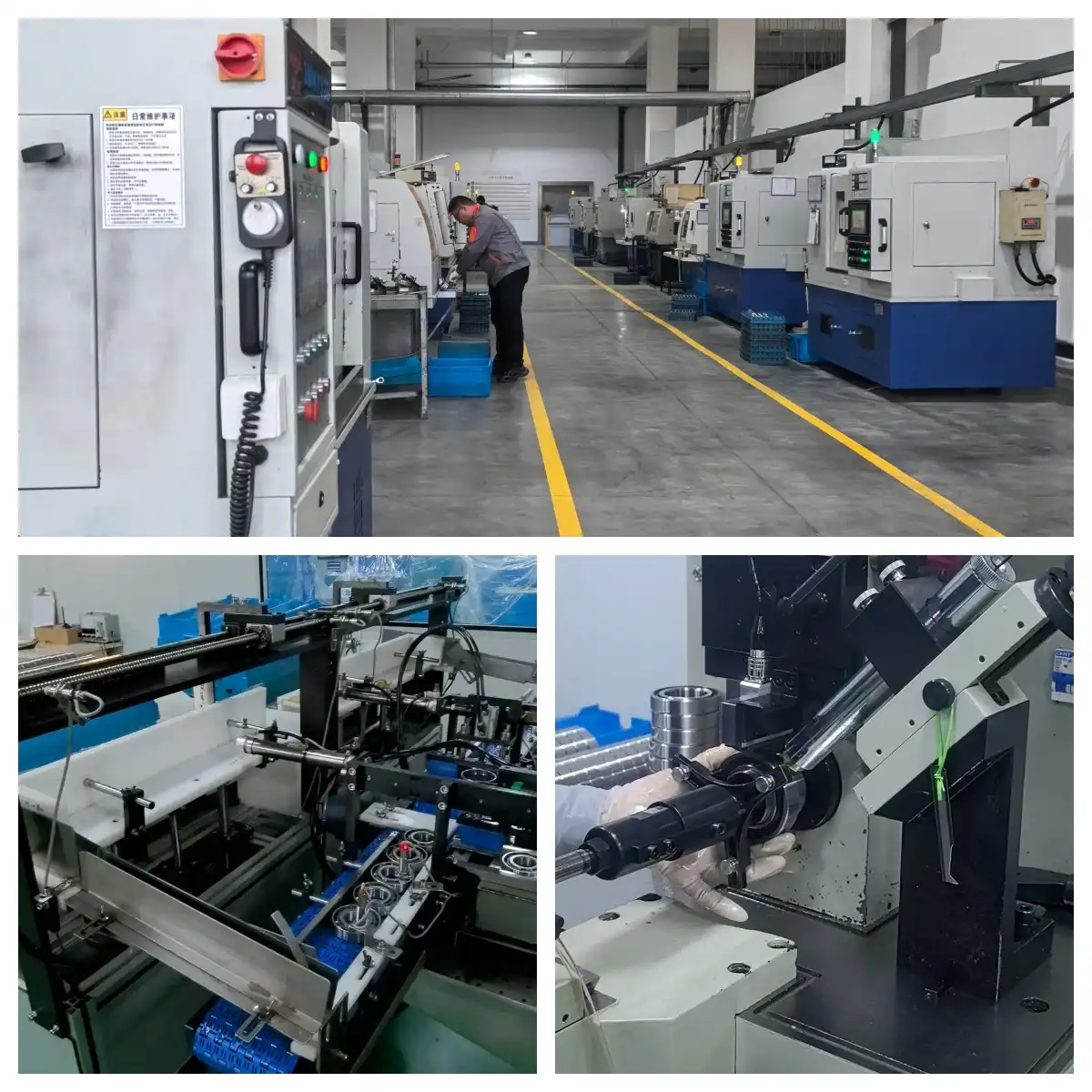
Our Luoyang factory has six specialized workshops that make both types of bearings. This lets us help clients find the best solutions based on real-world working conditions rather than just theoretical specs.
Evaluating Whether Angular Contact Bearing 7206AC Can Replace Deep Groove Bearings
Functional Performance Trade-offs
In some situations, replacing deep groove bearings with the Angular Contact Bearings 7206AC makes a noticeable difference. When thrust forces are higher than the values for deep grooves, the increased axial load capacity keeps the part from breaking too soon. Improvements in rigidity lower shaft deflection, which keeps tolerances in precise parts tight. When mixed loading conditions cause bearing failures to happen over and over again, the Angular Contact Bearings 7206AC fix the root causes instead of just the symptoms.
Cost factors keep these efficiency gains in check. Because they are harder to make and have tighter tolerances, angular contact bearings usually cost 30 to 50 percent more than deep groove bearings of the same type. For installation to go smoothly, skilled technicians are needed to make sure that the preload is set correctly, the parts are aligned correctly, and the mounting is set up correctly. Different lubrication requirements often call for higher-grade greases or oil circulation systems to work at their best.
The design is limited by the fact that the vertical load can only go in one way. Single angular contact bearings only handle pressure in one direction, while deep groove bearings can handle loads from both directions at the same time. Applications that need axial support in both directions need paired mounting setups (DB or DF configurations), which increases the number of parts needed and the difficulty of the installation. These needs must be taken into account when designing your machinery, or it could break down too soon.
Real-World Replacement Scenarios
A company that makes gear reducers came to us because their small transmission units were frequently breaking bearings. The analysis showed that the helical gear geometry caused both radial loads from the gear forces and a large axial thrust. We told them to get rid of their 6206 deep groove bearings and replace them with Angular Contact Bearings 7206AC in DB configuration. The change increased the life of the bearings by 250%, lowered the noise level of the gearbox by 8 dB, and stopped guarantee claims linked to failure before its time.
On the other hand, a pump maker asked if they could replace their centrifugal pump line's deep groove bearings with angular contact designs. The investigation showed that the loading was mostly radial and the axial forces were very low. The deep groove bearings' ability to work in both directions was very important for handling the rare backward operation that happened during startup. We told them not to change them because the Angular Contact Bearings 7206AC offered no performance advantage while increasing costs and complicating maintenance procedures.
These cases show that making decisions about replacements based on assumptions is not enough. You need to do a full load analysis. If a customer is thinking about upgrading their bearings, our engineering team will look at the working conditions, load patterns, and upkeep capabilities for free before suggesting solutions.
Installation and Maintenance Implications
When installing angular contact bearings, you need to be very careful, which is very different from installing deep groove designs. Adjusting the preload affects the stiffness, temperature rise, and service life of a bearing. Too little preload causes vibrations and lowers accuracy, while too much preload causes heat and speeds up wear. To get the best preload, you need special tools, training, and checks that go beyond what regular maintenance can do.
Mounting arrangements make things more complicated. When it comes to moment loads, DB arrangements are the stiffest. DF configurations are more tolerant of thermal expansion, and DT arrangements can hold more vertical loads. To make sure that replacing bearings during service intervals goes smoothly, your maintenance team needs clear paperwork that spells out the setup, preload values, and adjustment processes.
When using angular contact bearings, you usually need to use more grease. The Angular Contact Bearings 7206AC's contact geometry makes it work at higher temperatures than similar deep groove bearings, so it needs lubricants that are better at withstanding high temperatures. Especially in high-speed uses, relubrication times tend to get shorter. When your facility doesn't have the right lubrication management systems in place, the upkeep may be more difficult than the performance gains.
Key Technical Considerations for Procurement and Application
Dimensional Compatibility and Specifications
The Angular Contact Bearing 7206AC has a 30mm bore diameter, a 62mm outer diameter, and a 16mm width. These are standard sizes for all manufacturers based on ISO 15:2017 guidelines. When you replace deep groove bearings, make sure that the shaft and case sizes are right for the bearing and any seals, spacers, or mounting hardware that may be needed for a proper fitting. While the 16mm width fits a lot of standard deep groove bearings, angular contact designs sometimes need more axial space for mounting.
When exact requirements change, related bearing types can be used as replacements. The 7206B has a 40° contact angle, which makes it even better at handling horizontal loads but less good at handling speeds. The 7206C uses a 15° angle, which makes it best for faster speeds with less power. The 7207AC makes the hole diameter bigger to 35 mm while keeping the contact angle at 25°. This lets bigger shafts work in the same situations.
Pay close attention to the housing shoulder measurements. For angular contact bearings to work right, both rings need to have the right amount of axial support. There are times when deep groove bearing housings don't have enough shoulder height to properly hold angular contact bearings in place when they are under pressure. Before deciding to replace the housing, we suggest looking at the plans so that you don't have to make expensive changes during the fitting process.
| Bearing Model | Bore (mm) | OD (mm) | Width (mm) | Contact Angle | Primary Advantage |
|---|---|---|---|---|---|
| Angular Contact Bearings 7206AC | 30 | 62 | 16 | 25° | Speed and load are equal |
| 7206B | 30 | 62 | 16 | 40° | The highest vertical capacity |
| 7206C | 30 | 62 | 16 | 15° | Fastest speed |
| 7207AC | 35 | 72 | 17 | 25° | Larger diameter of the shaft |
Installation Best Practices
Cleaning the shafts, housings, and bearing seats well is the first step in installing things correctly. The main reason why bearings fail early is contamination, and angular contact bearings are especially vulnerable because of their tight standards. We suggest using lint-free cloths and approved chemicals, and staying away from compressed air, which could push dirt into surfaces that have been cleaned.
Heating methods make installation easier and keep things from breaking. Induction heaters evenly and precisely heat the hole so that it can be pressed onto a shaft. Another option is to heat the oil bath, but it is harder to control the temperature. Never heat something above 120°C; higher temperatures can change the metal in ways that make the bearing less effective. It is still possible to use mechanical presses for cold mounting as long as the right tools are used to spread the force through the bearing ring instead of the balls and cages.
To set up a preload, you need to follow a set of steps. Light preload (10–20 microns axial displacement) works well for high-speed tasks that want to keep friction to a minimum. Medium preload (20–40 microns) gives basic machines a balanced performance. Precision machine tools are most stiff when they have a heavy charge (40 microns or more). Dial indicators can be used to check axial displacement, torque wrenches can be used to check rotational resistance, or special bearing mounting tools can be used with built-in measurement systems.
Lubrication and Maintenance Guidelines
Most Angular Contact Bearing 7206AC applications can be lubricated with grease, which is easier to use and requires less maintenance than oil systems. Lithium complex greases with an NLGI grade 2 or 3 consistency are good for most uses, while polyurea-based greases make it possible to go longer between relubrication cycles in continuous operation. Base oils with a lower viscosity (ISO VG 32–68) work better in high-speed uses because they lower spinning losses and temperature rise.
When to re-oil depends on the speed, temperature, and factors in the surroundings. For moderate speeds and clean settings, our usual advice is to re-grease every 2,000 to 3,000 hours of use. For low-speed, clean applications, the intervals can be as long as 10,000 hours, while for high-speed applications, they can be as short as 500 hours. Too much lubrication raises temperatures and speeds up wear and tear. It works better to add just the right amount of grease to replace what has been lost than to overfill.
Finding the symptoms of common problems is the first step in fixing them. Too much noise is often a sign of bad lubricant, pollution, or the wrong preload. A temperature rise outside of normal working ranges could mean that there is too much preload, not enough greasing, or a problem with the alignment. When vibration gets worse, it means that there is wear, damage, or a bad fitting. Our technical support team helps customers figure out what's wrong and fix it, which cuts down on downtime and increases the life of bearings.
Market Comparison and Procurement Strategies
Industry-Leading Manufacturers
Different bearing companies around the world make Angular Contact Bearings 7206AC with different levels of quality and price structures. SKF, which is based in Sweden, has a reputation for high quality, and their prices reflect that. Their bearings have special steel mixes and surface processes that make them last longer in tough situations. Japan's NSK focuses on making precise products, and their P4 and P2 grade bearings are used in high-precision spinning applications. The fact that FAG, which is now part of the Schaeffler Group, offers full expert help and application engineering is enough to justify their high prices.
Over the past ten years, Chinese manufacturers have made big steps toward higher quality standards. Bearings that meet international standards can now be bought at reasonable prices from companies that have ISO 9001 and IATF 16949 certifications. There are differences in quality. Tier-one Chinese manufacturers who use modern tools and quality systems offer reliability that is close to that of foreign brands, while smaller operations may not be as consistent. When choosing a provider, it's important to do your research.
Because ATLYC has been making things for 15 years and has a system for managing quality, it has become a reliable supplier. Our ISO 9001 and IATF 16949 certifications show that we are dedicated to producing goods that meet consistent standards. We keep putting money into heat treatment facilities, precision grinding equipment, and inspection technology to make sure that every Angular Contact Bearing 7206AC meets the required standards. Customers from automakers and companies that make industrial equipment in South Korea, the US, and Germany have told us that our quality control and technical support are good.
Pricing and Value Considerations
Prices for bearings change a lot depending on the maker, tolerance class, and cage material. Standard P5 grade Angular Contact Bearings 7206AC from Chinese makers usually cost between $8 and $15 per unit in small to medium amounts. On the other hand, expensive European names charge between $25 and $40 per unit for the same specs. Prices for P4 precision grades go up by 50 to 100 percent, and P2 ultra-precision grades may cost three times as much as normal grades.
When you buy in bulk, you save a lot of money. Our price system gives savings for orders of 100 pieces or more, and the best cost-performance ratios are reached for orders of 500 pieces or more. Annual supply agreements offer extra benefits, including stable prices that don't change based on changes in raw materials, priority scheduling for production, and dedicated technical support. Customers who need a steady supply of more than one type of bearing often combine their orders to get the biggest savings and make the buying process easier.
The total cost of ownership is more than just the price of the car. Long-term economics are affected by things like bearing life, repair needs, and shutdown costs. Even though it costs more at first, a premium bearing that lasts twice as long as a cheap bearing and needs half as much upkeep is a better deal overall. Our application engineering team helps customers do lifecycle cost analysis, which makes sure that decisions about buying equipment are based on making it work better overall rather than just getting the lowest price.
Sourcing and Lead Time Management
Authorized wholesalers can get standard bearing sizes right away, but the prices usually include markups for delivery of 20 to 50 percent. Buying directly from the manufacturer lowers costs but increases lead times. For example, our standard production cycle for Angular Contact Bearings 7206AC in P5 grade takes seven working days. For P4 and P2 precision grades, it takes ten to fourteen days. It might take 3–4 weeks for custom specifications like changing the clearances, using different cage materials, or applying different coatings.
Inventory management plans weigh the costs of keeping items against the risk of running out of stock. Consignment agreements help critical applications that need safety stock—we keep agreed-upon inventory levels at customer sites, and ownership only changes hands when the items are used. This method makes sure that the product is available right away and keeps customers' money from being stuck in inventory. When our output schedule is tied to kanban systems, the timing of restocking is optimized based on how quickly things are used up.
Every shipment comes with quality paperwork, such as reports on measurements, material certifications, and test data that proves the product meets specifications. Customers who need specific traceability for aerospace or automotive uses get serialized parts with full records of how they were made. Our quality management system keeps records for seven years so that they can be used for any future claims or investigations.
Making the Decision: When to Choose Angular Contact Bearing 7206AC Over Deep Groove Bearings
Application Decision Matrix
To choose between bearing types, you need to carefully consider your operational needs. When there are radial and axial loads, high precision needs, or rigidity needs that are higher than what deep groove bearings can handle, Angular Contact Bearings 7206AC are the best choice. Some specific signs that this model should be chosen are thrust loads that are higher than 30% of radial loads, positioning accuracy needs less than 10 microns, or shaking problems that can be traced back to bearing displacement under load.
Deep groove bearings are still the best choice for applications with mostly radial loads, needs for bidirectional axial support, or situations where cost-effectiveness and ease of maintenance are most important. Because they are easy to install, come in sealed versions for dirty settings, and are widely available, they are usually the best choice unless there are special reasons to choose angular contact designs. Deep groove bearings are the most cost-effective choice when load analysis shows that radial forces are the main force and thrust is not important.
Economic reasoning weighs the initial costs against the gains in performance. Find the difference in yearly costs between the two kinds of bearings and then compare that to the benefits that can be measured, such as fewer hours of downtime multiplied by the value of the production per hour, better quality that lowers the amount of scrap, or longer maintenance intervals that lower the cost of labor. Upgrading to angular contact bearings is a good idea when the benefits outweigh the costs and the return time fits your company's needs.
Performance Optimization Strategies
Choosing the right mounting setup is the first step to getting the most out of your Angular Contact Bearings 7206AC. DB arrangements work well with machine tool spindles and other tasks that need the most rigidity and moment load capacity. DF configurations allow long shafts to expand and contract with temperature changes while maintaining good rigidity. When thrust is the main force, like in vertical motors or screw conveyors, DT arrangements increase the axial load capacity. Matching the design to the working conditions keeps the bearings from breaking down too soon and makes their life last longer.
Preload optimization finds the best mix between different needs. When used in high-speed situations, light preload reduces friction and temperature rise, which makes bearings last longer. When machining, a heavy preload increases stiffness, which improves accuracy in positioning and surface finish. Our application engineers help customers figure out the best preload based on their needs for speed, load, and accuracy. They then recommend the right spacers, shims, or spring preload systems to install in order to reach the target values.
The choice of lubricant affects both efficiency and the amount of upkeep that needs to be done. Oil mist or air-oil lubrication systems work well in high-speed uses because they reduce spinning losses and cool well. Synthetic greases that allow longer periods between relubrication work well in moderate-speed applications. Extreme temperature places need special lubricants, like high-temperature greases for hot places and low-temperature synthetics for cold places. By matching the lubricant to the operating conditions, common failure modes can be avoided, and the service life can be increased.
Future-Proofing Equipment Design
More and more, equipment makers are using angular contact bearings in their new machines because they know that their better performance is worth the slightly higher cost. This trend is especially clear in automation, robots, and precision assembly equipment, where the quality of the result is directly affected by how accurately the parts are placed. When you're making equipment for export markets or tough jobs, choosing tried-and-true bearings like the Angular Contact Bearings 7206AC lowers the risk of warranty issues and makes your product more competitive.
The performance of rotary contact bearings keeps getting better as technology changes. Modern materials, like ceramic balls, make things lighter and faster for longer. Better seal designs make sealed angular contact bearings as easy to use as deep groove bearings while still having a higher load capacity. Surface treatments, such as black oxide coatings or specialized platings, make things less likely to rust in harsh conditions. Keeping up with changes in bearing technology will help your equipment designs stay competitive.
Partnering with a supplier gives you more than just lower prices on parts. Our technical support helps customers from the first planning phase all the way through production. They offer advice on choosing bearings, making the best mounting arrangements, and fixing problems. Technical training programs teach maintenance teams the right way to install and fix things, which cuts down on early failures and warranty claims. Long-term supply deals make sure that quality and availability stay the same, which helps you stick to your production plans and build a reputation for dependability.
Conclusion
Angular contact bearings 7206AC replace deep groove bearings selectively based on operational demands. Their superior axial load capacity, enhanced precision, and improved rigidity solve specific engineering challenges in combined-load applications. The 25° contact angle, 30mm bore configuration, and availability in P5/P4/P2 tolerance classes address requirements that standard deep groove bearings cannot meet. Replacement decisions require thorough analysis of load conditions, speed requirements, installation capabilities, and economic considerations. Deep groove bearings remain optimal for radial-dominated loads and cost-sensitive applications. Partner with experienced manufacturers providing technical support, quality certifications, and reliable delivery to ensure successful bearing selection and long-term equipment performance.
FAQ
1. Can I directly swap a deep groove bearing for a 7206AC angular contact bearing?
Direct swapping requires verification of several factors. Dimensional compatibility must be confirmed—the 7206AC's 30mm bore, 62mm outer diameter, and 16mm width match many deep groove bearings, but angular contact bearings require proper axial support on both rings. Housing shoulders must be adequate height, and you need provisions for establishing preload. Single angular contact bearings support axial loads in one direction only, necessitating paired arrangements for bidirectional thrust applications. Installation complexity increases substantially compared to deep groove bearings.
2. What maintenance differences exist between these bearing types?
Angular contact bearings typically require more frequent inspection and relubrication compared to deep groove designs. Preload verification during maintenance intervals ensures proper bearing function—preload loosening allows vibration and reduces precision, while excessive preload accelerates wear. Lubrication specifications often call for higher-grade greases or synthetic lubricants due to higher operating temperatures. Installation requires trained technicians familiar with preload adjustment procedures, while deep groove bearings tolerate less precise installation practices.
3. How do I determine optimal preload for my application?
Optimal preload balances stiffness requirements against friction and temperature considerations. High-speed applications prioritize light preload (10-20 microns) to minimize heat generation. Precision machinery requiring maximum rigidity benefits from heavier preload (40+ microns). Bearing manufacturers provide preload recommendations based on speed parameters—our engineering team calculates application-specific preload values considering your operating conditions, then specifies appropriate mounting hardware to achieve target preload during installation.
Partner With ATLYC for Precision Angular Contact Bearings 7206AC
ATLYC delivers engineered bearing solutions backed by 15 years of manufacturing expertise and comprehensive quality certifications including ISO 9001 and IATF 16949. Our 7206AC angular contact bearings meet exacting specifications for GCr15 bearing steel construction, precision tolerance classes from P5 to P2, and proven performance in demanding automotive and industrial applications. We maintain seven-day delivery schedules for standard configurations while supporting OEM customization requirements with dedicated engineering assistance. Our manufacturing capacity across six specialized workshops ensures consistent supply reliability, serving customers throughout the United States, Germany, South Korea, and global markets.
As an experienced angular contact bearings 7206AC manufacturer, we understand the technical complexities and procurement challenges facing equipment manufacturers and bearing distributors. Contact our engineering team at auto@lyautobearing.com to discuss your specific application requirements, receive detailed technical specifications, or request samples demonstrating our manufacturing capabilities and quality standards.
References
1. Harris, T.A. and Kotzalas, M.N. (2006). Advanced Concepts of Bearing Technology: Rolling Bearing Analysis, Fifth Edition. CRC Press, Boca Raton.
2. ISO 15:2017. Rolling bearings — Radial bearings — Boundary dimensions, general plan. International Organization for Standardization, Geneva.
3. Schaeffler Technologies AG & Co. KG (2019). Rolling Bearings: Catalogue HR 1. Schaeffler Group Industrial, Herzogenaurach.
4. Palmgren, A. (1959). Ball and Roller Bearing Engineering, Third Edition. SKF Industries Inc., Philadelphia.
5. Hamrock, B.J. and Dowson, D. (1981). Ball Bearing Lubrication: The Elastohydrodynamics of Elliptical Contacts. John Wiley & Sons, New York.
6. Tallian, T.E. (1992). Simplified Contact Fatigue Life Prediction Model — Part I: Review of Published Models. Journal of Tribology, Transactions of ASME, Vol. 114, pp. 207-213.
Learn about our latest products and discounts through SMS or email