- English
- French
- German
- Portuguese
- Spanish
- Russian
- Japanese
- Korean
- Arabic
- Greek
- German
- Turkish
- Italian
- Danish
- Romanian
- Indonesian
- Czech
- Afrikaans
- Swedish
- Polish
- Basque
- Catalan
- Esperanto
- Hindi
- Lao
- Albanian
- Amharic
- Armenian
- Azerbaijani
- Belarusian
- Bengali
- Bosnian
- Bulgarian
- Cebuano
- Chichewa
- Corsican
- Croatian
- Dutch
- Estonian
- Filipino
- Finnish
- Frisian
- Galician
- Georgian
- Gujarati
- Haitian
- Hausa
- Hawaiian
- Hebrew
- Hmong
- Hungarian
- Icelandic
- Igbo
- Javanese
- Kannada
- Kazakh
- Khmer
- Kurdish
- Kyrgyz
- Latin
- Latvian
- Lithuanian
- Luxembou..
- Macedonian
- Malagasy
- Malay
- Malayalam
- Maltese
- Maori
- Marathi
- Mongolian
- Burmese
- Nepali
- Norwegian
- Pashto
- Persian
- Punjabi
- Serbian
- Sesotho
- Sinhala
- Slovak
- Slovenian
- Somali
- Samoan
- Scots Gaelic
- Shona
- Sindhi
- Sundanese
- Swahili
- Tajik
- Tamil
- Telugu
- Thai
- Ukrainian
- Urdu
- Uzbek
- Vietnamese
- Welsh
- Xhosa
- Yiddish
- Yoruba
- Zulu
Four Point Contact Ball Slewing Bearing Uses in Industry
Four point contact ball slewing bearings are primarily employed in machines that are moving one structure relative to another while at the same time transferring loads all over the place. The bearing is utilised in solar trackers, water treatment clarifiers, automation turntables, truck cranes, and trenchers. A Four Point Contact Ball Slewing Bearing is doing well for many applications. One modest set of rings may allow all three methods of loading. It is more space- and weight-efficient than double row setups. Reading about bearing design, use, selection, and what to look for when purchasing a bearing helps guarantee that the bearing will work well in real-world settings.

What Is a Four Point Contact Ball Slewing Bearing?
Construction and Working Principle
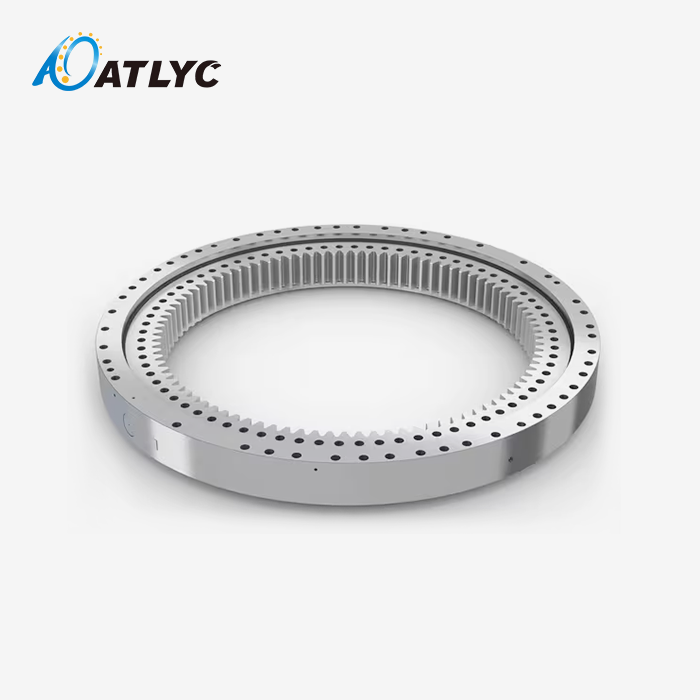
A Four Point Contact Ball Slewing Bearing consists of mounting holes, seals, grease fittings, steel balls, and a cage or spacers. It also has an outside circle. In certain designs, one of the rings is toothed. The track is a Gothic arch, so each ball may strike the rings up to four times. A single row of balls of this type can take axial stresses in both directions and a shaking moment as well. The inner ring is divided into half twice so that it may allow mounting the outer ring with rolling elements and cage without the intermediate ring halves. This makes it easy to put things together and to repair them afterward.
Contact Geometry Compared with Two-Point Contact
There are 35° of contact most of the time. When the load is only radial, each ball hits the raceway four times. A load that only goes in one direction makes each ball touch at two different spots. The difference is important when it comes to friction. When there are four points of contact, the contact patches slide. When there are two points of contact, things go more smoothly. This is the reason a fast app needs to stay in touch with two people at the same time. There are two types of axial loads that the bearing can handle. The other type is an eccentric load, which is a tilting moment. It's like having both single-row and double-row angular contact ball bearings in a small package.
Types and Size Range
Our Four Point Contact Ball Slewing Bearings come in three different styles: ones with no gear, ones with internal gear, and ones with external gear. The table shows the different sizes and weights of each.
| Type | Inner Diameter (mm) | Outer Diameter (mm) | Weight (kg) |
|---|---|---|---|
| No gear | 260–4272 | 480–4726 | 55–4000 |
| Internal gear | 458–4272 | 662–4726 | 94–4000 |
| External gear | 470–4272 | 694–4726 | 93.1–4000 |
50Mn, 42CrMo, S48C, 42CrMo4, and 16Mn are the options you have. Gearless units can be used in machines that have their own drive. The ring's drive teeth can be found on both internal and external gear types. You can tell which one will work best for your layout by where the pinion is placed.
Main Four Point Contact Ball Slewing Bearing Uses in Industry
Cranes, Excavators, and Material Handling
It is a bearing that connects the top boom to the chassis of a truck crane. The boom raises a cargo in a large circle, so it is hard for the boom to turn over. The boom is low, which helps maintain the vehicle's center of gravity low. Excavators may utilise it as a turntable between the bottom beam and the top beam. Digging creates shock loads, and dirt, grit, and sand may damage the racetrack. That's why heavy-duty integrated rubber seals are so necessary. A Four Point Contact Ball Slewing Bearing can take these loads and allow both machines to spin smoothly in either direction. That's why it is often utilised in construction equipment.
Wind Turbines and Solar Trackers
At the top of the tower are yaw mechanisms, which rotate the nacelle to face into the wind. This is because the bearing needs to withstand the weight of the cantilevered rotor, vibration, and large temperature variations. It is commonly coated with phosphate or zinc to protect it against corrosion. Solar trackers also need to be able to endure being outdoors and need to be sealed, although loads and speeds vary by design. The Four Point Contact Ball Slewing Bearing is not fast and usually remains in one position for a long period; hence, static safety is more essential than speed. “Get me the details on the coating and the seal as soon as possible. These control how long something will survive outdoors.
Automation, Marine, Mining, and Water Treatment
Automation turntables and robotic positioning stages have to run smoothly and take up minimal space. Mining equipment. Steel producing equipment. Offshore cranes and ship deck equipment. All of these need to be clean, dry, and at the correct temperature. These bearings are used to move the sluggish scraper bridges in water clarification equipment. If the seal is excellent, water and sludge can’t get in, and the structure can expand and contract as it needs to. Load, contamination, accuracy, noise, and documentation are all varied for each field. This is why I urge customers to use an example application as a reference, but just that; the final spec must come from how it will be utilised in the real world.
How a Four Point Contact Ball Slewing Bearing Handles Loads, Design, and Lubrication
Evaluating Axial, Radial, and Moment Loads Together
Axial forces operate along the axis of rotation while radial forces act across the axis. The moment forces attempt to shove one ring into the other. A crane boom, excavator top frame, or wind turbine nacelle may all create these three simultaneously. Diameter is simply one of the factors that determine turning ability. Some of the elements that matter are the distance between the load centers, the bolt circle diameter, the mounting bolts, and the support structure. If you want to know more about a Four Point Contact Ball Slewing Bearing, then you need to assess its overturning moment, duty cycle, shock loading, and safety factor. Check the limitations, both. ISO 76 covers ratings for static loads. ISO 281 covers ratings for rolling bearing life.
Raceway Design and Gear Arrangements
The ring size, the contact angle, the pitch diameter, the ball diameter, and the curvature of the raceway all determine how much load it can take, how stiff it is, how much torque it can manage, and how much moment resistance it has. Then the designers determine a path for the gear. The drive will take outside gear rings, and the pinion will come out of the bearing. The teeth are within the bore of the inner gear rings; thus, the outside envelope remains tiny. If the machine is gearless, you will have to provide a separate drive. If they are of the geared kind, ensure that the gearbox torque, backlash, module, and pinion are all compatible. It is important to conceive of mounting flatness, bolt preload, and housing stiffness as all being elements of the bearing system. This is because a non-straight seat affects the curvature of the raceway and reduces its lifespan.
Lubrication, Sealing, and Environmental Protection
This depends on the type of grease used, how well it works, and how often it needs to be oiled again. Every 100 to 200 hours, for normal use, you should grease it again. It needs to be done less often and with a different kind of grease in harsh places. When the bearing is hard to get to, centralized lubrication systems can help. Things don't rust in humid places or near the coast when they are coated or sealed. Seals keep out water, dust, salt, and chemicals. Finding out the load and sealing go hand-in-hand because pitting is often a sign of too much load, bad lubrication, or contamination. If you want to change the intervals, don't guess; use real operating data.
Four Point Contact Ball Slewing Bearing Comparison and Selection Guide
Comparison with Other Bearing Designs
There isn't a single best design. As a rule, four-point units cost less than crossed roller types. They can also handle shock well, but because they are stiffer, crossed rollers are better for positioning. You should use double-row ball bearings if you need to move heavy things.
| Design | Main strength | Typical use |
|---|---|---|
| Four-point contact ball | Compact, shock-tolerant, cost-effective for combined loads | Cranes, excavators, wind yaw, OEM turntables |
| Crossed roller | Higher stiffness, precise positioning | Precision positioning tables |
| Double-row ball | Higher capacity for heavy, stable load combinations | Heavier machines with more axial space |
How stiff, how much space, how much it costs, or how much it holds are the things that should guide your choice.
Step-by-Step Selection
Before you buy a Four Point Contact Ball Slewing Bearing, you need to know what kind of equipment it will be used on, how it will rotate, how fast it will go, how many hours it will be used, how it will bend, how often it will start and stop, and how long you want it to last. Next, find the safest and most useful loads. Loads from stopping, emergency stops, wind, impact, and eccentric loading should all be on this list. Also, check the width, height, clearance, mounting holes, gear arrangement, seals, and lubrication of the pitch. Make sure the support structure is flat, stiff, straight, and there is no runout. Also, make sure the bolts are strong. Finally, think about the total cost of ownership, including repairs, downtime for replacements, how reliable delivery is, technical support, and the length of the warranty. It doesn't matter how cheap a unit is if there is downtime afterward.
Installation and Maintenance for Longer Service Life
Each mounting surface needs to be clean, flat, and straight. Make sure you use the right grade of bolt, tighten it slowly, and add the right amount of preload. Make sure the bearing doesn't get hit, and then check the gears' backlash and how smoothly they turn. Watch the grease level, noise, vibration, torque, leaks, gear wear, raceway marks, loose bolts, and changes in clearance while it's being used. Early failure is often caused by too much load, too much moment, bad lubrication, contamination, misalignment, inadequate clearance, or deformation of the housing. Four Point Contact Ball Slewing Bearings last longer when they are put in place and checked regularly according to a written plan.
Four Point Contact Ball Slewing Bearing Procurement and Manufacturer Support
What to Include in an RFQ
By making a full request, everyone can save time. When you ask for a quote on a Four Point Contact Ball Slewing Bearing, please include drawings, measurements, load combinations, speed, duty cycle, operating environment, gear requirements, lubrication, sealing, material preference, inspection standards, quantity, and delivery location. It's possible that OEM projects will need unique mounting holes, gear geometry, coatings, or materials that can handle high temperatures. Before you compare quotes, make sure that each company charged the same amount for the same things. For example, the material, hardness depth, clearance, and gear grade should all be the same. If not, a lower number might hide a weaker design.
Quality Control and Documentation
Checks for quality keep life safe from fatigue. A lot of the time, procurement teams ask for ultrasonic testing of raw forgings to find holes inside them, magnetic particle testing after heat treatment to find surface cracks, raceway hardness and case depth verification, dimensional and runout checks, gear pitch error measurement, and clearance measurement. Ask for certificates of materials, records of how hard they are, reports on sizes, and information on clearance. When a Four Point Contact Ball Slewing Bearing is used in important machinery, it's important that it can be tracked. ASLYC has both ISO 9001 and IATF 16949 certifications. This gives buyers in the auto and industrial sectors a quality system that is written down and can be checked.
Why ATLYC Fits Long-Term Supply
Luoyang Auto Bearing Co., Ltd., trading as ATLYC, was established in 2010 as a single workshop manufacturing automated deep groove ball bearings. We have been in the industry for 15 years now, and we have six workshops, with 120 individuals working in manufacturing, research and development, quality control, and assembly. We manufacture six types of core bearings. We have clients in the US, Germany, South Korea, Russia, Iran, and Turkey. Our engineers examine the loads, sizes, and gear fit before they build the product. The Four Point Contact Ball Slewing Bearing comes in three styles: standard, bespoke, and OEM. We may also provide technical drawings and our inspection documents.
Conclusion: Choosing the Right Four Point Contact Ball Slewing Bearing for Industrial Use
Four Point Contact Ball Slewing Bearings are employed in cranes, excavators, wind turbine yaw systems, solar trackers, automated turntables, and water treatment clarifiers. This is because they can accommodate radial, axial, and tilting moments in a tiny two-ring unit. Its raceway form, with a 35° contact angle, enables it to take loads from both the left and right. Two-point contact must be maintained while working swiftly. You need to consider axial, radial, and moment loads simultaneously to make the optimal decision. Then you have to ensure that the gear type, clearance, lubrication, and sealing are all correct for the environment. The crossing roller and double row design may be utilised for numerous purposes; there is no reason not to. Four-point contact is appropriate for modest layouts that can absorb shock and don’t cost a lot of money. How effectively it was installed, maintained, inspected, and how clear the RFQ data was all impact how long it lasts and how much it costs to own.
FAQ
What is a Four Point Contact Ball Slewing Bearing used for?
It keeps a structure from falling while axial, radial, and moment loads are added up. There are many types of machines, such as truck cranes, excavators, solar trackers, wind turbine yaw systems, and automation turntables.
Can it run at high speed?
What makes something move quickly is its size, weight, lubrication, clearance, gearing, and duty cycle. Because high-speed work needs two points of contact to stay in place, I think you should have an engineer look over your plan before you sign it off.
Which materials do you offer?
We have 50Mn, S48C, 42CrMo4, and 16Mn in stock. Once you tell us about your load and environment, we'll talk about the best option.
What should a quotation request include?
Send plans, measurements, load data, information about the area, the gear you need, and how many you need. It takes less time to review when there are full details.
Do you build custom sizes or OEM designs?
Yes. We sell standard bearings, bearings made to order, and OEM bearings. They can look over your application before they start making things.
Request a Four Point Contact Ball Slewing Bearing Quote from ATLYC
Feel free to email your application to auto@lyautobearing.com along with your drawings, loads, dimensions, gear type, and quantity. Our engineers will look it over. We are an ISO 9001 and IATF 16949 certified company that makes Four Point Contact Ball Slewing Bearings. The outer diameters of our bearings range from 480 mm to 4726 mm, and they come in no-gear, internal gear, and external gear types. Visit https://aotezhoucheng.aixdb.cn/ to learn more about the product.
References
1. Rolling Bearing Analysis (Harris and Kotzalas, 5th Edition), 2006
2. ISO 76: Rolling Bearings – Static Load Ratings, 2006
3. Machinery's Handbook (31st Edition), 2020
4. DNVGL-ST-0361: Machinery for Wind Turbines, 2016
5. IATF 16949: Automotive Quality Management System Standard, 2016

6. ISO 9001: Quality Management Systems – Requirements, 2015
Learn about our latest products and discounts through SMS or email