- English
- French
- German
- Portuguese
- Spanish
- Russian
- Japanese
- Korean
- Arabic
- Greek
- German
- Turkish
- Italian
- Danish
- Romanian
- Indonesian
- Czech
- Afrikaans
- Swedish
- Polish
- Basque
- Catalan
- Esperanto
- Hindi
- Lao
- Albanian
- Amharic
- Armenian
- Azerbaijani
- Belarusian
- Bengali
- Bosnian
- Bulgarian
- Cebuano
- Chichewa
- Corsican
- Croatian
- Dutch
- Estonian
- Filipino
- Finnish
- Frisian
- Galician
- Georgian
- Gujarati
- Haitian
- Hausa
- Hawaiian
- Hebrew
- Hmong
- Hungarian
- Icelandic
- Igbo
- Javanese
- Kannada
- Kazakh
- Khmer
- Kurdish
- Kyrgyz
- Latin
- Latvian
- Lithuanian
- Luxembou..
- Macedonian
- Malagasy
- Malay
- Malayalam
- Maltese
- Maori
- Marathi
- Mongolian
- Burmese
- Nepali
- Norwegian
- Pashto
- Persian
- Punjabi
- Serbian
- Sesotho
- Sinhala
- Slovak
- Slovenian
- Somali
- Samoan
- Scots Gaelic
- Shona
- Sindhi
- Sundanese
- Swahili
- Tajik
- Tamil
- Telugu
- Thai
- Ukrainian
- Urdu
- Uzbek
- Vietnamese
- Welsh
- Xhosa
- Yiddish
- Yoruba
- Zulu
RE Series Crossed Roller Bearing: Optimize Compact Linear Systems
For a small rotary or linear system, the RE Series Crossed Roller Bearing is one of the most competent single-unit options available today if you are specifying bearings. This kind of bearing is designed with an integrated outer ring and a split inner ring, enabling it to accommodate radial, axial, and moment loads concurrently in a single, compact unit. When designing a robotic joint, precision rotary table, or medical imaging platform, knowing the performance of this crossed roller bearing and how to purchase it appropriately can directly influence the accuracy and service life of the system.

Understanding RE Series Crossed Roller Bearings: Specifications and Design Features
Structural Configuration
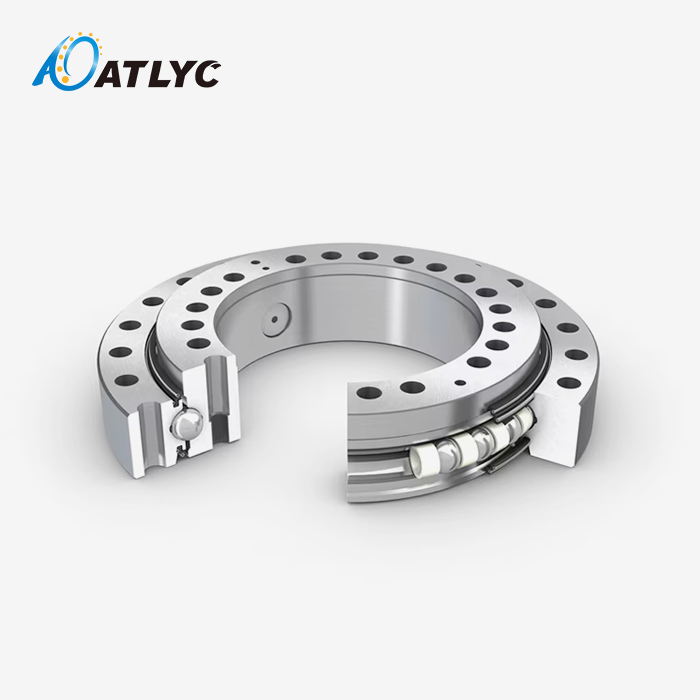
This RE Series Crossed Roller Bearing is different. The outer ring is a complete piece, while the inner ring is broken into two independent sections. It's the reverse of the RB series design and is best used when the inner ring has to rotate extremely accurately. The split inner ring enables you to set the rollers precisely and adjust the preload as you assemble the complete unit. This does not influence the strength of the outer ring.
Dimensional Range and Tolerance
This line of bearings comes in a lot of different sizes to fit a wide range of machine types:
| Parameter | Range |
|---|---|
| Inner Diameter | 20 mm – 1,100 mm |
| Outer Diameter | 70 mm – 1,500 mm |
| Width | 12 mm – 110 mm |
There are six different levels of accuracy: P6, P0, P5, P4, P3, and P3. P3 has the tightest range and is used for the most difficult precision tasks. Under normal loading settings, the running accuracy is between 5 and 10 micrometers.
Material and Hardness
The rings and rollers are constructed of GCr15 and GCr15SiMn steel. GCr15SiMn steel is a high-carbon chromium bearing steel strengthened to HRC 58-64. V-groove raceways are honed to a surface roughness of not less than Ra 0.2, sharp. This type of material ensures consistent resistance to fatigue and dimensional stability across a broad temperature range, especially crucial for continuously operating equipment.
How RE Series Crossed Roller Bearings Optimize Compact Linear Systems
The Crossed Roller Working Principle
A crossed roller bearing arranges cylindrical rollers at 90 degrees to each other and in precision-ground V-groove raceways. This linear design causes line contact in more than one manner at once. Therefore, the bearing can absorb loads in all directions — radial, axial, and tilting moment — without the requirement for a second bearing unit or elaborate housing construction.
The precision-made spacers are put between the adjacent rollers. This distributes the load evenly and prevents the rollers from contacting. Standard roller bearings usually get out of true, but this design overcomes that issue. Smooth, constant rotation results, with a coefficient of friction typically between 0.002 and 0.004.
Space Savings vs. Conventional Arrangements
The RE Series Crossed Roller Bearing may reduce the axial area by up to 60% compared to a dual-bearing arrangement with regular radial and thrust bearings. This reduction is important for tiny robots, manipulators, and rotary tables of machining centers since every millimeter of space is important for the overall design of the machine. This reduces the number of anchoring surfaces and thus the overall amount of alignment error by using one bearing instead of two or more conventional units.
Real-World Application Examples
Here are the main types of applications where this crossed roller design produces measured efficiency benefits:
Industrial robot joints and manipulator rotating parts: The moment load capacity of this bearing type supports cantilevered robot arm segments without additional support structures, reducing joint weight and improving positioning repeatability.
Machining center rotary tables: The P4 and P3 accuracy grades deliver the runout accuracy required for five-axis machining, where table positioning error directly affects part geometry.
Medical imaging and measuring instruments: Low torque fluctuation and smooth rotation are critical in CT scanner gantries, coordinate measuring machines, and IC manufacturing devices, where vibration directly degrades measurement quality.
Medical imaging and measuring tools: In CT scanner gantries, coordinate measuring machines, and IC manufacturing tools, where vibration directly lowers measurement quality, low torque fluctuation and smooth rotation are very important.
Comparing RE Series Crossed Roller Bearings: Making the Right Choice
RE vs. RB Series
Most people don't understand the difference between RE and RB setups. RB Series and RE Series are both crossed roller bearings, but the split rings are arranged in a different way.
| Feature | RE Series | RB Series |
|---|---|---|
| Integral Ring | Outer Ring | Inner Ring |
| Split Ring | Inner Ring | Outer Ring |
| Optimized For | Inner Ring Rotation | Outer Ring Rotation |
| Typical Application | Rotary tables, robot joints | Slewing-type applications |
If you pick the wrong configuration, it changes both how the parts are mounted and how well they rotate. Once the inner ring is the moving part and the outer ring is fixed to the frame, the RE series is the right choice.
Precision Grade Selection
Most of the time, P5 or P0 accuracy grades are enough for basic automation tools. P4 or P3 grades are best for making semiconductors, using coordinate measuring tools, and making high-precision machines. If you choose a higher accuracy grade than what the application needs, it will cost more and not work better, so it is better to match the grade to the real runout and setup needs.
Quality Assurance and Certification
For car and industrial OEM uses, ISO 9001 and IATF 16949 approval are must-haves when looking for a crossed roller bearing provider. These licenses show that the company follows a written quality control system and keeps production records that can be tracked. The company Luoyang Auto Bearing Co., Ltd. (ATLYC) has both licenses and has been selling precision bearings to people in the US, Germany, South Korea, Russia, Iran, and Turkey since 2010.
Procurement Insights: How to Source and Buy RE Series Crossed Roller Bearings
Evaluating an RE Series Crossed Roller Bearing Supplier
Production scale: When you search for a crossed roller bearing manufacturer for OEM or bulk orders, production size is a significant factor. ATLYC has 6 workshops, so a firm may manage shifting order quantities without increasing lead times. Look for suppliers that supply as standard: dimensional models, material approvals, and third-party inspection reports.
For instance, if procurement managers want OEM customisation such as various mounting hole patterns, special preload settings, or non-standard bore diameters, they should ensure that the vendor has the technical capability they want before placing a trial order. This will save a lot of time later.
Pricing, Lead Times, and Volume Discounts
If you purchase a lot of RE Series Crossed Roller Bearings, you may be able to enjoy price discounts for large quantities. One of the greatest strategies to keep pricing consistent and the supply flowing is a blanket order with scheduled releases. Before entering a long-term supply agreement, be careful to obtain in writing the lead times and that the vendor has an inventory of popular sizes.
Logistics and After-Sales Support
If you’re buying for export, be sure your RE Series Crossed Roller Bearing provider is familiar with international shipping documentation, customs classifications, and packing regulations for precision parts. Technical support after the sale, including assistance with the calculation of torque, ideas for the preload, and installation guidance, reduces the time required to commission the machine at the receiving plant.
Maintenance and Longevity Tips for RE Series Crossed Roller Bearings
Lubrication Practices
The majority of bearings in the RE series are pre-lubricated using lithium soap-based greases, e.g., Alvania EP2. The re-oiling is determined by the speed, temperature, and load of the machine. Greases with low outgassing are used in cleanrooms or vacuum environments, and are common in medical devices and the production of integrated circuits (ICs). Do not combine greases of various types, since the base oil is diluted and the raceways wear out more quickly.
Inspection and Wear Monitoring
Spin and check for odd variations in torque at normal maintenance intervals. This is generally an indication of worn rollers or raceways. Check axial and radial runout against the original specification to detect worn-out bearings before they influence the quality of the product. Track the outcomes of the inspections over time to determine trends of wear and adjust the frequency of repairs accordingly.
Handling and Storage
Storage of RE Series Crossed roller bearings should be done horizontally in the original packaging and protected from moisture and vibration. It is crucial to keep the broken inner ring together during storage or shipping. If you take it apart, the precision-ground mating surfaces might be damaged. When installing, utilize a presser flange to uniformly clamp the split ring half onto the housing bore. This will secure the rings and prevent fretting corrosion at the ring connection.

Conclusion
The RE Series Crossed Roller Bearing is a proven technological solution for compact rotary systems that must bear loads in more than one direction at the same time and need extremely tight runout tolerances. It features a high-carbon chromium steel split inner ring and full outer ring, and precision-ground V-groove raceways. Can be utilized in robots, machining centers, medical equipment, and integrated circuit-manufacturing devices. The three most essential factors that directly impact long-term bearing performance and overall system cost are selecting the correct accuracy grade, maintaining the optimal lubrication regimen, and partnering with a certified manufacturer.
FAQ
1. What is the primary structural difference between RE and RB series crossed roller bearings?
The RE Series Crossed Roller Bearing has an outer ring that is one piece and an inner ring that is split. This means that the inner ring can rotate. The RB series has a complete inner ring and a split outer ring, which makes it good for rotating the outer ring. If you choose the wrong series, it changes both how you place it and how accurately it rotates.
2. Can a single RE series bearing carry moment loads?
Yes. The bearing can handle radial, axial, and moment loads all at the same time because the circular rollers are placed orthogonally at 90-degree intervals.
3. What accuracy grade should I specify for a precision rotary table?
P5 is usually good enough for standard machining center rotary tables. The P4 or P3 grades are good for five-axis cutting or measuring instruments that need runout below 3 micrometers. Make sure you know exactly what runout you need before you place your order.
4. What lubrication should I use in cleanroom environments?
Normal lithium soap grease shouldn't be used in a clean room or a cleaner. Ask your source for greases that don't give off a lot of heat. If asked, ATLYC can provide bearings that are oiled in a way that is best for the application.
5. How do I manage the split inner ring during installation?
Do not take apart the split inner ring before putting it back together. To seat both halves of the ring into the housing bore at the same time, use a uniform presser flange. Raceways get out of alignment and wear out faster when the clamping force isn't even.
Partner with ATLYC for Your RE Series Crossed Roller Bearing Supply
ATLYC, which stands for Luoyang Auto Bearing Co., Ltd., has been making precision bearings since 2010. Their six production workshops are ISO 9001 and IATF 16949 certified. As a reliable maker of RE Series Crossed Roller Bearings, we offer OEM customization, flexible order volumes, and shipping to the US, Germany, South Korea, and other places. Email our engineering team at auto@lyautobearing.com to get a price or see what the product is made of.
References
1. Harris, T. A., & Kotzalas, M. N. — Rolling Bearing Analysis, Taylor & Francis, 2006.
2. SKF Group — SKF General Catalogue, SKF, 2018.
3. ISO — ISO 492: Rolling Bearings — Radial Bearings — Dimensional and Geometrical Tolerances, International Organization for Standardization, 2014.
4. Hamrock, B. J., Schmid, S. R., & Jacobson, B. O. — Fundamentals of Machine Elements, McGraw-Hill, 2005.
5. NSK Ltd. — NSK Precision Machine Components Catalogue, NSK, 2020.
6. American Bearing Manufacturers Association — ABMA Standard 20: Identification Code for Bearings, ABMA, 2011.
Learn about our latest products and discounts through SMS or email