- English
- French
- German
- Portuguese
- Spanish
- Russian
- Japanese
- Korean
- Arabic
- Greek
- German
- Turkish
- Italian
- Danish
- Romanian
- Indonesian
- Czech
- Afrikaans
- Swedish
- Polish
- Basque
- Catalan
- Esperanto
- Hindi
- Lao
- Albanian
- Amharic
- Armenian
- Azerbaijani
- Belarusian
- Bengali
- Bosnian
- Bulgarian
- Cebuano
- Chichewa
- Corsican
- Croatian
- Dutch
- Estonian
- Filipino
- Finnish
- Frisian
- Galician
- Georgian
- Gujarati
- Haitian
- Hausa
- Hawaiian
- Hebrew
- Hmong
- Hungarian
- Icelandic
- Igbo
- Javanese
- Kannada
- Kazakh
- Khmer
- Kurdish
- Kyrgyz
- Latin
- Latvian
- Lithuanian
- Luxembou..
- Macedonian
- Malagasy
- Malay
- Malayalam
- Maltese
- Maori
- Marathi
- Mongolian
- Burmese
- Nepali
- Norwegian
- Pashto
- Persian
- Punjabi
- Serbian
- Sesotho
- Sinhala
- Slovak
- Slovenian
- Somali
- Samoan
- Scots Gaelic
- Shona
- Sindhi
- Sundanese
- Swahili
- Tajik
- Tamil
- Telugu
- Thai
- Ukrainian
- Urdu
- Uzbek
- Vietnamese
- Welsh
- Xhosa
- Yiddish
- Yoruba
- Zulu
Top Crossed Roller Bearing Guide: Uses, Types, and Benefits
When choosing motion components for high-precision equipment, a dependable crossed roller bearing guide provides the best stiffness and multi-directional load support for demanding automation operations. Unlike typical linear guides, crossing roller designs use cylindrical rollers positioned at right angles to each other inside a single raceway for uniform force distribution and play elimination. This inherent design advantage makes crossed roller bearing guides an essential consideration for procurement managers and OEMs seeking constant precision, long service life and low maintenance in industrial applications.

Introduction
Crossed roller bearing guides are a key technology for precision equipment, offering greater stiffness and load capacity compared to traditional linear guides. These components provide smooth, precise linear motion required in high performance automation systems. They are used in automobile assembly lines, industrial robots, medical imaging equipment and aerospace testing rigs. They meet the demanding needs of contemporary industry. This handbook provides procurement managers, design engineers and OEMs with complete crossed roller bearing guide selection information, enabling you to make intelligent purchase choices that improve equipment dependability and operational efficiency while decreasing total cost of ownership.
Understanding Crossed Roller Bearing Guides
Core Design Principles
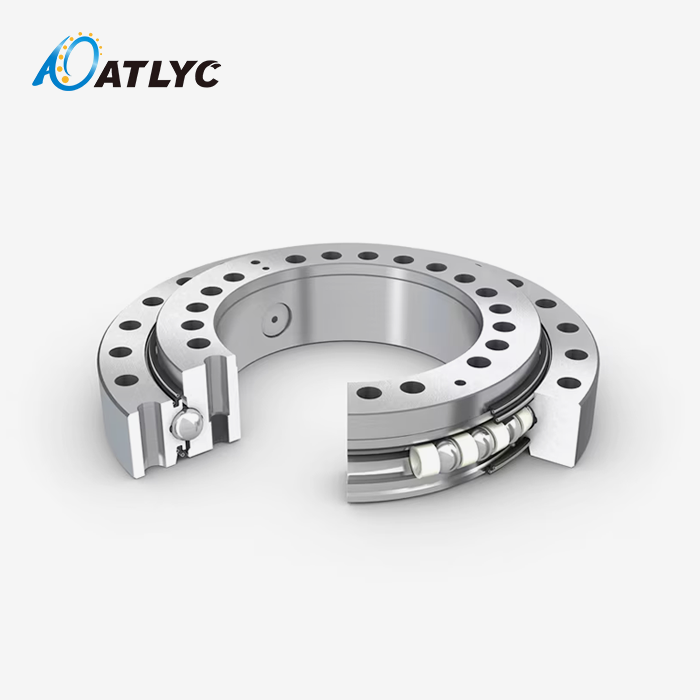
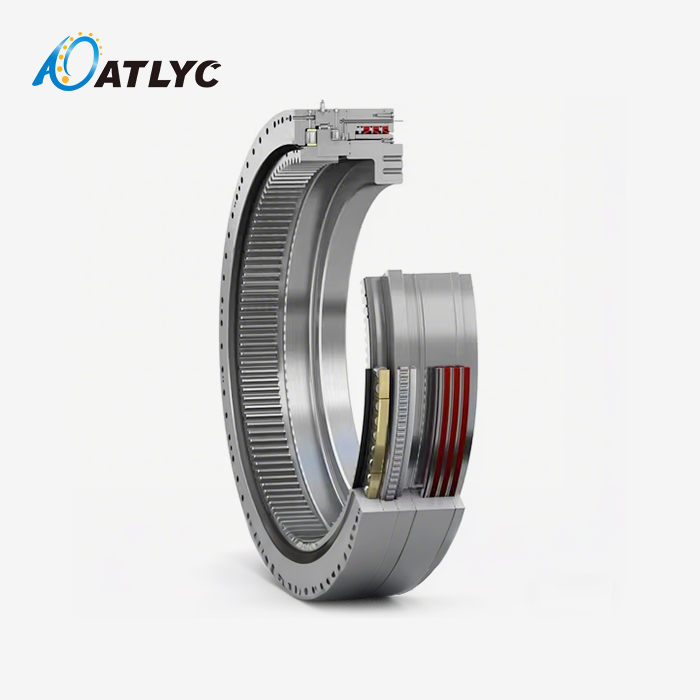
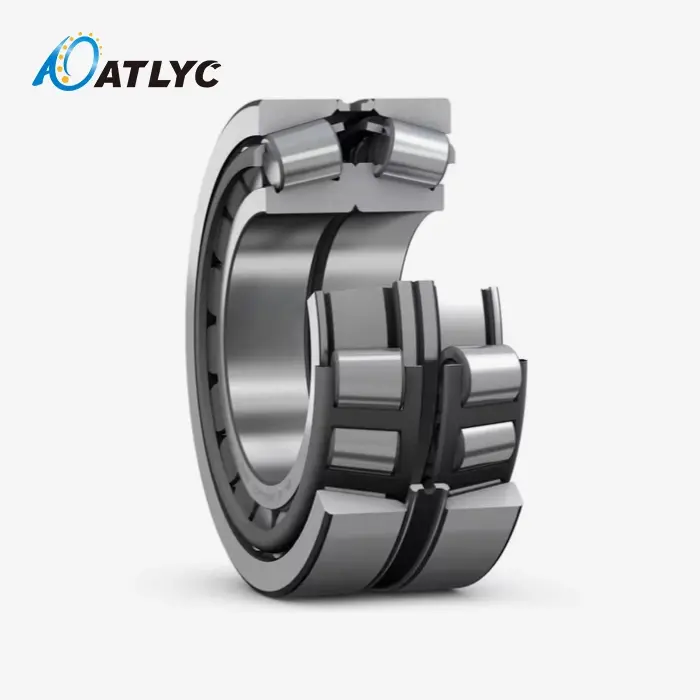
Crossed roller bearing guides are composed of cylindrical rollers placed perpendicular to each other in a single raceway. This makes it possible for them to carry radial, axial and moment loads concurrently with outstanding accuracy. This perpendicular orientation produces what engineers term "line contact" instead of the "point contact" of ball bearings and it spreads the loads across a larger surface area. This results in an efficient load distribution, high stiffness (up to 4 times that of normal designs) and little friction during operation. This arrangement guarantees smooth and precise movement even with the most complicated load combinations often seen in automated manufacturing systems.
Material and Manufacturing Standards
Material choice is the beginning of manufacturing excellence. The high-quality crossed roller bearing guides are made of bearing steel like GCr15 and SUJ2. The raceway is induction-hardened to 58-64 HRC. The effective hardening depth is tightly managed to avoid premature spalling under cyclic stress, a crucial quality step for procurement specialists assessing supplier capability. Manufacturing procedures are ISO 9001- and IATF 16949-compliant with stringent tolerances that directly impact bearing life and machine precision. When choosing the correct crossed roller bearing guide for precise applications with stringent performance criteria, it is essential to understand the design concepts and material specifications.
Types and Variants of Crossed Roller Bearing Guides
Standard and High-Load Model Comparison
Crossed roller bearing guides are available in many variants to accommodate different load and accuracy requirements. Standard models are perfect for basic automation operations in confined spaces and with modest loads. High-load versions are suitable for heavy-duty applications in CNC machining machines and industrial presses. The table below shows the important variations in performance:
| Model Type | Load Capacity | Rigidity | Typical Application | Maintenance Interval |
|---|---|---|---|---|
| Standard Series | Moderate | High | Collaborative robots, medical devices | 12-18 months |
| High-Load Series | Heavy | Very High | CNC machining, metal forming presses | 18-24 months |
| Ultra-Thin (RA Series) | Light to Moderate | High | Semiconductor equipment, precision measuring tools | 12 months |
| Heavy-Duty (RB Series) | Very Heavy | Extremely High | Industrial robotic wrists, rotary indexing tables | 24-36 months |
Comparing Bearing Technologies
In the evaluation of motion solutions, crossing roller bearing guides have significant benefits over ball bearing guides, plain bearing guides, and linear motion systems. Ball bearing guides offer reduced friction at the cost of stiffness and load capacity and are not recommended for applications with moment loads. Plain bearing guides need to be lubricated more often and have greater wear rates, which increases maintenance expenses throughout the equipment life cycle. While linear motion systems may take on enormous loads, they don't have the compact size or multi-directional load capabilities of crossing roller designs. By understanding these trade-offs, procurement teams may better match component choices with particular operational requirements and budget restrictions.
Leading Global Brands and Product Lines
Crossed Roller Bearing Guide Market is dominated by established players such as IKO, THK, NSK, FAG, and Hiwin. Each of these players has its own product lines with distinctive characteristics. IKO’s CRW series is perfect for small installations that need high moment capacity, while THK’s VRT series is designed for preload uniformity for zero-backlash placement. NSK specialises in corrosion-resistant coatings for tough environments, while FAG offers integrated lubrication systems to reduce the need for maintenance. Hiwin provides affordable pricing and has strong technical support networks across North America and Europe. These manufacturers back up their goods with authorised distributors that provide full warranty policies, technical documentation, and replacement parts availability, ensuring quality and dependability of service for long-term relationships.
Typical Applications and Use Cases
CNC Machining and Metal Fabrication
In precise CNC machining centers, the guiding of tool carriages and work tables is performed by crossed roller bearing guides, where the cutting forces generate complicated load vectors. A Midwest automobile parts company replaced standard linear guides with RB series crossed roller bearing guides on its five-axis machining machines, resulting in a 35% increase in positioning repeatability and a 22% reduction in tool breakage instances. The increased stiffness reduced deflection in heavy interrupted cuts, prolonging tool life and enhancing the quality of the surface finish. Investment produced ROI in 14 months via lower scrap rates and greater throughput.
Industrial Robotics and Automation
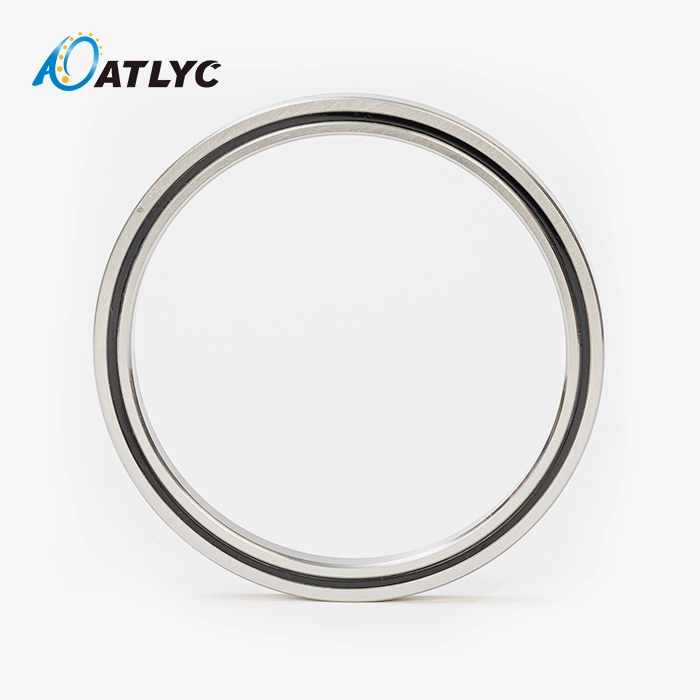
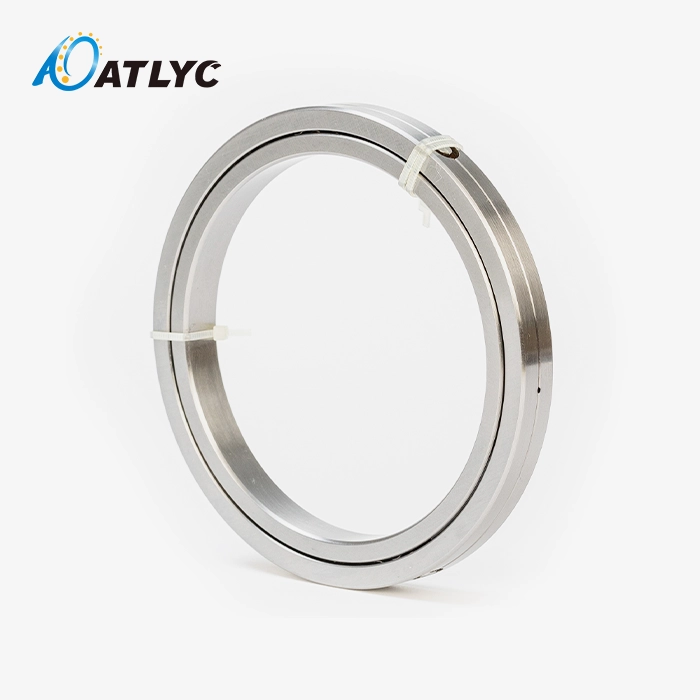
Crossed roller bearing guides are key components in robot joints, collaborative robot arms, and end effectors requiring accurate rotational movement combined with load-bearing capacity. The RA series’ ultra-thin profile enables lighter arm designs, resulting in lower inertia and energy consumption of about 18% while still keeping the stiffness necessary for accurate placement. A large electronics contract manufacturer has used RA8008UUCC0 crossed roller bearings in pick-and-place robots to handle sensitive circuit boards. The negative clearance preload requirement (usually -2 to -5 microns) reduced play and provided sub-micron repeatability, which was critical for reliable component placement on high-density assemblies.
Medical Imaging Equipment
Medical imaging systems have to be silent and operate well in tiny form factors that are challenging to maintain. CT scanners and X-ray rotating arms are equipped with crossed roller bearing guides to support imaging equipment weighing several hundred kilograms and to ensure perfect rotation of the gantry. Crossed roller bearing guides were chosen by a European OEM of medical equipment for their new portable CT scanner design. The compact profile helped reduce the overall weight of the system by 12%. The low starting torque allowed for smoother acceleration profiles, improving image quality by minimising motion artefacts during scans.
Semiconductor and Cleanroom Applications
Wafer handling robots and precision alignment tables in vacuum or cleanroom conditions that must be very clean and accurate are used in semiconductor production facilities. The RA series crossed roller bearing guide offers the essential rotational precision (typically sub-micron runout) and moment stiffness to handle sensitive silicon wafers without contamination concerns. The integrated seal design (UU standard) traps lithium soap-based grease, excludes micron-level pollutants, and maintains cleanroom compliance for the life of the bearing's service.
How to Select and Procure the Right Crossed Roller Bearing Guide
Technical Selection Criteria
Choosing the right crossed roller bearing guide means a comprehensive study of technical aspects that meet your application needs. The load capacity study should include radial, axial, and moment loads concurrently with suitable factors of safety for duty cycle and shock load circumstances. Design choices are generally driven by dimensional restrictions in space-constrained installations. Accuracy class selection is based on positioning needs; for instance, ISO P5 is good for general automation, P4 for precision machining, and P2 for ultra-precision applications such as semiconductor equipment. The ultra-thin RA series devices with high load capacity vs tiny cross section allow for lighter and more energy-efficient machine designs. Environmental concerns, including temperature extremes, contaminant exposure, and corrosive atmospheres, may require specialised sealing arrangements, corrosion-resistant coatings, or stainless steel construction, which affect material selection and procurement criteria.
Procurement Considerations and Logistics
Price dynamics of crossed roller bearing guides are based on quality classes, customisation needs and order sizes. With standard catalogue products, you may expect competitive pricing and shorter lead times. Established manufacturers usually have lead times of four to six weeks. Custom designs with specific mounting hole patterns, embedded gear teeth, or non-standard dimensions increase lead times to eight to twelve weeks but optimise system integration and reduce assembly costs. Bulk ordering strategies offer cost benefits for OEMs with predictable production volumes. Volume commitments usually result in lower prices from bearing manufacturers and also provide priority scheduling and inventory management assistance. When you evaluate suppliers, you should look at their quality management certifications (ISO 9001, IATF 16949), their production capacity to meet scaling needs, and their skills for technical support, including application engineering help and customisation knowledge.
Quality Control Checkpoints
Strict quality control is applied to the crossed roller bearing guide performance to satisfy the specification. Critical inspection points include: dimensional accuracy check of inner diameter, outer diameter and height to drawing tolerances; measurement of radial and axial runout to ensure geometric correctness; and hardness depth profiling of raceways to avoid premature spalling. Initial torque tests verify preload uniformity without excessive resistance, and non-destructive evaluation techniques such as ultrasonic testing and magnetic particle inspection uncover subsurface metallurgical flaws before assembly. These checks defend against field failures that interrupt production schedules and damage equipment. The table below summarizes key quality metrics procurement teams should verify with suppliers:
| Quality Parameter | Measurement Method | Acceptance Criteria | Impact if Out of Spec |
|---|---|---|---|
| Dimensional Accuracy | CMM or calibrated gauges | ±0.005 mm (standard); ±0.002 mm (precision) | Improper fit, installation difficulty |
| Radial Runout | Dial indicator | ≤5 μm (P5); ≤2 μm (P4) | Reduced positioning accuracy |
| Raceway Hardness | Rockwell tester | 58-64 HRC | Premature wear, shortened service life |
| Starting Torque | Torque sensor | Specified range per model | Inconsistent motion, excessive friction |
| NDT Inspection | Ultrasonic/MPI | Zero critical defects | Catastrophic failure risk |
Installation and Maintenance Best Practices
Proper fitting enhances the life and efficiency of the crossed roller bearing guide. Mounting surfaces must be maintained within flatness tolerances, usually 0.02 mm, to avoid fluctuations in preload, which would affect accuracy. Bolts are tightened to specified torque patterns and to specified torque levels to distribute the clamping force evenly. A major cause of failure is installation contamination. Clean assembly conditions and good handling technique minimise particle contamination. Maintenance management may greatly increase bearing life. Lubrication intervals are based on operating circumstances. Sealed bearings should be regreased every 12-18 months when working under normal conditions or more often when operating in a polluted environment. Monitoring of starting torque and noise levels during operation of machinery offers an early warning of wear or contamination problems. By avoiding typical problems such as shock loading above specified capacity, operating outside temperature requirements, or using unsuitable lubricants, bearing integrity may be preserved and premature replacement expenses avoided.
Key Technical Properties Driving Performance
The technological excellence of crossed roller bearing guides is based on their special geometric and material qualities. The line contact between the rollers and raceways distributes the load over a broader surface area than the point contact of ball bearings and hence has a better load capacity and stiffness. This design difference allows crossed roller bearing guides to reach stiffness values 3-4 times higher than equivalent ball bearing designs. By applying preload, the internal clearance is eliminated, and a negative clearance is achieved, which is usually in the range of -2 to -5 microns depending on the accuracy class and the application requirements. This preload provides minimal backlash on direction shift, which is essential in precision positioning operations on CNC machines and robotic systems. Load elastic deformation is still far less than ball-bearing alternatives, maintaining position accuracy even with complex load combinations. Manufactured from high-carbon chromium bearing steel (GCr15/SUJ2) provides optimum hardness, wear resistance, and fatigue life. The raceways are induction-hardened to 58-64 HRC. The hardened surface layer is deep enough to endure millions of load cycles without spalling. Contact seal designs (UU) efficiently retain grease and exclude dust and moisture, therefore decreasing maintenance and prolonging bearing life in demanding industrial situations.

Conclusion
Crossed roller bearing guides provide the high accuracy, stiffness, and load capacity needed in contemporary automation and industrial equipment where positioning accuracy and operational dependability have a direct influence on production. Understanding the technical differences between kinds of bearings, quality control points, and special application requirements will ensure that purchase choices are made intelligently to optimise equipment performance and reduce lifetime costs. With the needs of production changing for increased accuracy and efficiency, choosing the appropriate bearing supplier is more important than ever. By working with experienced manufacturers who have proven quality processes, scalable production capacity and fast technical support, you can be confident your equipment is performing at its peak, providing a sustainable competitive edge in challenging global markets.
FAQ
What factors most significantly influence crossed roller bearing guide lifespan?
Service life depends primarily on load conditions relative to rated capacity, lubrication quality and maintenance intervals, operating temperature, contamination exposure, and installation precision. Operating within rated load specifications while maintaining proper lubrication typically delivers service lives exceeding 20,000 hours in industrial automation applications. Contamination represents the leading cause of premature failure; effective sealing and clean operating environments extend lifespan substantially.
How do crossed roller bearing guides compare to ball bearing guides in precision applications?
Crossed roller bearing guides deliver superior rigidity and load capacity due to their line contact design, making them preferable for applications involving moment loads or requiring zero backlash. Ball bearing guides offer lower friction and faster speeds but sacrifice rigidity. For positioning accuracy below 5 microns and applications with complex load vectors, crossed roller designs prove more reliable and cost-effective over the equipment lifecycle despite higher initial investment.
How can I ensure I'm sourcing from authorized suppliers with reliable warranty support?
Verify supplier credentials through manufacturer websites listing authorized distributors and request documentation of ISO 9001 and IATF 16949 certifications. Reputable suppliers provide comprehensive product documentation, application engineering support, and clear warranty terms covering manufacturing defects. Established manufacturers like ATLYC maintain transparent quality processes and responsive technical support, building trust through consistent performance and customer service rather than pricing alone.
Partner with ATLYC for Your Crossed Roller Bearing Guide Requirements
ATLYC brings 15 years of bearing manufacturing expertise to OEMs and distributors seeking a dependable crossed roller bearing guide supplier combining precision engineering with international quality standards. Our ISO 9001 and IATF 16949 certifications demonstrate our commitment to consistent quality management, while our six specialized production workshops enable scalable manufacturing supporting both prototype quantities and high-volume production runs. We manufacture crossed roller bearing guides, including RA series ultra-thin models and RB series heavy-duty variants tailored to automotive components, industrial machinery, robotics, and automation equipment. Our quality control processes incorporate dimensional verification, hardness depth profiling, starting torque testing, and non-destructive inspection, ensuring every bearing meets specification before shipment. With established distribution networks serving customers in the United States, Germany, South Korea, Russia, Iran, and Turkey, we provide competitive pricing, reliable lead times, and technical support throughout your product development cycle. Contact our engineering team at auto@lyautobearing.com to discuss your specific application requirements, request detailed product catalogs, or obtain quotations for custom crossed roller bearing guide configurations. Visit https://aotezhoucheng.aixdb.cn/ to explore our complete bearing product range. We're committed to building long-term partnerships based on manufacturing excellence, responsive service, and continuous improvement, supporting your operational success.
References
1. Harris, T.A. and Kotzalas, M.N. (2006). Advanced Concepts of Bearing Technology: Rolling Bearing Analysis, Fifth Edition. CRC Press, Boca Raton, Florida.
2. ISO 14728-1:2017. Rolling bearings — Linear motion rolling bearings — Part 1: Dynamic load ratings and rating life.
3. Eschmann, P., Hasbargen, L., and Weigand, K. (1985). Ball and Roller Bearings: Theory, Design and Application, Second Edition. John Wiley & Sons, Chichester, United Kingdom.
4. American National Standards Institute (2013). ANSI/ABMA Standard 12.3: Crossed Roller Bearings — Boundary Dimensions and Tolerances.
5. Budynas, R.G. and Nisbett, J.K. (2015). Shigley's Mechanical Engineering Design, Tenth Edition. McGraw-Hill Education, New York.
6. DIN 616:2013. Rolling bearings — Dynamic load ratings and rating life — Calculation of modified reference rating life for universally loaded bearings.
Learn about our latest products and discounts through SMS or email