- English
- French
- German
- Portuguese
- Spanish
- Russian
- Japanese
- Korean
- Arabic
- Greek
- German
- Turkish
- Italian
- Danish
- Romanian
- Indonesian
- Czech
- Afrikaans
- Swedish
- Polish
- Basque
- Catalan
- Esperanto
- Hindi
- Lao
- Albanian
- Amharic
- Armenian
- Azerbaijani
- Belarusian
- Bengali
- Bosnian
- Bulgarian
- Cebuano
- Chichewa
- Corsican
- Croatian
- Dutch
- Estonian
- Filipino
- Finnish
- Frisian
- Galician
- Georgian
- Gujarati
- Haitian
- Hausa
- Hawaiian
- Hebrew
- Hmong
- Hungarian
- Icelandic
- Igbo
- Javanese
- Kannada
- Kazakh
- Khmer
- Kurdish
- Kyrgyz
- Latin
- Latvian
- Lithuanian
- Luxembou..
- Macedonian
- Malagasy
- Malay
- Malayalam
- Maltese
- Maori
- Marathi
- Mongolian
- Burmese
- Nepali
- Norwegian
- Pashto
- Persian
- Punjabi
- Serbian
- Sesotho
- Sinhala
- Slovak
- Slovenian
- Somali
- Samoan
- Scots Gaelic
- Shona
- Sindhi
- Sundanese
- Swahili
- Tajik
- Tamil
- Telugu
- Thai
- Ukrainian
- Urdu
- Uzbek
- Vietnamese
- Welsh
- Xhosa
- Yiddish
- Yoruba
- Zulu
What Load Ratings Suit Deep Groove Ball Bearing 60 series?
When engineers and procurement managers inquire about the Deep Groove Ball Bearing 60 series, one of the first technical questions asked is usually the Load Ratings. The 60 series is part of the ISO Dimension Series 10, the “Extra Light” metric series. The dynamic load rating (C) varies from around 4.75 kN for a 6000 bearing to over 35 kN for a 6018. The static load ratings (C₀) vary from about 2.36 kN to 29 kN within the series. These values make it suitable for small high-speed applications where space-saving and rotational accuracy are more important than maximal radial load capacity.
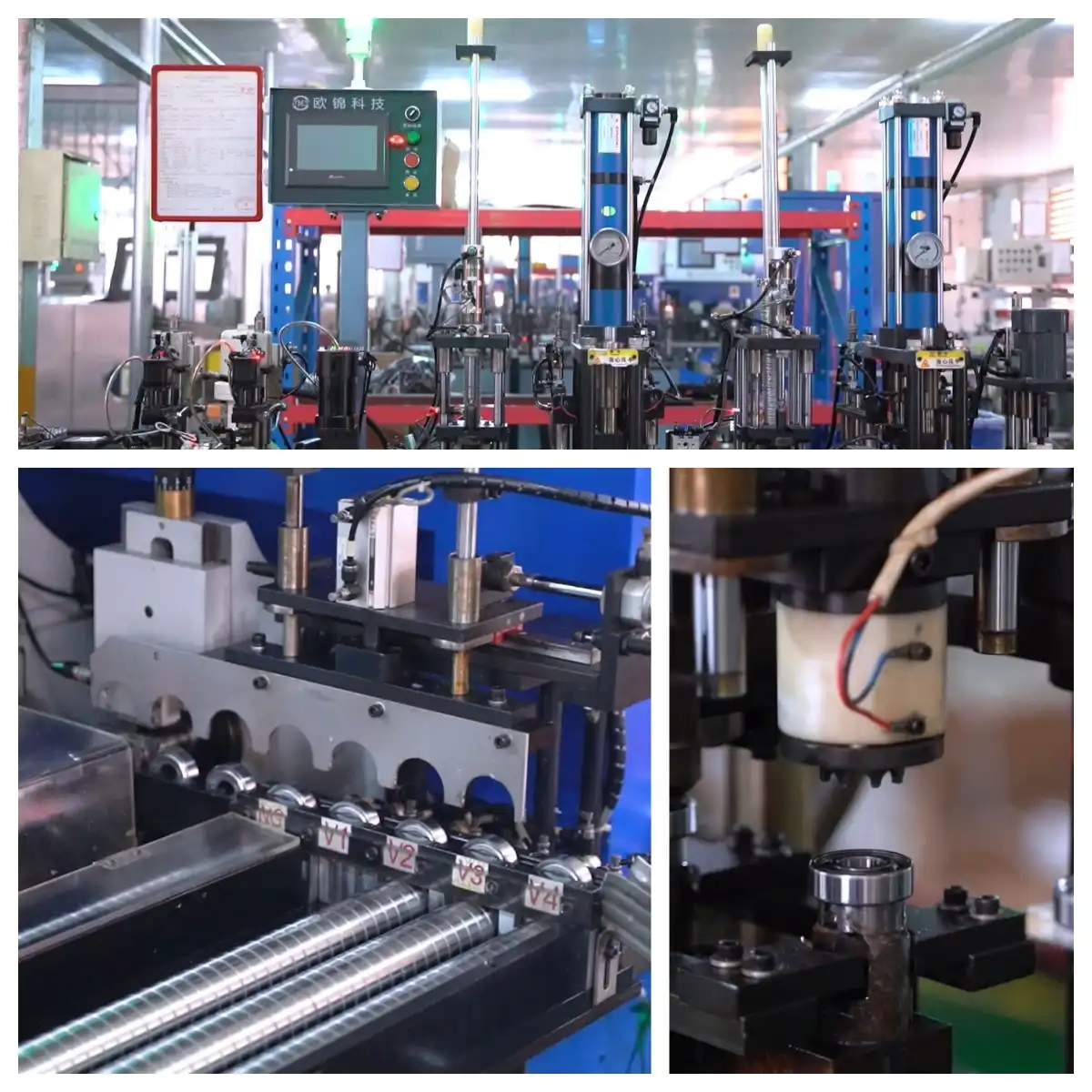
Understanding Load Ratings of the 60 Series
Dynamic vs. Static Load Ratings Explained
Every 60 series single-row radial bearing carries two fundamental load figures. The dynamic load rating (C) defines the constant radial load under which a bearing achieves one million revolutions of basic rated life (L10). The static load rating (C₀) defines the load that produces a permanent deformation of 0.0001 times the rolling element diameter. For practical procurement decisions, both figures together define the safe operational envelope of any 60 series unit.
The table below illustrates representative load ratings across common 60 series sizes, based on ISO 281 and manufacturer catalogs:
| Bearing No. | Bore (mm) | OD (mm) | Width (mm) | Dynamic C (kN) | Static C₀ (kN) |
|---|---|---|---|---|---|
| 6004 | 20 | 42 | 12 | 9.36 | 5.00 |
| 6006 | 30 | 55 | 13 | 13.20 | 7.65 |
| 6008 | 40 | 68 | 15 | 16.80 | 10.20 |
| 6010 | 50 | 80 | 16 | 21.60 | 14.30 |
| 6014 | 70 | 110 | 20 | 30.70 | 21.80 |
These values confirm that as bore diameter increases within the series, both C and C₀ scale upward, though more modestly than in the medium (62) or heavy (63) series due to the lighter cross-section geometry.
Material Influence on Load Capacity
A bearing’s material directly impacts the load a bearing can endure. GCr15 high-carbon chrome steel (SAE 52100 equivalent) remains the industry standard, with a heat-treated hardness of HRC 60-64. AISI 440C stainless steel works in corrosive settings, but with a little loss in fatigue life. Variants of hybrid ceramics, with balls made of silicon nitride, have lower density and better stiffness – an advantage in ultra-high-speed spindles – but the static load capacity is usually lower than that of all-steel counterparts. The procurement teams need to define the material grade to verify that the load ratings are appropriate for the application.
Operating Conditions That Shift Effective Load Ratings
Radial and Axial Load Balance
The Deep Groove Ball Bearing 60 series is primarily intended to carry radial loads, but the deep raceway design enables it to bear mild axial loads, in the range of 25-50% of the radial load rating, depending on the internal clearance. If radial and axial loads are mixed, engineers utilize the equivalent dynamic load calculation P = X·Fr + Y·Fa, where X and Y are factors from ISO 281 tables. One of the most prevalent reasons for premature bearing failure in industrial equipment is misjudging this balance.
Temperature and Lubrication Effects
Operating temperature also affects the effective load capacity. Standard GCr15 steel starts to lose hardness at prolonged temperatures beyond 120°C, which lowers the dependable load ceiling. Stabilized rings are offered for continuous duty at temperatures exceeding 150°C. The lubrication condition is similarly important: a poorly lubricated 60 series bearing under moderate radial stress may fail much sooner than a well-lubricated bearing under a higher load. Standard specification for sealed units (2RS or ZZ versions) is a lithium-based NLGI Grade 2 grease filled to 30-40% of free cavity volume
Noise and Vibration Under Variable Loads
Variable load cycles introduce vibration harmonics that accelerate raceway wear. Precision-ground raceways finished to Z3/V3 or Z4/V4 quality levels significantly dampen noise and extend service life in electric motor and servo applications. Selecting the correct internal clearance class — CN for standard duty, C3 for high-speed or elevated-temperature conditions — also prevents destructive preload buildup as components expand thermally.
Comparing the 60 Series with Similar Series for Load Suitability
Understanding where the 60 series fits relative to adjacent series helps procurement teams avoid over-engineering or under-specifying.
| Parameter | 60 Series (Light) | 62 Series (Medium) | 63 Series (Heavy) |
|---|---|---|---|
| Cross-Section | Smallest | Moderate | Largest |
| Load Capacity | Lower | Moderate | Highest |
| Speed Capability | Highest | Moderate | Lower |
| Weight | Lightest | Moderate | Heaviest |
| Typical Use | Motors, instruments | Pumps, gearboxes | Heavy industrial |
Deep groove bearings are more efficient than angular contact bearings for handling combined axial and radial loads if the axial force is more than 50% of the radial load. Thrust bearings are still the right option for solely axial thrust applications. The 60 series deep groove ball bearings are the most flexible of all: small, swift, and powerful enough to satisfy the needs of the great majority of automotive auxiliary systems, HVAC motors, and automation joints.
The 60 series is the lowest unit cost in its range of bore sizes and provides an economical procurement alternative from a cost-performance standpoint for big-volume OEM applications where weight savings and speed capabilities take priority over maximum load capacity.
How to Choose the Right 60 Series Bearing for Your Application
Translating machine parameters into bearing specifications starts with four inputs: radial load (Fr), axial load (Fa), rotational speed (n), and required service life (L10h). With these figures, you can apply the bearing life equation from ISO 281:2007 to confirm whether a given Deep Groove Ball Bearing 60 series unit meets your operational target — typically 20,000 to 30,000 hours for continuous industrial duty.
Here are the core selection criteria procurement engineers should verify before finalizing a specification:
- Load rating headroom: Select a bearing where the equivalent dynamic load (P) stays below 30% of the rated C value to achieve extended L10 life with an appropriate safety factor (S.F. ≥ 1.5 for general machinery).
- Speed compatibility: Confirm the limiting speed for the chosen lubrication type. Grease-lubricated 60 series bearings typically support 10–20% lower maximum speeds than oil-lubricated equivalents.
- Clearance class: CN clearance suits standard conditions; C3 is recommended for electric motors exceeding 3,000 RPM or elevated ambient temperatures.
- Seal type: 2RS rubber contact seals protect against contamination but add friction. ZZ metal shields suit cleaner, higher-speed environments.
- Certification compliance: For automotive OEM supply chains, IATF 16949 certification from the bearing manufacturer is non-negotiable. ISO 9001 certification covers general industrial procurement.
These criteria form a reliable checklist that reduces specification risk and simplifies supplier qualification across global procurement programs.
Maintenance Tips to Maximize Load Performance
With proper maintenance, the load integrity of 60 series bearings will be maintained throughout their service life. Re-lubrication periods are dependent on speed and load. For open bearings at mild loads (P/C < 0.1) and speeds below 70% of limiting speed, yearly re-greasing is often adequate. At higher loads, it is recommended to do quarterly inspection cycles.
Noise characteristics and vibration amplitude should be monitored by inspection teams as early-warning indications. High-frequency vibration spikes are an early warning of raceway spalling – frequently before any apparent surface damage occurs. Detect spikes early to keep replacement costs affordable. Bearings should be stored in their original packing, at a relative humidity of 40-70%, and away from magnetic fields or vibrating surfaces, both of which may produce false brinelling on stationary raceways.
SKF maintenance data shows that proper treatment during installation may save up to 16% of early bearing failures. Use press-fit tools that deliver force to the ring being fitted, not via the rolling parts.
Conclusion
The Deep Groove Ball Bearing 60 series with conventional bore sizes offers dynamic load values from about 4.75 kN up to more than 35 kN, which is suitable for most small automotive, automation, and light industrial applications. Its significance is not only in the raw load capacity but in the combination of high-speed capabilities, decreased mass, and the dimensional compactness impossible for heavier series. A good choice of size, material, clearance class, and sealing configuration will turn the rated performance of the bearing into actual service life. Combining these options with a systematic maintenance schedule and 60 series bearings guarantees reliable, cost-effective performance across severe duty cycles.
FAQ
1. What factors determine the dynamic load rating of a 60 series bearing?
Dynamic load rating (C) is governed by internal geometry — ball diameter, number of balls, and raceway curvature — along with material fatigue properties. ISO 281 standardizes the calculation. For 60 series bearings, the lighter cross-section means fewer and smaller balls compared to the 62 series at the same bore, which directly reduces C.
2. Can 60 series bearings handle combined radial and axial loads simultaneously?
Yes. The deep raceway geometry accommodates axial loads up to approximately 25–50% of the radial load rating. For loads exceeding that ratio, angular contact bearings or paired arrangements become more appropriate.
3. What internal clearance class is recommended for automotive applications?
C3 clearance is standard for electric motors and drivetrain auxiliaries operating above 3,000 RPM or in elevated-temperature environments. Standard CN clearance suits lower-speed, ambient-temperature installations.
4. How does bearing material affect load ratings in corrosive environments?
AISI 440C stainless steel reduces fatigue life by approximately 20–30% compared to GCr15 chrome steel at equivalent loads. Specify stainless only when corrosion resistance genuinely justifies the tradeoff.
5. What certifications should a qualified supplier hold?
ISO 9001 covers quality management systems. IATF 16949 is required for automotive OEM supply chains. Both certifications verify consistent manufacturing process control and traceability — critical for long-term supply reliability.
Partner with ATLYC for Certified Deep Groove Ball Bearing 60 Series Supply
ATLYC — Luoyang Auto Bearing Co., Ltd. — has manufactured precision bearings since 2010, holding both ISO 9001 and IATF 16949 certifications across six production workshops. As a trusted Deep Groove Ball Bearing 60 series supplier, we support OEMs, distributors, and industrial equipment manufacturers with verified load ratings, scalable order volumes, and technical consultation. Contact our engineering team at auto@lyautobearing.com to request a catalog or customized quote.
References
1. ISO 281:2007 — Rolling Bearings — Dynamic Load Ratings and Rating Life. International Organization for Standardization, 2007. https://www.iso.org/standard/38102.html
2. SKF Group. SKF Rolling Bearings Catalogue (PUB BU/P1 17000/2 EN). SKF, 2018. https://www.skf.com/group/products/rolling-bearings/ball-bearings/deep-groove-ball-bearings
3. NSK Ltd. NSK Rolling Bearing Catalogue CAT. No. E1102. NSK, 2019. https://www.nsk.com/products/ball-bearings/deep-groove/
4. Timken Company. Timken Engineering Manual. Timken, 2021. https://www.timken.com/resources/engineering-resources/
5. NTN Corporation. NTN Rolling Bearings Catalogue No. 2202-IX/E. NTN, 2020. https://www.ntn-snr.com/en/products/rolling-bearings/deep-groove-ball-bearings
6. Hamrock, B.J., Schmid, S.R., & Jacobson, B.O. Fundamentals of Machine Elements (3rd ed.). CRC Press, 2014. https://www.routledge.com/Fundamentals-of-Machine-Elements/Hamrock-Schmid-Jacobson/p/book/9781482235890
Learn about our latest products and discounts through SMS or email