- English
- French
- German
- Portuguese
- Spanish
- Russian
- Japanese
- Korean
- Arabic
- Greek
- German
- Turkish
- Italian
- Danish
- Romanian
- Indonesian
- Czech
- Afrikaans
- Swedish
- Polish
- Basque
- Catalan
- Esperanto
- Hindi
- Lao
- Albanian
- Amharic
- Armenian
- Azerbaijani
- Belarusian
- Bengali
- Bosnian
- Bulgarian
- Cebuano
- Chichewa
- Corsican
- Croatian
- Dutch
- Estonian
- Filipino
- Finnish
- Frisian
- Galician
- Georgian
- Gujarati
- Haitian
- Hausa
- Hawaiian
- Hebrew
- Hmong
- Hungarian
- Icelandic
- Igbo
- Javanese
- Kannada
- Kazakh
- Khmer
- Kurdish
- Kyrgyz
- Latin
- Latvian
- Lithuanian
- Luxembou..
- Macedonian
- Malagasy
- Malay
- Malayalam
- Maltese
- Maori
- Marathi
- Mongolian
- Burmese
- Nepali
- Norwegian
- Pashto
- Persian
- Punjabi
- Serbian
- Sesotho
- Sinhala
- Slovak
- Slovenian
- Somali
- Samoan
- Scots Gaelic
- Shona
- Sindhi
- Sundanese
- Swahili
- Tajik
- Tamil
- Telugu
- Thai
- Ukrainian
- Urdu
- Uzbek
- Vietnamese
- Welsh
- Xhosa
- Yiddish
- Yoruba
- Zulu
XU Series Cross Roller Bearing: Key Specs for CNC Machines
If you are involved in CNC machine procurement or engineering, you already know that bearing selection has a direct impact on machine precision, uptime, and long-term cost. XU Series Cross Roller Bearing is a precision bearing unit especially designed for high-load and high-accuracy applications. This bearing has cylindrical rollers in a 90° cross pattern in a one-piece integrated ring construction. It carries radial, axial, and moment loads concurrently, all in a compact footprint. Few bearing types can match its level of stiffness, precision, and space economy for CNC rotary tables, robotic joints, and indexing systems.

Understanding XU Series Cross Roller Bearing Specifications
If your team is successful in achieving perfection in the specifications just before making a purchase, they will not only be able to save time and money, but they will also be able to avoid engineering rework. I would ask that you give me permission to take you through the most important aspects of this circumstance.
Dimensional Range and Material
The XU Series cross roller bearing covers a wide size range to fit diverse machine configurations:
| Parameter | Range |
|---|---|
| Inner Diameter | 20 mm – 1100 mm |
| Outer Diameter | 70 mm – 1500 mm |
| Width | 12 mm – 110 mm |
They are made from GCr15 or GCr15SiMn high-carbon chromium bearing steel and heat-treated to a surface hardness of 58–64 HRC. The material choice lends the raceway considerable wear resistance to the permanent loads of machining.
Accuracy Grades Available
The precision grade is directly related to the ability of your CNC machine to retain tolerances. The XU cross roller bearing is manufactured in the precision classifications P6, P0, P5, P4, and P2 according to the ISO specifications. In grade P4 or P2, both radial and axial runout may be kept below 2 microns – a significant number in semiconductor equipment, medical imaging, and five-axis machining machines.
Load Capacity and Preload Configuration
The 90° cross arrangement of cylindrical rollers provides line contact with the V-groove raceway, which results in a far larger load capacity than point-contact alternatives. It accommodates radial, axial, and moment loads within one unit, when two stacked angular contact XU Series Cross Roller Bearings would usually be needed. The preload is factory-adjusted at zero or negative clearance, which means no backlash right from the time you install it.
How XU Series Cross Roller Bearings Improve CNC Machine Performance
When people who are responsible for making decisions have a greater awareness of how a particular sort of bearing operates in real settings, they are better able to justify the spending that is being allocated to that bearing. This is because they have a better understanding of how the bearing functions in actual situations.
Rigid One-Piece Ring Structure
The XU bearing differs from split-ring cross roller bearings (e.g., RB or RE series) in that it has an undivided inner and outer ring. This integrated structure avoids ring separation under stress, a major failure mode in split systems under intense interrupted cutting. The result is a uniform stiffness across the whole rotation cycle – a must for rotary table applications.
Direct-Mount Design for Space Savings
Both ring ends are pre-machined with countersunk or threaded mounting holes. This means you mount the bearing directly to your machine frame, without presser flanges or specific housings. For machine tool designers constrained to narrow confines, this saves assembly height and parts without losing stiffness.
Smooth, Low-Friction Rotation
Every roller set has a space retainer to avoid roller-to-roller contact and skewing. This provides a uniform rotating torque over the whole speed range – a critical consideration when your CNC system needs smooth, repeatable indexing. Low starting torque also minimizes servo motor load, which may prolong drive component life.
Comparing XU Series with Other Bearing Solutions
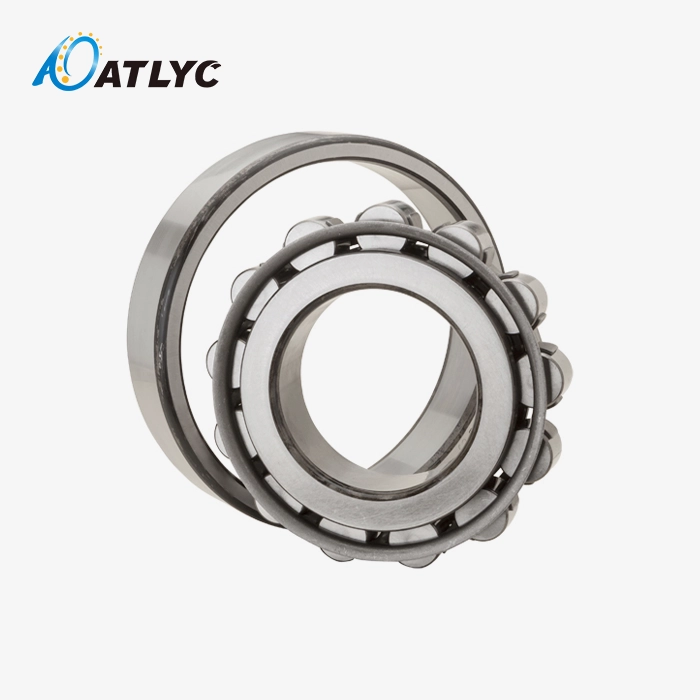
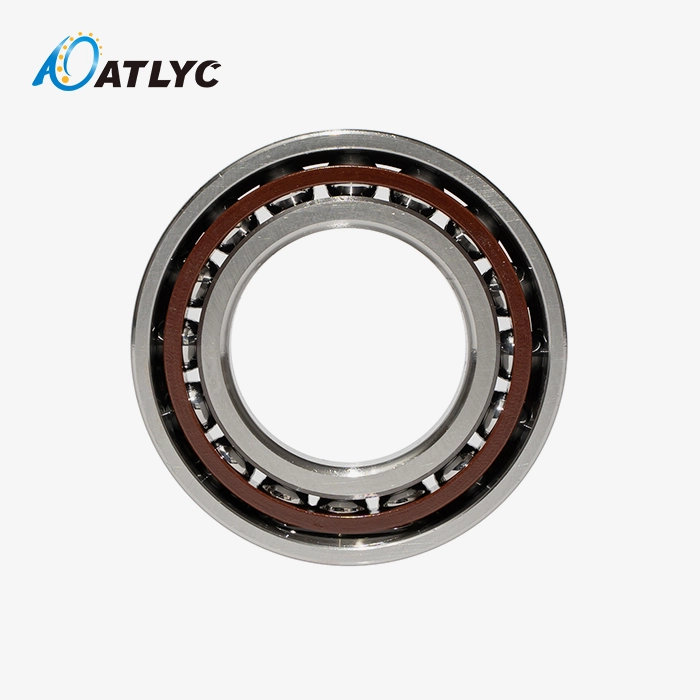
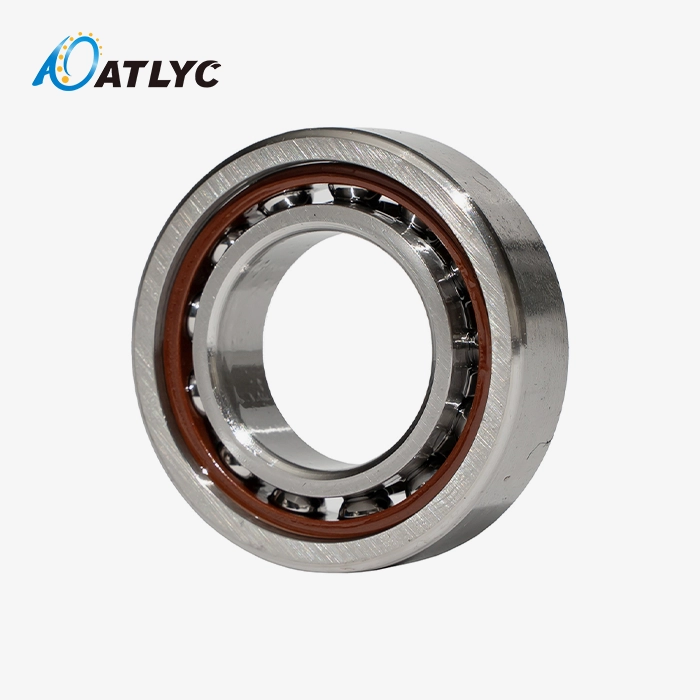
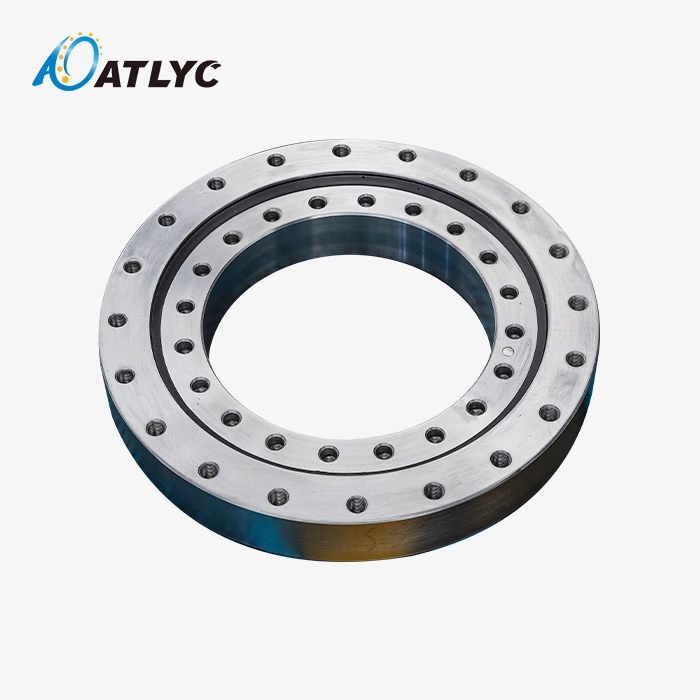
Procurement teams usually consider more than one kind of bearing before making a final sourcing selection. The XU cross roller bearing is superior to other alternatives in terms of bearing type, moment load capacity, compactness, precision grade, and typical CNC use. The XU cross roller bearing is of excellent quality and ideal for use in rotary tables and robot joints. The angular contact pair bearing is a medium-grade bearing ideal for spindles. This is a medium-size cylindrical roller bearing for radial loads. The slewing ring bearing has exceptionally excellent performance and a huge size for heavy-duty turntables. The deep groove ball bearing is small and appropriate for light-duty spinning.
| Bearing Type | Moment Load Capacity | Compactness | Precision Grade | Typical CNC Use |
|---|---|---|---|---|
| XU Cross Roller | High | Excellent | P2–P6 | Rotary tables, robot joints |
| Angular Contact Pair | Medium | Low (dual-bearing stack) | P4–P5 | Spindles |
| Cylindrical Roller | Medium | Medium | P5–P6 | Radial-dominant loads |
| Slewing Ring | Very High | Large | P6 | Heavy-duty turntables |
| Deep Groove Ball | Low | Small | P6 | Light-duty rotation |
When the moment load capacity and the rotational precision must be combined in a limited space, the XU shape is the ideal solution. Slewing rings are larger and less precise but can handle higher weights. Angular contact pairs are exceedingly precise but need greater axial space and careful matching of preload when paired together. The XU Series Cross Roller Bearing is an excellent compromise between these two options for five-axis machining machines and automatic assembly systems.
Procurement Insights for Businesses: Sourcing XU Series Cross Roller Bearings
It takes more than checking store costs to find precision bearings for production lines. Here are some things that experienced procurement managers look for in a XU Series Cross Roller Bearing supplier:
Verify Supplier Certifications
Any bearing supplier that works with automakers or machinery makers should have ISO 9001 and IATF 16949 certifications. These certificates show that the provider has written process controls, measurement checking methods, and systems for taking appropriate action. Before making an order, you should always ask for certification papers and check when they are still valid.
Quality Control Protocols to Expect
Every output batch should be checked by a qualified provider for the following things:
CMM dimensional inspection to verify bore diameter, mounting hole position, and width parallelism within tolerance.
Rotational accuracy testing to confirm inner and outer ring runout meets the specified accuracy class (e.g., within 0.005 mm for P5 grade).
Starting torque verification to confirm uniform preload and rule out tight spots that cause premature fatigue.
Eddy current or magnetic particle inspection (MPI) to detect surface and subsurface defects in raceways.
Hardness testing to verify that raceway hardness remains consistent across the effective case depth.
CNC-grade bearings must go through these checks. They are more likely to fail early and cause production to stop if you skip them.
Lead Times and Customization Options
You can usually get standard XU cross roller bearings in common sizes right away. Custom sizes, higher levels of accuracy, or different mounting arrangements need more lead time. Talk about sample timelines, batch sizes, and the ability to make changes early on in the process of planning your supply chain. If a supplier has its own engineering team, they can shorten the time it takes to develop new products and change the geometry of the bearings to fit the design of your machine.
Choosing the Right XU Series Cross Roller Bearing for Your CNC Machines
To start the process of choosing the right bearing, you first need to ensure that the specifications of the bearing meet the requirements of the machine you are using. Here is a distilled list of the most critical things your engineering team must consider.
Match Accuracy Grade to Application Demand
Not all applications need P2 grade. A regular rotary table in a typical machining center may do well with P5; a wafer aligner or CT scanner needs P4 or P2. If you get a grade higher than you need, you pay more for little practical benefit. Choose your accuracy grade to match the positioning tolerance of your part design.
Assess Load Profile Before Specifying Size
Calculate combined radial, axial, and tilt moment loads at peak cutting circumstances. The XU cross roller bearing is rated for combined loads. However, using the peak load rather than the average load for sizing provides protection against fatigue failure. Your supplier’s technical staff should be able to do a load-life calculation (using the L10 fatigue life formula according to ISO 281) to check that your selected size matches your specified service interval.
Consider Environmental and Speed Conditions
CNC environments are different. A high-speed spindle table is not the same as a low-speed, high-torque indexing station. When asking for bearing advice, include your operational temperature range, contaminant exposure, and rotational speed restriction. The supplier may suggest which sort of lubrication, seal configuration, and clearance class are right from there.

Conclusion
The XU Series Cross Roller Bearing fits the true technological demands of CNC machines with its compact size, high stiffness, high load capacity and simple direct placement on the machine. This bearing type is ideally suited for all precision levels from P6 to P2, whether you are searching for a five-axis machining center, an automated indexing table, or a robotic joint assembly. Selecting the right quality, size, and preload for your application is the difference between a bearing that will endure and one that will fail prematurely. Work with a competent source that has inspection records to demonstrate their specifications.
FAQ
1. What factors affect the service life of a cross roller bearing in a CNC machine?
Service life depends on load magnitude, rotational speed, lubrication quality, mounting accuracy, and operating temperature. Bearings mounted with misalignment or running without adequate lubrication will reach fatigue limits well before their rated L10 life. Routine inspection every 500–1,000 operating hours and proper grease replenishment extend service intervals significantly.
2. Can XU Series cross roller bearings be customized for non-standard sizes?
Yes. Manufacturers with in-house grinding and turning capacity can produce custom bore diameters, outer diameters, widths, and mounting hole patterns. Custom accuracy grades are also available. Buyers should provide detailed drawings and load requirements when requesting custom specifications.
3. How does maintenance compare to traditional ball bearings?
Cross roller bearings require less frequent replacement due to their higher load capacity, but they do need controlled lubrication schedules. Unlike standard deep groove ball bearings, they should not be over-greased, as excess lubricant increases running torque. Most manufacturers recommend lithium-based or synthetic grease with re-lubrication intervals matched to the operating cycle.
4. What accuracy grade is standard for CNC rotary table applications?
P5 is the most common standard for general CNC rotary tables. Applications requiring sub-micron positioning, such as optical alignment or precision grinding, typically specify P4 or P2 grade bearings.
Partner with ATLYC for Your XU Series Cross Roller Bearing Supply
Since 2010, Luoyang Auto Bearing Co., Ltd. has operated ATLYC and made precision bearings there. We sell XU Series Cross Roller Bearings to customers in the US, Germany, South Korea, and other places. We have six production workshops, 120 skilled workers, and are certified to ISO 9001 and IATF 16949. Get in touch with our team to get group prices, specifics, and confirmed delivery dates. Please send an email to auto@lyautobearing.com to get a price from a reputable XU Series Cross Roller Bearing maker.
References
1. Harris, T. A., & Kotzalas, M. N. Rolling Bearing Analysis: Essential Concepts of Bearing Technology. CRC Press, 2006.
2. ISO 281:2007. Rolling Bearings — Dynamic Load Ratings and Rating Life. International Organization for Standardization, 2007.
3. Brändlein, J., Eschmann, P., Hasbargen, L., & Weigand, K. Ball and Roller Bearings: Theory, Design and Application. Wiley, 1999.
4. NSK Ltd. NSK Precision Machine Components Catalog: Cross Roller Bearings. NSK Technical Report, 2018.
5. Modern Machine Shop — "Selecting Bearings for CNC Rotary Tables." Gardner Business Media, 2021.
6. Eschmann, P. Life and Load Ratings of Rolling Bearings. Springer-Verlag, 1985.
Learn about our latest products and discounts through SMS or email