- English
- French
- German
- Portuguese
- Spanish
- Russian
- Japanese
- Korean
- Arabic
- Greek
- German
- Turkish
- Italian
- Danish
- Romanian
- Indonesian
- Czech
- Afrikaans
- Swedish
- Polish
- Basque
- Catalan
- Esperanto
- Hindi
- Lao
- Albanian
- Amharic
- Armenian
- Azerbaijani
- Belarusian
- Bengali
- Bosnian
- Bulgarian
- Cebuano
- Chichewa
- Corsican
- Croatian
- Dutch
- Estonian
- Filipino
- Finnish
- Frisian
- Galician
- Georgian
- Gujarati
- Haitian
- Hausa
- Hawaiian
- Hebrew
- Hmong
- Hungarian
- Icelandic
- Igbo
- Javanese
- Kannada
- Kazakh
- Khmer
- Kurdish
- Kyrgyz
- Latin
- Latvian
- Lithuanian
- Luxembou..
- Macedonian
- Malagasy
- Malay
- Malayalam
- Maltese
- Maori
- Marathi
- Mongolian
- Burmese
- Nepali
- Norwegian
- Pashto
- Persian
- Punjabi
- Serbian
- Sesotho
- Sinhala
- Slovak
- Slovenian
- Somali
- Samoan
- Scots Gaelic
- Shona
- Sindhi
- Sundanese
- Swahili
- Tajik
- Tamil
- Telugu
- Thai
- Ukrainian
- Urdu
- Uzbek
- Vietnamese
- Welsh
- Xhosa
- Yiddish
- Yoruba
- Zulu
How Do RE Crossed Roller Bearings Improve Precision?
The RE crossed roller bearings increase accuracy by putting the cylindrical rollers orthogonal to each other between V-shaped raceways, so each roller changes direction at 90° alternately. This shape distributes radial, axial, and moment loads concurrently across a larger contact area. This results in near-zero backlash, micron-level runout precision, and much improved stiffness against traditional ball or tapered roller bearings. Using a single RE crossed roller bearing instead of multiple row arrangements reduces the assembly footprint without compromising rotational stability. This design feature is what separates acceptable from outstanding machine performance for OEMs and automation engineers looking for repeatable placement in tight places.
Understanding Crossed Roller Bearings and Their Precision-Enhancing Design
What Makes the RE Design Structurally Unique
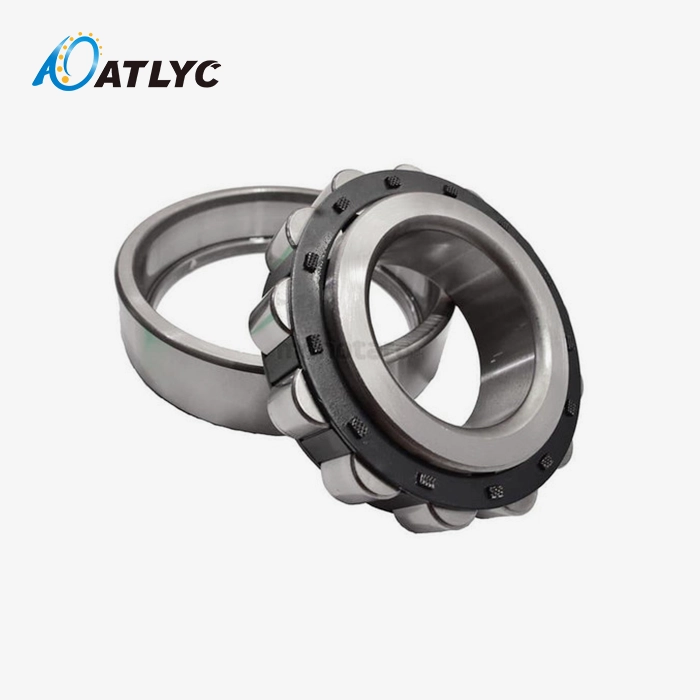
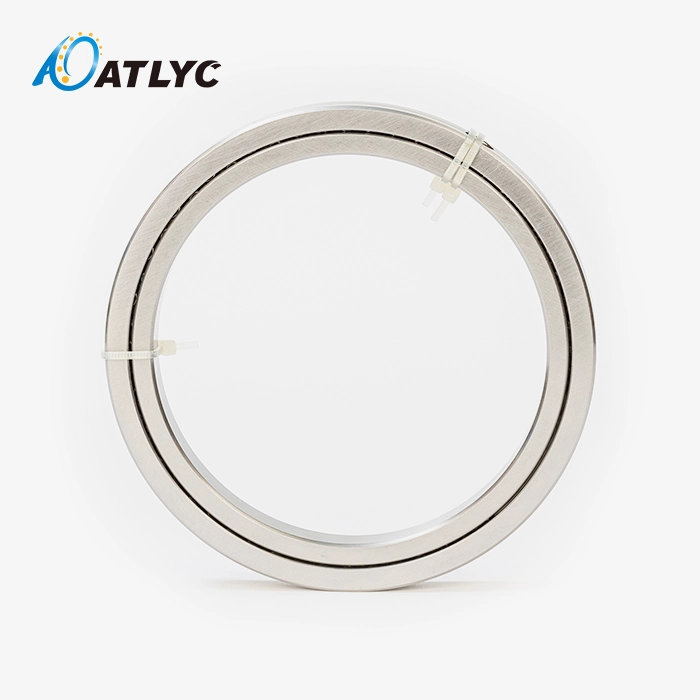
The outer ring of the RE series is solid (fused) while the inner ring is divided into two halves. V-grooved raceways with cylindrical rollers at alternate 90° angles. The rollers are separated by spacers to prevent them from contacting. Being organized in a horizontal fashion, RE Crossed Roller Bearings may spin extremely accurately. Normal ball bearings function by creating point contact. RE bearings, however, have line contact all along the length of the roller, thereby increasing the load-bearing surface.
How Roller Orientation Affects Rotational Accuracy
Wheels are placed side-by-side with their axles facing the opposite way so the load is never focused on a single contact zone. When the force is equally distributed over the track, there is no micro-deflection when spinning. Runout limitations for RE series bearings are typically in the micrometer range for ISO P5, P4, or P2 grades. When used in a rotary table or robotic joint, these bearings allow positioning moves to be repeated to within ±1 µm, a figure that is difficult to attain with conventional angular contact ball bearings.
Compact Form, High Rigidity
Size effectiveness is an often overlooked benefit. The crossed roller design provides a lot of stiffness in a tiny cross-section; therefore, engineers may reduce the axial length by 30–40% compared to paired normal bearings. Lighter assemblies use less material, are less draggy, and more responsive to changes. Such qualities are crucial in high-cycle robotic lines. RE Crossed Roller Bearings are three to four times stiffer than comparable angular contact ball bearings according to released data.
Key Performance Advantages of RE Crossed Roller Bearings for Precision Applications
The table below shows how RE Crossed Roller Bearings measure up against common alternatives in key performance areas:
| Parameter | RE Crossed Roller Bearing | Angular Contact Ball Bearing | Tapered Roller Bearing |
|---|---|---|---|
| Load Types Supported | Radial + Axial + Moment | Radial + Axial | Radial + Axial |
| Rigidity (relative) | 3–4× baseline | Baseline | 1.5–2× baseline |
| Precision Grade Available | P2 / P4 / P5 | P4 / P5 | P5 / P6 |
| Backlash | Near zero (preloaded) | Low | Moderate |
| Compact Cross-Section | Yes | No | No |
When choosing parts for CNC rotating tables, robot arm joints, or precise measurement tools, these numbers are important.
Load Capacity and Rigidity
The 1:1 roller crossing ratio makes the contact area bigger in all load directions. This means that a single bearing can handle the total load without having to be mounted separately. The consolidated load path makes it easier for OEMs to build small industrial gearheads or actuator modules by reducing the number of parts needed and simplifying the shape of the housing.
Accuracy Grades and Runout Performance
RE ISO tolerance classes P5, P4, and P2 are used to make crossed roller bearings. Precision optical pointing systems and stages for handling semiconductor wafers require runout accuracy of less than 2 µm. This is what P2-grade units can do. The RE series' high-precision versions give the same performance batch after batch. This is what procurement engineers mean when they talk about "consistent quality."
Lifespan and Maintenance Considerations
High-carbon chromium steel GCr15 that has been heated until its surface is 58–64 HRC is the standard material for RE bearings. For environments that are likely to rust, stainless steel (SUS440C) versions are available. Service life is much longer than that of normal roller bearings if they are properly oiled. Depending on load and speed, grease should be replaced every 2,000 to 5,000 hours of operation. This cuts down on unplanned downtime and the total cost of ownership.
Application Scenarios Where RE Crossed Roller Bearings Excel
Robotics and Automated Equipment
Repeatability is a must in collaborative robot joints and SCARA arms. RE Crossed Roller Bearings provide the moment stiffness needed to stay in place even when the product is positioned in different ways. When a robot joint bearing bends under load, it causes cumulative angular error. The RE series' almost-zero backlash gets rid of this issue and keeps the end-effector on target.
Medical Devices and Imaging Systems
For picture clarity and patient safety, medical CT scanners and surgical robots need to rotate in a way that is smooth and doesn't cause vibrations. Because RE bearings have even roller contacts, torque ripple is kept to a minimum. This makes motion smooth and free of mechanical noise. Stainless steel versions can be cleaned and germ-free, which is popular in the medical device industry.
Aerospace and Defense Equipment
Antenna positioning systems, inertial navigation platforms, and precision optical gimbals all put a lot of stress on bearing accuracy when temperature changes and shock loads are applied. Because they are very stiff and can handle a lot of loading, RE Crossed Roller Bearings keep their position from moving when this happens. This makes them a reliable choice when failure is not an option.
How to Choose the Right RE Crossed Roller Bearing for Your Application
Selecting the right bearing starts with understanding the load profile. The table below offers a practical selection guide:
| Application Type | Recommended Accuracy Grade | Key Selection Factor |
|---|---|---|
| CNC Rotary Tables | P4 / P5 | Moment load capacity, bore size |
| Robot Joint Actuators | P4 / P2 | Compact cross-section, zero backlash |
| Medical Imaging Equipment | P4 / P2 | Low torque ripple, corrosion resistance |
| Semiconductor Handling Stages | P2 | Ultra-low runout, cleanliness |
| Industrial Turntables | P5 | High radial load, long service life |
Load Type and Dimensional Constraints
Start by mapping your load vector: purely radial, purely axial, combined, or moment-dominant. RE crossed roller bearings handle all three simultaneously, but sizing still matters. Bore diameter, outer diameter, and width must match your housing design. ATLYC's engineering team can assist with dimensional confirmation before order placement.
Material and Surface Treatment Options
Standard GCr15 steel suits most industrial environments. For food processing, marine, or chemical exposure, SUS440C stainless offers the corrosion resistance needed without sacrificing hardness. Custom surface coatings and cage materials are also available on request, depending on operating temperature and lubrication type.
Customization and Competitive Value
RE crossed roller bearings from a specialist manufacturer should offer documented traceability, precision inspection reports, and application-specific customization. Compared to European or Japanese equivalents, competitively manufactured RE bearings from certified Chinese factories deliver equivalent precision grades at a lower per-unit cost—particularly valuable for OEMs running high-volume production lines.
Procurement Insights — How to Effectively Source RE Crossed Roller Bearings
Working With Authorized Manufacturers
In the world repair aftermarket, fake bearings are a real danger. When you buy directly from a maker that is ISO 9001 and IATF 16949 certified, you can be sure that the product is real, that its dimensions can be tracked, and that the insurance will cover it. As standard paperwork that should come with every shipment, ask suppliers for batch inspection reports and material certificates.
Lead Times and International Logistics
It usually takes between 15 and 30 days for authorized Chinese makers to make a batch of standard RE Crossed Roller Bearings. For available sizes, it's often possible to get faster delivery. For buyers in North America and Europe, sea freight and local storage can keep extra stock on hand for just-in-time assembly plans.
Bulk Pricing and Long-Term Supply Agreements
The cost per unit always goes down when you order in bulk. Signing an annual supply agreement with a manufacturing partner locks in prices, makes sure there is enough production capacity, and makes planning purchases easier. When it comes to the automotive and automation industries, many medium- to large original equipment manufacturers (OEMs) use rolling 12-month contracts. This is because the costs of supply interruption are much higher than any short-term price difference between suppliers.

Conclusion
RE Crossed roller bearings are more precise because they feature a unique configuration that no other bearing has: alternating orthogonal rollers, line contact across V-grooved raceways, and preset near-zero backlash. This permits a bearing to carry combined loads across a limited area and reach precision levels of a few micrometers in a consistent manner. Performance data continually reveals that this bearing type is superior to earlier ones, and this is true for everything from robotic joints to medical imaging and CNC machines. For procurement teams who worry about supply stability, quality certification, and technical depth, selecting the correct bearing standard is as critical as choosing the right manufacturing partner.
FAQ
1. What is the difference between RE and RB crossed roller bearings?
RE series bearings feature an integrated outer ring and a split inner ring, making them suited for applications where the outer ring rotates. RB series bearings reverse this configuration with an integrated inner ring and split outer ring, ideal for applications where the inner ring rotates. Both types use the same orthogonal roller arrangement but serve different mounting orientations.
2. What precision grade should I specify for a robot joint?
For most collaborative robot joints, P4 grade provides sufficient accuracy with practical manufacturing cost. Applications demanding repeatability below 2 µm, such as semiconductor stages, should specify P2 grade.
3. Can RE crossed roller bearings handle shock loads?
Yes. The line contact geometry and high rigidity of RE bearings give them better shock absorption than ball bearings. However, sustained high-shock environments should be evaluated against rated dynamic load capacity with an appropriate service factor applied.
4. How often should these bearings be relubricated?
Under normal industrial operating conditions, grease replenishment every 2,000 to 5,000 hours is a standard guideline. Actual intervals depend on speed, temperature, and load intensity.
Partner With ATLYC for Precision RE Crossed Roller Bearings
ATLYC offers RE Crossed Roller Bearings made to P2–P5 accuracy grades with full inspection documentation. Luoyang Auto Bearing Co., Ltd. has been making these bearings for 15 years and is ISO 9001/IATF 16949 certified. Our team is ready to help you with your application, whether you need a normal book size or a solution that was specifically designed for you. You can email us at auto@lyautobearing.com to talk about your needs and get a price.
References
1. Harris, T. A., & Kotzalas, M. N. — Rolling Bearing Analysis, Taylor & Francis, 2006.
2. International Organization for Standardization — ISO 492: Rolling Bearings — Radial Bearings — Dimensional and Geometrical Tolerances, ISO, 2014.
3. Hamrock, B. J., Schmid, S. R., & Jacobson, B. O. — Fundamentals of Machine Elements, McGraw-Hill, 2005.
4. NSK Ltd. — NSK Precision Machine Components Catalog, NSK Technical Report, 2018.
5. American Bearing Manufacturers Association — ABMA Standard 20: Radial Bearings of Ball, Cylindrical Roller, and Spherical Roller Types, ABMA, 2011.
6. Weck, M., & Brecher, C. — Werkzeugmaschinen: Konstruktion und Berechnung (Machine Tools: Design and Calculation), Springer, 2006.
Learn about our latest products and discounts through SMS or email