- English
- French
- German
- Portuguese
- Spanish
- Russian
- Japanese
- Korean
- Arabic
- Greek
- German
- Turkish
- Italian
- Danish
- Romanian
- Indonesian
- Czech
- Afrikaans
- Swedish
- Polish
- Basque
- Catalan
- Esperanto
- Hindi
- Lao
- Albanian
- Amharic
- Armenian
- Azerbaijani
- Belarusian
- Bengali
- Bosnian
- Bulgarian
- Cebuano
- Chichewa
- Corsican
- Croatian
- Dutch
- Estonian
- Filipino
- Finnish
- Frisian
- Galician
- Georgian
- Gujarati
- Haitian
- Hausa
- Hawaiian
- Hebrew
- Hmong
- Hungarian
- Icelandic
- Igbo
- Javanese
- Kannada
- Kazakh
- Khmer
- Kurdish
- Kyrgyz
- Latin
- Latvian
- Lithuanian
- Luxembou..
- Macedonian
- Malagasy
- Malay
- Malayalam
- Maltese
- Maori
- Marathi
- Mongolian
- Burmese
- Nepali
- Norwegian
- Pashto
- Persian
- Punjabi
- Serbian
- Sesotho
- Sinhala
- Slovak
- Slovenian
- Somali
- Samoan
- Scots Gaelic
- Shona
- Sindhi
- Sundanese
- Swahili
- Tajik
- Tamil
- Telugu
- Thai
- Ukrainian
- Urdu
- Uzbek
- Vietnamese
- Welsh
- Xhosa
- Yiddish
- Yoruba
- Zulu
RA Cross Roller Bearing OEM Guide: Specs and Custom Options
If you're sourcing precision motion components for robotics, medical imaging, or semiconductor equipment, the RA cross roller bearing belongs at the top of your specification list. This guide walks through design principles, technical specs, OEM customization options, installation practices, and supplier selection — everything a procurement engineer or equipment manufacturer needs to make a confident, well-informed sourcing decision.

Understanding RA Cross Roller Bearings: Design and Working Principles
What Makes the RA Series Unique
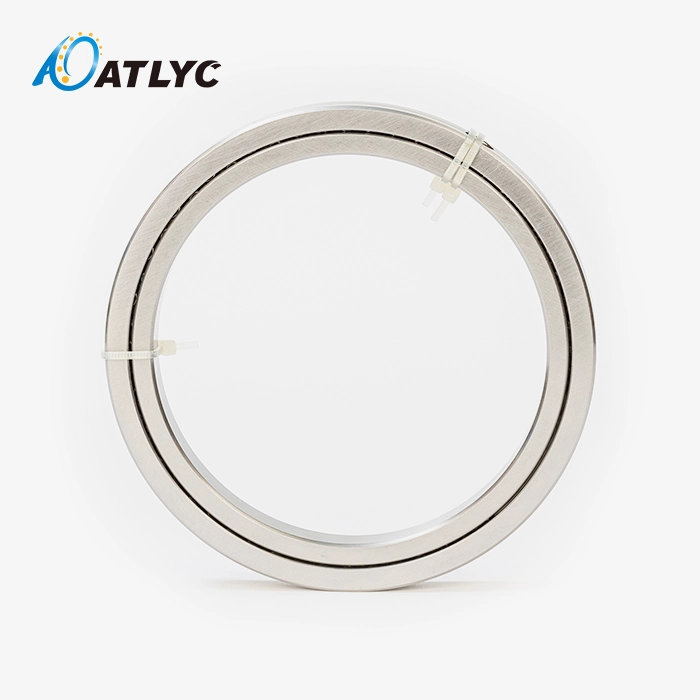
The RA Cross Roller Bearing is a version of the normal RB line that has walls that are very thin. A 90-degree V-groove raceway with spacers between the cylindrical rollers that move in opposite, perpendicular directions is what makes it unique. Because of its shape, this bearing can handle radial, axial, and moment loads all at the same time, which is something that regular bearings can't do in such a small space.
Structural Architecture
When you use a RA type cross roller bearing, the inner ring is a solid, combined structure that is designed to give you very accurate inner-ring spinning. Since the outer ring can be separated, it is very important that the housing and lip are clamped correctly during installation. Because the cross-section height is much lower than the RB series, this bearing is the best choice when both weight reduction and room limits are important.
Key Application Sectors
The RA series cross roller bearing works well in tough environments:
Collaborative robot joints: The thin profile reduces rotational inertia, improving the payload-to-weight ratio of cobot arms.
Portable CT and X-ray scanners: Zero-clearance rotation supports imaging clarity in tight, sterile housings.
Semiconductor wafer handlers: Moment load capacity holds positioning accuracy at the micrometer level within cleanroom or vacuum environments.
The RA series has become very popular among OEMs who can't afford positional shift or premature wear. These three areas show why.
Comparing RA Cross Roller Bearings with Alternative Bearings
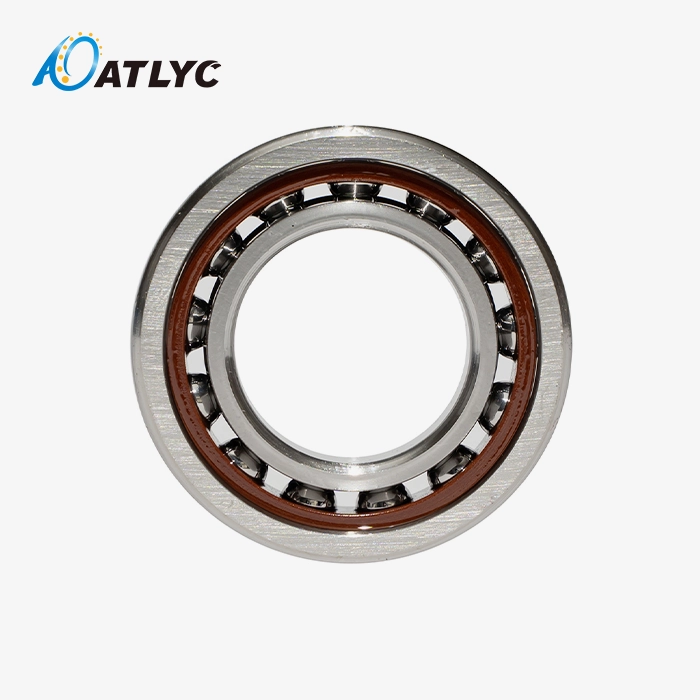
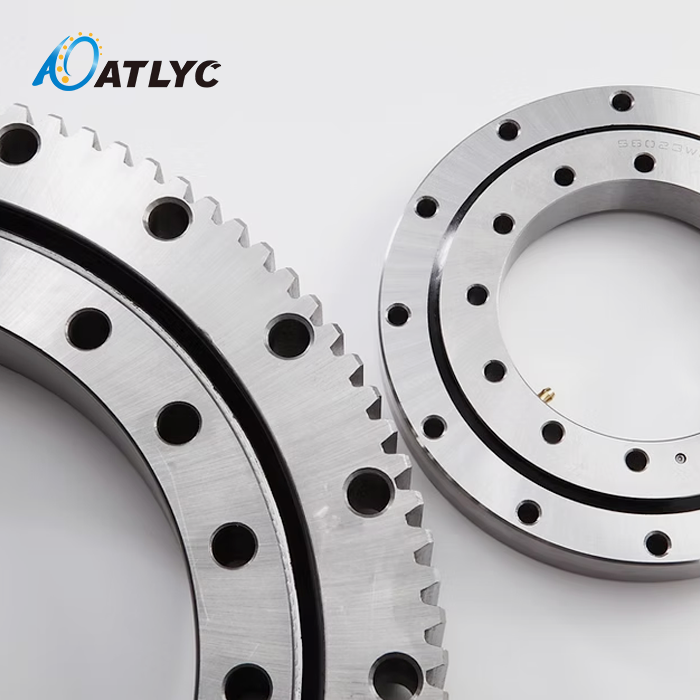
Buying groups often want to know how the RA type compares to other types of bearings. As you can see, each type of bearing has a different load direction, rigidity, and compactness, as well as a typical use case. The table below shows the different types of RA Cross Roller Bearings and their properties. The RA cross roller has radial and axial moments that are very high and very thin, making it useful in robotics, medicine, and semiconductors. The angular contact ball has axial and radial moments that are medium to high and is moderately used in spindles and gearboxes. The thrust ball has axial-only values that are low to medium and moderate, making it useful for low-speed thrust applications. The slewing ring has radial and axial moments that are high and bulky, making it suitable for cranes, turntables, and heavy machinery.
| Bearing Type | Load Direction | Rigidity | Compactness | Typical Use Case |
|---|---|---|---|---|
| RA Cross Roller | Radial + Axial + Moment | Very High | Ultra-thin | Robotics, medical, semiconductor |
| Angular Contact Ball | Axial + Radial | Medium | Moderate | Spindles, gearboxes |
| Thrust Ball | Axial only | Low–Medium | Moderate | Low-speed thrust applications |
| Slewing Ring | Radial + Axial + Moment | High | Bulky | Cranes, turntables, heavy machinery |
| Hybrid Cross Roller | Radial + Axial + Moment | High | Moderate | Mid-load automation |
Where RA Bearings Win
When mounting room is very limited and stiffness in more than one direction is important, the cross roller bearing RA series works better than angular contact bearings. RA bearings take up much less space along the axis than slewing rings, which is a big plus in robotic arm joint design, where every millimeter counts.
Where Alternatives May Be Preferred
Most of the time, angular contact bearings can handle higher rotational speeds. They might be cheaper if your program runs all the time at high RPM with light loads. When you only need horizontal motion at low speeds and don't need the extra strength of a cross roller design, thrust ball bearings work well.
Making the Right Call
If you want to choose between bearing types, you should always do a load study first. Write down the numbers of the radial, axial, and moment loads. Then, compare them to the basic dynamic load rate (C) of the bearings you're considering. The RA series cross roller bearing uses L10 = (C/Pc)^(10/3) to figure out its service life, which is different from the standard ball bearing formula because it takes into account line contact mechanics.
OEM Specifications and Customization Options for RA Cross Roller Bearings
Standard Specification Overview
Understanding the standard technical parameters of RA type cross roller bearings helps OEM buyers write accurate purchase specifications and avoid costly mismatch errors.
| Parameter | Typical RA Series Range |
|---|---|
| Bore Diameter | 20 mm – 460 mm |
| Dimensional Tolerance | P5 / P4 (ISO standard) |
| Raceway Material | High-carbon chromium steel (GCr15) |
| Cage Type | Synthetic resin or steel |
| Sealing | Open, shielded, or sealed variants |
| Basic Dynamic Load Rating (C) | Application-dependent |
Customization Capabilities
OEM clients often require modifications beyond catalog specifications. At Luoyang Auto Bearing Co., Ltd. (ATLYC), we have handled custom requests across all six bearing production categories since 2010. Common customization options for the RA Cross Roller Bearing include:
Non-standard bore and outer diameter combinations for proprietary housing designs
Surface treatments such as phosphating or black oxide for corrosion resistance in humid or chemical environments
Special lubricants, including fluorine-based low-outgassing greases for cleanroom and vacuum applications
Precision grade upgrades (P4 or P2) for applications demanding sub-micron positional accuracy
Quality and Compliance Standards
All RA type cross roller bearings produced at our facility are manufactured under ISO 9001 and IATF 16949 certified quality management systems. Dimensional inspection follows ISO 492 tolerances, and finished bearings undergo noise, vibration, and hardness verification before shipment. Bulk orders benefit from consistent batch quality, with full traceability documentation available for audits. Lead times are negotiated at contract stage, and we support both sample validation orders and high-volume production runs for distributors in the US, Germany, South Korea, and other export markets.
Installation and Maintenance Best Practices for RA Cross Roller Bearings
Pre-Installation Preparation
Before you place any RA series cross roller bearing unit, check the housing hole to make sure it is round and the surface is smooth. Since the outer ring is small and can be separated, any irregularities in the housing are directly transferred to the raceway, which lowers the quality of load distribution. To clamp the outer ring evenly during assembly, use a shoulder and flange that were both carefully machined to match.
Correct Fitting Techniques
It is never a good idea to use press-fit installation directly on rolling elements. Only put force on the ring that needs to be fixed. It is okay for interference fits to use thermal expansion fitting, which involves heating the housing to 80–100°C. After installation, make sure that the axial and radial runout values are within the tolerance class for your RA series cross roller bearing. Cross-torque the supporting bolts so that the thin outer ring doesn't get stressed in one place.
Lubrication and Ongoing Maintenance
When used in industry, lithium soap-based grease with EP ingredients (like Alvania EP2 or a similar) works well for most tasks. How often you need to re-oil depends on the load level, working temperature, and speed factor (n dm). To keep things clean in semiconductor or hospital settings, use approved low-outgassing fluorine grease. At every scheduled maintenance interval, check for strange noises, a rise in temperature, or more running torque. These are early signs of raceway wear or lubricant degradation.
Choosing the Right RA Cross Roller Bearing Supplier and Brand Insights
Evaluating Global Brands
NSK, SKF, and Timken have all been making fine bearings for a long time. Japanese robotics supply lines have a lot of respect for NSK's cross roller series. SKF focuses on helping engineers and keeping an eye on digital conditions. Timken is well-known in heavy-duty industry settings. A certified Chinese manufacturer like ATLYC offers a good cost-performance balance for OEM buyers who want both low prices and a lot of technical information. This is done without sacrificing quality documentation.
Supplier Qualification Criteria
Here are some things you should look for in an RA-type cross roller bearing supplier:
Active ISO 9001 and IATF 16949 certifications with third-party audit history
In-house grinding and precision inspection equipment
Documented process controls for dimensional and material traceability
Experience with export compliance for your target market (US, EU, or others)
Clear IP protection and NDA protocols for custom designs
Why Long-Term Partnerships Work Better
— It's easy to see how IP protection and NDA methods work for custom designs.

Conclusion
The RA Cross Roller Bearing is one of the few that has both an ultra-thin shape and the ability to carry loads in more than one way. Every choice in the sourcing process, from picking the right precision grade to making sure the RA Cross Roller Bearing manufacturer is qualified, impacts both the performance of the product and its overall cost of ownership. The most reliable way to go is to work with a certified manufacturer whose quality systems have been tested and proven. This is true whether you need standard catalog units or fully customized OEM configurations. ATLYC helps clients all over North America and the world with their needs by providing scale, licensing, and technical support.
FAQ
1. How does the RA series differ from the RB series?
The outer ring cross-section of the RA series cross roller bearing is much smaller than that of the RB series. The RB is the standard model, and the RA is designed to be smaller and lighter so it can be used in situations where that is important.
2. Can RA type bearings operate in contaminated environments?
They can, as long as the right sealing and lubrication materials are used. Types that are sealed and EP-additive greases can handle light infection. Talk to a bearing engineer about whether you need a sealed RA series cross roller bearing or extra external shielding in places with harsh chemicals or particles.
3. What factors most affect load capacity?
The basic dynamic load rate (C) is affected by the roller width, the effective contact length, the raceway hardness (usually HRC 58–64), and the material grade. Precision grade is also important. Higher grades keep tolerances tighter, which keeps the theoretical load distribution over the life of the bearing.
4. Are these bearings suitable for high-speed rotation?
The top speed of a cross roller bearing RA unit is slower than that of similar ball bearings because of the sliding contact between the spacers and the preload. Instead of running at high RPM all the time, they work best when they are intermittently, oscillatingly, or precisely rotating at a reasonable speed.
5. How do I calculate expected service life?
Use the equation L10 = (C/Pc)^(10/3), where Pc is the corresponding radial load and fw is the load factor for shock and vibration. This formula shows how line contact works in cylindrical rollers.
Partner with ATLYC for Your Next RA Cross Roller Bearing Order
ATLYC has been selling high-precision bearings to companies in the US, Germany, South Korea, and other places since 2010. As an ISO 9001- and IATF 16949-certified manufacturer, we can offer full OEM customization and reliable export logistics for our RA Cross Roller Bearing supply. Get in touch with our engineering team right away to talk about your needs, ask for samples, or get a low price. To begin, please email us at auto@lyautobearing.com.
References
1. NSK Ltd. Precision Machine Components: Cross Roller Bearings Technical Catalog. NSK, 2022.
2. SKF Group. Bearing Selection and Application Principles. SKF Technical Publication, 2021.
3. Timken Company. Engineering Manual: Roller Bearing Basics and Load Calculations. Timken, 2020.
4. ISO 492. Rolling Bearings — Radial Bearings — Dimensional and Geometrical Tolerances. International Organization for Standardization, 2014.
5. Hamrock, B.J., Schmid, S.R., & Jacobson, B.O. Fundamentals of Machine Elements. McGraw-Hill, 2014.
6. IATF 16949:2016. Quality Management System Requirements for Automotive Production and Relevant Service Parts Organizations. International Automotive Task Force, 2016.
Learn about our latest products and discounts through SMS or email