- English
- French
- German
- Portuguese
- Spanish
- Russian
- Japanese
- Korean
- Arabic
- Greek
- German
- Turkish
- Italian
- Danish
- Romanian
- Indonesian
- Czech
- Afrikaans
- Swedish
- Polish
- Basque
- Catalan
- Esperanto
- Hindi
- Lao
- Albanian
- Amharic
- Armenian
- Azerbaijani
- Belarusian
- Bengali
- Bosnian
- Bulgarian
- Cebuano
- Chichewa
- Corsican
- Croatian
- Dutch
- Estonian
- Filipino
- Finnish
- Frisian
- Galician
- Georgian
- Gujarati
- Haitian
- Hausa
- Hawaiian
- Hebrew
- Hmong
- Hungarian
- Icelandic
- Igbo
- Javanese
- Kannada
- Kazakh
- Khmer
- Kurdish
- Kyrgyz
- Latin
- Latvian
- Lithuanian
- Luxembou..
- Macedonian
- Malagasy
- Malay
- Malayalam
- Maltese
- Maori
- Marathi
- Mongolian
- Burmese
- Nepali
- Norwegian
- Pashto
- Persian
- Punjabi
- Serbian
- Sesotho
- Sinhala
- Slovak
- Slovenian
- Somali
- Samoan
- Scots Gaelic
- Shona
- Sindhi
- Sundanese
- Swahili
- Tajik
- Tamil
- Telugu
- Thai
- Ukrainian
- Urdu
- Uzbek
- Vietnamese
- Welsh
- Xhosa
- Yiddish
- Yoruba
- Zulu
RB9016 at 90×130×16 mm: Enough Rigidity for Your CNC Spindle?
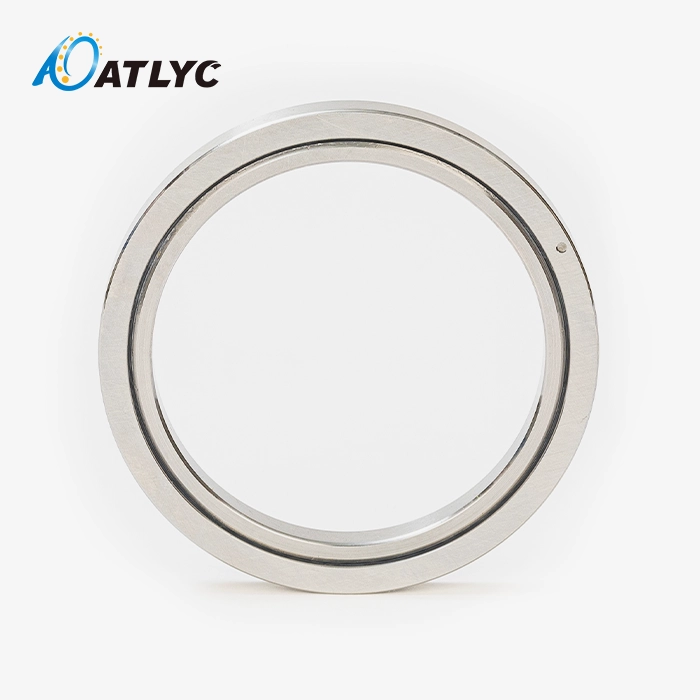
When evaluating bearing options for CNC spindle applications, the RB9016 cross roller bearing at 90×130×16 mm dimensions delivers exceptional rigidity through its crossed-roller configuration and integral ring design. This compact bearing provides simultaneous handling of radial, axial, and moment loads—essential capabilities for maintaining machining precision. The 90 mm bore diameter, 130 mm outer diameter, and 16 mm width create an optimized geometry that minimizes deflection while maximizing contact efficiency. Manufactured from premium Gcr15 or Gcr15SiMn bearing steel with precision accuracy levels ranging from P6 to P4, this bearing offers the structural stiffness your CNC spindle requires for consistent performance.

Understanding RB9016 Rigidity: Hardware Overview and Specifications
How stiff the 90x130x16 mm cross roller bearing is at its base is determined by its dimensional shape. This small footprint includes strong structural parts that were made to handle the mechanical stress that comes up in precision machining tasks.
Crossed-Roller Configuration and Load Distribution
The unique crossed-roller arrangement places cylinder-shaped rollers perpendicular to each other in raceways that have been precisely ground. There are line contacts between each roller and both the inner and outer rings, not point contacts like in ball bearings. This shape makes load-carrying tracks that work well and spread forces evenly across the supporting structure. With its alternate roller orientation, the bearing can handle radial loads, axial loads, and moment loads all at the same time, without the need for any other bearing setups.
Material Composition and Structural Integrity
The level of manufacturing starts with the materials that are used. The usual material for cross roller bearings is Gcr15 bearing steel. Gcr15SiMn is also available for uses that need more wear protection. Both materials are heated in special ways that make sure the toughness is evenly distributed across the ring and wheel parts. The heat treatment makes the core tough while keeping the surface hardness at a level that allows for longer service life under cyclic loading. The structure of the assembly is kept together by the inner and outer rings. The outer ring has a plug system that makes fitting easier and makes sure the roller stays in place. This design feature makes installation easier and gives you access to manage oil, both of which are important for keeping operations running smoothly in production settings.
Precision Accuracy Grades and Performance Standards
There are different levels of accuracy, such as P6, P0, P5, and P4. Each level sets different limits for the accuracy of measurements and rotations. P4-grade bearings are the most precise and have the least amount of runout change, which is important for high-precision positioning jobs. To get these levels of accuracy, the precision grinding processes needed advanced manufacturing skills and thorough quality control methods. Before it is shipped, each bearing is checked for dimensions and spin to make sure it meets the required standards.
| Specification Category | RB9016 Parameters | Industrial Significance |
|---|---|---|
| Dimensions | 90×130×16 mm | Compact profile for space-constrained spindle designs |
| Material Options | Gcr15, Gcr15SiMn | High-strength steel ensures load capacity and durability |
| Accuracy Grades | P6, P0, P5, P4 | Precision levels match application requirements |
| Load Capacity | Radial, Axial, Moment | Multi-directional handling eliminates supplementary bearings |
| Ring Design | Inner/Outer Integrity with Plug | Simplifies installation and maintenance procedures |
Why Rigidity Matters for CNC Spindle Accuracy
Cutting forces are created during CNC machining processes that try to move the spindle out of its original position. These bending forces are canceled out by the stiffness of the bearings, which keeps the tool in the right place throughout the cutting cycle. When there isn't enough stiffness, finished parts have mistakes in their dimensions, the surface is rougher, and tools wear out faster. When you cross-roller designs, the high contact ratios between the rollers and the raceways make them very stiff, so they don't bend much when they're under load. Another important part of bearing rigidity is minimizing vibration. Unwanted movements can damage the quality of the surface finish and cause resonant frequencies to rise in the machine structure. Cross roller bearings have a balanced shape and even load distribution that lowers vibration amplitudes compared to other types of bearing setups. This makes the system more stable and extends the life of the parts.
RB9016 Performance Analysis: Practical Review and Benchmarking
To rate the performance of the RB9016, you have to look at how its theoretical specs translate into its actual performance in industrial settings.
Vibration Resistance and Rotational Smoothness
When roller geometry is adjusted and production is done with great care, the friction rate is low. This has a direct effect on how smoothly the rollers rotate. When friction is low, torque requirements stay the same during the rotation cycle. This keeps motor load changes that can cause vibration to a minimum. The crossed-roller arrangement also evens out the contact forces, which stops uneven loading patterns that cause periodic problems. Vibration amplitudes are measured across frequency ranges that are relevant to machining operations. Cross roller bearings of good quality show much lower levels of vibration than other types of bearings, especially when they are loaded together. When surface finishes need to be below 0.4 micrometers Ra or tolerances for size need to be within 5 micrometers, this performance advantage becomes very important.
Load Capacity Under Operational Stresses
Cross roller bearings are easier to use than paired bearing setups because they can hold loads in more than one way. Cutting processes put radial forces on one bearing, feed systems put axial forces on it, and offset tool positions put moment loads on it. This consolidation makes the assembly simpler and gets rid of the alignment problems that come with installing multiple bearings. Load rates depend on the type of material, the size of the bearing, and the level of accuracy. The shape of 90x130x16 mm has a lot of space and can be used for medium- to heavy-duty cutting tasks. Dynamic load ratings show how long a bearing can handle moving loads, while static load ratings show the most weight that can be put on it when it's not turning, like when the workpiece is being set up.
Thermal Stability During Continuous Operation
Heat from friction and outside sources changes the size of the bearings and wears down the grease, which affects how well they work. Cross roller bearings don't make a lot of internal heat because they have a low friction coefficient, and their integrated ring form makes it easy for heat to escape. Thermal stability makes sure that the preload is always maintained and stops expansion-related binding that lowers the accuracy of rotation. Monitoring the temperature during operation gives information about the health of the bearings and how well they are being oiled. When the working temperature stays below 80°C, it means that the lubrication is good and the load is reasonable. Temperature rises can mean a number of problems that need to be looked into, such as not enough lubrication, too much preload, or sudden increases in load.
Comparative Performance Insights
Comparing cross-roller technology to other types of bearings makes the performance benefits clear. To get the same level of rigidity, angular contact ball bearings need to be paired up, and the preload needs to be carefully adjusted. Tapered roller bearings can hold a lot of weight, but they create sliding friction that makes more heat. When it comes to axial load capacity, cylindrical roller bearings work well for rotational loads but need extra thrust bearings. The crossed-roller design gives the best performance in all directions of force within a small space. This design efficiency is what makes it so popular in robots, precision positioning tables, and CNC spindle applications that need complete solutions but don't have a lot of room.
Installation and Setup Considerations for Optimal Rigidity
By following the right fitting steps, you can get the most out of cross roller bearings and keep them from breaking down too soon.
Mounting Surface Preparation and Alignment
The bearing manufacturer sets tolerances for how flat and straight the mounting surfaces must be. Roughness levels below 1.6 micrometers Ra are usually required for surface finishes to make sure that loads are spread out evenly and stress doesn't build up in one place. Cleaning methods get rid of impurities that might get in the way of proper fitting or add rough particles to the bearing environment. Verifying the alignment during installation stops operational problems caused by loading that isn't aligned correctly. Within 0.02 mm per 100 mm of width, the bearing mounting sides should stay straight. Measuring with a dial sign confirms alignment before the final tightening steps are taken. When something isn't lined up right, it causes uneven loading patterns that speed up wear and lower the accuracy of spinning. For precision applications, RB9016 bearings are designed to support stable operation by maintaining reliable alignment and load distribution.
Torque Specifications and Bolt Tightening Procedures
The mounting bolt pressure has a direct effect on the preload on the bearing and the spread of contact stress. The manufacturer specifies the torque values that produce the right clamping force without putting too much stress on the system. Calibration of a torque wrench makes sure that it is accurate within ±4% of the values that are given. This stops the wrench from under-tightening, which lets parts move, or over-tightening, which damages them. The pressing forces are spread out evenly around the bearing's diameter by sequential tightening patterns. When tightening four-bolt setups or six or more bolts, cross-pattern tightening or star-pattern tightening stops the bolts from warping. By applying torque incrementally in three steps—33%, 66%, and 100% of the end torque—stress can relax between stages, resulting in a uniform clamping force distribution.
Lubrication Selection and Application Methods
Managing lubrication has a big effect on how long a bearing lasts and how consistently it works. Grease lubrication works best in situations where the speed range is moderate and maintenance intervals are hard to get to. Extreme pressure additives in lithium-based greases are enough to cover most CNC spindle uses. The number of times they need to be oiled depends on how often they are used and the weather. For high-speed or continuous-duty uses, oil lubrication systems are the best way to keep things cool and get rid of dirt. By filtering and controlling the temperature, circulating oil systems keep the quality of the lubricant stable, which makes bearings last longer than those that are grease-lubricated. The viscosity at working temperatures is taken into account when choosing an oil. For precision bearings, ISO VG 32 or VG 46 oils are usually used.
Preventive Maintenance Schedules
Setting inspection times based on production cycles or operating hours helps find problems early on, before they become too big to fix. Vibration tracking uses frequency analysis to find changes in the state of bearings; rising amplitudes show that wear is progressing. Temperature readings show how well something works at high temperatures; slow rises in temperature suggest that the grease is breaking down or that contaminants are getting in. When to re-grease depends on the type of grease, the working conditions, and the surroundings. In clean, moderate-temperature settings, 2,000-hour intervals may be fine, but in dirty or hot settings, cleaning needs to be done more often. The right way to re-lubricate something gets rid of old grease while avoiding overfilling, which raises the temperature of the machine.
| Maintenance Task | Inspection Frequency | Key Indicators | Action Thresholds |
|---|---|---|---|
| Vibration Monitoring | Every 500 operating hours | Amplitude changes, frequency patterns | >20% amplitude increase requires investigation |
| Temperature Measurement | Daily during production | Operating temperature trends | Temperature >80°C or >15°C increase signals issues |
| Lubrication Status | Every 1,000 hours | Grease condition, contamination | Discoloration or particle content requires relubrication |
| Mounting Bolt Torque | Every 2,000 hours | Torque retention | Torque loss >10% requires retightening |
| Dimensional Accuracy | Every 5,000 hours | Runout measurements | Runout increase >0.005 mm indicates wear |
Comparing RB9016 with Market Alternatives: Finding the Best Rigidity Solution
To choose the best bearing options, you need to know how the different technologies meet the needs of different applications and work within the limits of the system.
Cross Roller Bearing Advantages
One of the best things about cross roller bearing technology is that it can handle more weight at once. This way of designing is very helpful for situations where you need to handle radial, axial, and moment loads but don't have a lot of fitting room. The small cross-section makes the spindle housing smaller, which lowers the cost of production and lets machines be made in smaller spaces. Rotational accuracy features work well in situations where exact placement and low runout are needed. The line contact shape and balanced roller setup keep changes to a minimum while the machine is rotating, meeting goals for surface finish and dimensional tolerance. Compared to paired bearing arrangements, which need careful preload adjustment and alignment proof, single bearing arrangements don't need as much maintenance.
Alternative Bearing Technology Comparisons
Angular contact ball bearing pairs are about as accurate as radial contact ball bearing pairs, but they need bigger installation spaces to be as rigid. The complexity of the preload adjustment makes building take longer and requires expert knowledge for best performance. But for ultra-high-speed uses above 15,000 RPM, where cross-roller bearings have trouble keeping their grease in, ball bearings are better. When maximum capacity supports more complexity, tapered roller bearings work great for big loads. Because tapered roller bearings have rolling contact, they produce more heat than cross roller bearings, so they need better cooling systems. Applications that care more about load capacity than rotary accuracy may choose tapered roller solutions, even tho they need to be managed for heat.
Size Range and Application Flexibility
Cross roller bearings come in a wide range of sizes, from 20 mm to 1,100 mm in diameter on the inside, up to 1,500 mm in diameter on the outside, and from 12 mm to 110 mm in width. This range of sizes makes it useful for a wide range of uses, from small precision instruments to large machining center rotary tables. The 90x130x16 mm profile is a medium size that can be used with CNC vertical machining centers, horizontal machining centers, and precision grinding. Customization lets you meet specific needs that aren't met by regular store items. Changes to the bore sizes, special accuracy grades, and materials made just for the job make standard designs work in different situations. When OEMs use bearings in their own designs, the ability to make things in a variety of ways is especially useful.
Cost-Performance Considerations
Cross roller bearings have 20–30% longer service lives than traditional arrangements when used in the same situations. This is because they distribute load more evenly and wear down less quickly. Long-term operational costs are cheaper when maintenance is done less often, and production quality is maintained throughout the bearing's life cycle when accuracy is better.
Procurement Guide for RB9016: Pricing, Vendors, and Warranty Insights
Strategic procurement practices make sure that bearings are of good quality, that deliveries are reliable, and that there are long-term relationships with suppliers that support the production of goods, including the use of RB9016 for specific bearing requirements.
Supplier Qualification Criteria
Companies that make bearings and have both ISO 9001 and IATF 16949 certifications show that they are committed to quality management systems that work in both automotive and industrial settings. These certifications show that the ways of checking for quality, making things, and keeping records are up to international standards. Verification through third-party audits gives you confidence in the supplier's skills and consistent performance. A manufacturing capacity review checks to see if providers can meet current needs and plan for future volume growth. Production sites should show that they have the advanced cutting tools, precise measuring tools, and environmental controls needed to reach P4 accuracy levels. In capacity reviews, the abilities of the equipment, the knowledge of the workers, and the quality control tools that make sure consistent product delivery are all looked at.
Pricing Structures and Volume Considerations
Unit prices depend on the number of items ordered, the level of accuracy, and the material's specifications. Standard accuracy grades like P5 usually have good prices for modest numbers, while P4 precision levels cost more because they require more manufacturing steps. By making production schedules more efficient and buying materials more efficiently, volume agreements make it possible to get better prices. Shipping costs, payment terms, and the cost of keeping inventory all figure into the total cost analysis. When packages are combined, the cost of freight per unit goes down, and flexible payment terms make it easier to handle cash flow. Just-in-time delivery plans cut down on the cost of keeping inventory while making sure production stays steady through reliable supply chains.
Quality Assurance and Testing Protocols
Before a bearing is shipped, it is put through a series of thorough tests. Using precise measuring tools that can be traced back to national standards, dimensional checks make sure that the product meets the required tolerances. Rotational testing with loads on it confirms that the operation is smooth and the noise level is acceptable. Vibration testing finds flaws in the manufacturing process that could shorten the life of a product or make it less effective. Throughout the manufacturing process, three-level quality control tools set up steps for inspection. When steel comes in, it is inspected to make sure it is of good quality and the right size. In-process checks are done during heat treatment and grinding to find any problems before the final assembly. All specs are checked one last time before they can be packed up and sent.
Warranty Coverage and Technical Support
Warranty terms that cover problems with the way the product was made lower the risk of investments in procurement. Standard coverage lasts between 12 and 24 months from the date of delivery. For critical applications, longer warranties are available. Damage caused by improper installation, inadequate lubrication, or operation outside of the specified parameters is usually not covered by the warranty. With technical support, you can get help with application engineering, installation, and fixing problems. Suppliers who offer application-specific advice can help you choose the best bearings for your needs and the situations you'll be using them in. Installation support through detailed instructions or on-site help cuts down on startup problems and speeds up the time it takes to be ready for production.

Conclusion
Cross roller bearings with measurements of 90x130x16 mm are very rigid, which is important for CNC spindle uses that need accuracy, stability, and the ability to handle heavy loads. The crossed-roller configuration can handle loads in more than one direction within a small space, and it does this without the complexity that comes with paired bearing arrangements. Performance and service life are directly affected by the quality of the materials, how precisely they are manufactured, and the accuracy grade that is chosen. The RB9016 model is designed to provide reliable rotational accuracy and stable performance in applications where compact dimensions and high rigidity are required. To have a successful execution, you need to pay attention to the steps for installation, the ways for upkeep, and the requirements for qualifying suppliers. The full performance potential can be reached, and early failure modes can be avoided with the right preparation of the mounting surface, torque specifications, and lubrication management. Strategic procurement that takes into account the total cost of ownership, quality assurance standards, and technical support skills builds reliable supply chains that help meet long-term output goals.
FAQ
What accuracy grade should I specify for precision machining applications?
It is best to use P5 accuracy grades for general precision cutting with errors of 0.01 to 0.02 mm. When tolerances need to be less than 0.005 mm or surface finishes need to be less than 0.4 micrometers Ra, P4 grades are needed. When quality standards call for maximum accuracy, the price increase is justified by the better performance.
How does bearing size affect rigidity and load capacity?
When the bearings are bigger, there is more contact area between the wheels and the raceways. This directly increases the load capacity and stiffness. The 90 mm bore diameter gives you a lot of space for medium-duty machining tasks. Larger bearings spread loads over more contact surfaces, which is better for tasks that need stronger cutting forces or longer moment arms.
What maintenance intervals ensure optimal bearing performance?
Monitoring vibrations every 500 hours of operation finds problems early on. The amount of time between relubrications depends on how the machine is being used, but it's usually between 1,000 and 2,000 hours. Temperature tracking during work shifts finds problems with heat that need to be looked into. Every 5,000 hours, a full checkup checks the correctness of the measurements and the amount of wear.
Partner with ATLYC: Your Trusted Cross Roller Bearing Manufacturer
ATLYC makes high-quality cross roller bearings and has been doing so for 15 years. They are also certified by ISO 9001 and IATF 16949. Our 120-person team runs six specialized production workshops that make bearings with accuracy grades up to P4 and inner diameters ranging from 20 mm to 1,100 mm. We use high-quality Gcr15 and Gcr15SiMn bearing steels in our products, which are made through precise grinding and advanced heat treatment methods. Before shipping, our three-level quality control system checks 12 core performance factors to make sure they are correct. This makes sure that the quality of your CNC spindle applications is always the same. Our technical team has a lot of experience with automotive, industrial machinery, and automation applications, which helps procurement managers find a reliable RB9016 supplier. We offer reasonable prices, reliable wait times, and the ability to customize our products to meet the needs of customers all over the world, including those in the United States, Germany, South Korea, and more. Email our engineering team at auto@lyautobearing.com to talk about your unique needs and get full specifications that meet your quality and performance goals.
References
1. Chen, W., & Liu, H. (2021). Precision Bearing Technology for CNC Machine Tools: Design Principles and Application Guidelines. Beijing: Machinery Industry Press.
2. Hamrock, B. J., Schmid, S. R., & Jacobson, B. O. (2004). Fundamentals of Fluid Film Lubrication: Second Edition. New York: Marcel Dekker.
3. Harris, T. A., & Kotzalas, M. N. (2006). Advanced Concepts of Bearing Technology: Rolling Bearing Analysis, Fifth Edition. Boca Raton: CRC Press.
4. ISO 199:2014. Rolling Bearings – Thrust Bearings – Geometrical Product Specifications (GPS) and Tolerance Values. Geneva: International Organization for Standardization.
5. Stachowiak, G. W., & Batchelor, A. W. (2013). Engineering Tribology: Fourth Edition. Oxford: Butterworth-Heinemann.
6. Weck, M., & Brecher, C. (2006). Machine Tools Production Systems 2: Design and Calculation. Berlin: Springer-Verlag.
Learn about our latest products and discounts through SMS or email